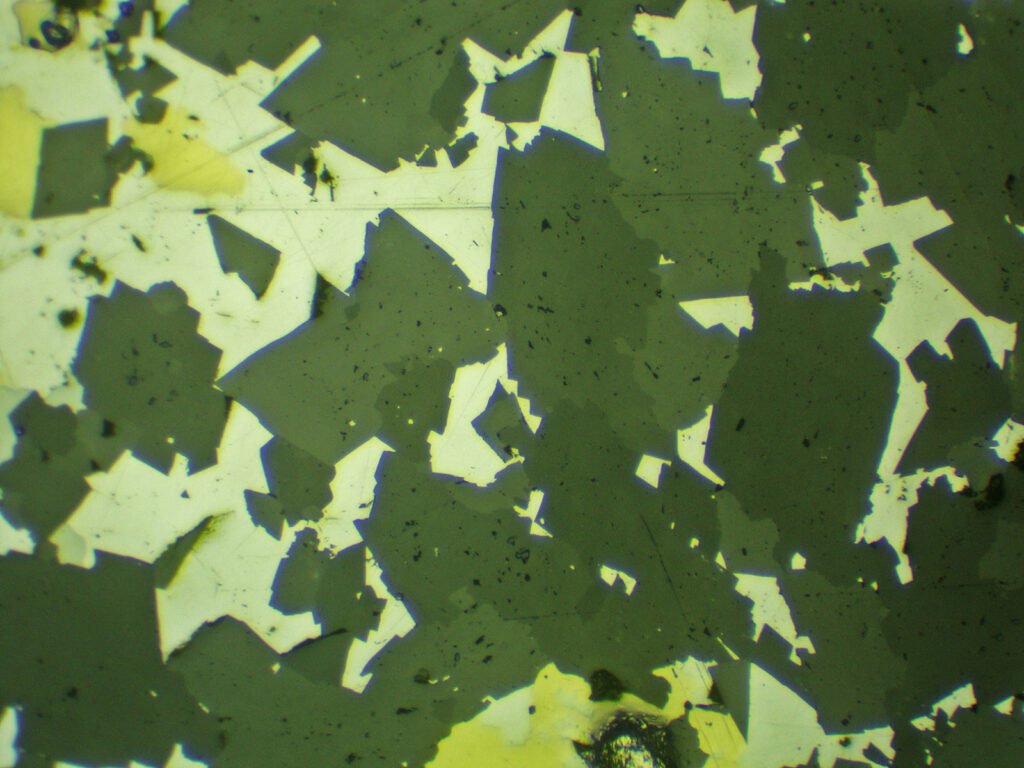
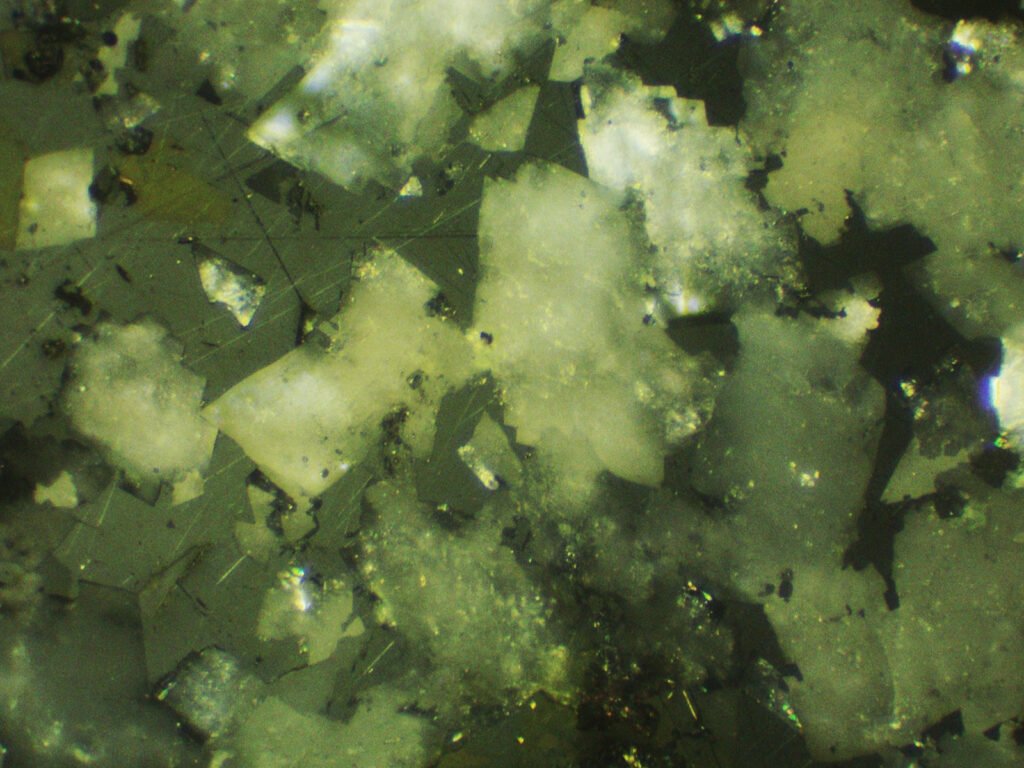
Crystal system: Trigonal rhombohedral.
Color: White, gray to pink. It can be colorless, yellow, brown or black (if with Fe).
Habit: Usually massive. Crystals are tabular, can have curved faces. Columnar, stalagtite, granular.
Cleavage: [10-11] perfect, rhombohedral (in 3 directions), as calcite too.
Tenacity: Brittle.
Twinning: Common, single contact twins.
Fracture: Conchoidal.
Mohs Hardness: 3.5 – 4
Parting: No.
Streak: White.
Lustre: Vitreous, pearly, dull.
Diaphaneity: Transparent.
Density (g/cm³): 2.84 – 2.86
2. Geology and Deposits
Dolomite is a common sedimentary mineral that forms strata hundreds of meters thick, the “dolomites”, which can be mineralized to sulfides, so dolomite is a common gangue mineral. The origin of dolomite is controversial. See “The Dolomite Question” (Fairbridge, 1957). Dolomite is common in clastic sediments and metamorphic carbonates (marbles).
It occurs as porphyroblasts in talc-schists and chlorite-schists. It also occurs in evaporites as a primary mineral. In igneous rocks, dolomite occurs as a product of hydrothermal alteration of basic and ultrabasic rocks; in many carbonatites it is one of the components.
Paragenesis is neither typical nor diagnostic.
3. Mineral Associations
There are no typical and diagnostic minerals associated with dolomite, a situation that finds parallels in the calcite approach.
4. Transmitted Light Microscopy
Refraction indices: ne: 1,500 (pure) – 1,520 (with Fe) no: 1,679 (pure) – 1,703 (with Fe)
PLANE POLARIZED LIGHT – PPL
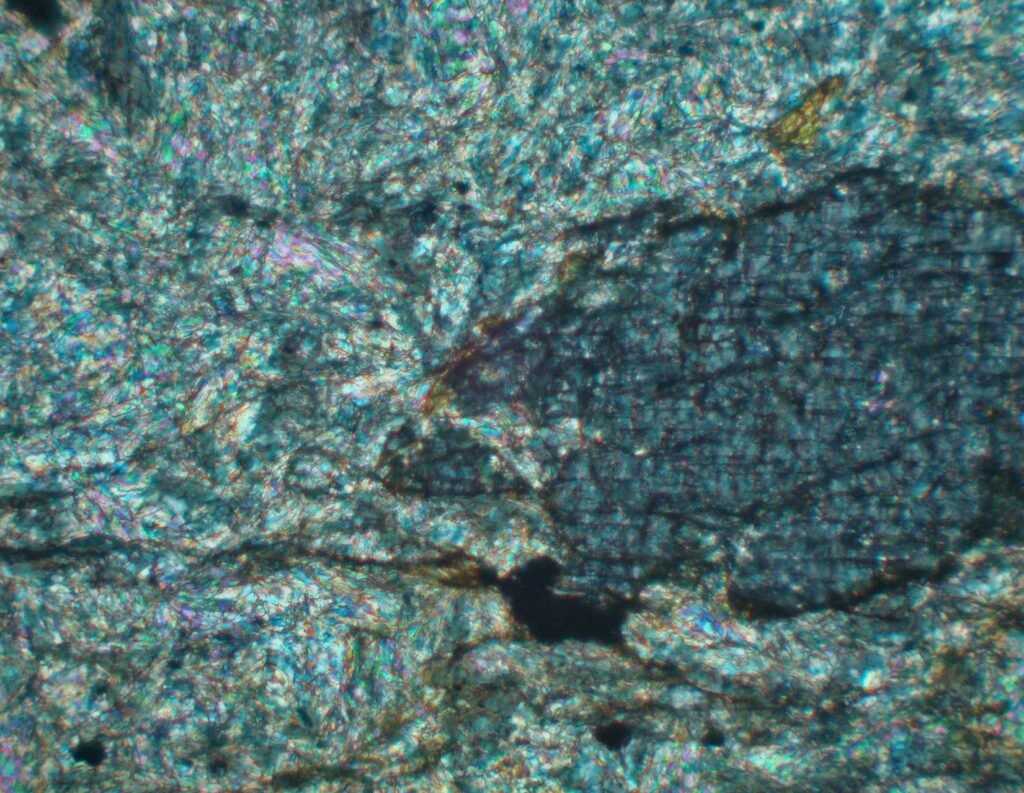
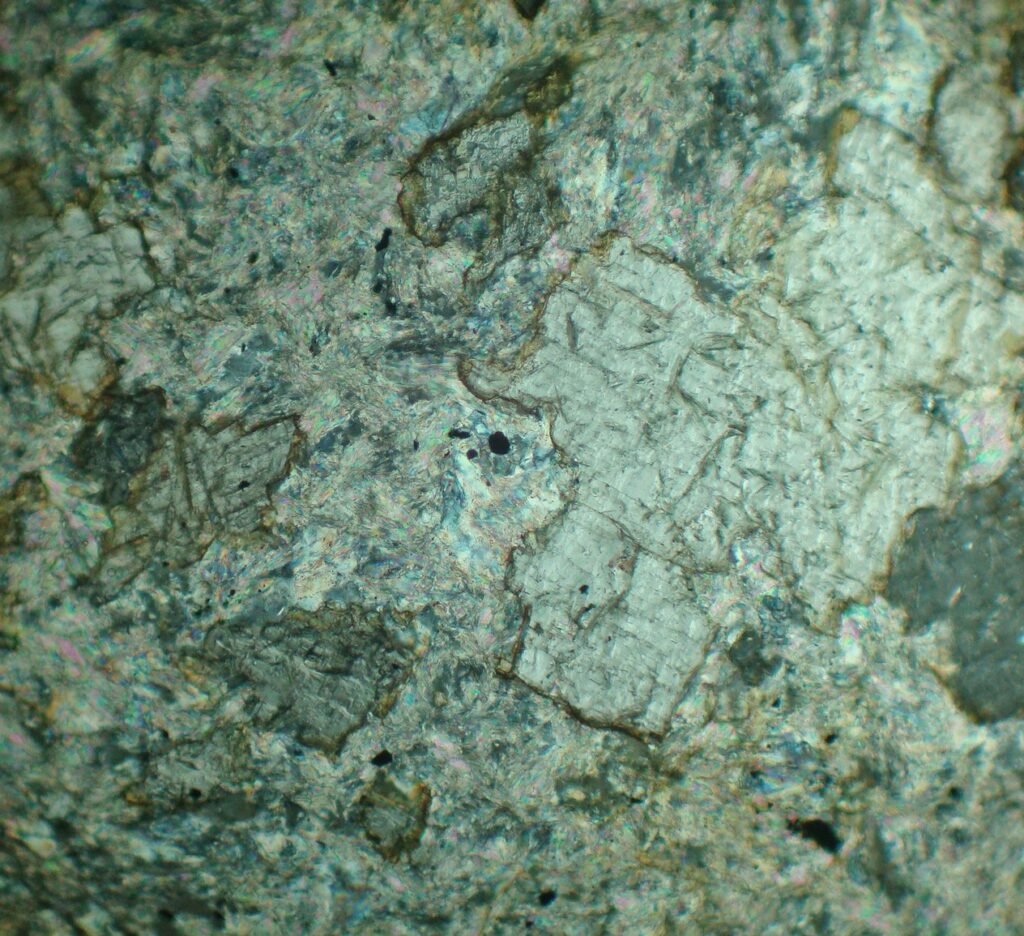
Color / Pleochroism:Colorless. It may be a little gray or with brown tones (Fe contents). Vague or iridescent pastels possible.
Relief: The relief varies between low and moderate to high every 90º to the rotation of the stage in crystals with well defined cleavage.
This phenomenon has been dubbed “relief pleochroism” and is typical of carbonates (calcite, dolomite, aragonite, siderite, rhodochrosite and magnesite).
When microcrystalline, these carbonates do not show “relief pleochroism”.
Cleavage: Rhombohedral {10-11}, there are two cleavages that intersect in rhombs, forming angles of 60º and 120º. Adjacent sides of the rhombohedron intersect at 73°.
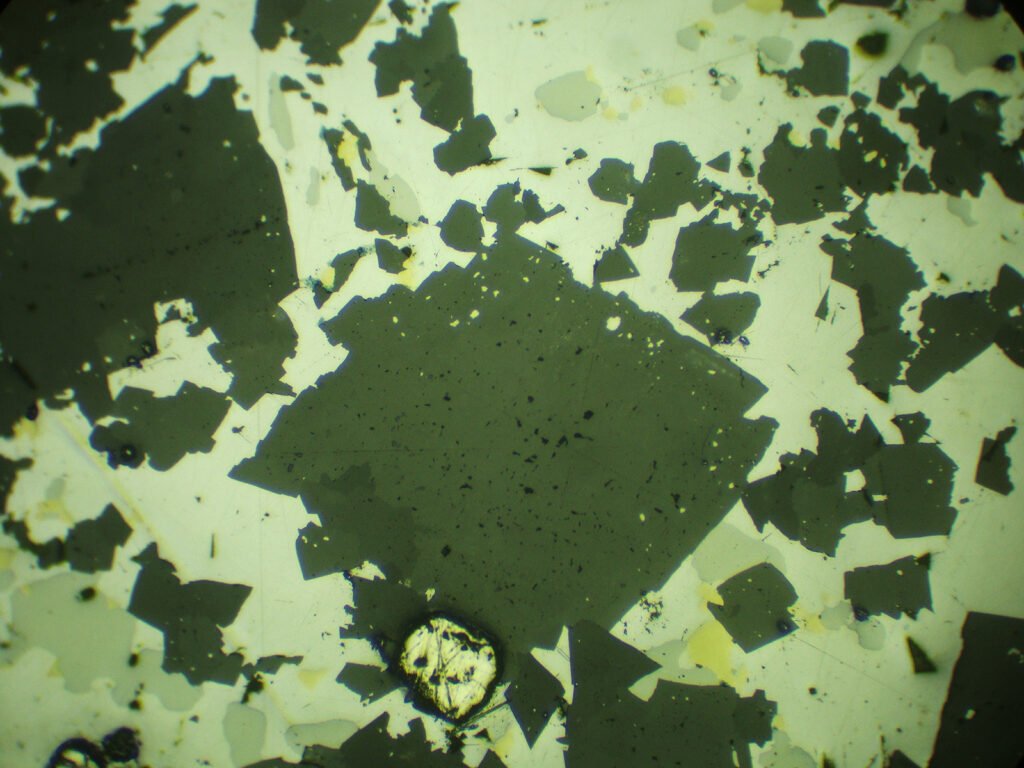
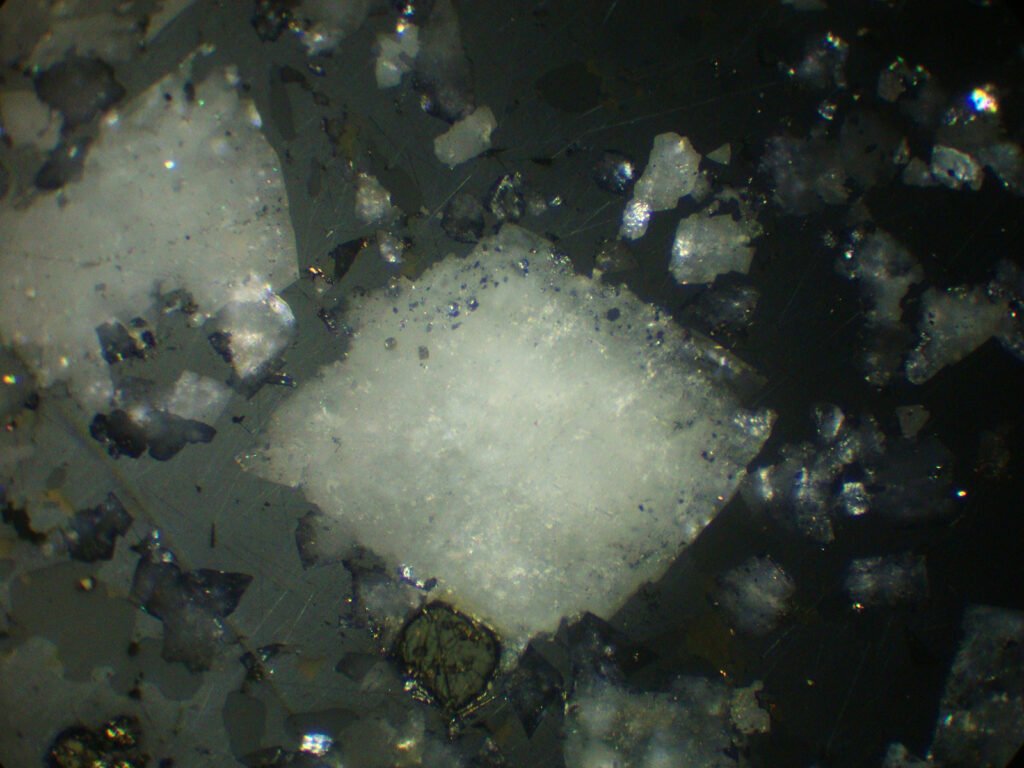
Habits: Granular, rhombohedral, rarely columnar. In carbonate rocks it is euhedral, in contrast to the coexisting anhedral calcite. Dolomite form anhedral to subhedral detrital grains in marble.
CROSSED POLARIZED LIGHT – XPL
Birefringence and Interference Colors: Birefringence from 0.179 to 0.183: intense colors of up to 4th order, difficult to classify and recognize. They are cream colors of higher orders, they can resemble pearly white.
Extinction: Symmetrical with respect to the two cleavages.
Elongation sign: Does not applies.
Twins: Lamellar, on (02-21). Depending on the grain orientation, one or two sets of twins appear. Twin lamellae are parallel to the shortest diagonal of the rhombohedron. Twins are rarer than in calcite.
Zoning: No.
CONVERGENT LIGHT
Character: U(-)
2V angle: No.
Alterations: dolomite is not easily attacked by weathering.
May be confused with: under the petrographic microscope it is not possible to distinguish the carbonates from each other.
In theory, calcite has more frequent twins, lower relief, forms rhombohedrons less frequently and does not have the frequent coloration of dolomite. With the product “alizarin red” the calcite turns pink and can be distinguished from dolomite.
Cold diluted HCl test: calcite effervesces, dolomite does not.
Aragonite, an orthorhombic polymorph of calcite, does not show rhombohedral cleavage and has parallel extinction.