PYROLUSITE
Pyrolusite – Mn4+O2 – is an oxide that constitutes one of the most important Mn ore minerals. In manganese mining, a term used is “wad”, attributed to a mixture of manganese minerals formed by submicroscopic grains mainly of pyrolusite and psilomelane.
Pyrolusite is classified in the Rutile Group and is trimorphic with akhtenskite and ramsdellite. Pyrolusite, when well crystallized or forming pseudomorphic crystals on orthorombic manganite, is called “polianite”. The term is nowadays obsolete, but very useful to distinguish between poorly crystallized pyrolusite and well-crystallized pyrolusite, which under the microscope have completely different characteristics.
Pyrolusite crystals are rare; of long prismatic habit, developed parallel to (001), with fibrous texture, square basal sections and up to 8 cm. Macroscopically, pyrolusite can be confused with manganite and todorokite. Mn dendrites are never pyrolusite, as was believed, but formed from other difficult to identify Mn oxides (see Potter & Rossman, 1979).
1. Characteristics
Crystal system: Tetragonal, ditetragonal dipyramidal.
Color: Light steel gray, gray black, various shades of gray, sometimes bluish when massive, black.
Habit: Massive, powdery, granular, columnar, reniform, botryoidal, concretionary, capillary, dendritic. Crystals rare.
Cleavage: {110} perfect, rarely visible; only in large crystals.
Tenacity: Brittle.
Twinning: Rare, on {031} and {032}, can be polysynthetic.
Fracture: Irregular, conchoidal.
Mohs Hardness: Very variable. Earthy: 2 – 2.5 (fingers get dirty). Crystals: 6.5
Parting: No.
Streak: Black to bluish black.
Lustre: Metallic, dull, earthy.
Diaphaneity: Opaque, translucent when in fine fragments.
Density (g/cm³): 4.8 (average)
2. Geology and Deposits
Pyrolusite forms under oxidizing conditions (with atmospheric oxygen) and high pH and, therefore, is restricted to the sedimentary cycle, constituting a product of weathering on other Mn minerals, often manganite, on which it forms pseudomorphoses.
It forms in the oxidation zones developed over rocks and hydrothermal deposits containing manganese. Also in deposits formed by the circulation of meteoric waters. Colloidal processes and bacterial activity are important in their formation. It mainly originates in swamps and lakes; also in shallow marine conditions (often with an oolitic texture).
3. Mineral Associations
Pyrolusite occurs associated with common gangue minerals such as quartz (including chalcedony), calcite and barite. Occurs with other Mn minerals such as manganite, hollandite, jacobsite, psilomelane, cryptomelane, hausmannite, braunite, todorokite, chalcophanite, alabandite, bixbyite and rhodonite.
It also occurs with goethite, hematite, magnetite, malachite, vanadinite and gold.
4. Transmitted Light Microscopy
Does not apply, as pyrolusite is opaque. Literature states that pyrolusite is translucent when in fine fragments.
5. Reflected Light Microscopy
The differences between well-crystalized pyrolusite, the so-called “polianite”, and “normal” pyrolusite are so significant that both are presented below individually.
5.1 POLIANITE
Sample preparation: Most samples are very bad for polishing. Very rarely, compact aggregates of polyanite intergrown with quartz occur, which are easy to polish. The hardness of polyanite is very high, higher than that of quartz and does not have the typical cavities of pyrolusite. Crystals often disaggregate a little parallel to z. Sections parallel to (001) are markedly harder than sections perpendicular to it.
PLANE POLARIZED LIGHT – PPL
Reflection color: Light white with soft yellow tones, can be brownish.
Compared with the color of hollandite, the color of polianite is more yellowish;
Compared with the color of magnetite, the color of polianite is yellowish white.
Compared to the color of hematite, the color of polianite is yellowish and not bluish.
Compared with the color of manganite, the color of polianite is almost white;
Compared with the color of ramsdellite, the color of polianite is almost the same.
Pleochroism: Distinct between yellowish, brownish and bluish gray.
Reflectivity: Between 18.46 and 30.62%, very variable, it can only be correctly evaluated in the rare sections of good quality.
Bireflectance: distinct between yellowish white, soft gray, soft blue and yellow-gray.
CROSSED POLARIZED LIGHT – XPL
Isotropy / Anisotropy: Strong anisotropy between gray, orange, brown and blue. Parallel extinction.
Internal reflections: No.
May be confused with: arsenopyrite, in no way suggests it is an oxide of Mn. Sections with sharp and coarse fractures have higher reflectivity than portions with very fine fractures.
General Characteristics:
Grain shape: difficult to describe, as the “pure” polianites of typical occurrences show enormous divergence in grain textures, shapes and sizes. Polianite can form isooriented crusts over manganite pseudomorphoses, similar to many pyrolusites. The individual crystals are prismatic according to (110), (100) with (111), (101), but generally only aggregates are observed. In other instances there are crusts lining cavities (tectonic crevices), showing the prism only a little and often ending in a rounded shape due to twins. In other occurrences, acicular crystals in siderite form needles with (110), pointed second (hhl) and (001).
Cleavage (110) is only extremely rarely visible in the tiny crystals. This cleavage is clearly visible in low-quality sections; in well-polished sections the cleavage is barely visible.
Twins may occur in thin individual lamellae or repeat the stannite pattern, parallel to (101), often with pseudohexagonal repeating cyclic repeats. Acicular crystals from some deposits often show twins of two or three individuals according to (301).
Zonation is rare, but sometimes has a spectacular development.
Substitutions, very varied, are observed in the variable contents of polianite in “pyrolusites” and “psilomelanes”. Very common is the pseudomorphic replacement of manganite by polianite. In addition, pyrolusite replaces braunite, magnetite, todorokite and ramsdelite.
5.2 PYROLUSITE
Sample preparation: The chemical composition is similar to polianite, but it is often heavily contaminated by other metallic oxides, also by adsorbed water.
The polishing of pyrolusite, with the huge number of very variable cracks of very different dimensions, can only be carried out after a careful impregnation of the sample. Materials especially porous and fractured, very soft, formed by polianites neither very fine nor very coarse, even using this methodology only acquire a reasonable polish.
PLANE POLARIZED LIGHT – PPL
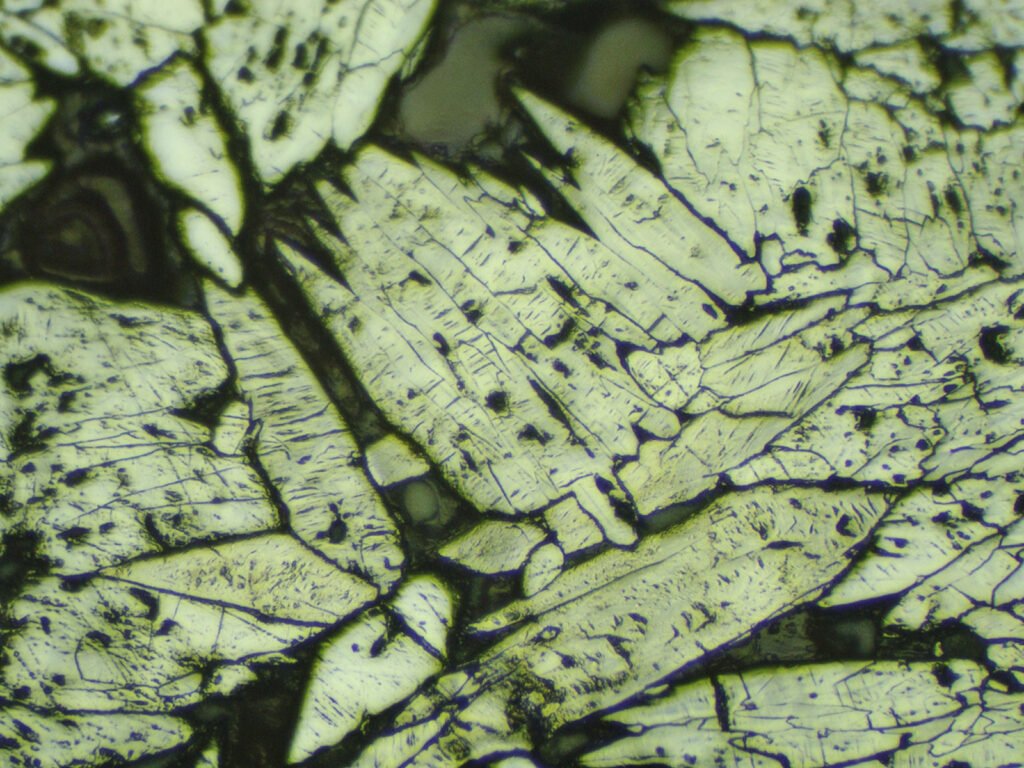
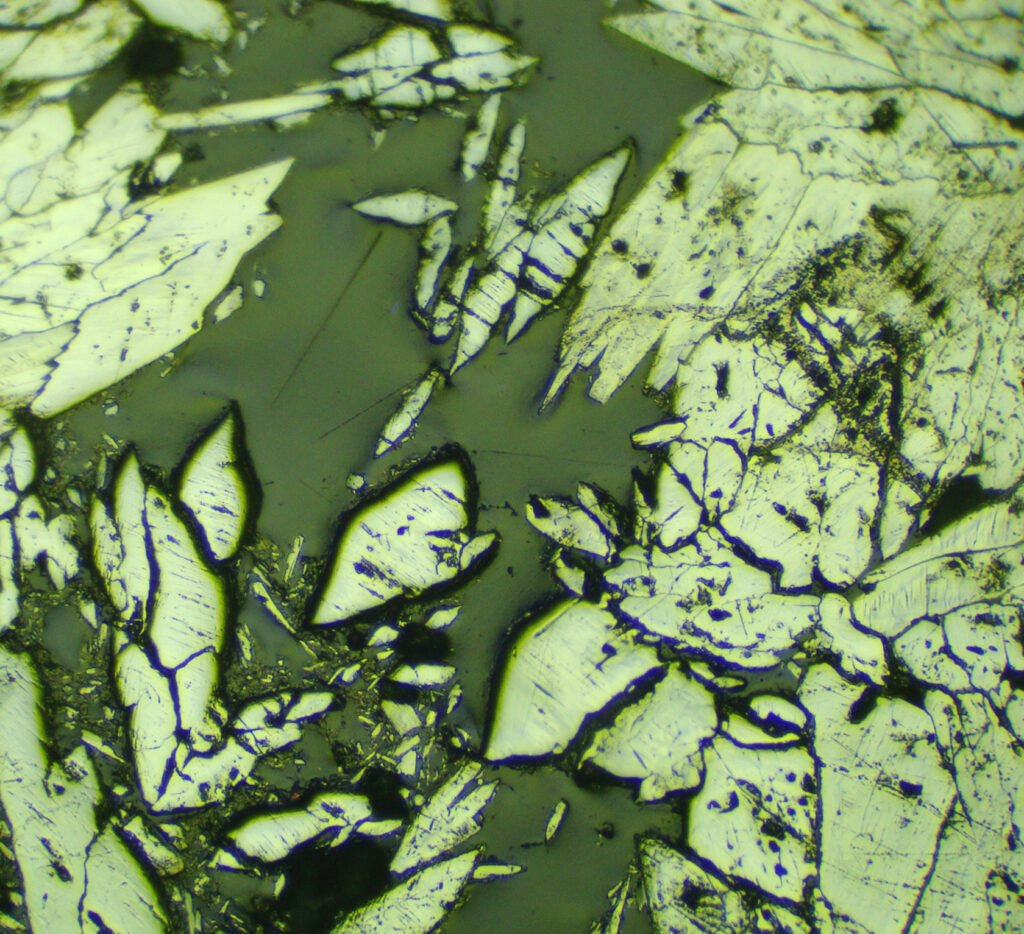
Reflection color: White with a clear shade of cream and yellow, predominating in relation to the other existing colors.
Compared with the color of hollandite, the color of pyrolusite is more yellowish;
Compared with the color of magnetite, the color of pyrolusite is yellowish white.
Compared with the color of hematite, the color of pyrolusite is yellowish and not bluish.
Compared with the color of manganite, the color of pyrolusite is almost white;
Compared with the color of ramsdellite, the color of pyrolusite is almost equal.
Pleochroism: No.
Reflectivity: 18.46 to 30.62%. Reflectivity of nearly 30% of polyanite is achieved in some cases.
Sometimes the reflectivity is markedly lower, due to the very fine porosity of the pyrolusite.
Bireflectance: Clear between yellow and yellow-gray.
CROSSED POLARIZED LIGHT – XPL
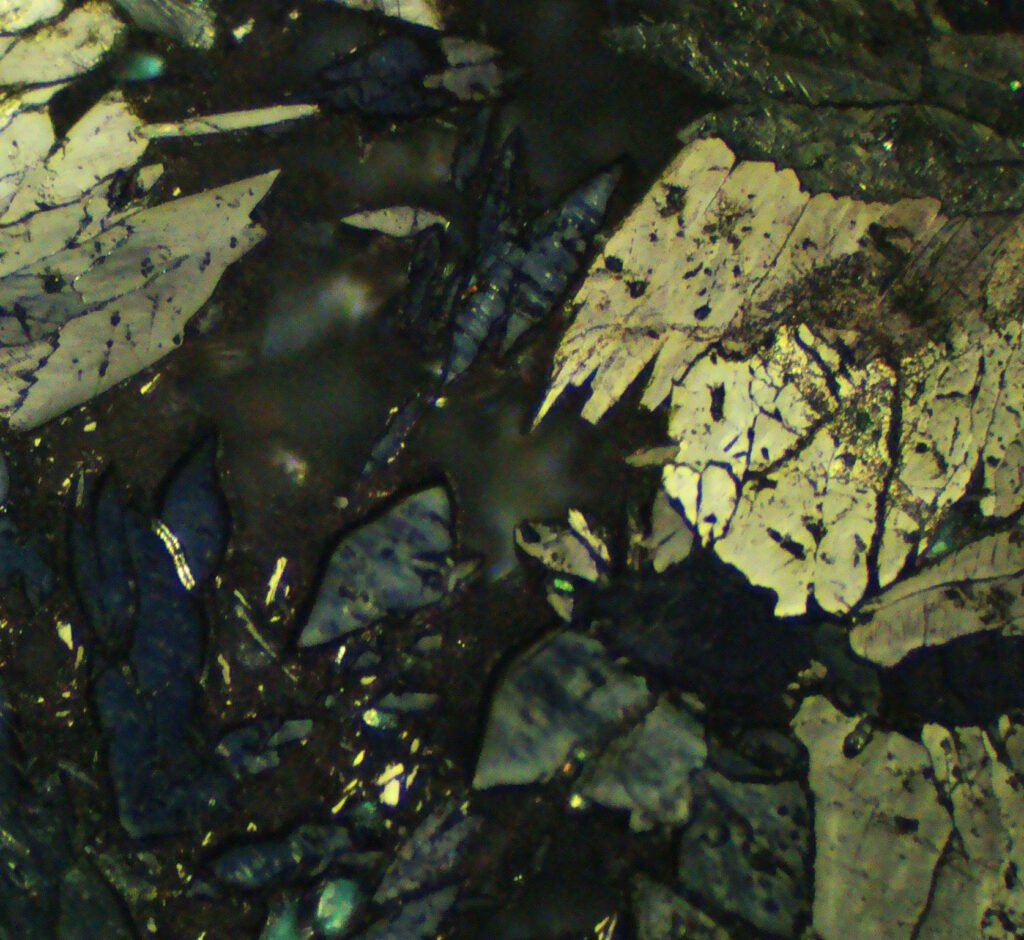
Isotropy / Anisotropy: Strong anisotropy from cream to gray-blue, but the colors are extremely sensitive to minimal problems at nicol crossing.
Very fine-grained aggregates appear almost isotropic.
Internal reflections: No.
May be confused with: other Mn minerals.
Ramsdellite is similar but has lower reflectivity and white hue.
Chalcophanite has similar reflectivity in one of its bireflectances.
General Characteristics:
Grain shape: due to the different formation environments, there are several appearances.
– extremely fine-grained crustiform masses, which form individual levels within “psilomelane” and other oxidized manganese ores, all formed from gels.
– coarser grained aggregates often have strange structures, divisions into sectors and zoning.
– pyrolusite can occur as a lattice immersed in limonites with rhythmic structure.
– filling fractures or shrinkage cracks, even very thin and/or dendritic.
– granular masses with clearly visible individuals
– large crystals with a block or rhombohedral structure.
– “black wad”, from which it is not possible to prepare polished sections, is possibly formed by finely dispersed pyrolusite.
– large crystals alongside small crystals with very varied shapes and appearance and orthorhombic behavior.
Shrinkage cracks are always present, in varying amounts, simulating variations in hardness. They may be almost absent in rhythmic zones and in the alignments formed by filling cracks, but they are very evident in “crystalline” masses. This is due to the fact that all pyrolusites are pseudomorphoses on manganite. This transformation is simple, since the x and z axes of manganite completely coincide with the x and z axes of pyrolusite; only on the y-axis is a contraction required. This modification implies the formation of lamellae and cavities (cracks) parallel to (010), whose existence causes the reflectivity of the basal sections (parallel to x and y) to present great variations. In the same way, cracks cause huge variations in hardness, which can range between 1 and 7, in reality it is an apparent variation due to a variable toughness at very small scales. Cracks adsorb substances that are foreign to the original composition of the mineral, causing erroneous chemical analyses. Ultimately, depending on the resin composition of the polished sections, the cracks quickly capture oil from the resin, making it brittle and destroying the polished section.
Twins never occur.
Substitutions of pyrolusite over manganite, as already mentioned, are very frequent. “Healthy” manganite, by the way, is a very rare mineral. In the transformation of manganite, friable masses can be generated or the crystalline form and radial structure of the manganite are preserved in all possible stages of porosity and fracturing of the pyrolusite. The shrinkage cracks formed in parallel with (010) of the manganite may be filled with limonite, which greatly increases the hardness of the set. Even the black masses that make up the oolitic manganese ores, without any evidence of a previous presence of manganite, often show shapes similar to those described above. Other minerals that are substituted for pyrolusite are braunite, hausmannite, franklinite and many others. Due to the enormous variation of textures, it is not possible to offer a complete overview of them here.