SIDERITE

Siderite – FeCO3 – is a rarer carbonate of the Calcite Group, typical of hydrothermal veins with metals and an important historical iron ore, with 48% iron, no S or P, but some Mg, Mn, Ca, Zn and Co. It supplies a superior quality steel, already recognized by the Romans as “ferrum nordicum”. Its density, close to that of chalcopyrite and sphalerite, creates problems in processing.

Siderite crystals, up to 25 cm, are similar to calcite, but there are far fewer combined forms: the typical form of siderite is the simple rhombohedron, often flattened or with curved faces. The crystal surface may become iridescent due to the formation of goethite. It forms three series, with magnesite (Mg), with rhodochrosite (Mn) and with smithsonite (Zn), the limit is 50% iron.

There are at least a dozen varieties, generally based on higher levels of some elements (Mg, Mn, etc.) or habits (colloidal, botryoidal, etc.). Siderite is magnetic if heated and effervescent with hot diluted HCl.

1. Characteristics

Crystal system: Trigonal scalenohedral.          

Color: Pale yellow, gray, light to dark brown, green, yellow-green, white, red, black, rarely colorless.     

Habit: Rhombohedral, scalenohedral to prismatic crystals, often curved. Fibrous, stalagtite, spherulitic, cleavable masses, fine-grained massive, concretionary, mamelonate, oolitic, granular, nodular and botryoidal.     

Cleavage: {01-11} perfect, rhombohedral, in 3 directions, like calcite.       

Tenacity: Brittle.        

Twinning: Lamellar on {01-12}, infrequent.       

Fracture: Irregular, conchoidal.       

Mohs Hardness: 3.5 – 4.5

Parting: No.         

Streak: White.         

Lustre: Vitreous, silky, pearly.          

Diaphaneity: Transparent.           

Density (g/cm³): 3.96


2. Geology and Deposits

In igneous rocks it occurs in veins and vesicles. It can occur in carbonatites and, rarely, in cryolite granitic pegmatites and in nepheline syenite pegmatites. It occurs in many Sn ores and is very typical of low to medium temperature hydrothermal veins mineralized with metals. In mineralized bodies it can occur in veins as a product of hydrothermal and metasomatic alteration of limestones and dolomites, forming tabular coarse grain bodies, which are locally mined.

In metamorphic rocks, it is common in iron-rich sedimentary rocks and in banded iron formations (BIFs). In these rocks, siderite may be a product of iron oxidation by fungi such as Lichenothelia.

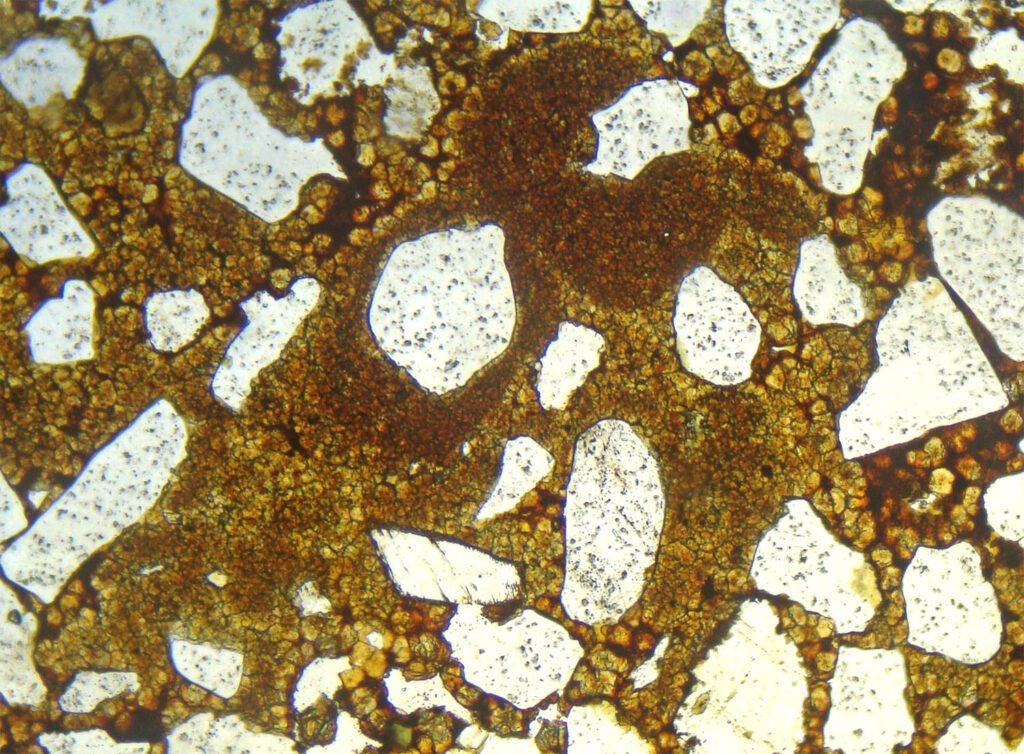
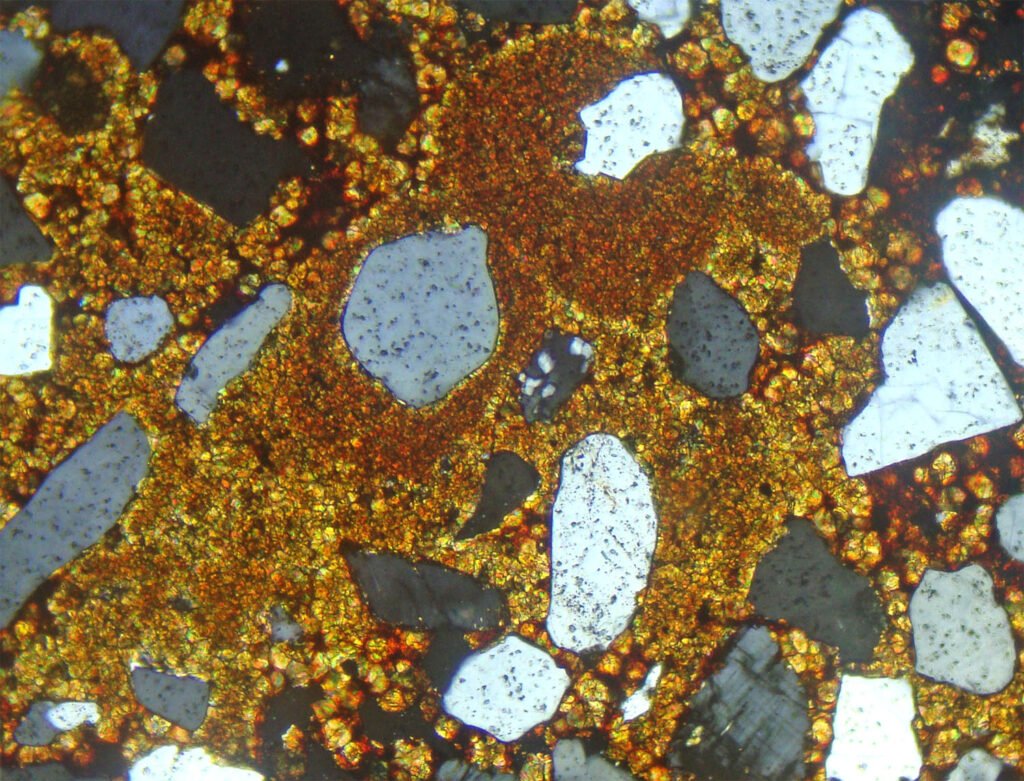
In sedimentary rocks it is a diagenetic mineral common in shales, coal seams and sandstones, where it forms concretions with great frequency, which may contain many different fossils of flora and fauna. It is found in hot springs and in swamps (“bogs”). The oxygen isotopic compositions of sphaerosiderite (“sphaerosiderite”), which occurs in soils, are a parameter for the isotopic composition of meteoric waters shortly after deposition.


3. Mineral Associations

Paragenesis is not diagnostic for its identification.


4. Transmitted Light Microscopy

Refraction indices:  nω: 1,875   nε: 1,633   The indices vary with the chemical composition.

PLANE POLARIZED LIGHT – PPL

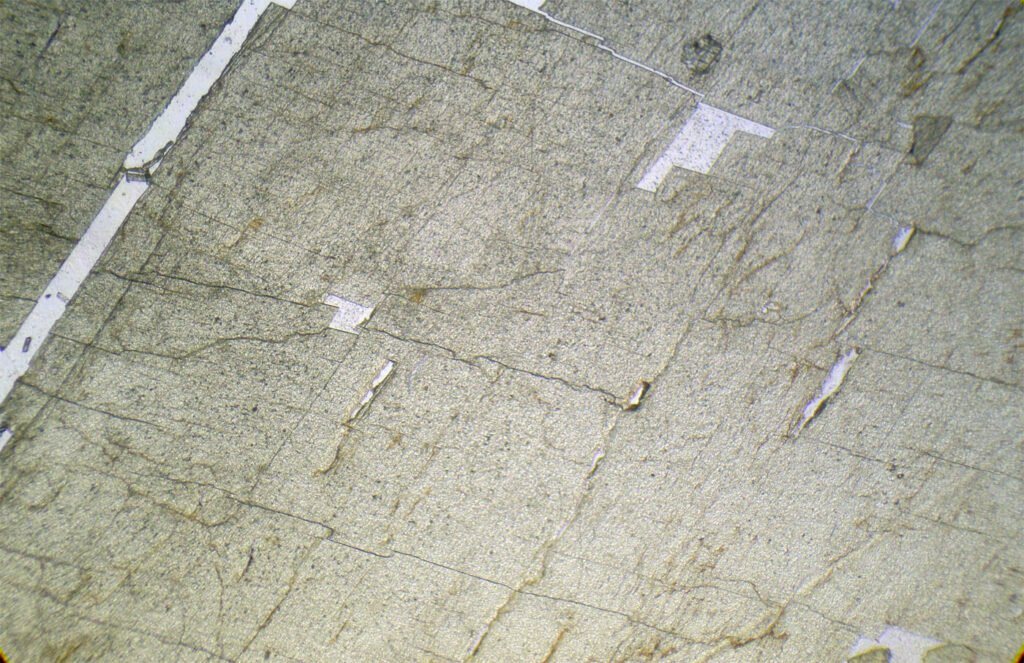
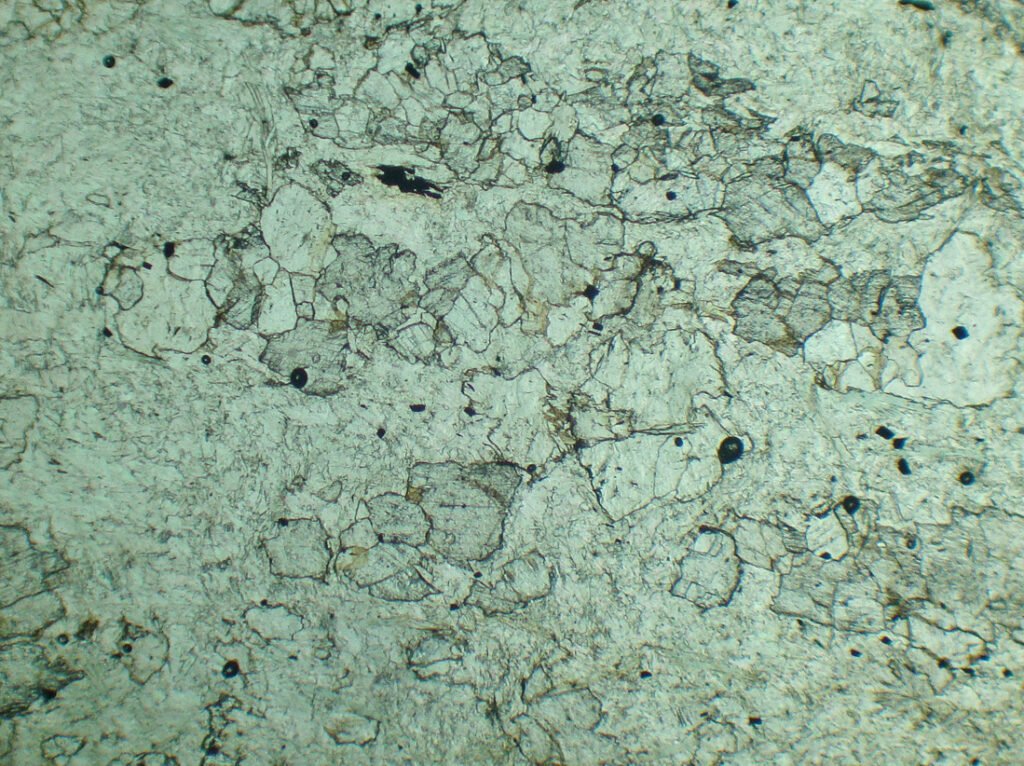
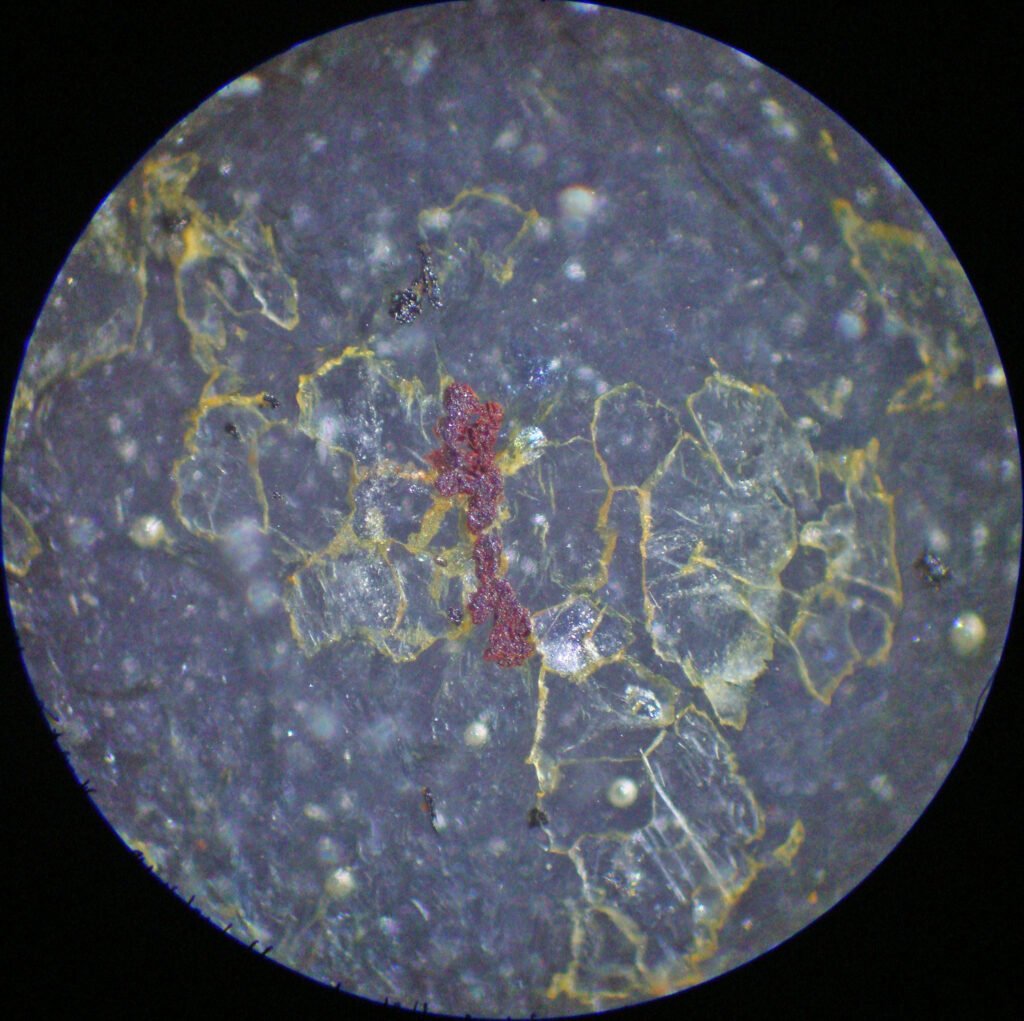
Color / Pleochroism: Colorless to gray or pale yellow-brown. Pleochroism absent or weak.  

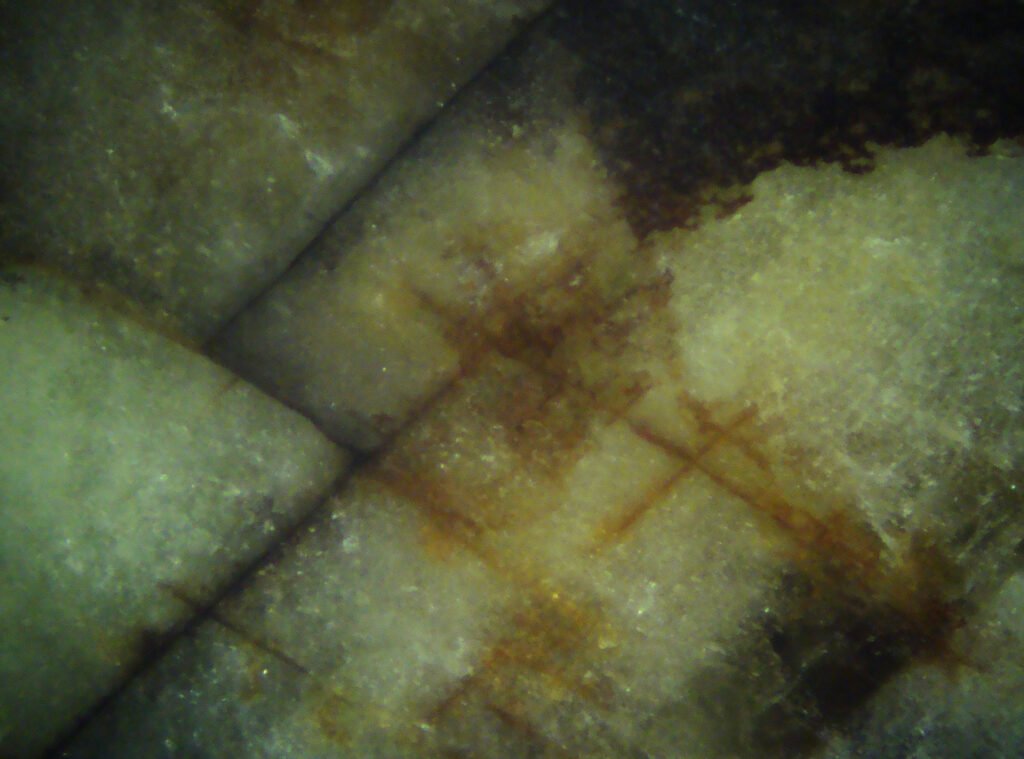
Relief:  The relief varies between low and moderate to high every 90º to the rotation of the stage in crystals with well defined cleavage. This phenomenon has been dubbed “relief pleochroism” and is typical of carbonates (calcite, dolomite, aragonite, siderite, rhodochrosite and magnesite). When microcrystalline, these carbonates do not show “relief pleochroism”.          

Cleavage: Perfect on {10-11} when in large grains (rhombohedral like calcite, dolomite, etc.). Adjacent cleavage planes intersect at 75°.

Fine-grained masses, spherulites, etc. does not show cleavage.

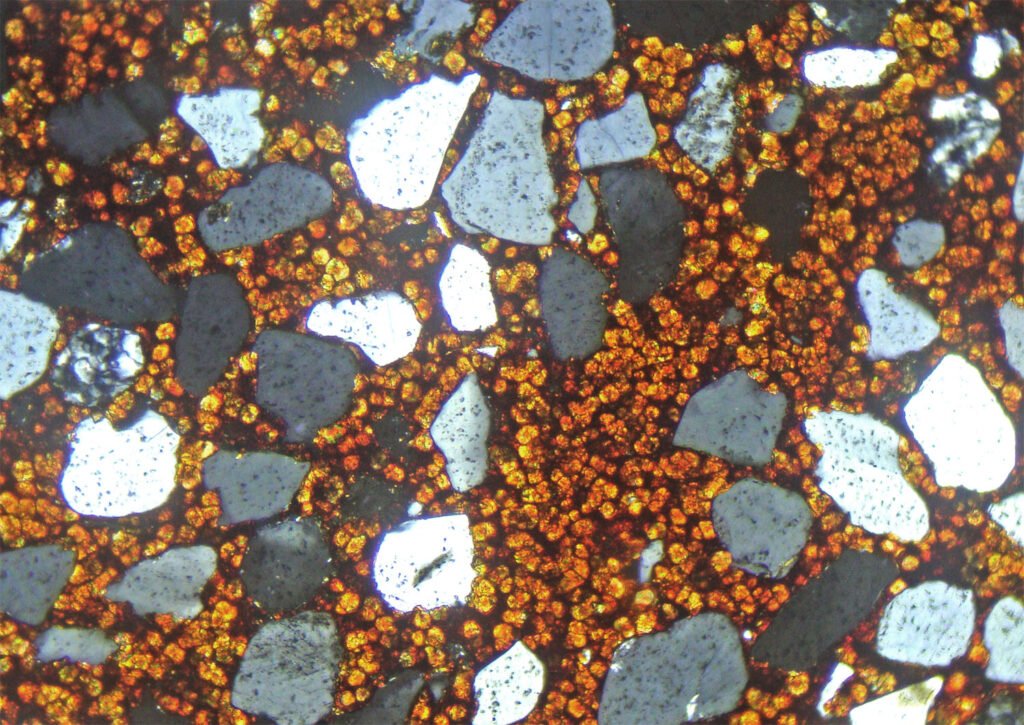
Habits: Idiomorphic (euhedral) fine to coarse grained, typically hypidiomorphic (subhedral) to xenomorphic (anhedral), granular or oolitic.            

CROSSED POLARIZED LIGHT – XPL

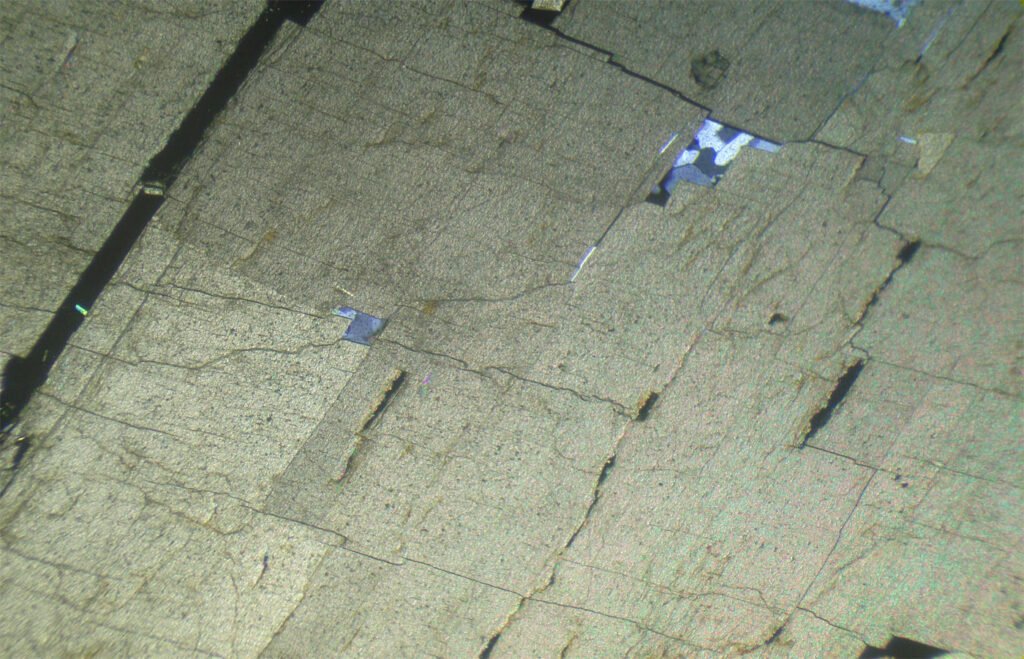
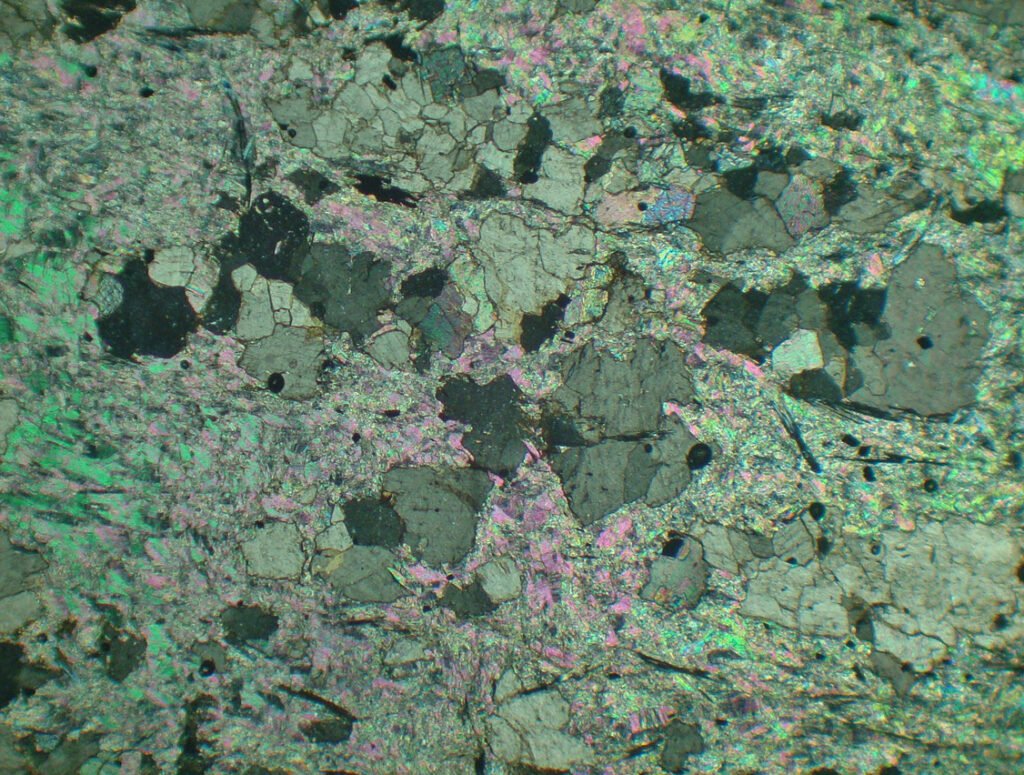
Birefringence and Interference Colors:  Birefringence of 0.242 (extremely high, the highest of carbonates): 4th order colors, typically cream with fine scattered colored lines. It clearly develops “pseudo-dichroism”.          

Extinction:  Symmetrical with respect to the cleavage planes.          

Elongation sign: Does not applies.            

Twins: Lamellar twins in {01-12}, pressure twin lamellae are very rare, but very common in dolomite and calcite.         

Zoning: No information available.             

CONVERGENT LIGHT

Character: U(-), usually difficult do determine.

2V angle: No.         

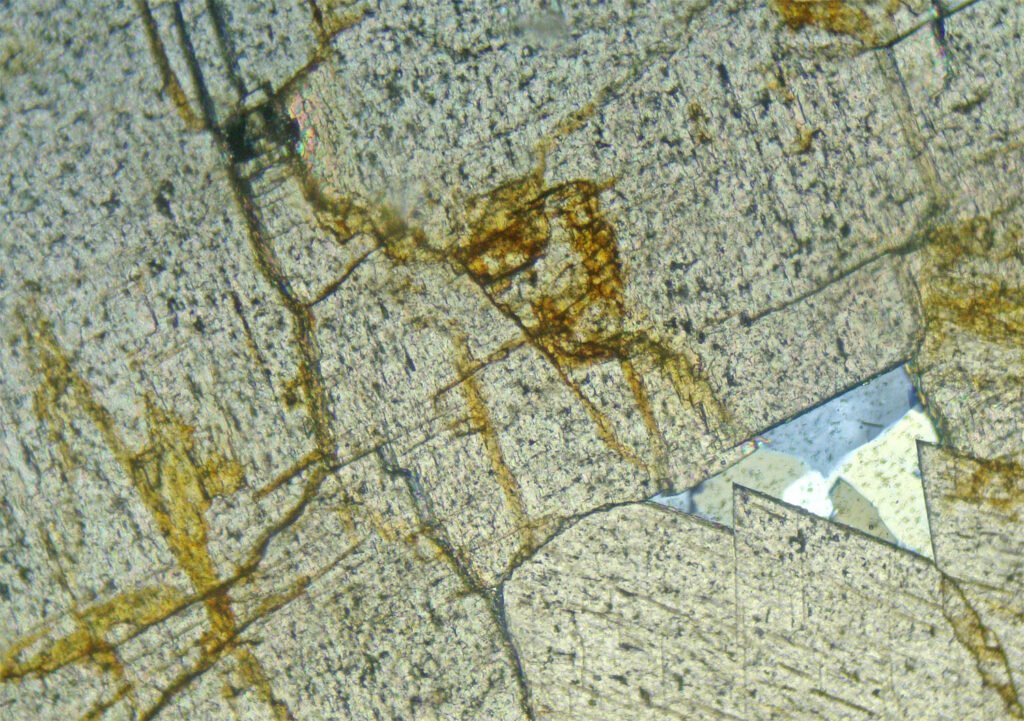
Alterations: oxidizes forming radial dendritic aggregates of goethite (limonite) that resemble “ice flowers”. This alteration to iron oxides and hydroxides of orange to reddish colors is an important diagnostic feature, considering that the other carbonates do not develop it.

May be confused with: difficult to impossible to distinguish from other carbonates under the petrographic microscope without a universal platinum. Coloring techniques and acid solubility are good tests.

Titanite and cassiterite are optically biaxial and look completely different.        

5. Reflected Light Microscopy

The identification of siderite using the petrographic microscope, both Transmitted Light and Reflected Light, is possible in only a few isolated cases when alteration features, such as the development of goethite, suggest the presence of siderite. Microscopy is not the correct analytical method for identifying siderite.

Sample preparation: the polishing of siderite, like that of other carbonates, is simple and is of excellent quality. It is similar to sphalerite polishing when in large crystals.

PLANE POLARIZED LIGHT – PPL

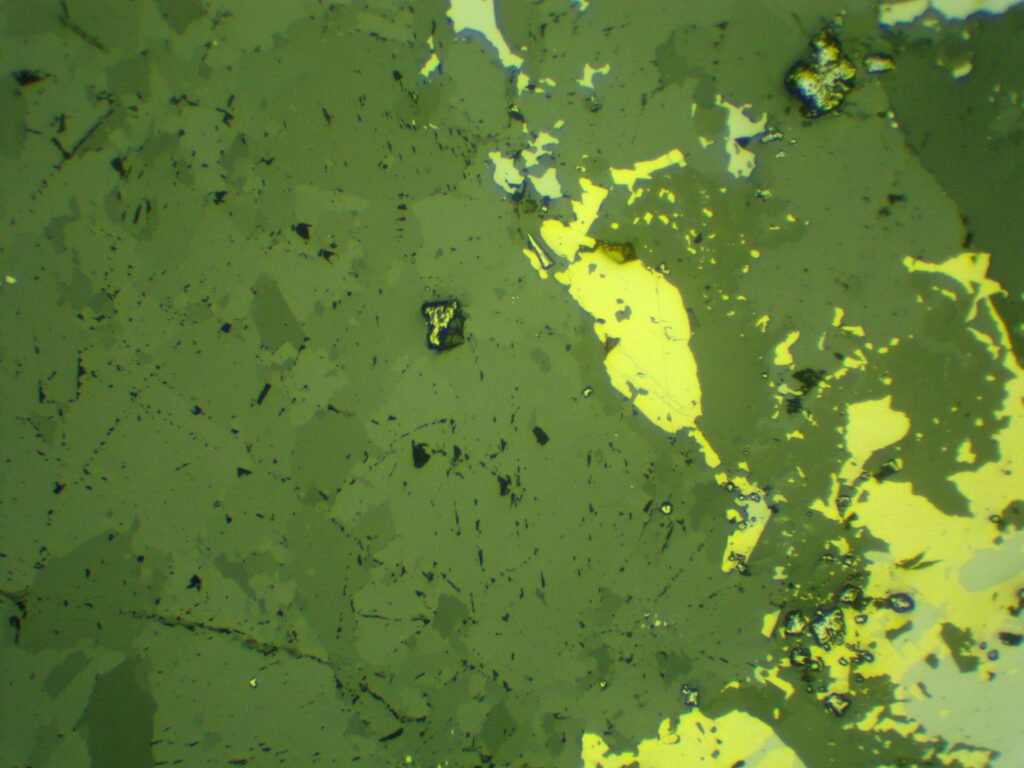
Reflection color:  Dark gray.      

Pleochroism: No.      

Reflectivity: Low (<10%).        

Bireflectance: Distinct between dark gray and light gray.       

CROSSED POLARIZED LIGHT – XPL

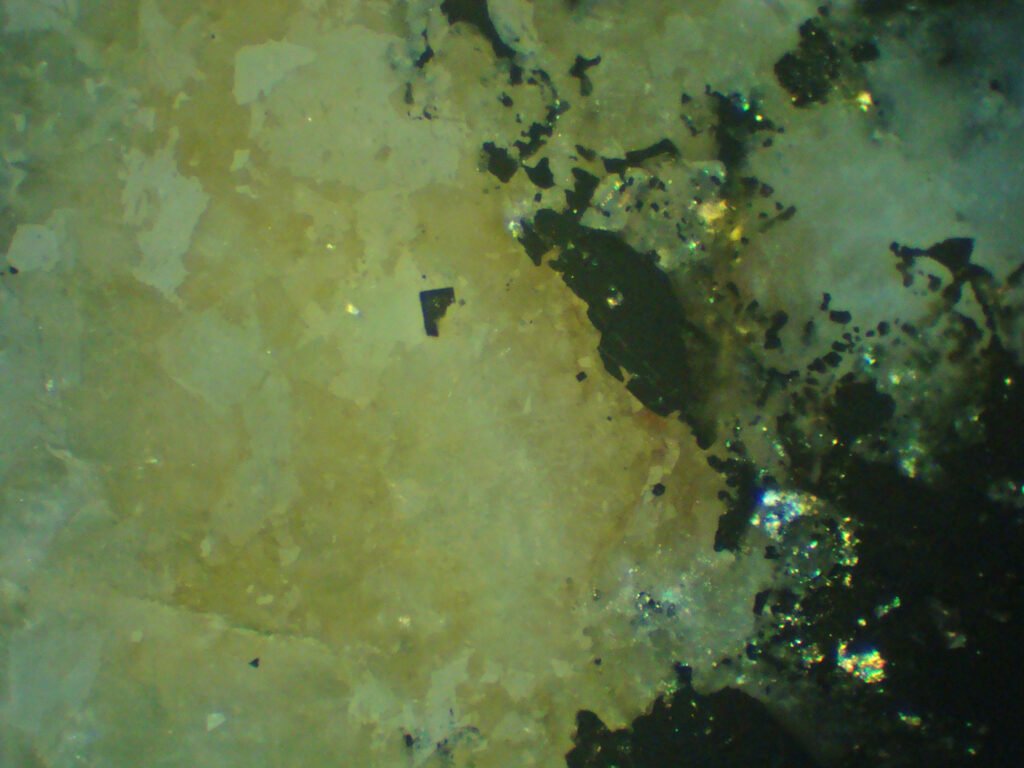
Isotropy / Anisotropy: Very strong and very diagnostic anisotropy, masked by internal reflections.        

Internal reflections: Yellowish-white to brownish internal reflections, usually double due to the double refraction of the mineral. 

May be confused with: other carbonates, such as smithsonite.

Calcite, magnesite and dolomite have markedly lower reflectivities.

Sphalerite and rhodochrosite are sometimes very similar to siderite.

Cerussite, anglesite and pyromorphite are only slightly clearer in PPL, but the paragenesis is different.       

General Characteristics: 

Grain shape: The grains are very often euhedral, more rarely idioblastic. Its size varies a lot, it can reach 20 cm in hydrothermal veins. In sedimentary rocks, the sizes are much smaller, below 0.1 mm. As the latter are often formed from gels, corresponding textures can often be found.

Cleavage typical of carbonates, rhombohedral, is visible and causes the appearance of triangular polishing pits, which may be aligned. In the cleavage planes, limonite or goethite may develop as alteration products. Limonite is more common in this condition. Both can form pseudomorphs on siderite.

Twins are frequent, but always much rarer than in calcite. Their frequency varies from occurrence to occurrence; they may even be relatively abundant.

Zonation is common but difficult to recognize in polished section, in thin blade it is much sharper.

Deformations due to tectonic stresses lead to lamellae of pressure twins.

Cataclase occurs similarly to calcite, but siderite is more brittle.

Recrystallization can occur.

Inclusions, very fine (“dust”), of hematite are possible.

Substitutions 1: Siderite is often a substitution for other carbonates.

Substitutions 2: Siderite is also replaced by other carbonates. Furthermore, by alteration, goethite and lepidocrocite, sometimes pyrolusite and psilomelane, can be formed, generating very well-developed replacement textures. Siderite can be replaced by hematite (especularite).