SMITHSONITE

Smithsonite – ZnCO3 – is a relatively common carbonate that often occurs as part of a mixture of Zn ore minerals called “calamine” in the mining industry. It could be a Cd ore.

“Calamine” is not a mineral, but a term for a mixture of smithsonite and hemimorphite, which are identical in hand sample; until the 18th century they were believed to be a single mineral. In the mix, hemimorphite is much rarer than smithsonite. In Mineralogy there have been attempts to call one of the two minerals that make up the mixture “calamine”, but the term was later discarded. Smithsonite and hemimorphite can alter to a hydrated zinc carbonate, hydrozincite, which is considered by some sources to be the third constituent mineral of calamine.

Smithsonite is classified in the Calcite Group. It is usually massive or botryoidal. Crystals are rare, can reach 10 cm and, when clear and transparent, have strong double refraction. It forms two bounded solid solutions, with Mn (rhodochrosite) and with Fe (siderite). May contain Fe, Mg, Ca, Cd, Cu, Mn, In and Co.

Shows effervescence in heated dilute HCl. Under shortwave UV light it fluoresces pink, under longwave UV light it shows pale yellow-gray to pale green colors. It forms epitaxy with zincite, octavite and calcite. There are at least 8 varieties, including “dry bone ore” (massive, porous, matte varieties with a honeycomb structure) and “turkey fat ore” (globular, botryoidal and stalagtite forms of yellow smithsonite).

1. Characteristics

Crystal system: Trigonal scalenohedral.          

Color: White, light to dark gray, brown (Fe), rarely green (Cu), yellow (Cd), blue (Cu), etc.     

Habit: Very rare crystals. Reniform, botryoidal, stalagtite, massive, earthy, spherulitic, granular, friable, solid compact, porous, etc. 

Cleavage: Rhombohedral: {10-11} almost perfect.

Tenacity:  Brittle.       

Twinning: No.       

Fracture: Irregular, subconchoidal.       

Mohs Hardness: 4.5

Parting: No.         

Streak: White.         

Lustre: Silky, pearly, vitreous.          

Diaphaneity: Transparent.           

Density (g/cm³): 4.4


2. Geology and Deposits

Smithsonite is a carbonate that occurs primarily in oxidation zones (“iron hat” or “gossan”) of sphalerite-based zinc ores. In contrast, siderite and rhodochrosite are guide minerals for non-oxidized paragenesis. Therefore, smithsonite and siderite+rhodochrosite are mutually exclusive.

Sometimes it occurs replacing adjacent carbonate rocks.

Form “pearls” in caves.


3. Mineral Associations

It associates with primary sulfides (galena, sphalerite), quartz, fluorite and carbonates (calcite, dolomite).

In addition, secondary Zn minerals (hydrozincite, hemimorphite, willemite), secondary Pb minerals (pyromorphite, cerussite, wulfenite, mimetite, anglesite), secondary Cu minerals (auricalcite, rosasite, malachite, azurite, chrysocolla) and secondary compounds of Fe (limonite).


4. Transmitted Light Microscopy

Refraction indices:  nω: 1.842 – 1.850    nε: 1.619 – 1.623        

PLANE POLARIZED LIGHT – PPL

Color / Pleochroism: Colorless to faintly colored.

Relief:  High.          

Cleavage: Rhombohedral {10-11}, almost perfect.

Habits: Massive, earthy, porous, etc.            

CROSSED POLARIZED LIGHT – XPL

Birefringence and Interference Colors: Birefringence between 0.223 and 0.227: high order colors, pearly, difficult to define.           

Extinction: Probably paralell.           

Elongation sign: No information available. 

Twins: No.        

Zoning: No.             

CONVERGENT LIGHT

Character: U(-)          

2V angle: No.        

Alterations:  alters to hydrozincite.         

May be confused with: hemimorphite.         

5. Reflected Light Microscopy

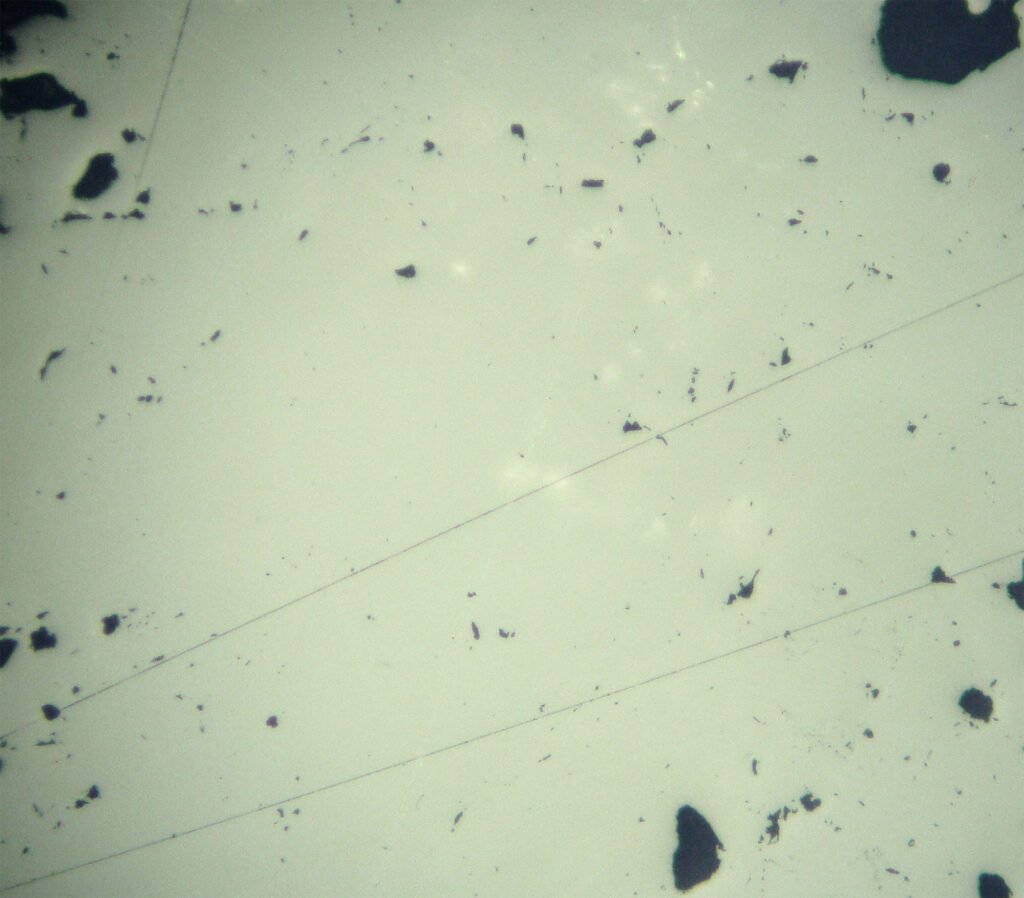
Reflected light microscopy is not the recommended analytical method for the identification of smithsonite. However, it is important to make a polished thin section or a polished section to identify the opaque minerals that occur associated with smithsonite.

Sample preparation: smithsonite polishing is simple and is of good quality.       

PLANE POLARIZED LIGHT – PPL

Reflection color: Gray.       

Pleochroism:  Strong.     

Reflectivity: Low to medium.        

Bireflectance: No.       

CROSSED POLARIZED LIGHT – XPL

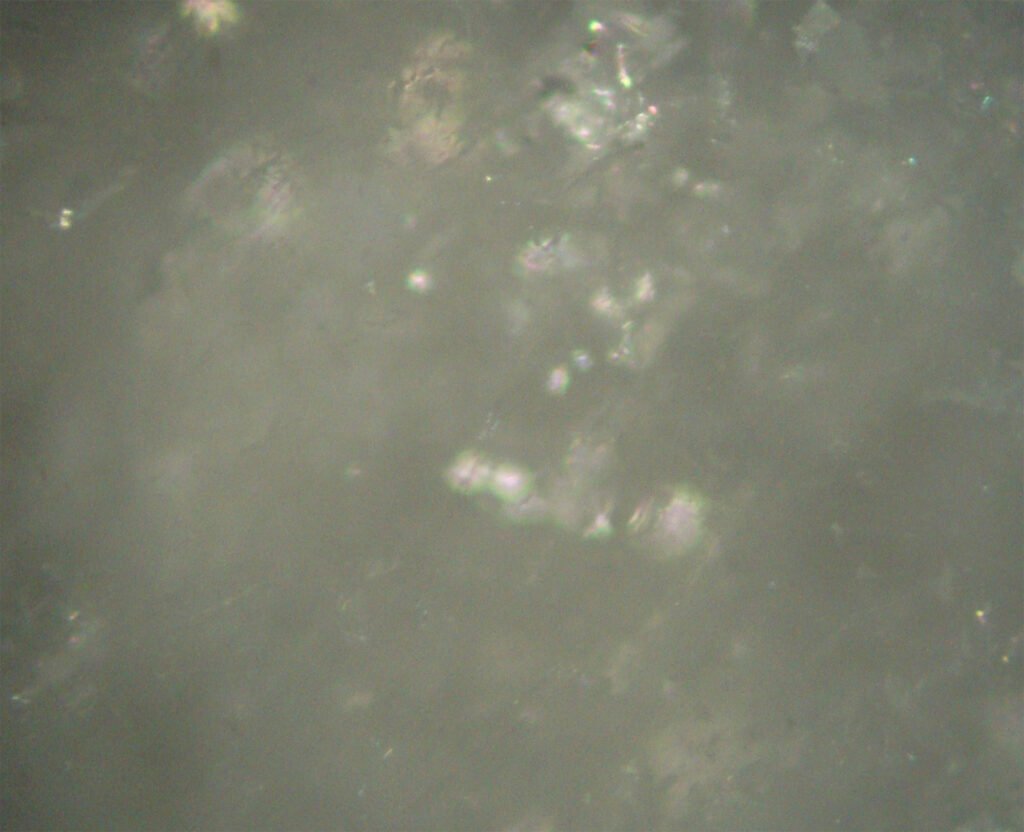
Isotropy / Anisotropy: Strong anisotropy, masked by abundant internal reflections.

Internal reflections: Widespread white, pale green or yellowish.

May be confused with: several other secondary minerals that occur in the same paragenesis.

Siderite and rhodochrosite are similar, but the paragenesis of smithsonite excludes both.

Calcite and dolomite have much lower reflectivity.

Cerussite has reflection pleochroism as high as smithsonite, but the minimum reflectivity of cerussite corresponds to the maximum reflectivity of smithsonite.

Hemimorphite is very similar, but lacks reflection pleochroism.

Hydrozincite, also fine-grained, is also strongly anisotropic.

Prehnite is harder and wavellite is softer, both do not effervesce in dilute hydrochloric acid.

Chrysocolla is less hard and has a more intense color, but it is difficult to differentiate.       

General Characteristics: 

Cleavage can be seen only rarely.

Polishing pits, despite excellent cleavage, are rare because the grain sizes are usually very small.

Rhythmic structures as in the “Schalenblende” (= see sphalerite) are apparently common.

Twins do not occur.