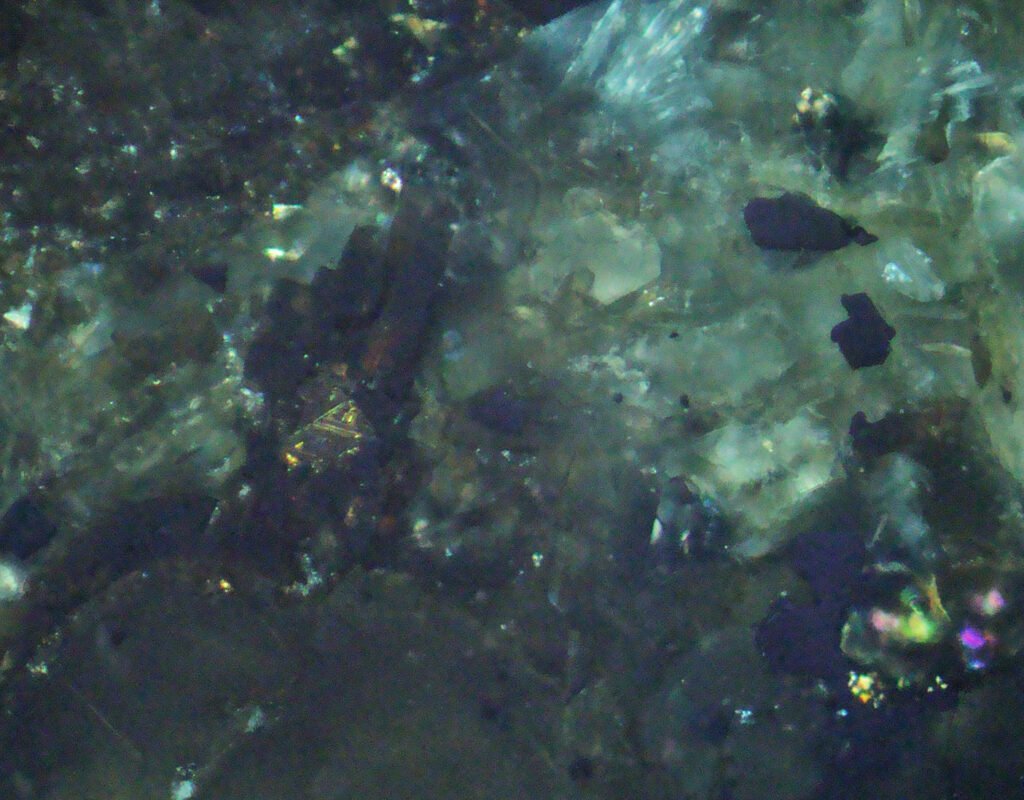
1. Characteristics
These characteristics are of gehlenite.
Crystal system: Tetragonal scalenohedral.
Color: Yellowish-brown, colorless, greenish-gray.
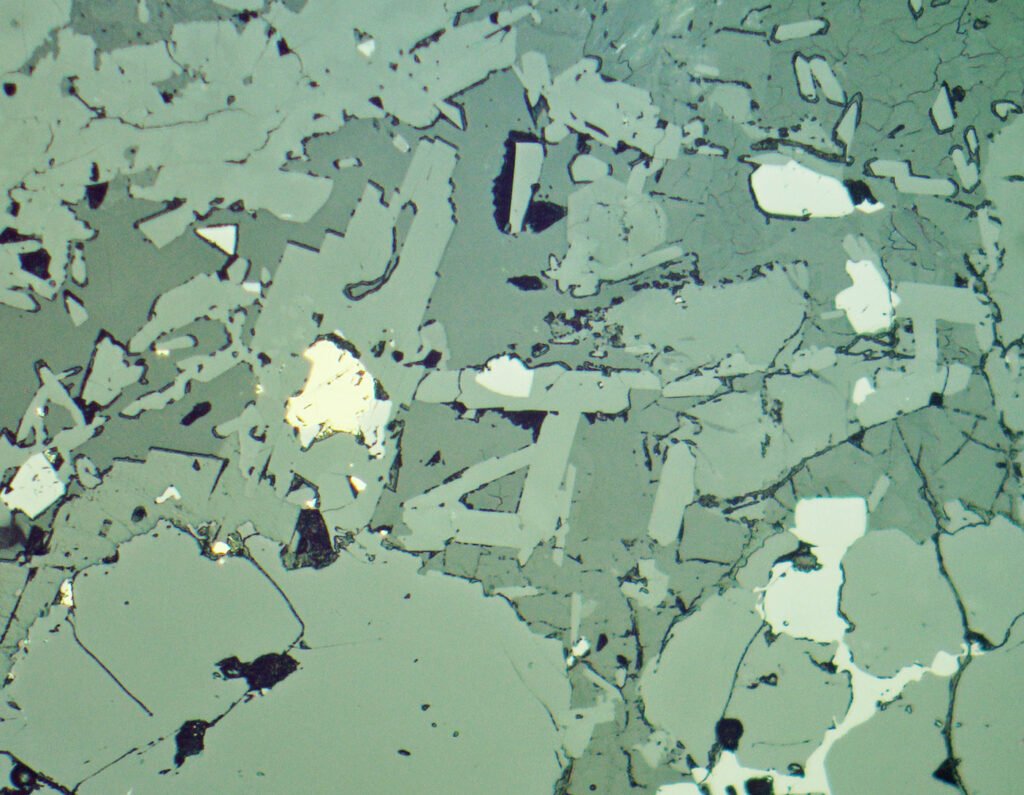
Habit: Short prismatic shape, resembling cubes modified by the octahedron. Granular, massive.
Cleavage: {001} good, {110} bad.
Tenacity: Brittle.
Twinning: Simple in {100} and {001}. Lamellar by {001}.
Fracture: Without information, it’s probably irregular.
Mohs Hardness: 5 – 6
Parting: No.
Streak: White, gray-white.
Lustre: Vitreous, resinous.
Diaphaneity: Transparent.
Density (g/cm³): 3.03
2. Geology and Deposits
Melilite is a mafic mineral that occurs only in calcium-rich ultramafic volcanic rocks and is characteristic of melilitites. It is found in rocks of the sanidinite facies and rarely in alnoite dikes.
It can be found in the contact metamorphic aureole of granites, in skarns developed in high-grade impure marbles.
It may contain typical parallel rod inclusions such as zeolite fibers parallel to the Z-axis. It may contain glass as inclusions.
3. Mineral Associations
In volcanic rocks, it is associated with feldspathoids (nepheline, leucite), augite, olivine, diopside, and apatite.
In skarns, it occurs with carbonates (calcite, dolomite), garnets (pyrope, grossular, andradite), vesuvianite, wollastonite, spinel, phlogopite, rankinite, bicchulite, spurrite, fassaite, clinozoisite, and pleonast.
4. Transmitted Light Microscopy
Refraction indices: nω: 1.670 nε: 1,660 (gehlenite)
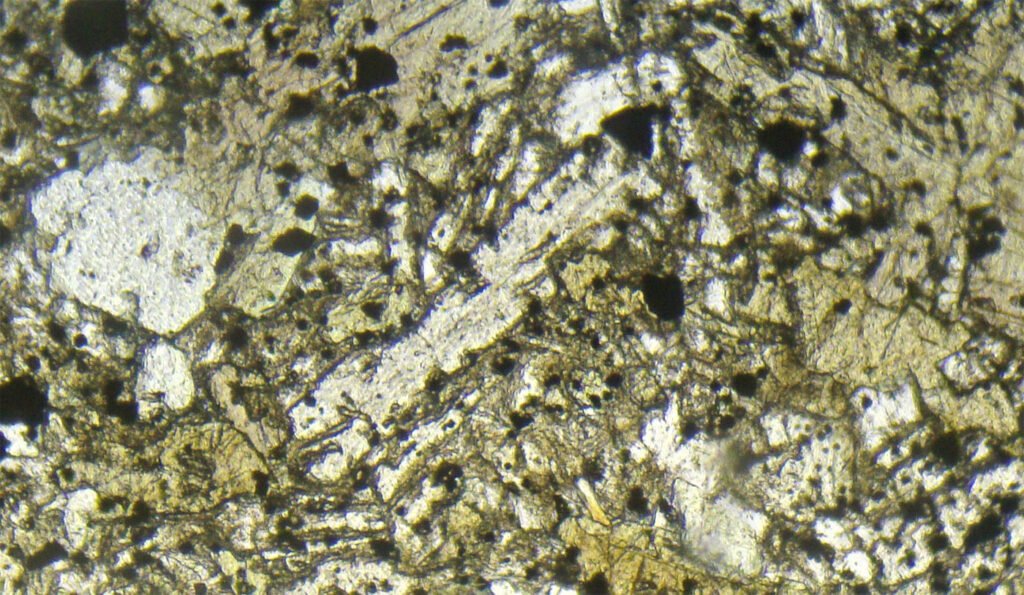
PLANE POLARIZED LIGHT – PPL
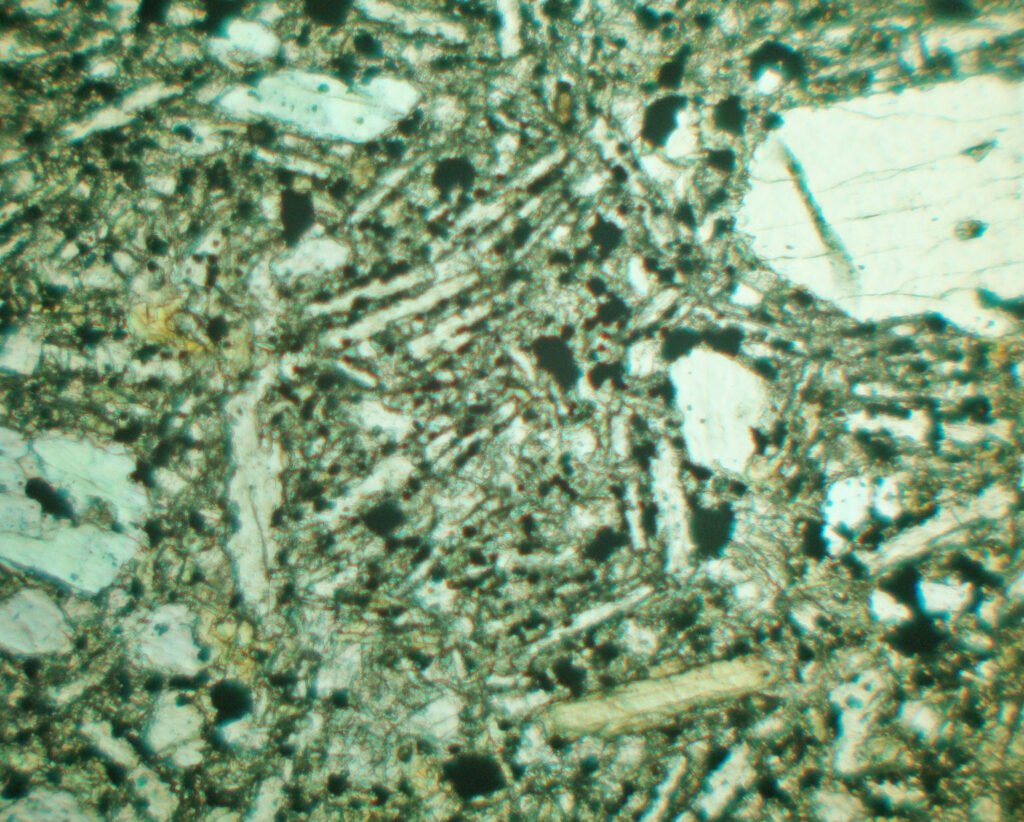
Color / Pleochroism: Akermanite is colorless; gehlenite is colorless, rarely pale honey-yellow to brown with weak pleochroism.
Relief: Moderate.
Cleavage: Akermanite: {001} distinct; Gehlenite {001} and {110} distinct.
Habits: Tabular on (001), prismatic (hk0). Square and elongated basal sections. Akermanite forms thin lamellae according to {001}; gehlenite short columns parallel to {100} and thick plates along {001}.
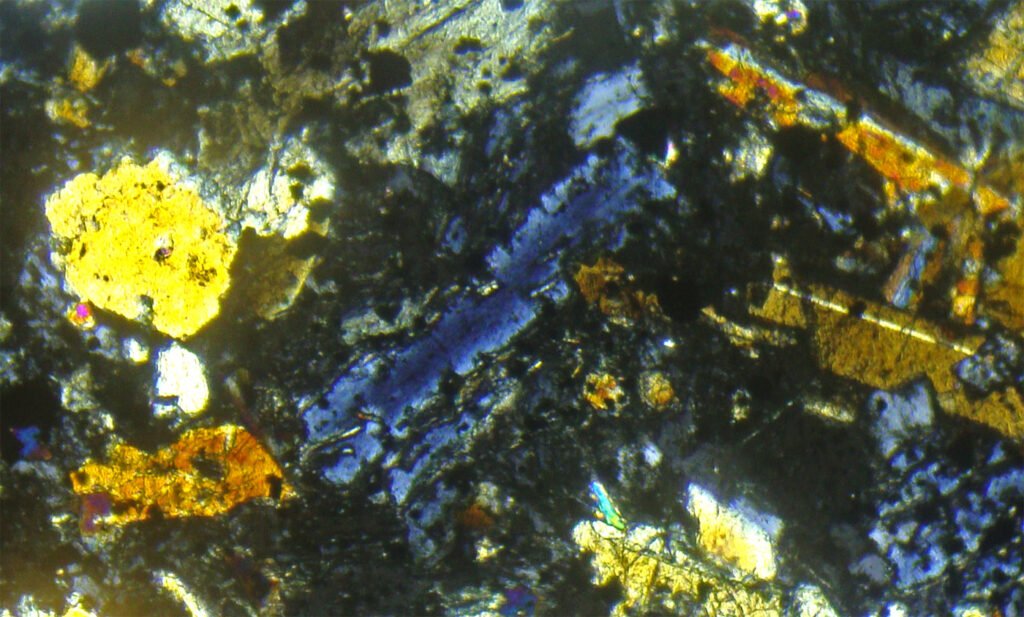
CROSSED POLARIZED LIGHT – XPL
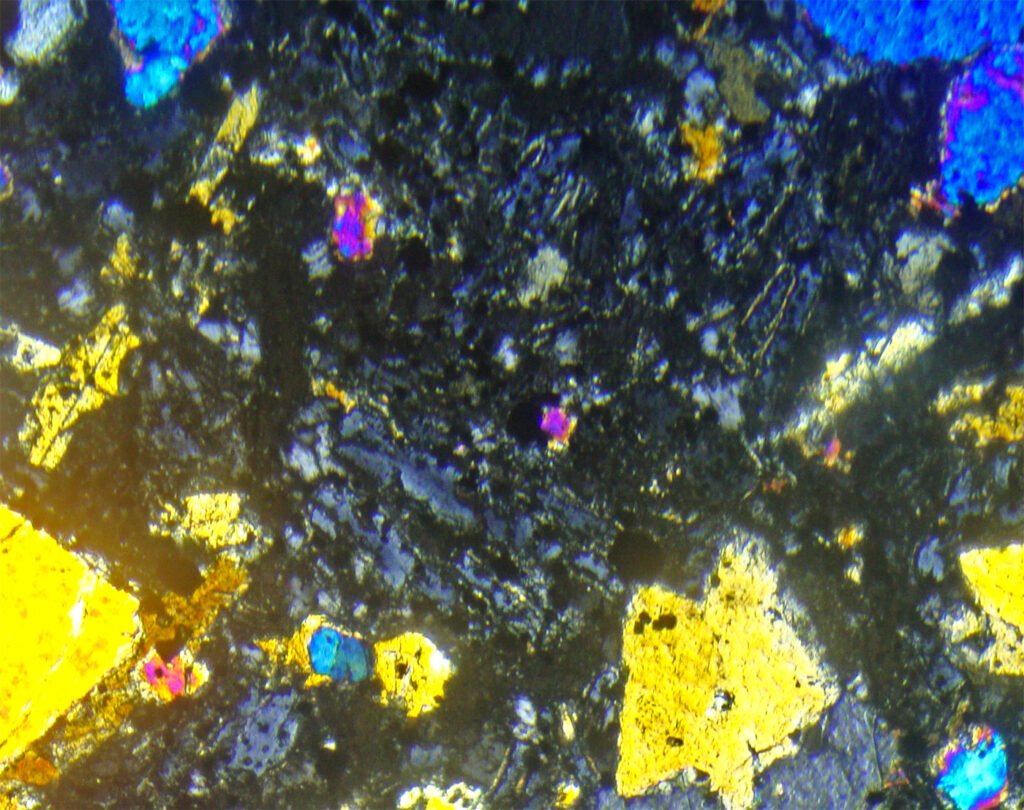
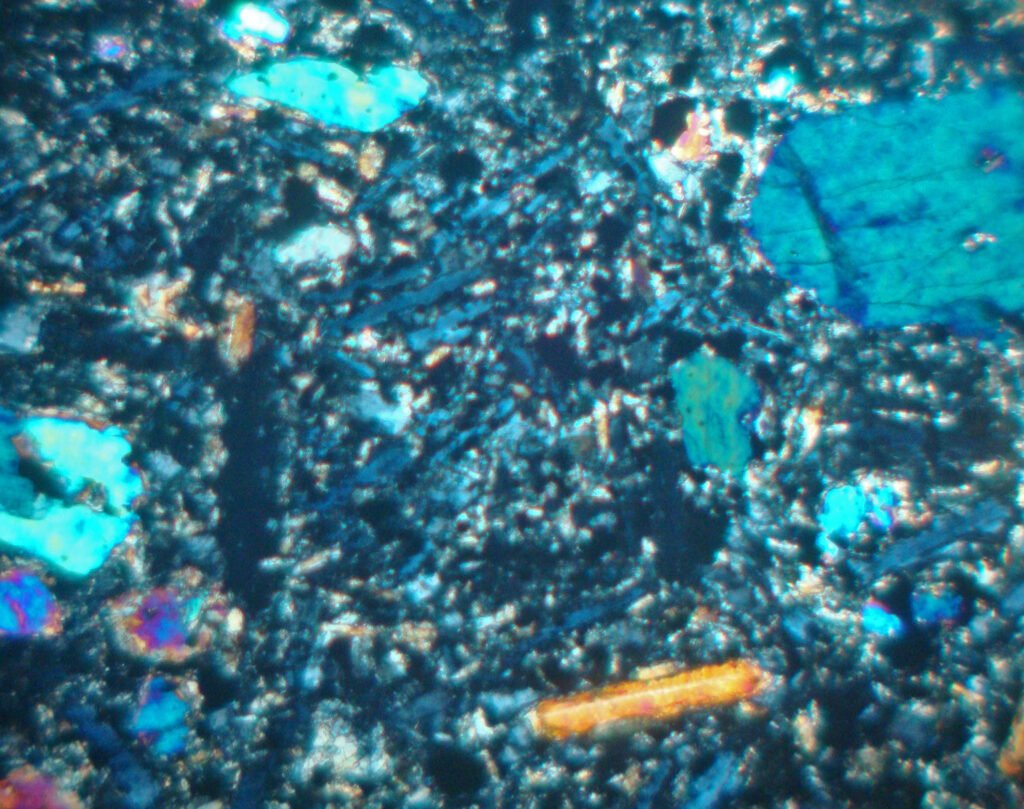
Birefringence and Interference Colors: Birefringence of 0.008 in akermanite and 0.011 in gehlenite: 1st order colors: various shades of gray to at most straw yellow. Melilite with birefringence = 0.000 is common in lavas, showing anomalous light brown or “Berlin blue” interference colors due to its strong scattering.
Extinction: Usually paralell.
Elongation sign: ES(+) or ES(-), always the opposite of the optical character.
Twins: Rare interpenetration twins.
Zoning: It may exhibit zonation with acicular inclusions.
CONVERGENT LIGHT
Character: U(+) or U(-)
2V angle: No.
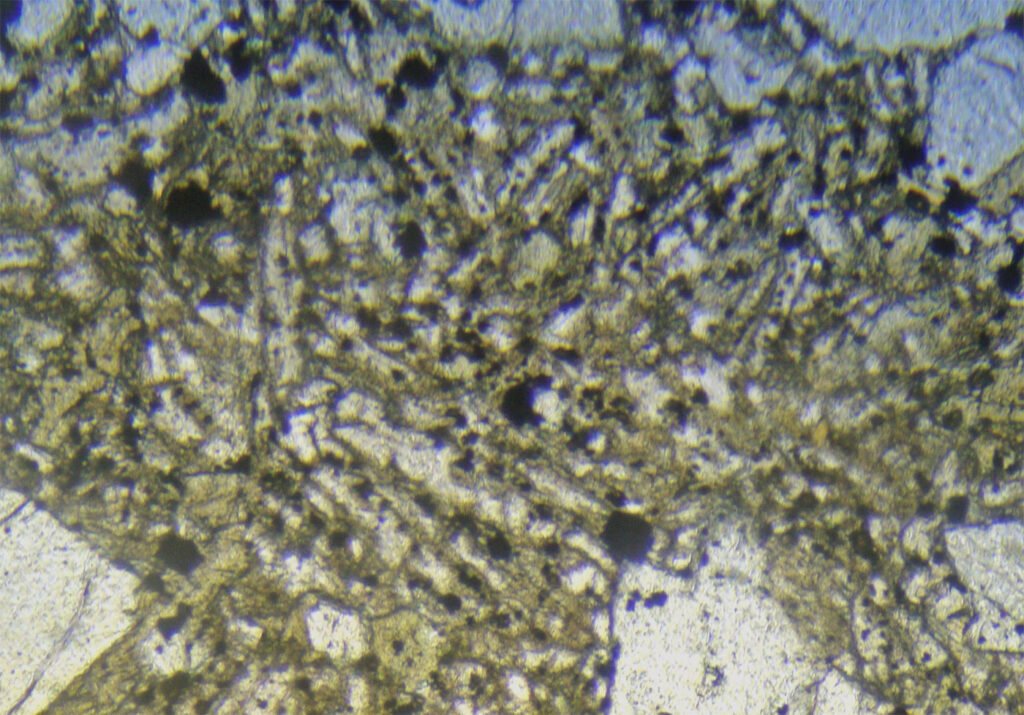
Alterations: It is easily altered by hydrothermal action, forming zeolites: the growth of nearly isotropic fibers of mordenite, nucleating along the basal planes of the crystals, gives rise to the “rod-like” texture.
May be confused with: Paragenesis, birefringence, and frequent “Berlin blue” colors are diagnostic.
Vesuvianite has a higher relief and no cleavage.
Apatite forms hexagonal prismatic crystals and never exhibits anomalous interference colors.
Volcanic glass is isotropic, and zoisite is B(+).