CERUSSITE

Cerussite – PbCO3 – is a carbonate with a more restricted distribution, generally associated with Pb ores. As it contains 77.5% Pb, it can constitute an important ore.

It is classified in the Aragonite Group and is usually very pure, but may contain Ag and Cr. It forms a series with strontianite (from Sr). The largest recorded cerussite crystal was 60 cm. It can be faceted. WARNING! As it contains Pb, inhalation of dust should be avoided when breaking it, and hands should be washed after handling.

There are three varieties: with Ag, with Cr, and with Zn. It may exhibit yellow fluorescence under long-wave ultraviolet light and under X-rays.

It forms pseudomorphs on anglesite, kaledonite, hydrocerussite, bournonite, phosgenite, leadhillite, linarite, pyromorphite, and vanadinite. In turn, pseudomorphs occur on cerussite of pyromorphite, minium, malachite, quartz, galena, limonite, calcite, siderite, phosgenite, dolomite, and chrysocolla.

1. Characteristics

Crystal system:  Orthorhombic prismatic.         

Color: Colorless, white, gray, pale yellow, black with inclusions. Shades of blue, green, or red.

Habit: Massive, granular, reticulated, tabular, powdery, fibrous, stalactitic, acicular, twinned crystals.       

Cleavage: {110} good, {021} good, {010} poor, {012} poor.      

Tenacity: Very brittle.

Twinning: Twins are almost universal and very characteristic. They are usually simple or cyclic contact twins along {110}, producing pseudo-hexagonal or reticulated compound crystals. Also contact twins in {130}, producing heart-shaped compounds. Both laws can occur in the same aggregate. A series of twins along different planes can occur. Reticulated aggregates of long prismatic crystals are almost exclusive to cerussite.     

Fracture: Conchoidal       

Mohs Hardness: 3 – 3.5

Parting: No.         

Streak: White.         

Lustre: Intense greasy vitreous, adamantine.         

Diaphaneity: Transparent.           

Density (g/cm³): 6.5 (higher than common rock forming minerals; a very diagnostic feature, similar to scheelite.


2. Geology and Deposits

Cerussite is an alteration carbonate of galena, forming in the oxidation zones of lead sulfide ores, especially in arid regions. There, cerussite occurs alongside a large number of other secondary minerals of the elements that made up the primary mineralogy of the deposit.


3. Mineral Associations

It is associated with galena, from which it is derived by alteration.

In addition, it is found with other secondary Pb minerals in the oxidized portions of polymetallic ores: anglesite, phosgenite, pyromorphite, mimetite, vanadinite, minium, leadhillite, hydrocerussite, and kaledonite.

Secondary Zn minerals (smithsonite), secondary Cu minerals (malachite, azurite, linarite, chrysocolla, bournonite), carbonates (calcite, dolomite, siderite), barite, sphalerite, limonite, native silver, and quartz also occur there.


4. Transmitted Light Microscopy

Refraction indices:  nα: 1.804     nβ:  2.076     nγ: 2.078

PLANE POLARIZED LIGHT – PPL

Color / Pleochroism:Colorless.

Relief:  Very high.          

Cleavage: May be visible, considering that there are two good cleavages.          

Habits: Massive, granular, reticulated, tabular, powdery, fibrous, stalactitic, acicular, twinned crystals.            

CROSSED POLARIZED LIGHT – XPL

Birefringence and Interference Colors: birefringence of 0.273: high-order colors, reminiscent of calcite/dolomite colors.  

Extinction:  Paralell to elongation.          

Elongation sign: Difficult to ascertain due to the high birefringence. 

Twins:  Very common.        

Zoning: No.             

CONVERGENT LIGHT

Character: B(-), difficult to determine due to high birefringence. 

2V angle: 8 – 14º.         

Alterations: No information available.          

May be confused with: other carbonates, but it does not have the perfect cleavage of calcite and, therefore, does not develop polishing pits in polished section.

Aragonite exhibits strong effervescence with dilute HCl.

Phosgenite is softer (Mohs 2.5).

Hemimorphite is harder (Mohs 4.5-5).

Anglesite is never twinned.  
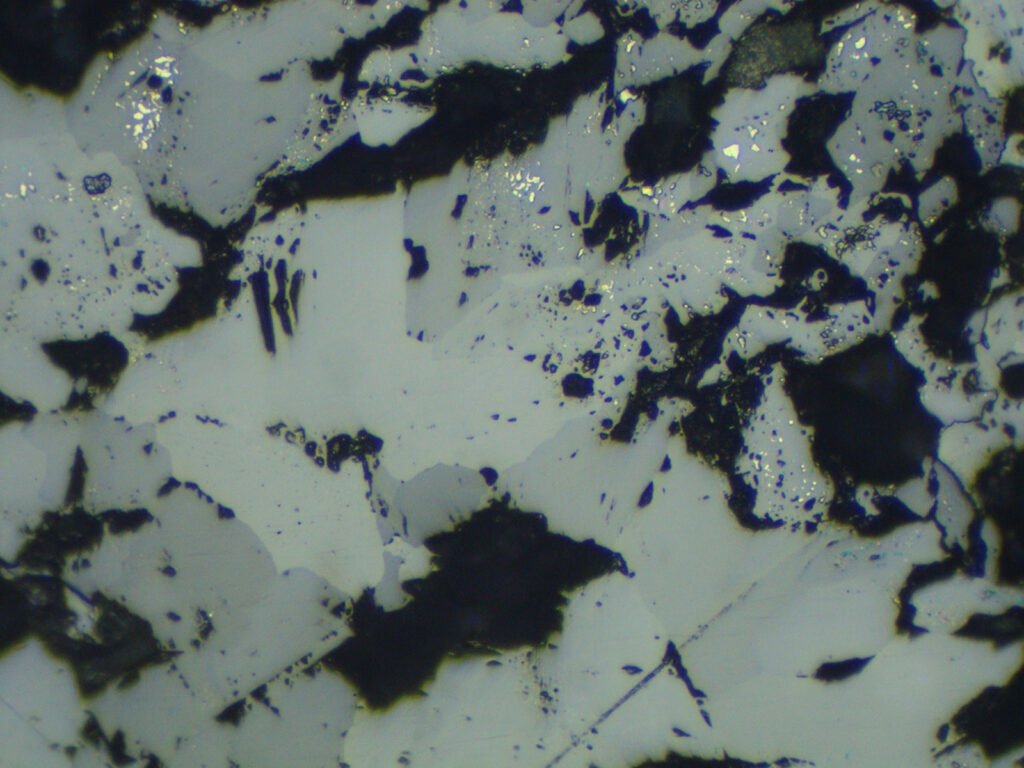
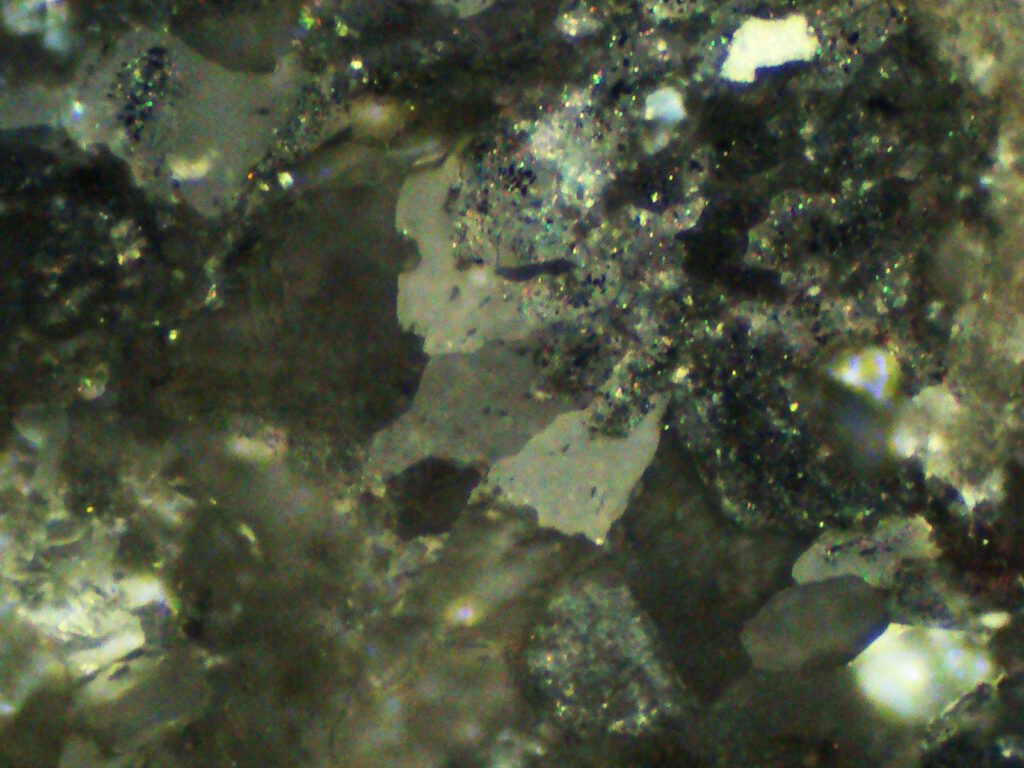
5. Reflected Light Microscopy

Identifying cerussite using reflected light is not easy, as is the case with most transparent minerals. However, there are some features that are quite diagnostic for cerussite, such as its association with galena remnants.

Sample preparation: Cerussite, like all carbonates, acquires a great polish easily, provided it occurs in well-developed crystals.       

PLANE POLARIZED LIGHT – PPL

Reflection color: Medium to dark gray, with no associated color tones. 

Pleochroism: Strong, like calcite and dolomite.      

Reflectivity: Low (10-12%), but higher than the gangue.     

Bireflectance: Pronounced.       

CROSSED POLARIZED LIGHT – XPL

Isotropy / Anisotropy: Strong anisotropy in shades of gray.        

Internal reflections: Intense and abundant, milky and brownish.

Internal reflections can occur in pairs due to the double refraction of cerussite. This observation is difficult to make (see the double internal reflections).

Due to the high dispersion of cerussite, internal reflections often have broad colored edges.

May be confused with: Paragenesis is very helpful in its identification. It is easily identified as a carbonate.

Typical features include galena relics, the presence of twins, highdensity, and absence of cleavage. Other transparent minerals of oxidized lead minerals exhibit much weaker pleochroism. The high lead content induces a high refractive index, therefore exhibiting intense luster.       

General Characteristics: 

Grain shape: exhibits very varied grain sizes.

Cleavage cannot be observed, but structures derived from the cleavage of galena from which cerussite formed can sometimes be found.

Galena relics frequently occur mixed with cerussite.

Inclusions: very fine, very small inclusions may be covellite, chalcocite, argentite, or native silver.

Galena retroformations from cerussite sometimes occur, developing very well-developed rhythmic structures.