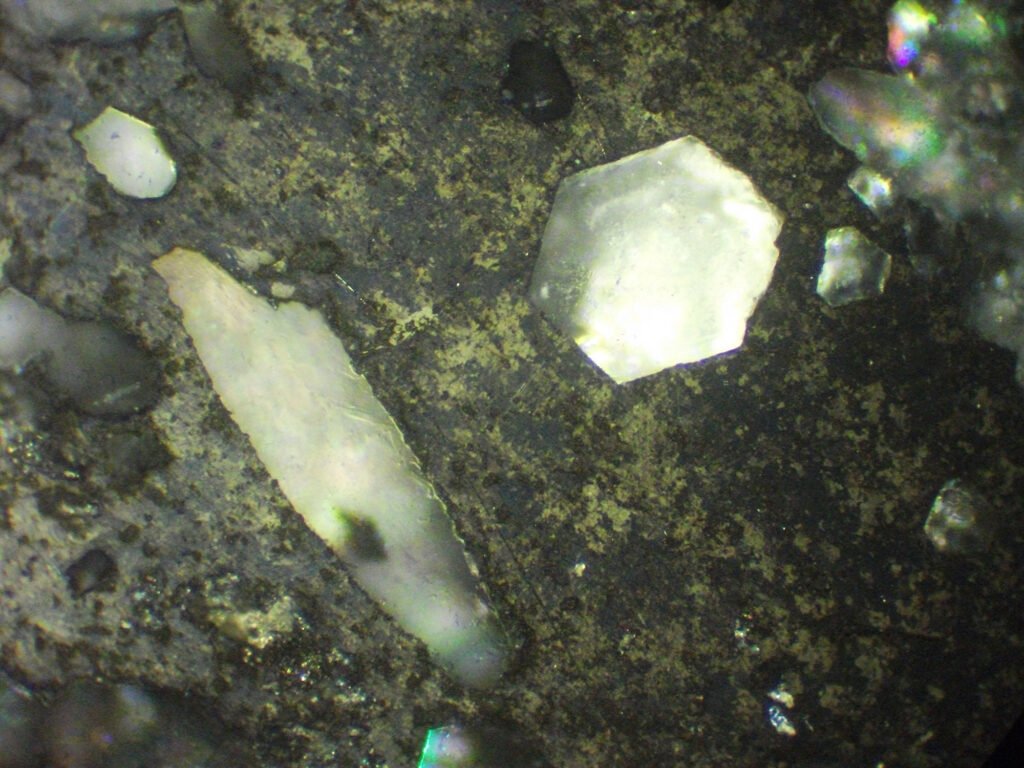
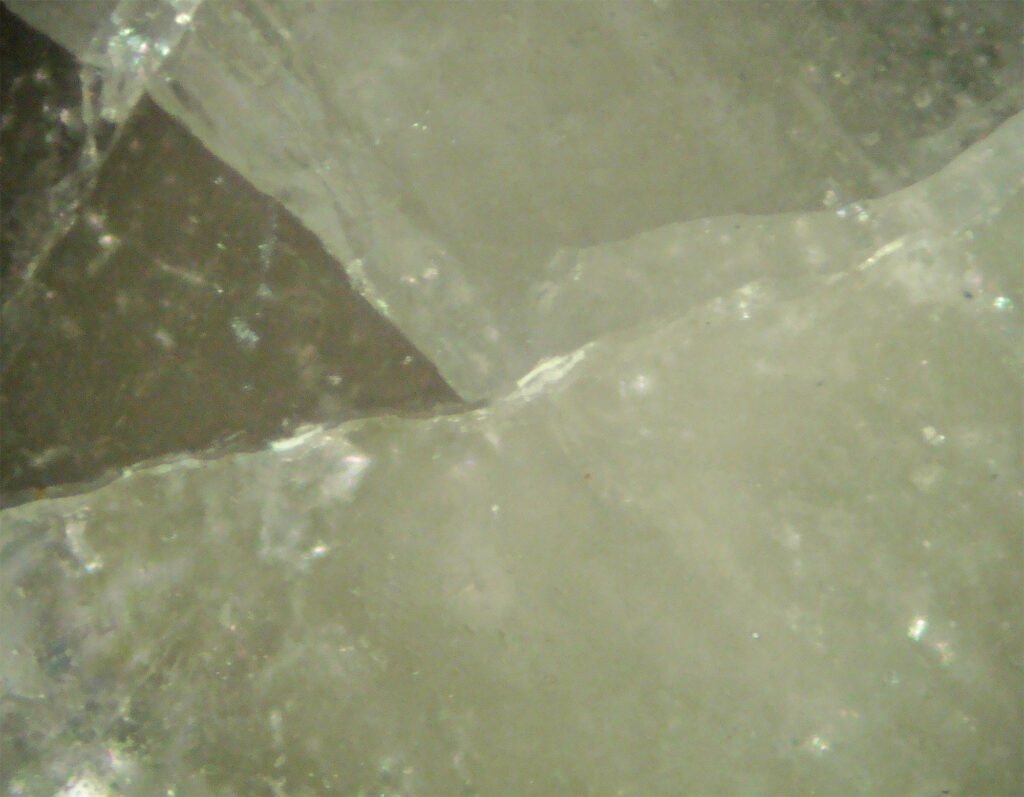
Many minerals have colorless, milky to white internal reflections, sometimes with spots of multicolored reflections. Some may occasionally show internal reflections in other colors. These are colorless to white transparent minerals, usually with a vitreous luster.
Many are identical: massive, transparent, whitish colors, more or less defined cleavages and similar densities. Care must be taken not to confuse spodumene with microcline, for example. Or call a pollucite, milky quartz.
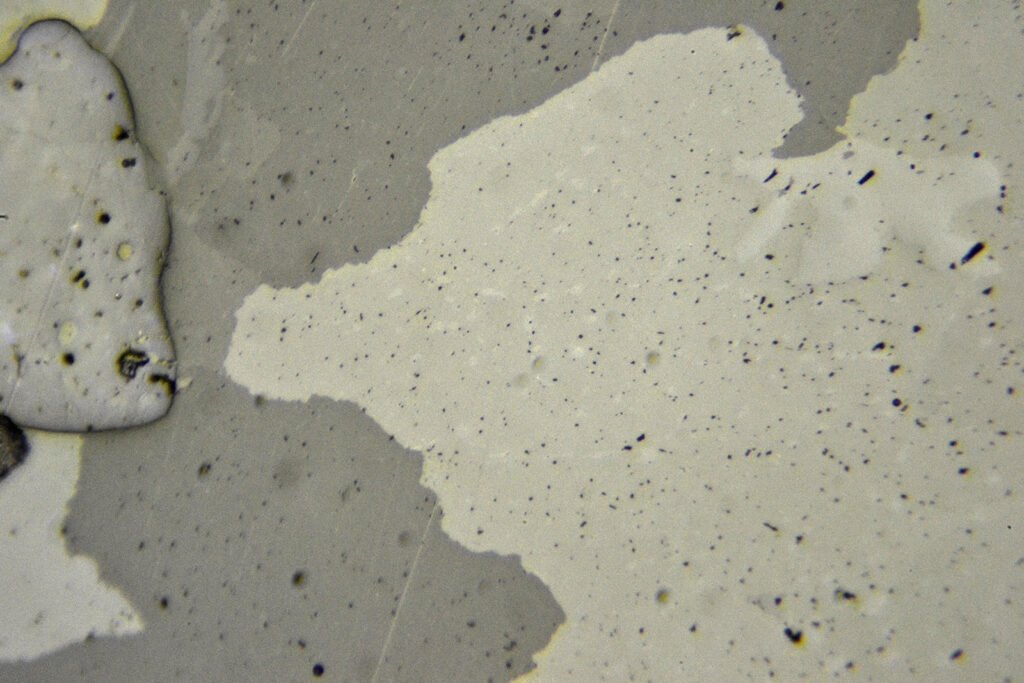
In PPL, they have a dark gray color and low reflectivity: “gangue gray”. “Gangue” is a term that generically designates transparent low-value minerals that accompany opaque minerals that contain metals. The name comes from the German "Gangarten" (= minerals that occur in veins).
Image: in XPL, quartz, a typical gangue mineral, in longitudinal and basal sections.
Check the characteristics of only the minerals likely by the paragenesis of the ore.
Use other analytical techniques in addition to Reflected Light microscopy, which will most likely be the case. But there are many situations in which Transmitted Light microscopy also does not resolve the issue.
Carbonates (calcite, dolomite, magnesite, siderite, rhodocrosite) exhibit strong grayscale pleochroism in PPL. If there are many twins, it is likely calcite. Pleochroism allows you to see the twins. In XPL there is very strong, easy-to-see anisotropy and generalized white reflections.
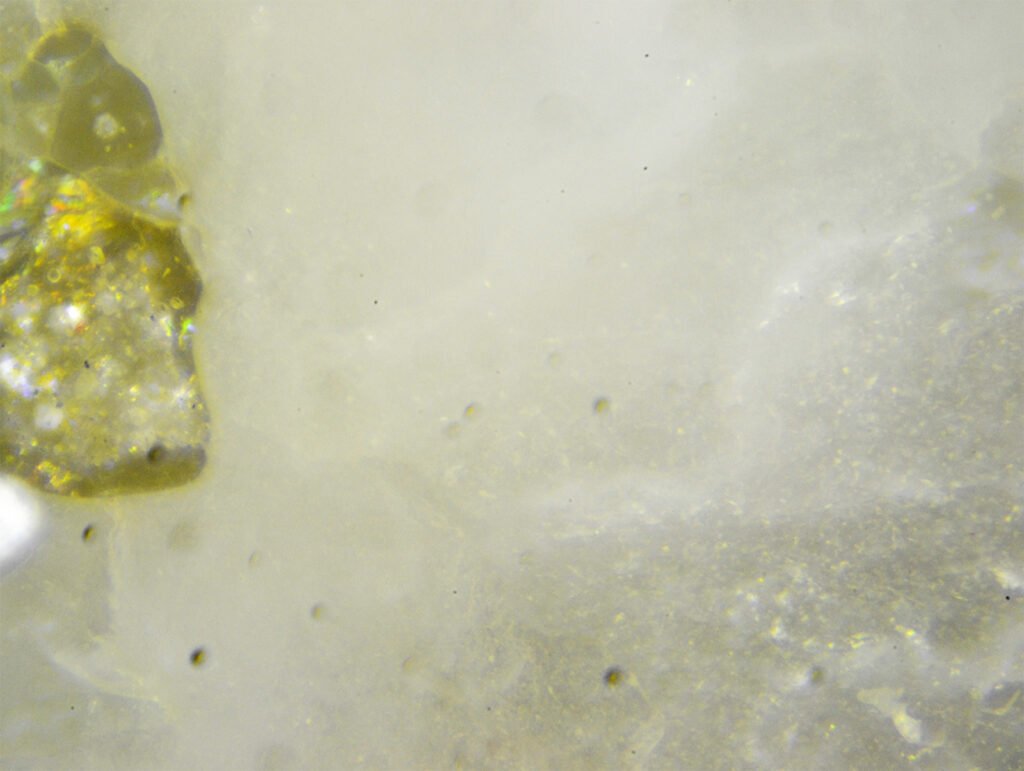
Images: calcite in PPL and in XPL.Yellowish in XPL = apatite.
Minerals, in XPL with generalized colorless, milky, white or multicolored internal reflections.