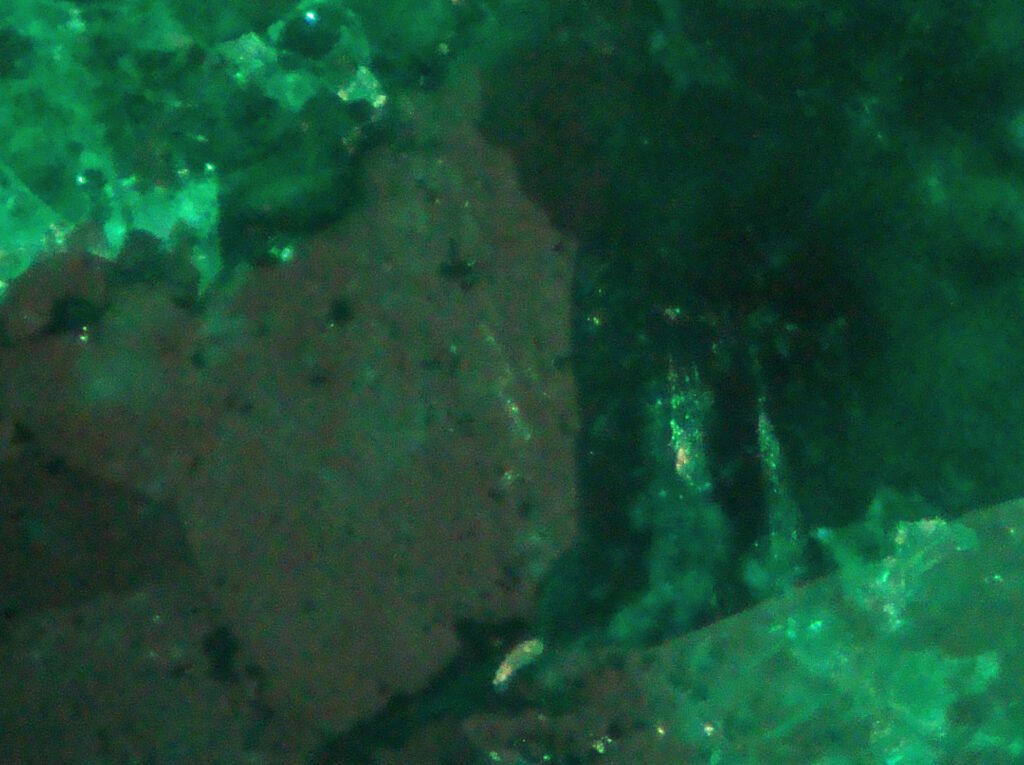
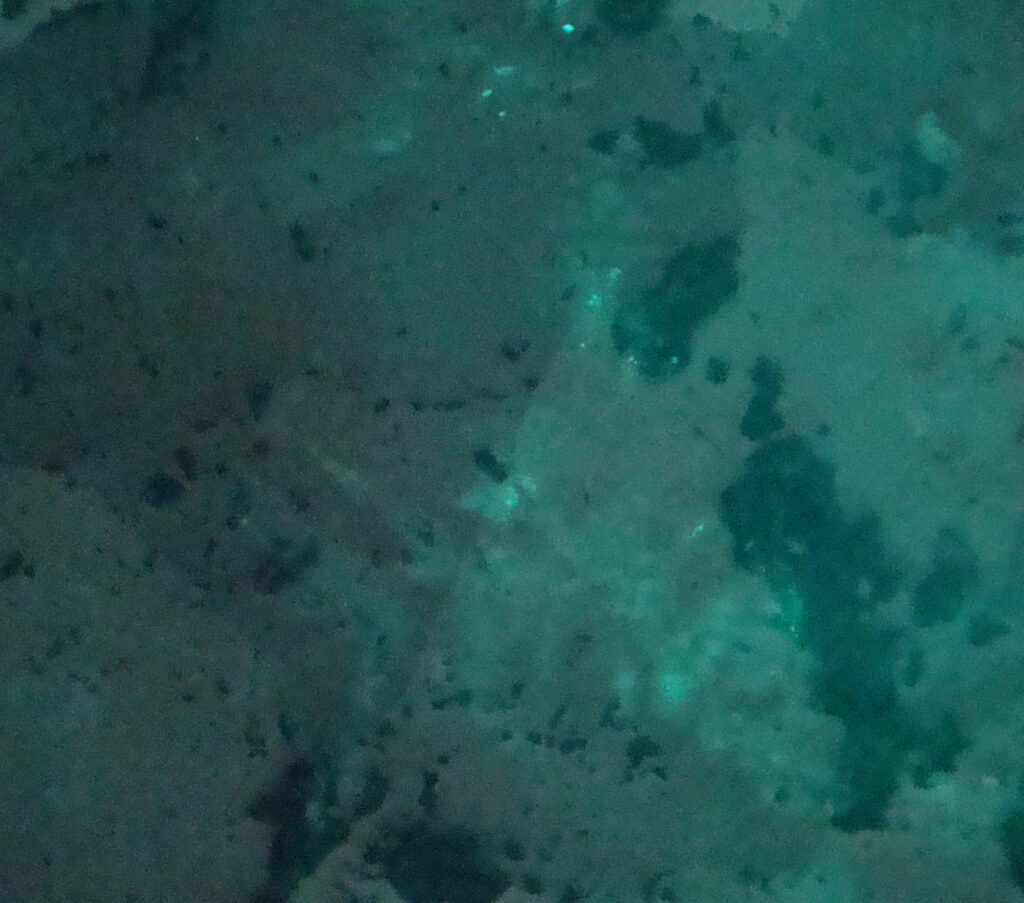
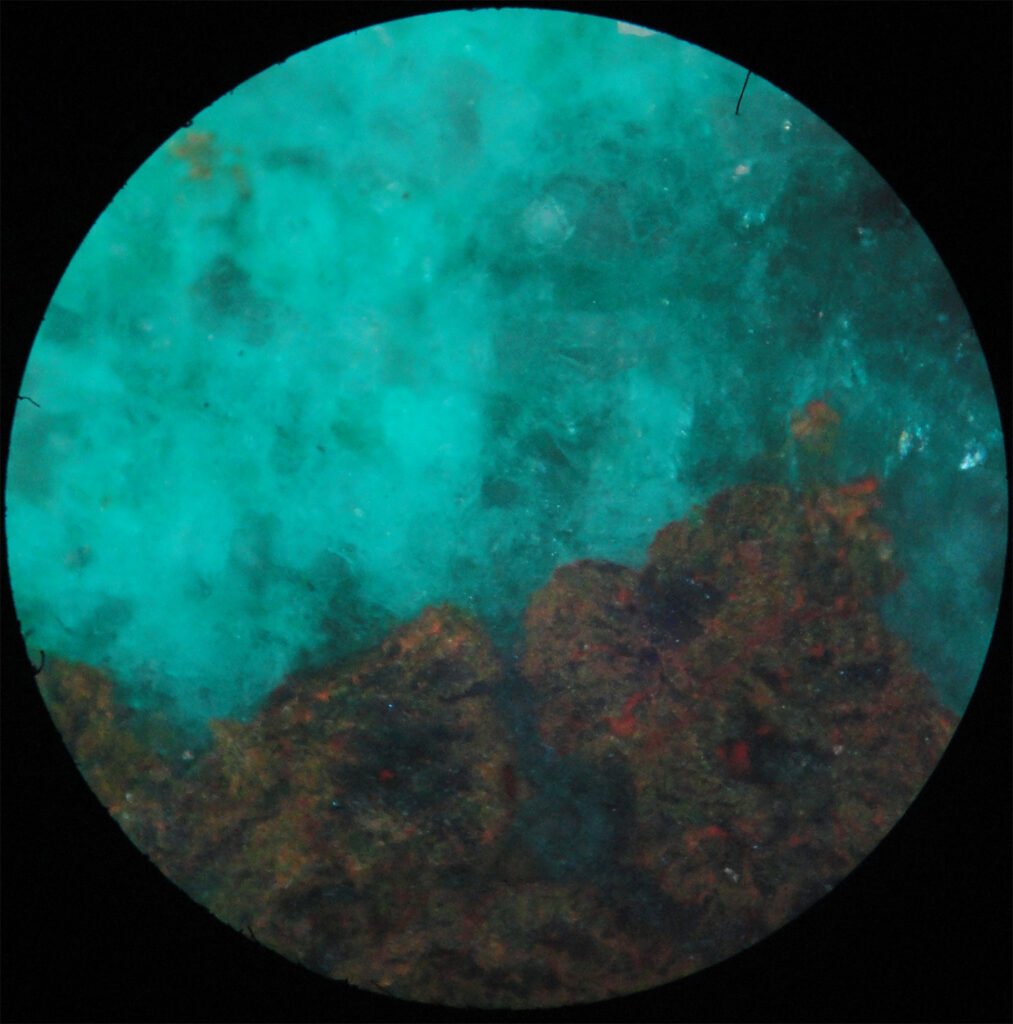
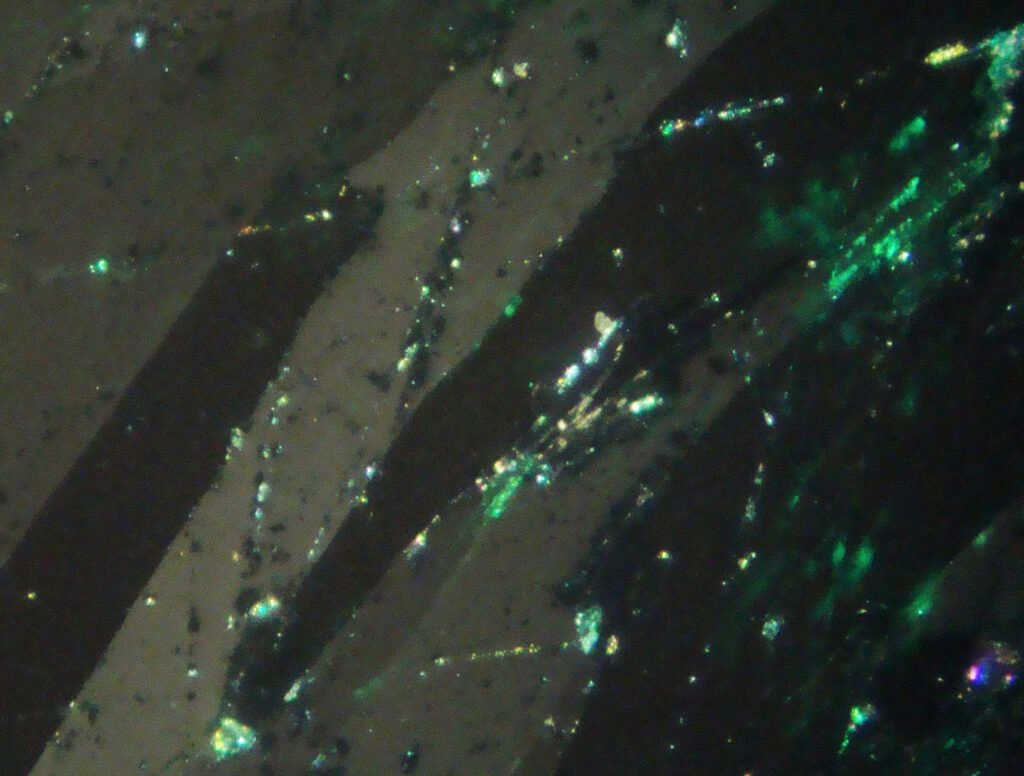
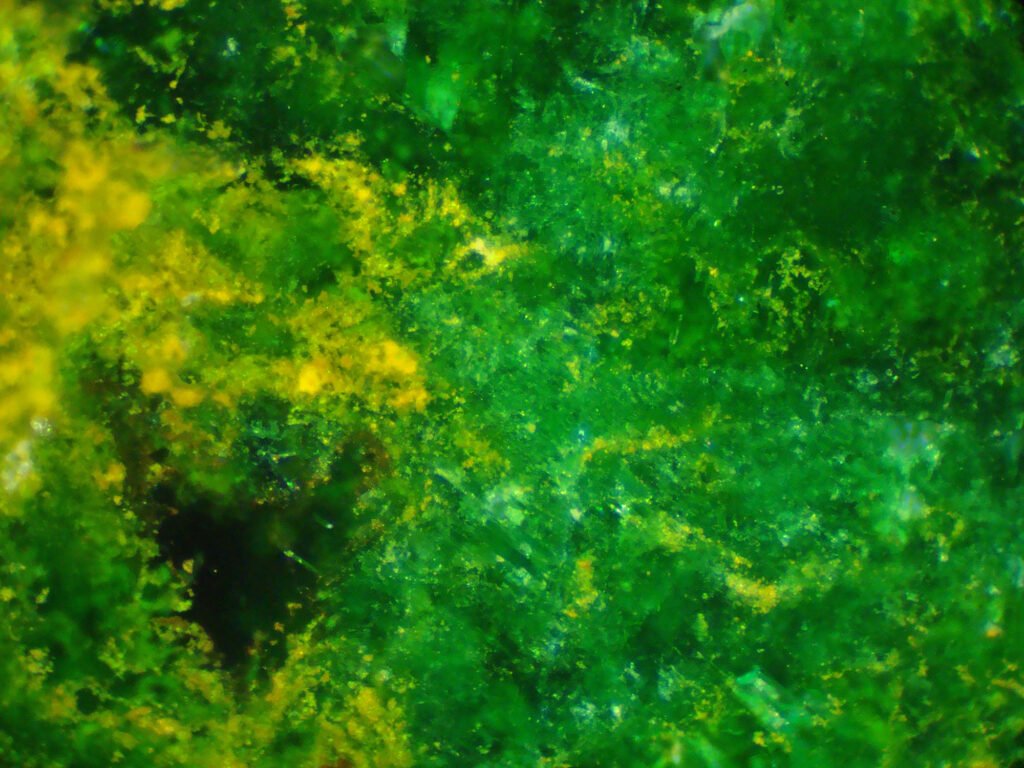
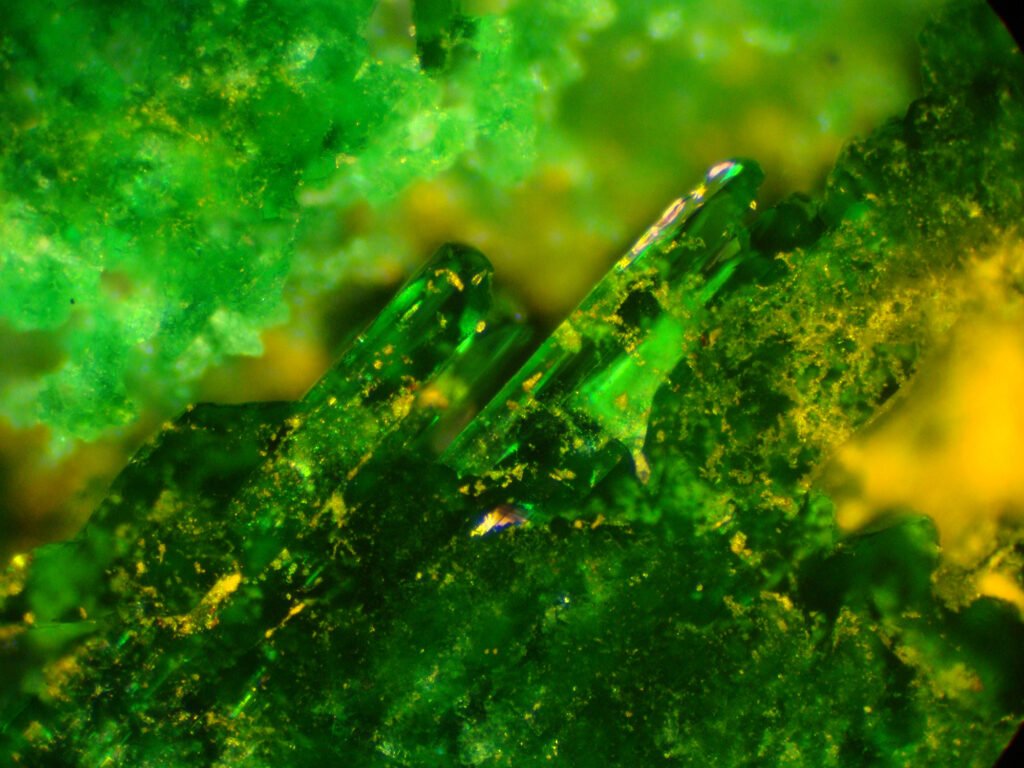
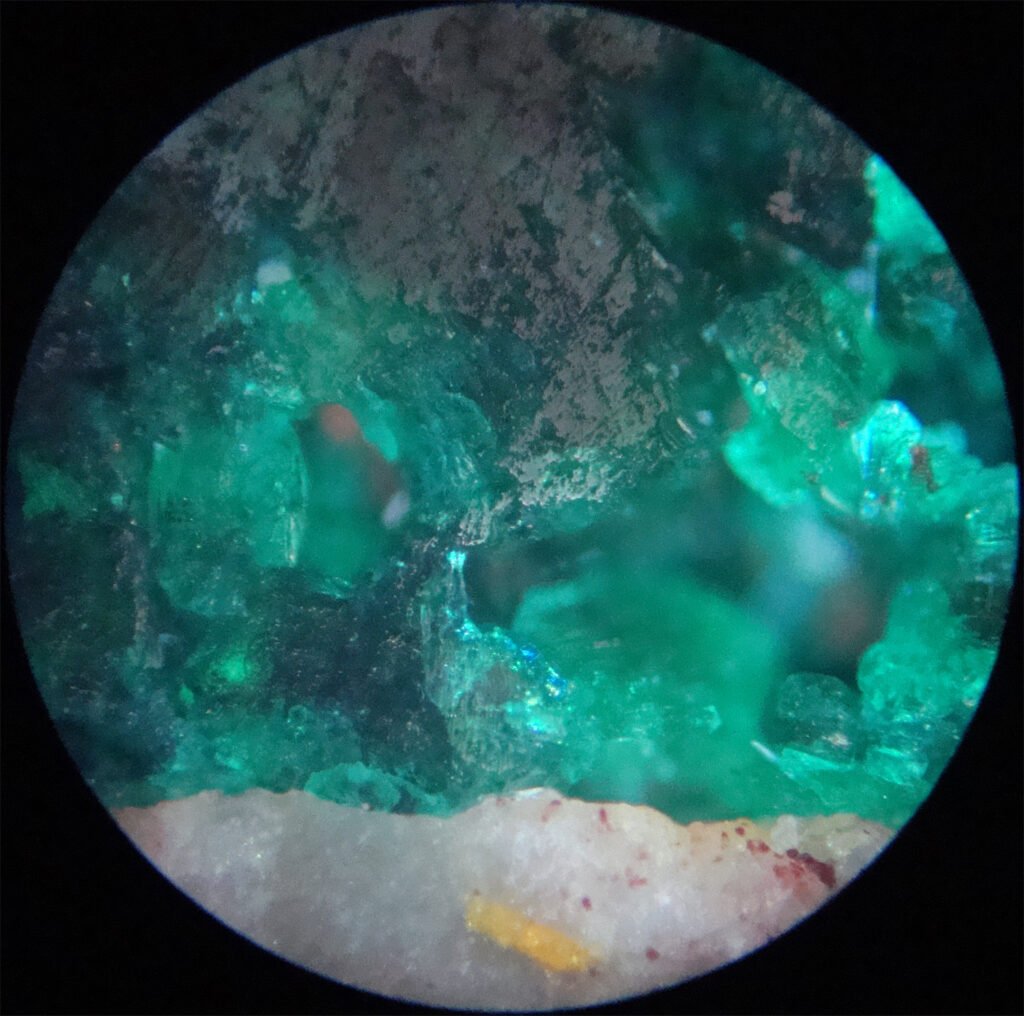
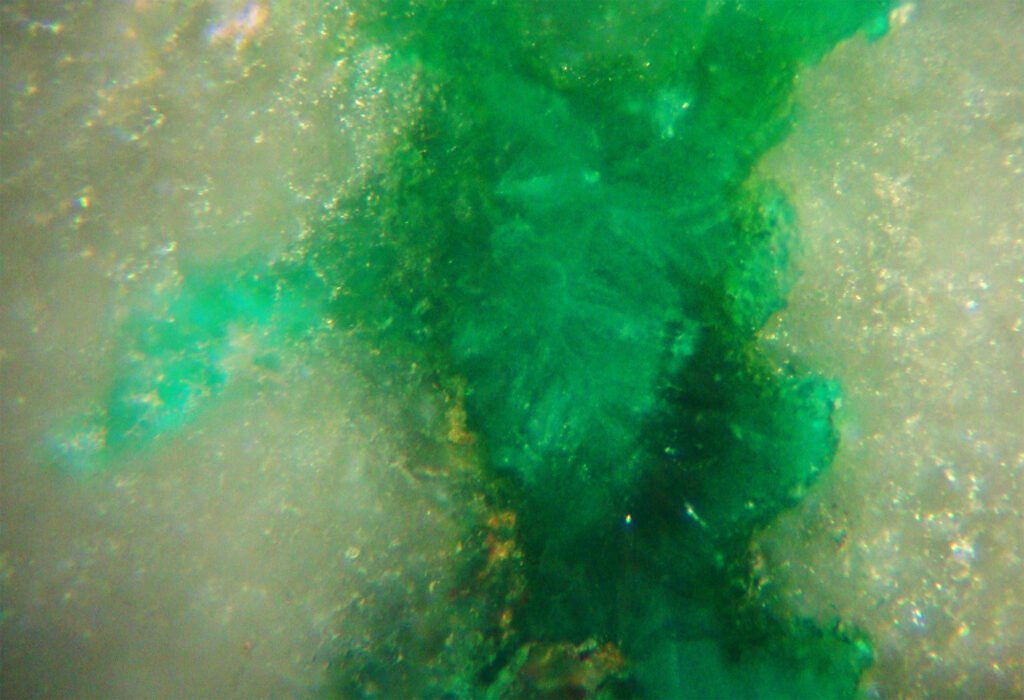
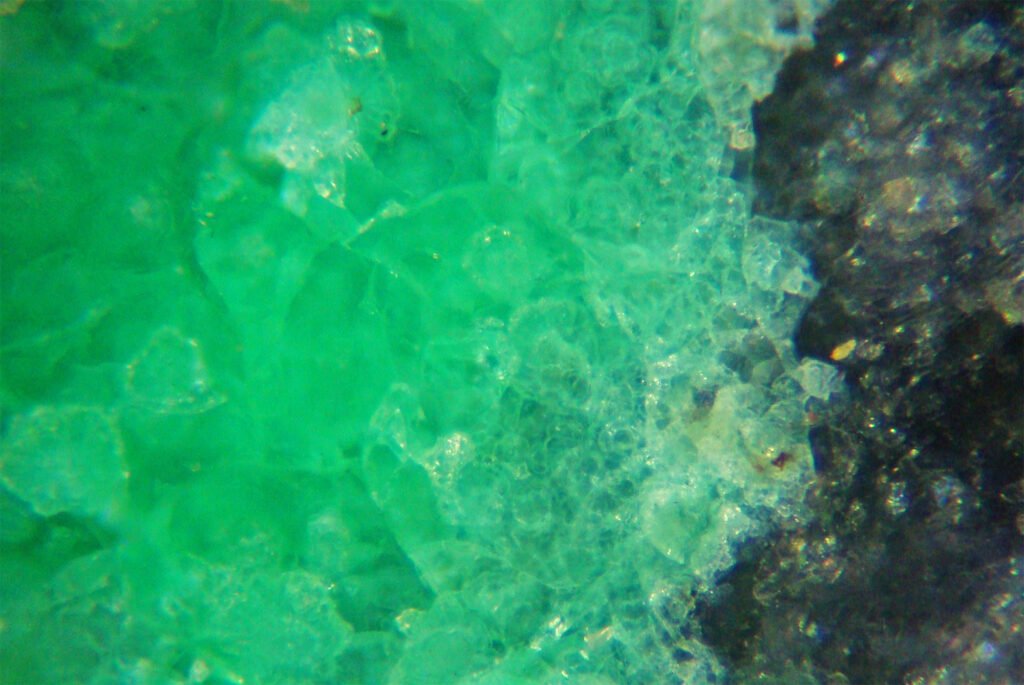
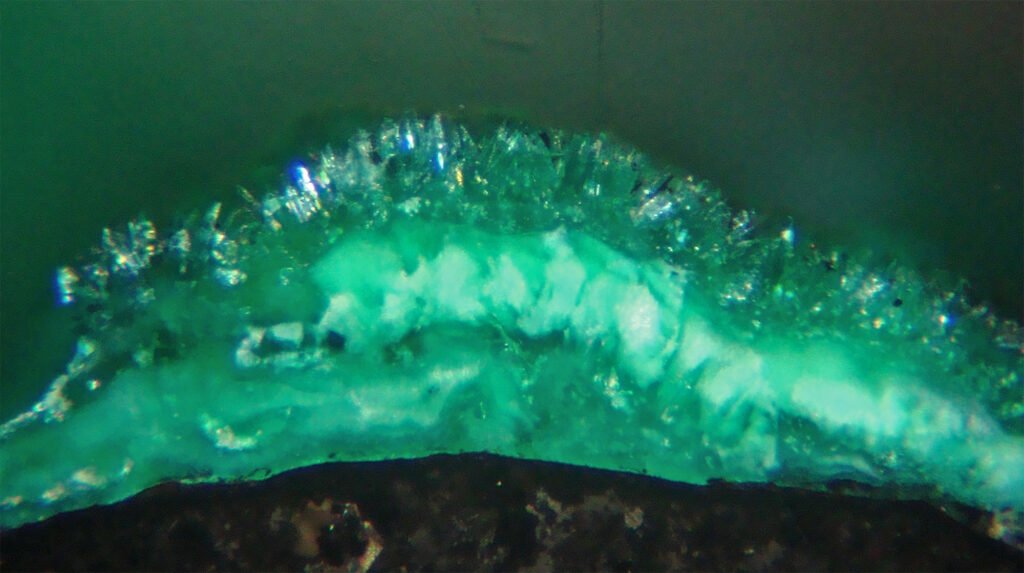
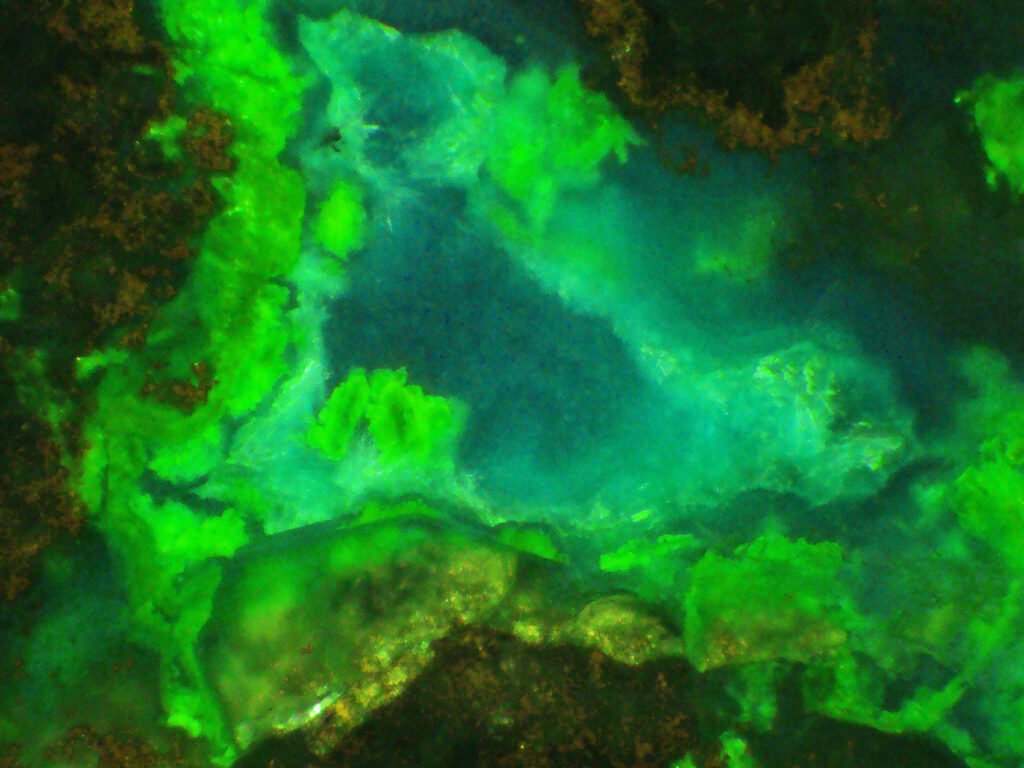
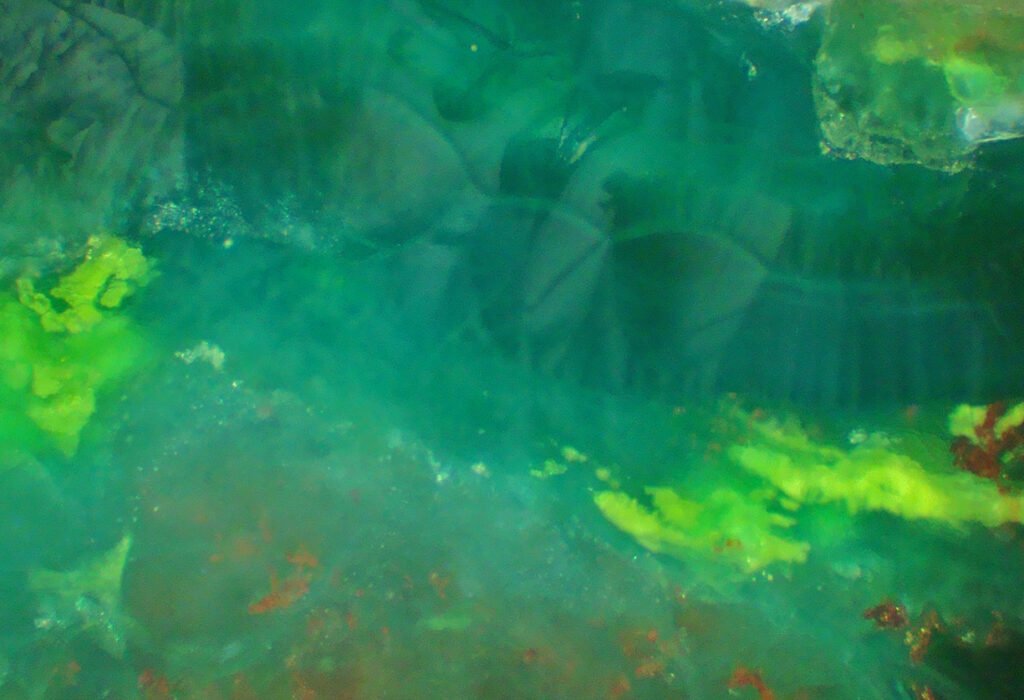
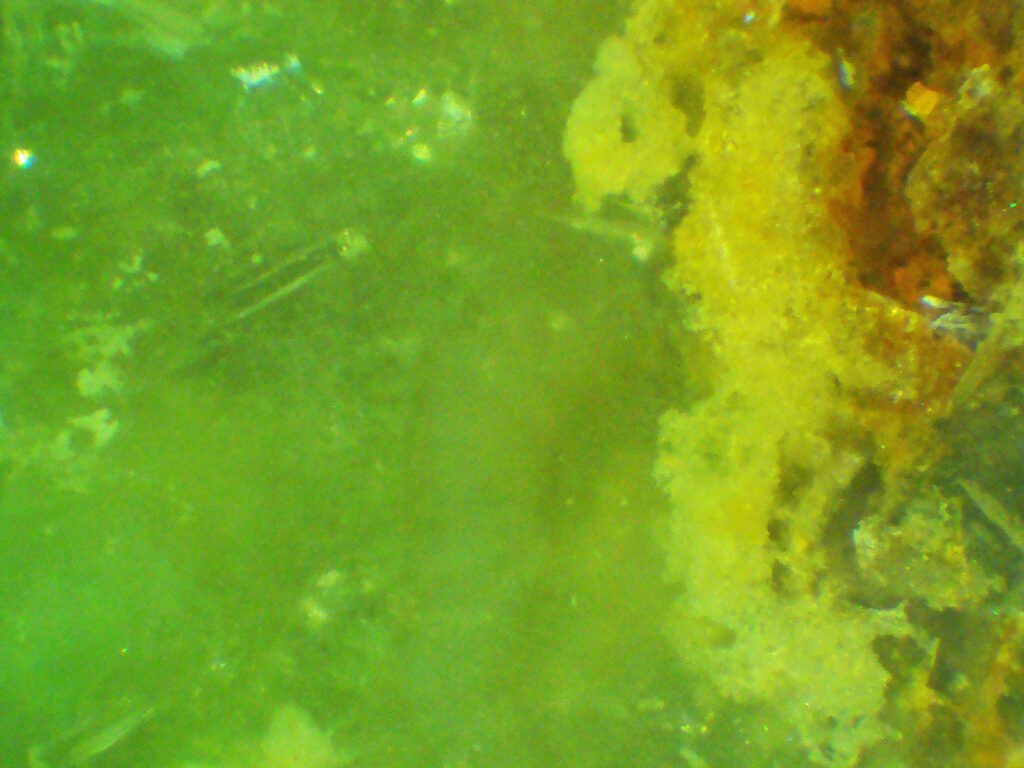
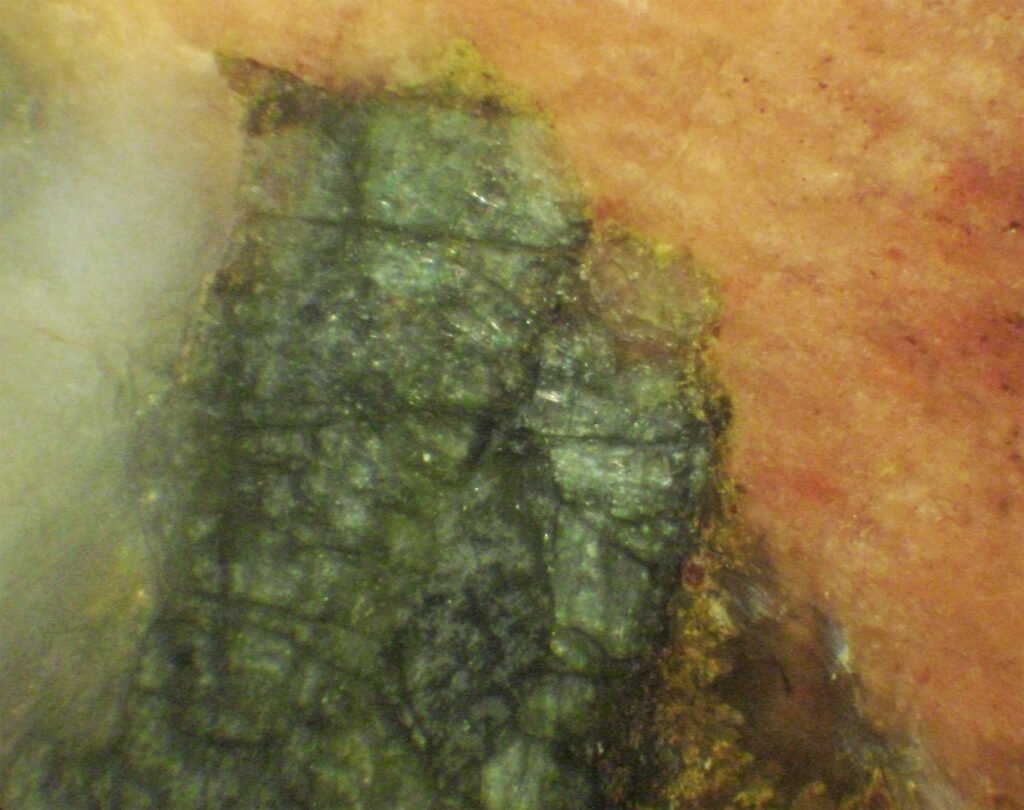
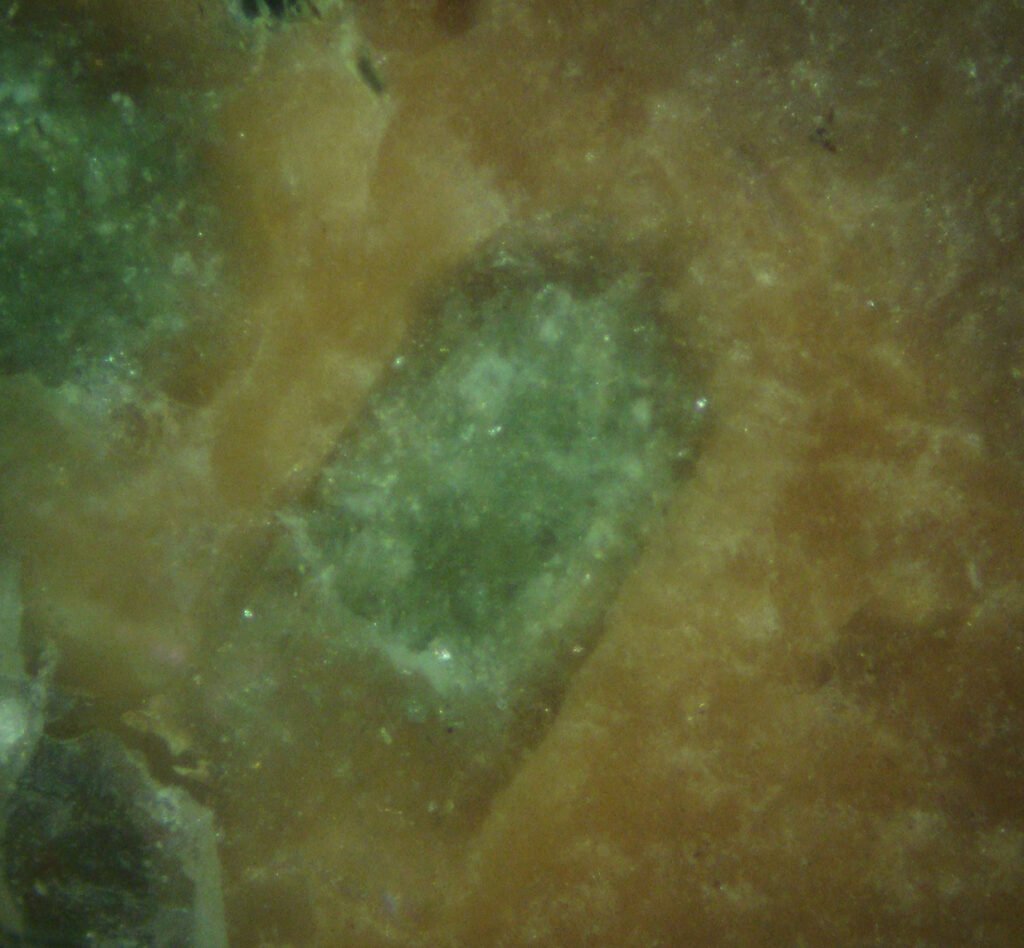
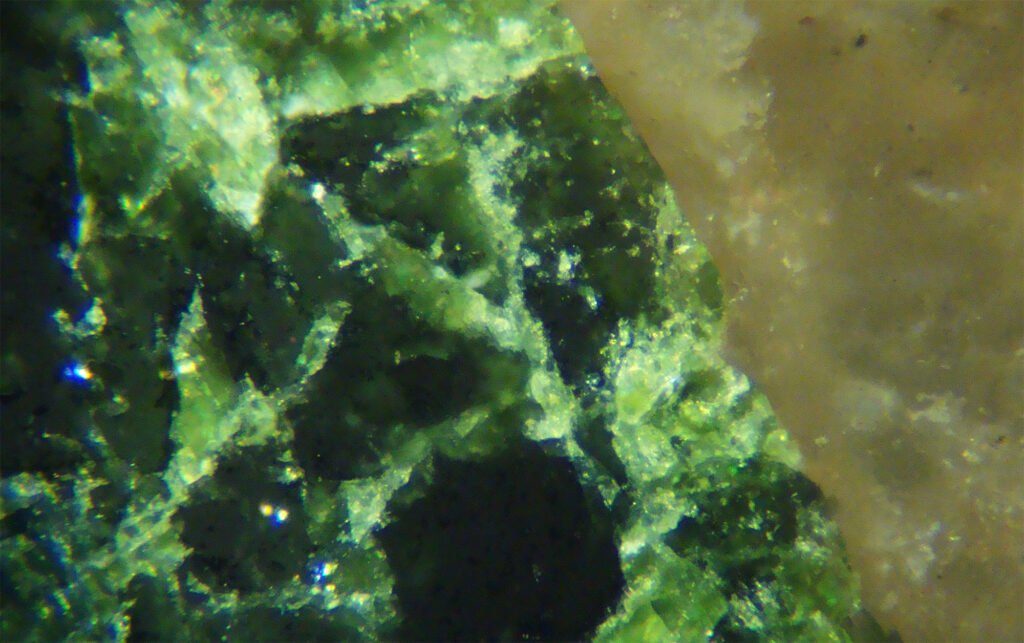
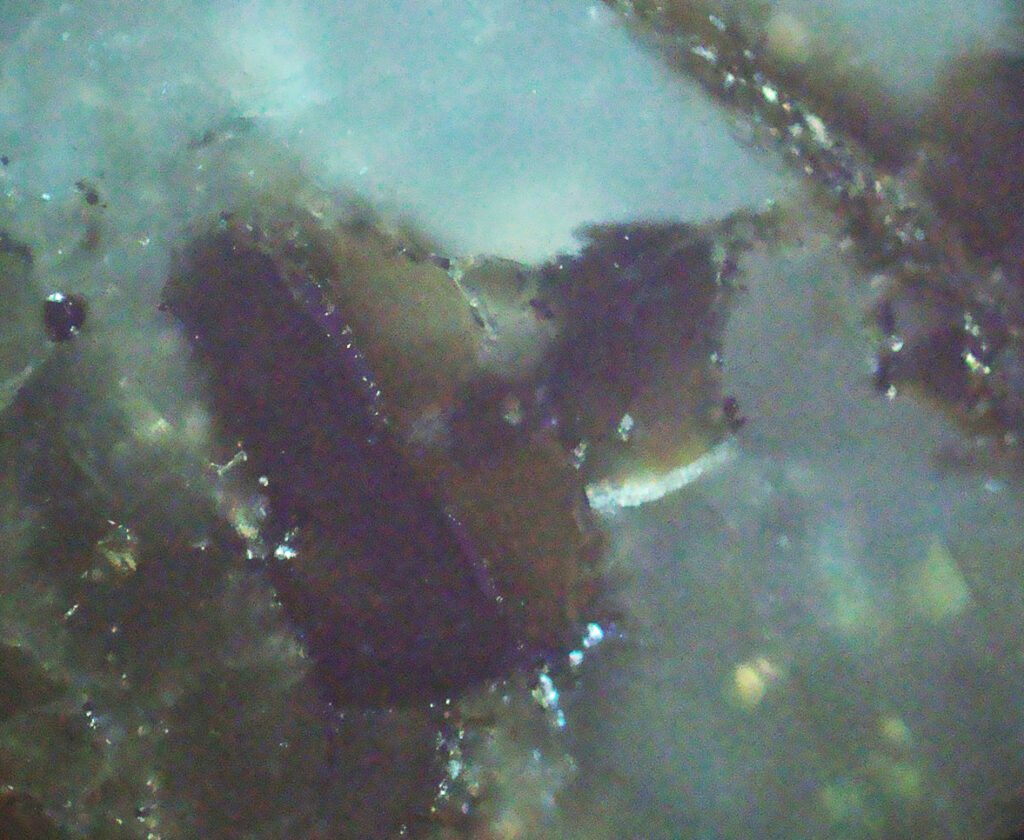
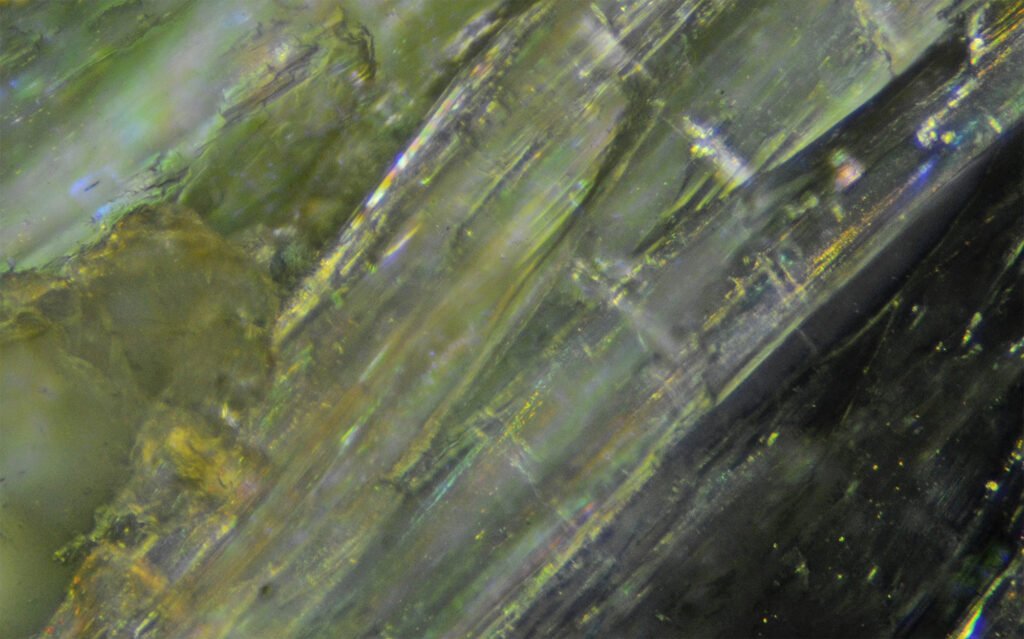
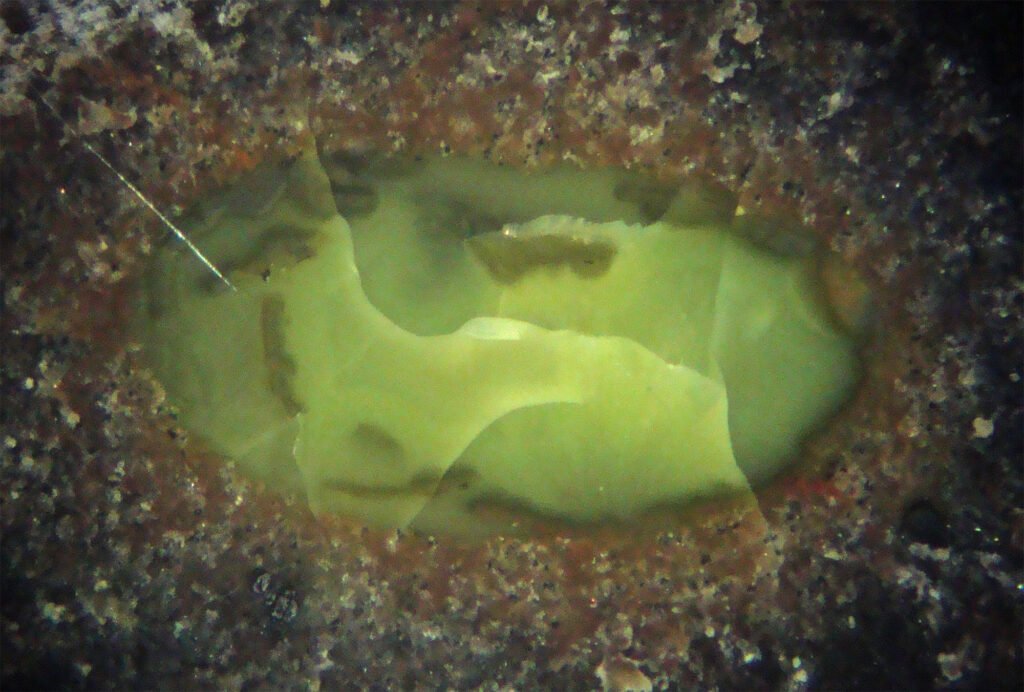
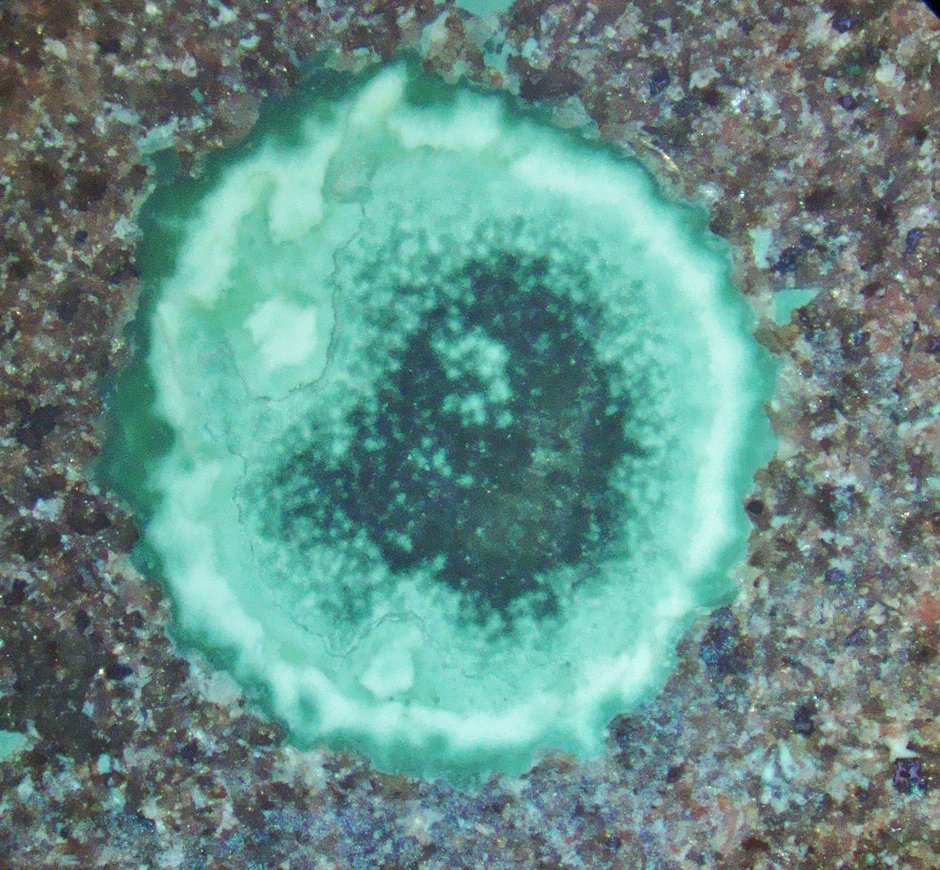
Usually the green color of the mineral can be seen with the unaided eye in the polished section.
There are at least 10 more or less common secondary copper minerals with green to greenish colors whose identification is very difficult to impossible both with Reflected Light and Transmitted Light.
Other analytical techniques must be used to identify them.
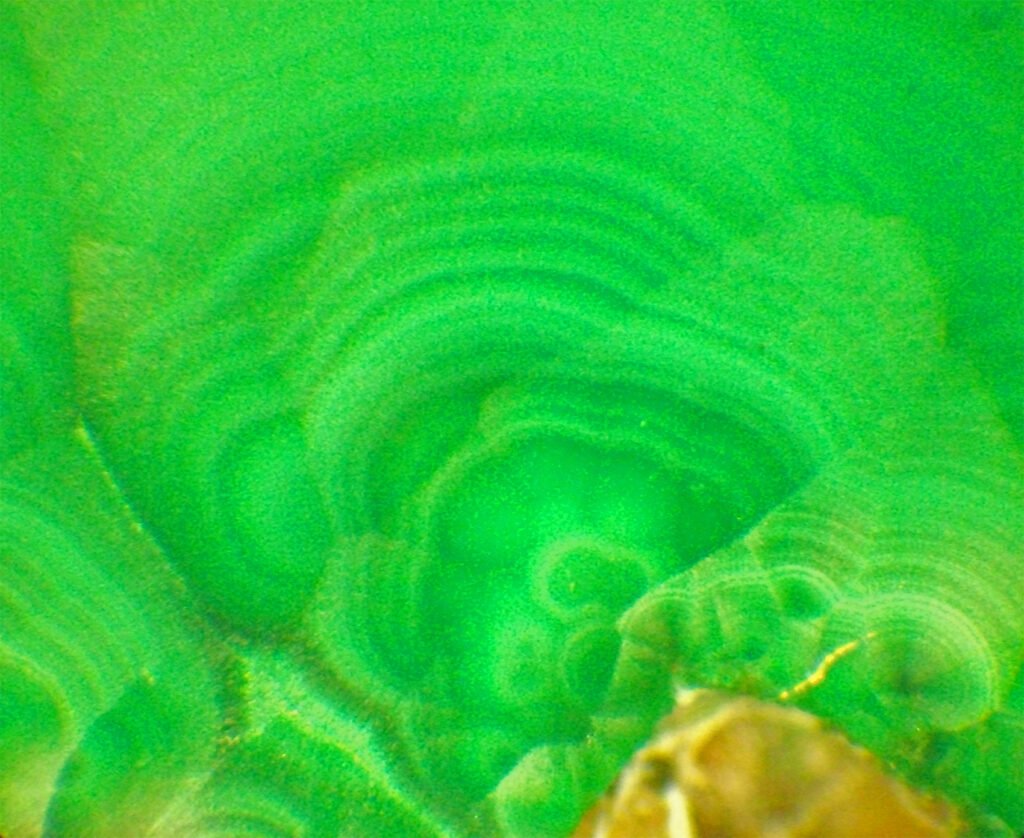
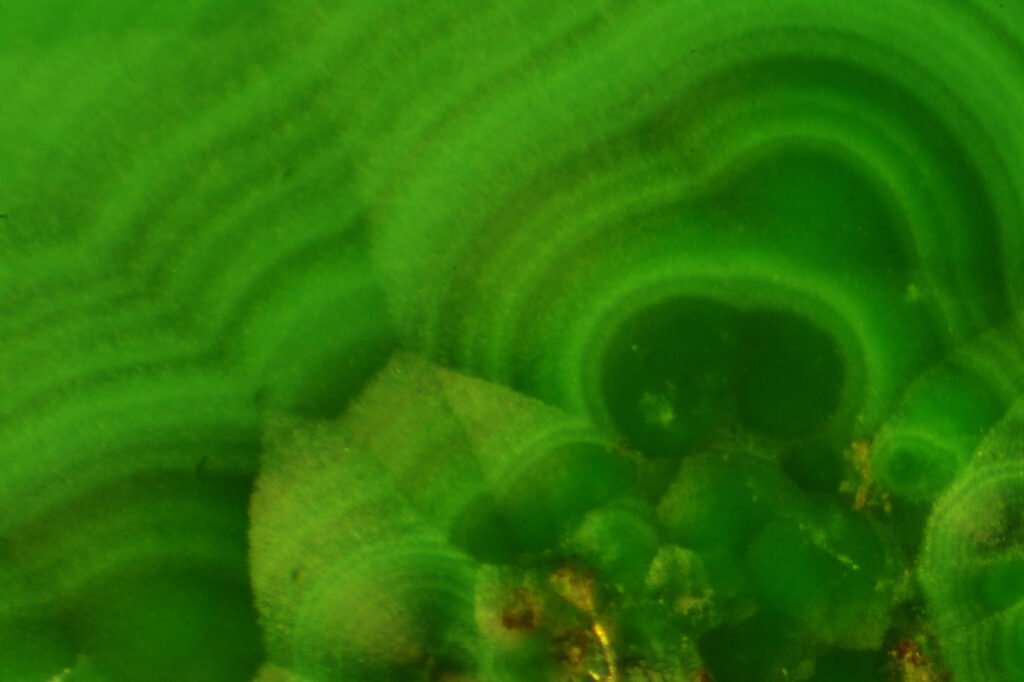
PPL: dark gray color, without pleochroism. Reflectivity of 6-8%, with distinct bireflectance. It forms banded aggregates like chalcedony or radial aggregates of long prismatic crystals. Shows strong effervescence with cold dilute hydrochloric acid.
XPL: Very strong anisotropy in gray, difficult to observe when in small crystals. Intense internal reflections in various shades of green. Most common secondary copper mineral.
Images: In XPL, green internal reflections in banded malachite.
PPL: white gray color, much lighter than gangue and lighter than other secondary Cu minerals. Higher reflectivity (8%?). The tiny size of the crystals makes it difficult to observe pleochroism and bireflectance. Typical habit as subparallel crystal crusts. Rare mineral.
XPL: intense reflections in green, but it is possible to observe a distinct anisotropy.
Images: in XPL, pseudomalachite crust with green reflections.
PPL: light gray color with a cream tone, much lighter than the gangue. No pleochroism. Low reflectivity, no bireflectance.
XPL: strong anisotropy for a brown tone, best seen with NC+2°. When rotating the stage, 2 positions of intense green reflections alternate with two positions where the brown color dominates.
Image: in XPL+2º, dioptase crystals with typical behavior.
PPL: gray-white color, much lighter than the gangue minerals, without pleochroism. Very low reflectivity, no bireflectance. Some green reflections present at PPL. Polishing grooves are persistent.
XPL: very strong anisotropy between light brown and dark brown, with bright green reflections on contacts and imperfections. The worse the polish, the more green reflections and the less visible the anisotropy.
Images: in XPL+2º, antlerite (shades of brown with green reflections).
.PPL: white gray without pleochroism. 10% reflectivity, above gangue minerals. No bireflectance. Tabular to granular habit. Typical copper mineral of Porphyry Copper Deposits.
XPL: weak anisotropy, hardly visible due to the light generalized green reflections that cover the entire aggregate.
Images: in XPL, atacamite (green) and unidentified mineral (yellow).
PPL: gray white color, much lighter than the gangue. No pleochroism. Low reflectivity (4-6%?), no bireflectance. Many polishing grooves, as it is the least hard (D=3) of the secondary Cu minerals. Secondary copper mineral of arid and saline environments.
PL: Distinct brown and green anisotropy, weaker than antlerite and dioptase. Generalized green reflections; tend to black.
Images: in XPL+2º, pseudomalachite (green to brown grains).
.PPL: gray white color, much lighter than the gangue. No pleochroism. Low reflectivity (4-6%?), no bireflectance. Varying habits, it can form acicular to fibrous crystal aggregates. Very rare secondary copper phosphate.
XPL: anisotropy clearly visible in light gray, but internal reflections in green are widespread. Small crystals make analysis difficult.
Images: in XPL, libethenite (green), quartz (white).
A copper sulphate with colors between green and dark blue, like chrysocolla.
PPL: dark gray color, as dark as the gangue. No pleochroism. Very low reflectivity, no bireflectance. A slight shade of the same color as the internal reflections in XPL is visible.
XPL: no anisotropy. Intense widespread internal reflections in light green or bluish green or light blue or dark blue.
Images: in XPL, chalcantite (light green), gangue (dark reflections).
Rather common secondary copper mineral, even in old slags.
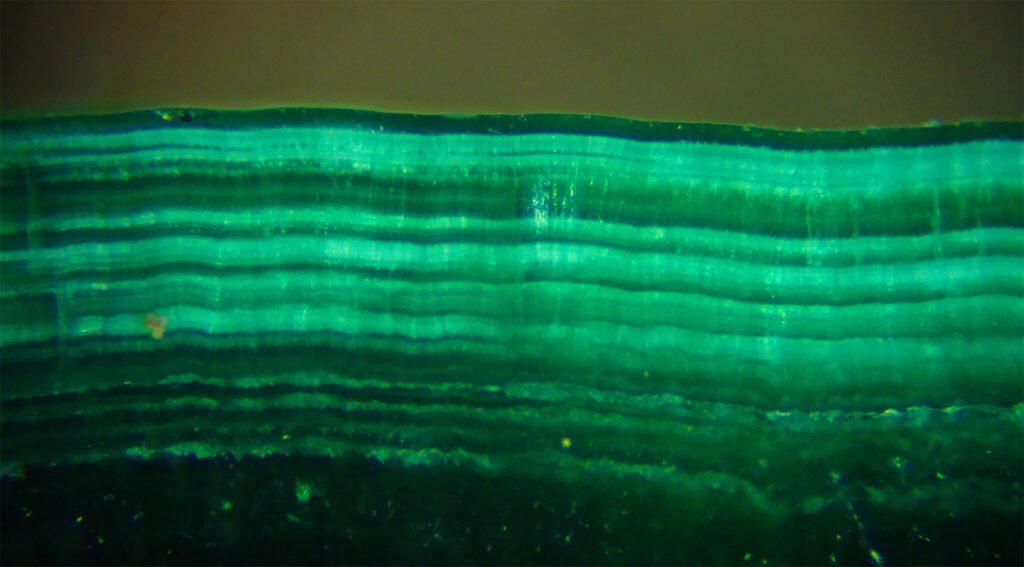
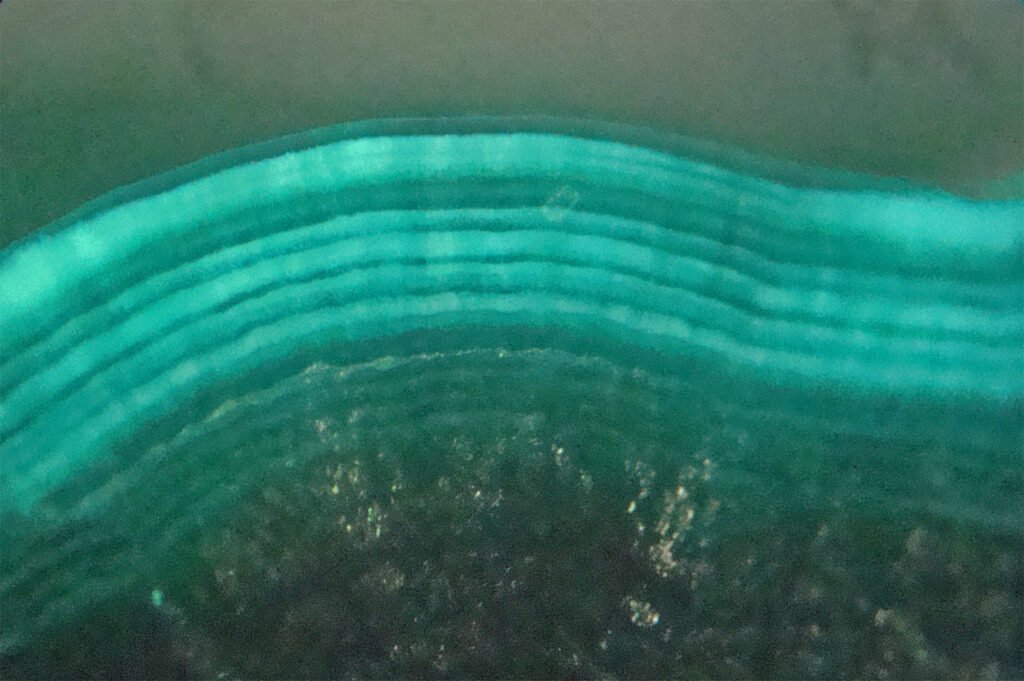
PPL: dark gray color, as dark as the gangue. No pleochroism. Very low reflectivity (<10%), with light bireflectance. It associates with other copper minerals. Acicular habit is very typical
XPL: weak anisotropy. Internal reflections in medium green.
Images: in XPL, brochantite (green, acicular crystal band, top layer), another copper mineral (light green), rock (dark).
PPL: very dark gray color and extremely low reflectivity. No pleochroism and no bireflectance. It never forms crystals visible under the microscope, but always masses with complex structures. Very common secondary copper mineral with colors between green and blue.
XPL: green, blue or dark internal reflections. Very common is an intense sky blue, but it does not reach the dark blue of azurite.
Images: in XPL, chrysocolla (blue), unidentified mineral (light green).
PPL: dark greenish gray color, without pleochroism. Very low reflectivity (4%), no bireflectance. Secondary lead mineral of lead ores with many different colors, green is one of them.
XPL: no anisotropy. Generalized internal reflections are possible in various shades of green, as well as in other colors and even colorless.
Images: in XPL, pyromorphite (green), gangue (yellowish).
PPL: dark gray color, without pleochroism. Very low reflectivity, no bireflectance. Well-developed prismatic habit may occur. Very common rock-forming silicate.
XPL: anisotropy can occur but is difficult to see. Widespread internal reflections in pale grayish green, may be multicolored.
Image: in XPL, epidote (green), orthoclase (pink), quartz (white).
PPL: dark gray reflection color, slightly lighter than orthoclase. No pleochroism. Low reflectivity, no bireflectance. Rock-forming clinopyroxene, less abundant than augite.
XPL: generalized internal reflections in various shades of green, very luminous, even so it is possible to perceive a distinct anisotropy.
Images: in XPL, diopside (green) and orthoclase (creamy-pinkish).
PPL: Dark gray reflection color, slightly lighter than quartz. No pleochroism. Low reflectivity (~4%), no bireflectance. Long prismatic habit is typical, with the characteristic cleavage of amphiboles. Common rock-forming amphibole, usually with long-prismatic habit.
XPL: no anisotropy. Light green, luminous, generalized internal reflections. They can be multicolored. Basal sections show symmetrical extinction in relation to their rhombic shape and cleavages.
Images: in XPL, actinolite prisms with green reflections.
PPL: dark greenish gray color, without pleochroism. Low reflectivity, similar to the gangue minerals. No bireflectance. Massive appearance, with many polishing grooves. Clay mineral common in volcanic rocks, filling vesicles and matrix.
XPL: no anisotropy. Widespread internal reflections in various shades in light green that do not change color when rotating the stage.
Images: in XPL, basalt vesicles filled with celadonite (green).
Minerals with widespread internal green reflections; may be bluish.