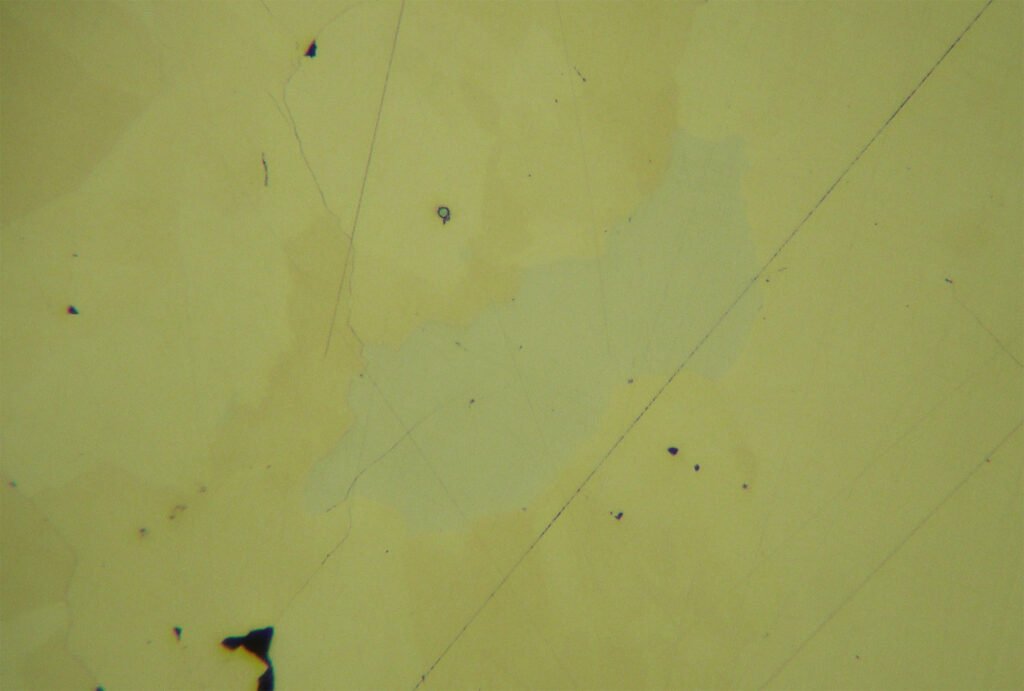
MAUCHERITE
Maucherite – Ni11As8 – is a very rare arsenide found in Co-Ni-As-Ag sulfide ores.
It may contain Co, Fe, Sb, Cu, and S.
1. Characteristics
Crystal system: Tetragonal trapezohedral.
Color: Reddish silvery-white, tarnishing to a darker reddish-gray (like copper).
Habit: Tabular // a (001). Also pyramidal; crystals up to 1 mm.
Massive, granular, rarely radially fibrous.
Cleavage: No. Striations on the faces.
Tenacity: No information available.
Twinning: In {203} and {106}.
Fracture: Irregular.
Mohs Hardness: 5
Parting: No.
Streak: Dark gray.
Lustre: Metallic.
Diaphaneity: Opaque.
Density (g/cm³): 7.83
2. Geology and Deposits
Maucherite almost always occurs in Co-Ni-As-Ag-type hydrothermal veins, associated with other Ni arsenides and sulfides.
In some cases, it originates from the magmatic differentiation of chromite and nickeline.
3. Mineral Associations
It is associated with common gangue minerals such as calcite and barite, and with common sulfides such as galena and sphalerite.
It evidently occurs alongside other Ni minerals such as nickeline, pentlandite, argentopentlandite, breithauptite, millerite, gersdorffite, gaspéite, skutterudite, safflorite, rammelsbergite, pararammelsbergite, and parkerite.
Typical minerals in the paragenesis include various Ag minerals (native silver, acanthite, pyrargyrite-proustite, dyscrasite), Co minerals (cobaltite, langisite, linnaeite, siegenite), and Cu minerals (chalcopyrite, cubanite, valleriite, algodonite).
It is also found with gold, chromite, pyrrhotite, uraninite, garnet (uvarovite), and pyroxene.
Associated secondary minerals include goethite and annabergite.
4. Transmitted Light Microscopy
Not applicable, as maucherite is completely opaque.
5. Reflected Light Microscopy
Sample preparation: Maucherite takes an excellent polish, and the polished surfaces remain in good condition (without tarnishing) for a long time. In contrast, fractured surfaces tarnish rapidly. The polishing hardness of maucherite is moderate: greater than that of chalcopyrite and sphalerite, approximately the same as that of nickeline, and lower than that of löllingite, rammelsbergite, and safflorite.
PLANE POLARIZED LIGHT – PPL
Reflection color: White to light gray with a faint pinkish tint. Without other minerals for comparison, the color impression is white.
Compared to the color of nickeline, maucherite is light gray and slightly darker, with a violet hue.
Compared to the color of cobaltite, the color of maucherite is very similar.
Compared to the color of chalcopyrite, maucherite is grayish with a violet tint.
Compared to the color of löllingite, maucherite is distinctly brownish-gray.
Compared to the color of breithauptite, maucherite is bluish-gray.
Pleochroism: No.
Reflectivity: 50.8 to 52.95%
Bireflectance: Slight.
CROSSED POLARIZED LIGHT – XPL
Isotropy / Anisotropy: Weakly anisotropic; it may appear pseudo-isotropic. Anisotropy colors range from dark olive green to brown and violet.
Internal reflections: No.
May be confused with: other Ni minerals, but the association with nickeline is highly characteristic. Maucherite is easily overlooked when alongside nickeline. Diagnostic features include the absence of pleochroism (compared to other Ni minerals in the paragenesis) and weak or absent anisotropy (associated minerals exhibit stronger anisotropy).
Nickeline displays strong pleochroism and much stronger anisotropy.
Skutterudite is less pink and slightly harder.
Breithauptite is very similar.
Rammelsbergite is harder, whiter, and shows stronger anisotropy.
Safflorite is harder, whiter, and more anisotropic.
Cobaltite is much harder.
General Characteristics:
Grain shape: Maucherite is generally tabular, occurring in aggregates of sub-parallel to radial crystals. The crystals can be pyramidal and are always very small. Euhedral crystals are very common. It may occur in massive or granular forms. Anhedral aggregates with frequent, very fine lamellar twinning are also common. Unlike rammelsbergite, maucherite can exhibit a fibrous habit, with fibers arranged in radial groups.
Cleavage is absent.
Zoning is evidenced by lamellar striations in different directions.
Lamellar twinning is common, but the lamellae are very fine and difficult to observe.
Replacements 1: Maucherite replaces gersdorffite and nickeline.
Replacements 2: Maucherite can be replaced by niccolite, cubanite, chalcopyrite, and native silver. Maucherite crystals with preserved cores and rims replaced by nickeline may occur.
Intergrowths occur with nickeline; maucherite may also be enclosed by it. Replacement intergrowths can be of two types: with nickeline (replacing gersdorffite) or with pyrrhotite (replacing Fe-bearing gersdorffite).
Inclusions of gold and siegenite sometimes occur.
Rims of maucherite may form around euhedral and subhedral gersdorffite crystals.