RAMMELSBERGITE
Rammelsbergite – NiAs2 – is an arsenide with a more restricted distribution that is a component of Co-Ni-As-S ores.
It is classified within the Löllingite Group (FeAs2), with which it forms a solid solution. It is isostructural with marcasite and is trimorphous with pararammelsbergite (the low-temperature polymorph) and krutovite.
Common impurities include Fe, S, Co, Se, and Sb. The crystals are always minute (max. 5 mm).
1. Characteristics
Crystal system: Orthorhombic holohedral.
Color: Tin-white with a pale pinkish hue. Tarnishes rapidly to iridescent colors.
Habit: Generally massive, granular, fibrous to radiating. Rarely prismatic crystals elongated along [010].
Cleavage: {101} distinct.
Tenacity: Brittle.
Twinning: Lamellar twinning on {101}.
Fracture: Irregular.
Mohs Hardness: 5.5 – 6
Parting: No.
Streak: Grayish-black.
Lustre: Strong metallic.
Diaphaneity: Opaque.
Density (g/cm³): 7.0 – 7.2
2. Geology and Deposits
Rammelsbergite is typical of hydrothermal Co-Ni-Ag-type ore veins formed at moderate temperatures.
3. Mineral Associations
It occurs with common gangue minerals such as quartz, fluorite, barite, and carbonates (calcite, dolomite, ankerite, cerussite).
It occurs obviously with other Ni and Co minerals such as skutterudite, safflorite, löllingite, niccolite, gersdorffite, annabergite, pecoraite, (Ni)-skutterudite, and pararammelsbergite.
It also occurs with native bismuth, native silver, galena, algodonite, domeykite, and “mohawkite” (a mixture of native copper, domeykite, algodonite, and paxite).
The associated radioactive minerals—uraninite and pitchblende—require special precautions!
4. Transmitted Light Microscopy
Not applicable, as rammelsbergite is completely opaque.
5. Reflected Light Microscopy
Sample preparation: Rammelsbergite is easy to polish, yielding a perfect polish. Its polishing hardness is similar to that of skutterudite and nickeline. It is slightly lower than the hardness of safflorite and löllingite, and significantly lower than that of arsenopyrite, cobaltite, and glaucodot.
PLANE POLARIZED LIGHT – PPL
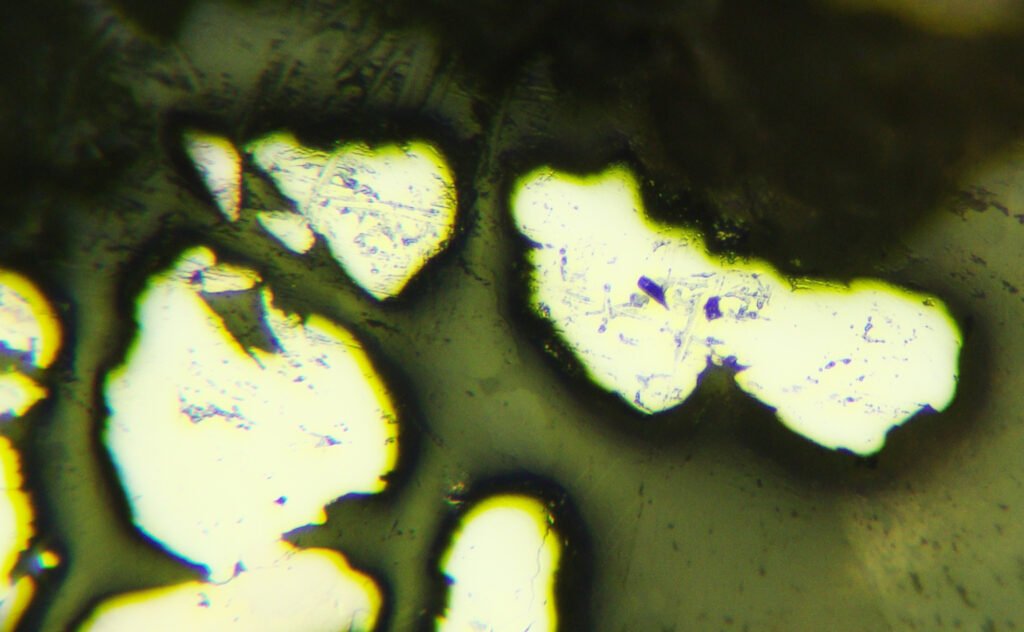
Reflection color: Pure white, much whiter than other Ni-Co-Fe arsenides.
Compared to the color of maucherite, the color of rammelsbergite is pure white, without a pinkish tint.
Compared to the color of safflorite, the color of rammelsbergite is yellowish.
Compared to the color of native bismuth, the color of rammelsbergite is white.
Compared to the color of arsenopyrite, the color of rammelsbergite is white and lacks the creamy tint of arsenopyrite.
Compared to the color of galena, the color of rammelsbergite is white. The color of galena appears light gray.
Pleochroism: Slight, ranging from yellowish-white to bluish-white.
Reflectivity: 55.8 to 58%
Bireflectance: No.
CROSSED POLARIZED LIGHT – XPL
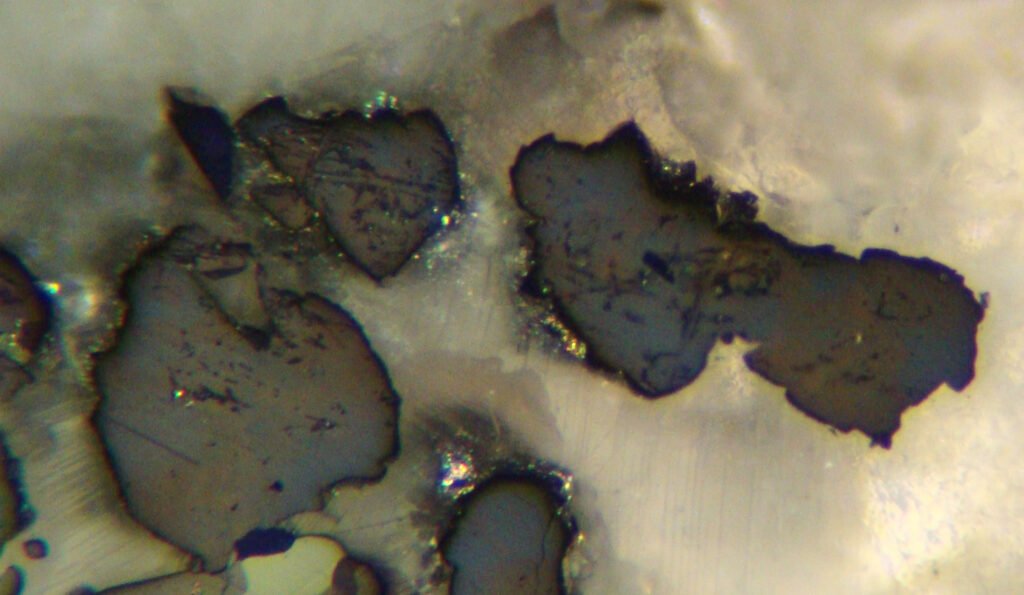
Isotropy / Anisotropy: Strong, very typical anisotropy, though weaker than that of safflorite and löllingite: colors ranging from brown, pink, and greenish to various shades of blue.
Internal reflections: No.
May be confused with: It is difficult to distinguish the “white” minerals of the Löllingite Group from one another. Twinning is characteristic of rammelsbergite.
Linnaeite, skutterudite, and gersdorffite—which also appear white under crossed polars—are isotropic.
Arsenopyrite is significantly harder.
Löllingite is less hard and exhibits stronger anisotropy.
Safflorite generally displays strong zoning and a characteristic habit, yet distinguishing it from rammelsbergite can be very difficult. Its pleochroism and anisotropy are stronger than those of rammelsbergite.
Pararammelsbergite does not exhibit polysynthetic twinning.
General Characteristics:
Grain shape: generally occurs as aggregates or compact, fine-grained mosaics of interlocking grains. When tending toward an idiomorphic habit, it forms small rectangular crystals arranged in radial bundles. Skeletal crystals may occur.
Textures, spherulitic and radial, composed of fibrous or tabular crystals, are very common.
Cleavage is rarely visible.
Twinning is almost always present, forming well-defined lamellae; these lamellae may be further subdivided into even finer lamellae. Simple twins may predominate.
Zoning is observed only after chemical etching, usually at grain margins.
Intergrowths with nickeline (concentric) and with minerals of the skutterudite group occur.
Pseudomorphs of rammelsbergite after native silver—including silver with a dendritic or “wire” habit—are possible and can be perfect.
Coatings around dendritic silver and bismuth crystals may occur.
Replacements 1: rammelsbergite can replace nickeline, pitchblende, and Ni-skutterudite.
Replacements 2: Rammelsbergite can be replaced by nickeline, safflorite, native arsenic, proustite, and gersdorffite.