5. Reflected Light Microscopy
Sample preparation: Enargite takes a good polish. In coarse-grained aggregates or in masses derived from famatinite, fractures and pores are difficult to eliminate. Its polishing hardness is medium—higher than that of bornite, chalcocite, chalcopyrite, and galena; equivalent to or greater than that of luzonite and tennantite; and slightly lower than that of sphalerite.
PLANE POLARIZED LIGHT – PPL
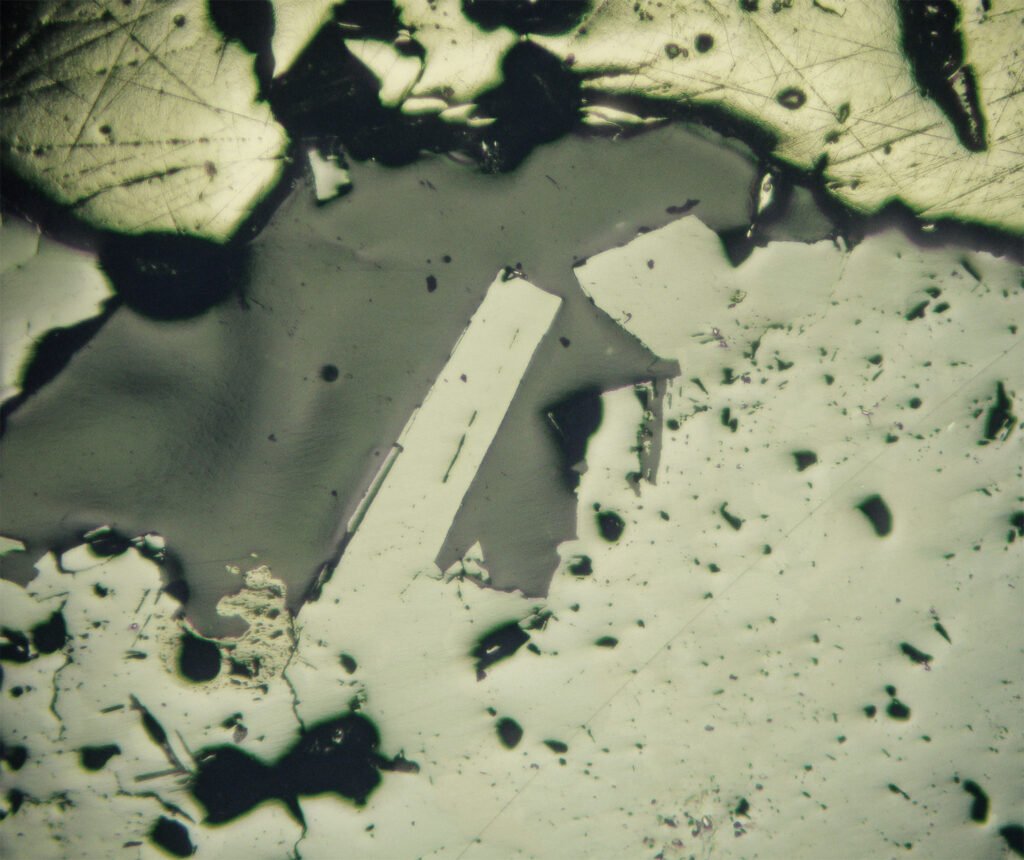
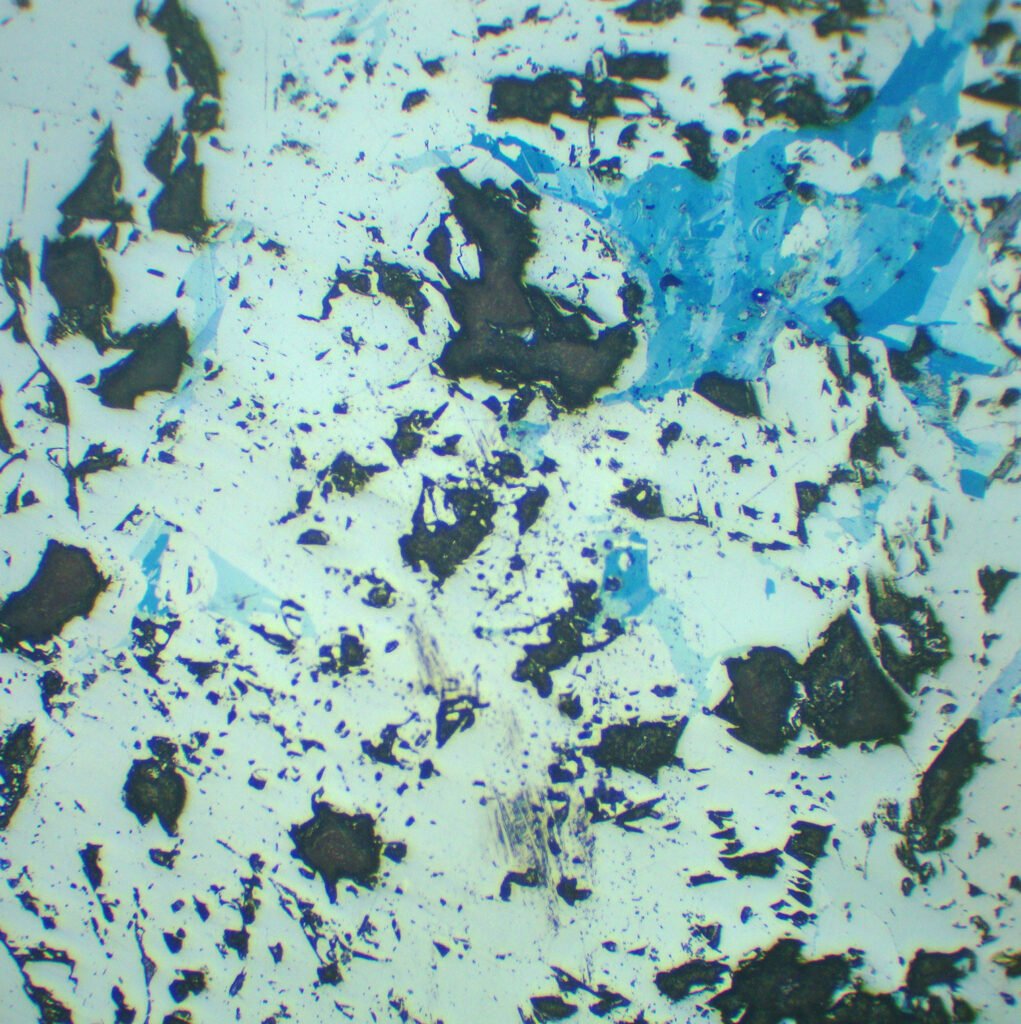
Reflection color: Pinkish-gray to light brown with a slight pinkish tint; it can appear pinkish-gray. The color impression depends heavily on the colors of neighboring minerals.
Compared to bornite, enargite’s color is whiter—specifically, pinkish-white.
Compared to galena, enargite’s color is grayish-brown.
Compared to luzonite, enargite’s color is darker, less brown, and less yellow.
Compared to famatinite, enargite’s color is grayish-blue; it is very similar but slightly darker.
Compared to tennantite, enargite’s color is a darker pink.
Compared to chalcopyrite, enargite’s color is white.
Compared to krennerite, enargite’s color is very similar, but its reflectivity is much lower.
Pleochroism: Weak; ranges from violet or pinkish-gray to bluish-gray or grayish-violet.
It should be observed at intergranular contacts.
It may vary among enargite samples from different occurrences.
Reflectivity: 25.48 – 26.78%.
Bireflectance: Weak.
CROSSED POLARIZED LIGHT – XPL
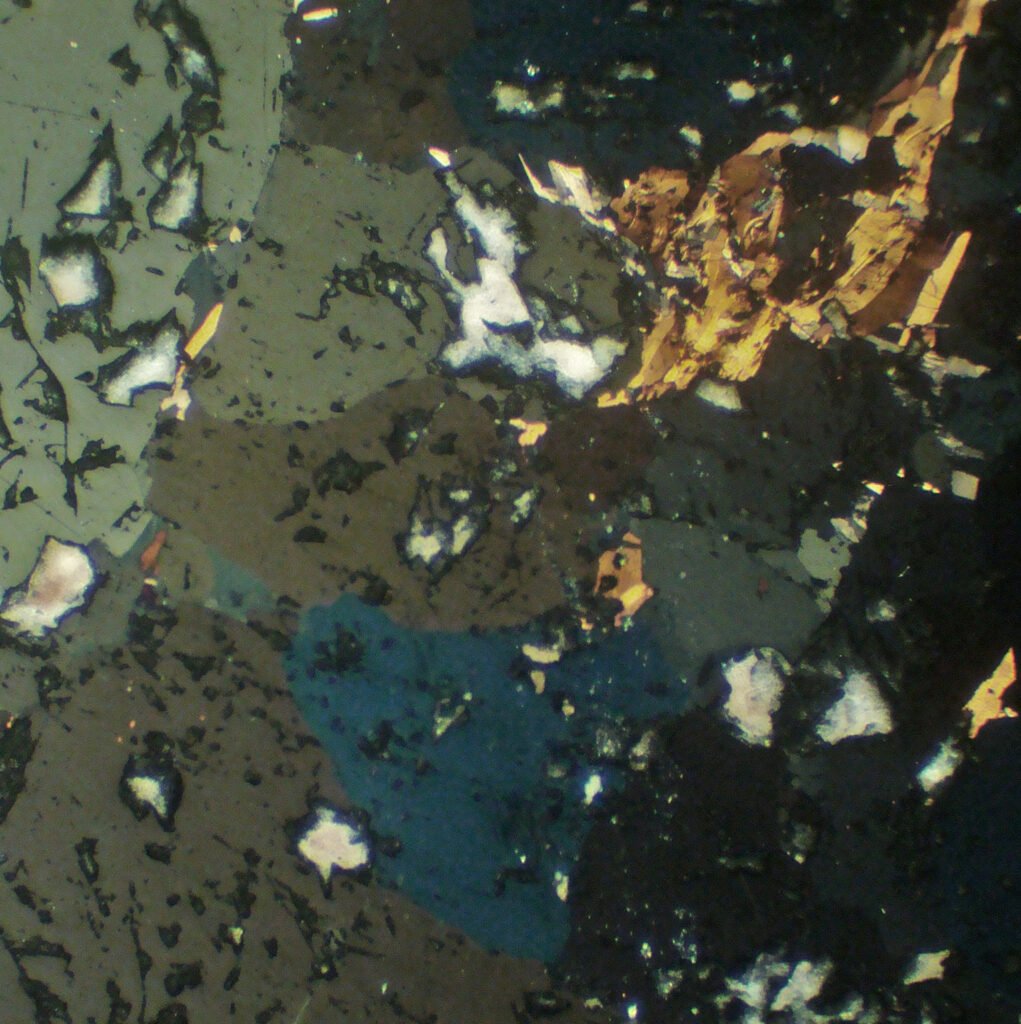
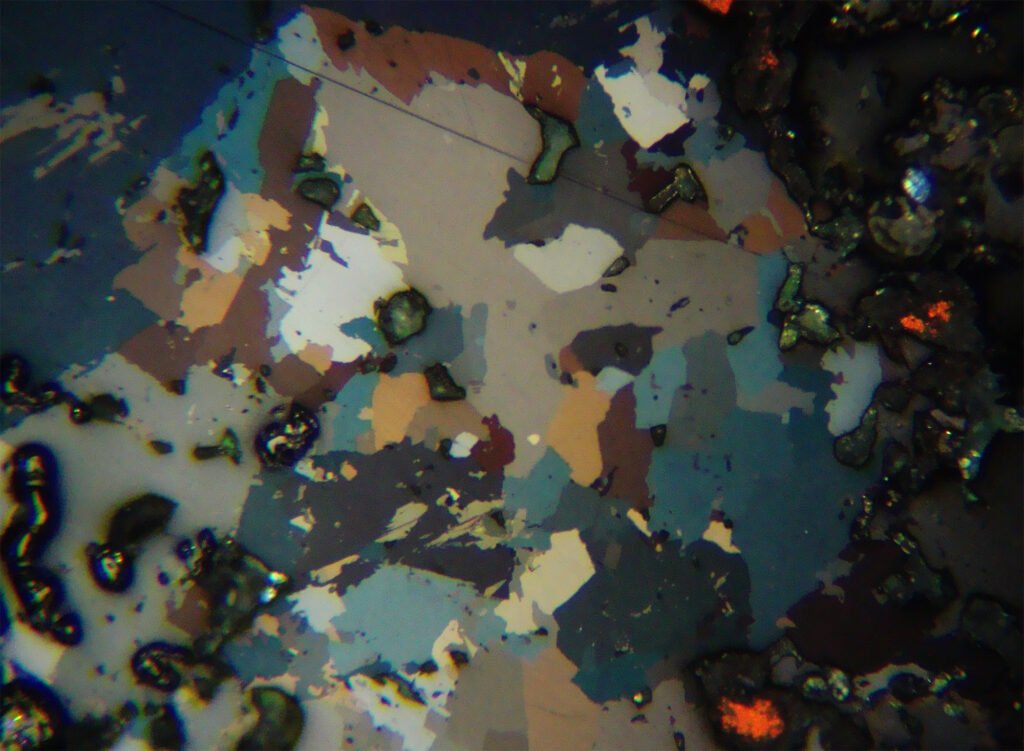
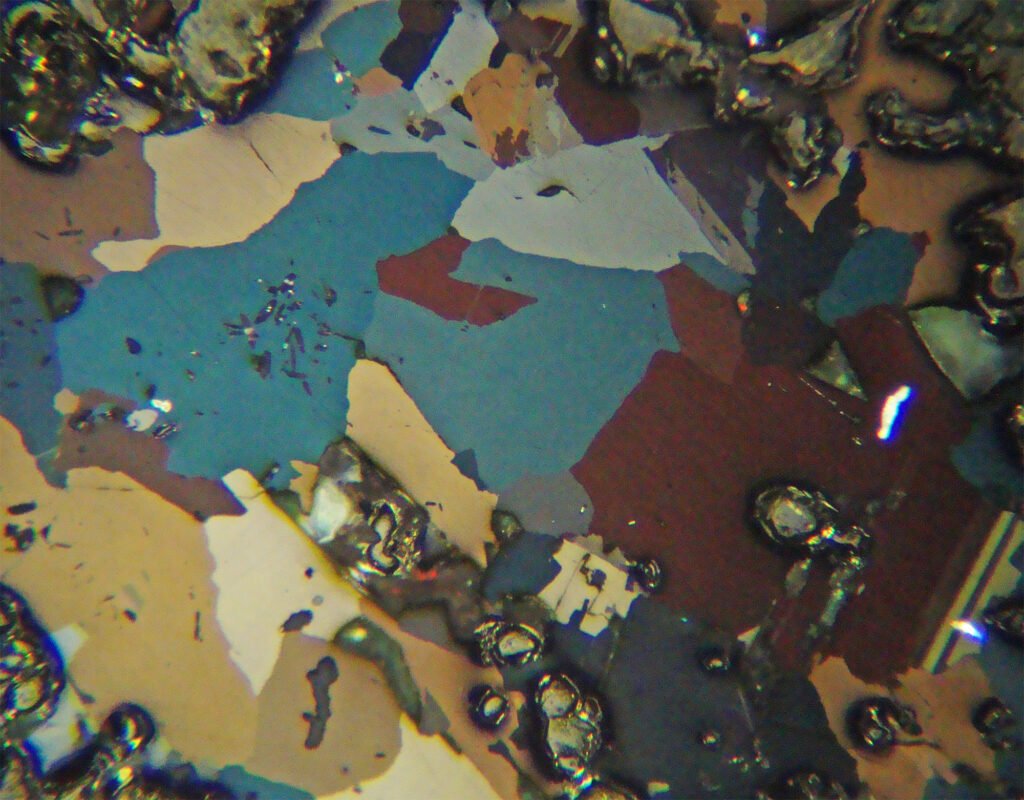
Isotropy / Anisotropy: Strong, colorful anisotropy in bright light, from gray-green to orange-brown or dark blue to brown, with violet and green tones.
The anisotropy appears to be different between enargites of different occurrences.
The extinction is straight, but in most sections a complete extinction is difficult to obtain.
Internal reflections: Rare, in deep red tones. These reflections can be frequent in well-formed crystals.
May be confused with: several common minerals and some rarer ones, such as lautite, which are, however, softer.
Bornite has a deeper color and is much less anisotropic.
Germanite is softer, has a deeper color, is lighter, and is isotropic.
Luzonite and famatinite exhibit extensive lamellar twinning and are more orange in color.
General Characteristics:
Grain shape: in monomineralic aggregates, enargite grains are rounded, irregular, and angular (jagged)—often intergrown or “interfingered”—yet still show signs of prismatic development. The grains can be large, reaching 6 cm across. In polymineralic aggregates, enargite forms short prismatic grains.
Cleavage parallel to {110} is frequently observable—practically always in coarse-grained aggregates—and becomes very distinct upon chemical etching.
Twinning is rarely observed; however, twin lamellae or trillings parallel to (320) sometimes occur. Such twins are rare in typical enargite. Pressure-induced twin lamellae are also sometimes present. Minerals exhibiting numerous twin lamellae are typically not enargite, but rather luzonite or famatinite.
Zoning is not visible without etching. Upon etching, however, zoning often becomes very distinct.
Cataclasis is frequently observed in enargite, an early-forming mineral.
Transformation of enargite into a green, isotropic substance can be observed at various stages. This material was termed “grüner Enargit” (“green enargite”) by Hans Schneiderhöhn and “mottled enargite” by Graton & Murdoch. It is a Cu-As mineral belonging to the “fahlore” group (tennantite-tetrahedrite), occurring either with or without relict enargite. Enargite often forms from luzonite. This paramorphic transformation follows crystallographic directions: the (110) cleavage of enargite coincides with the twin planes of luzonite. The reverse process—transformation of enargite into luzonite—rarely occurs; when it does, it produces enargite with lighter, more yellowish lamellae that closely resemble luzonite twinning.
Replacements 1: replacements are very common, as enargite is an early-forming mineral (except for crystals in cavities). Enargite can be replaced by bornite, chalcocite, pyrite, galena, and covellite, and more rarely by chalcopyrite and certain other ores. Replacement textures are often excellent.
Replacements 2: enargite can replace pyrite, chalcopyrite, sphalerite, tennantite, pitchblende, and quartz.
Myrmekites are not known.
Intergrowths occur with klockmannite, jordanite, sphalerite, wurtzite, and luzonite.
Oriented overgrowths of sphalerite on enargite have been observed, with the pseudo-hexagonal axis of the enargite coinciding with the trigonal axis of the sphalerite.