5. Reflected Light Microscopy
Sample preparation: Due to its high hardness, it is sometimes difficult to achieve a good polish on marcasite. The polishing hardness of marcasite is greater than that of pyrrhotite and equivalent to that of pyrite. Hardness varies substantially depending on the crystallographic direction. Consequently, polishing performed without sufficient care yields poor results. Excessive polishing leads to surface isotropization. In high-quality polished sections, distinguishing between pyrite and marcasite is easy.
PLANE POLARIZED LIGHT – PPL
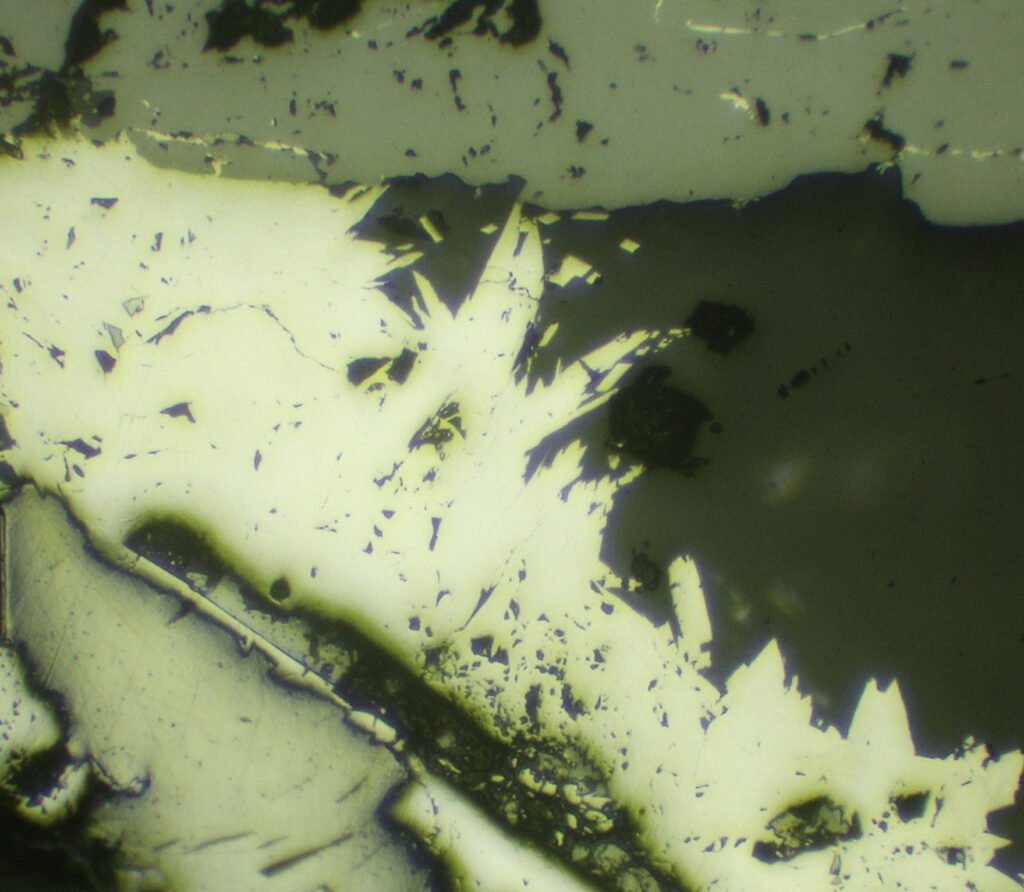
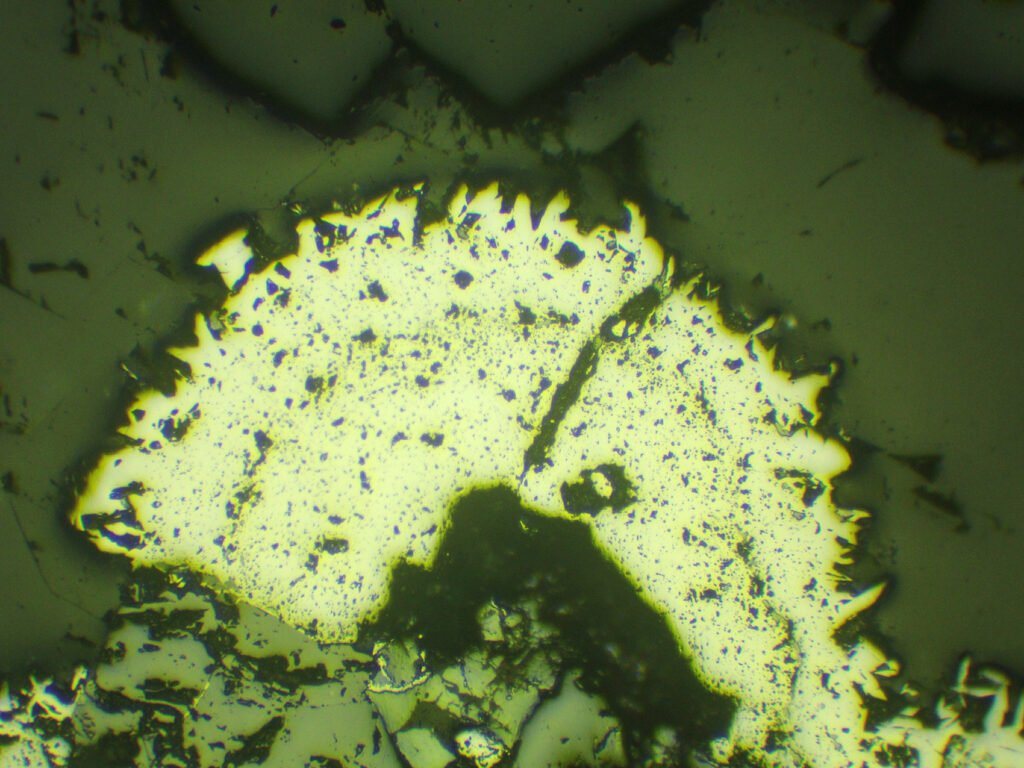
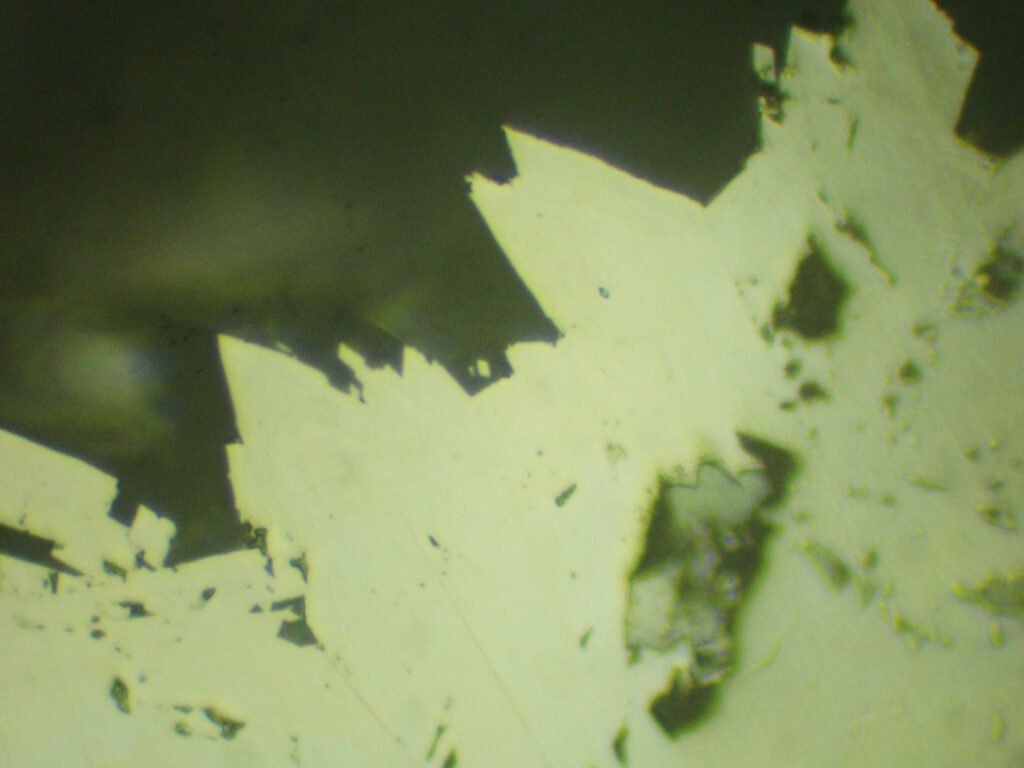
Reflection color: Yellowish-white with a slight pinkish or greenish tint. In rare cases, soft brown tones occur.
Compared to the color of pyrite, marcasite is whiter and has a greenish tint.
Compared to the color of arsenopyrite, marcasite displays a greenish-yellow tint.
Compared to the color of silver, marcasite is gray with a bluish-green tint.
Pleochroism: Distinct, ranges from bluish-white to cream: [100]: creamy white; [010]: pale yellowish-white; [001]: white with a pinkish-brown tint. Greenish hues may occur.
Other sources cite: // a = pinkish-brownish white, very similar to the color of pyrite; // b = soft yellow; // c = creamy white. Colors “b” and “c” are very similar to each other.
Reflectivity: 49,01 a 53,83%.
Bireflectance: Distinct.
CROSSED POLARIZED LIGHT – XPL
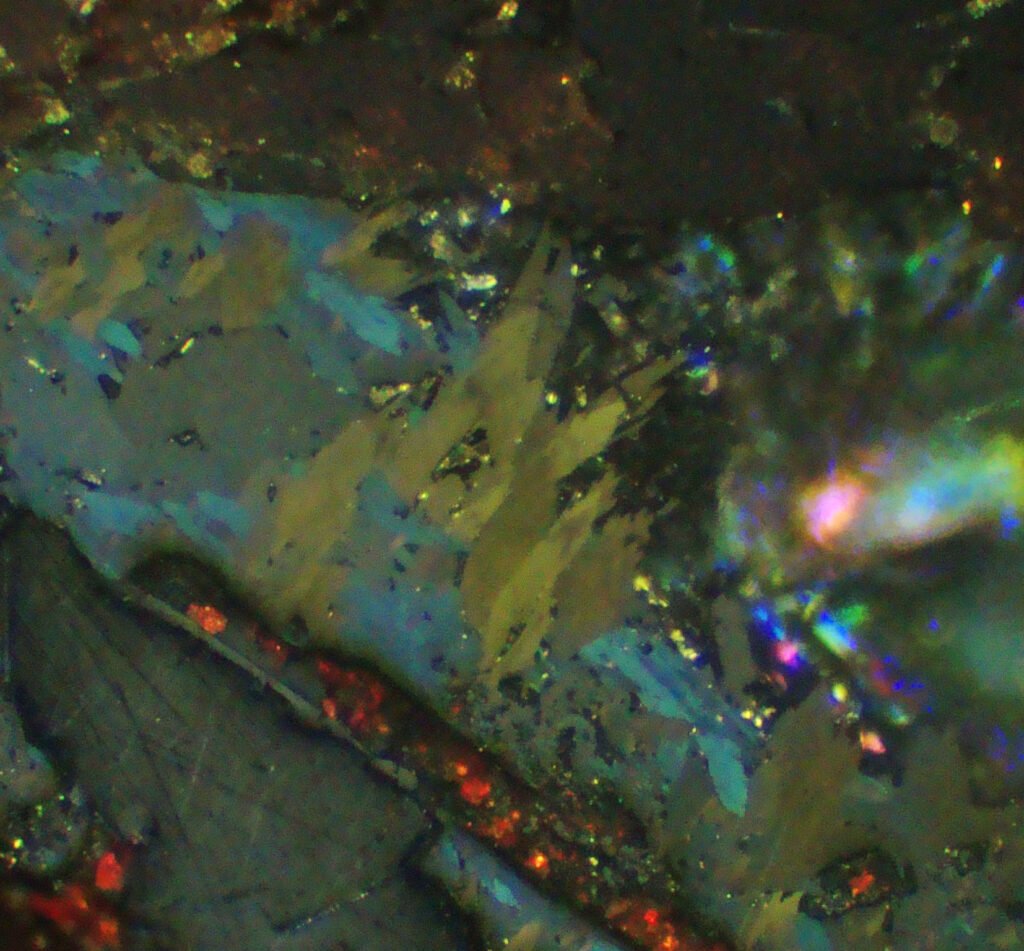
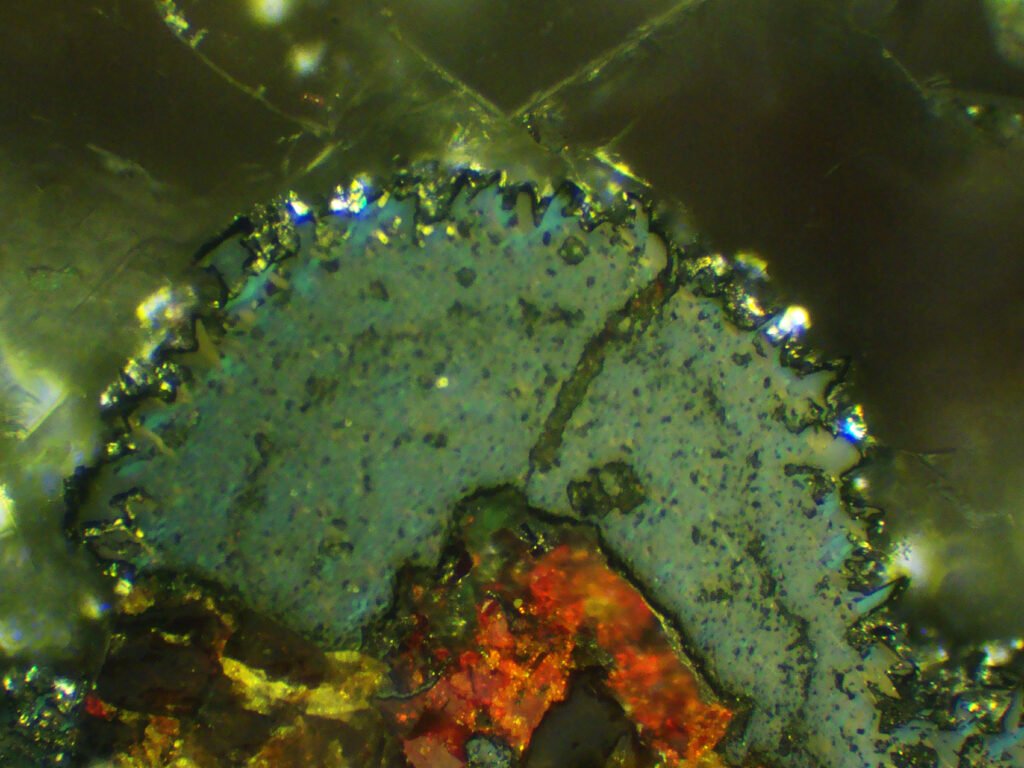
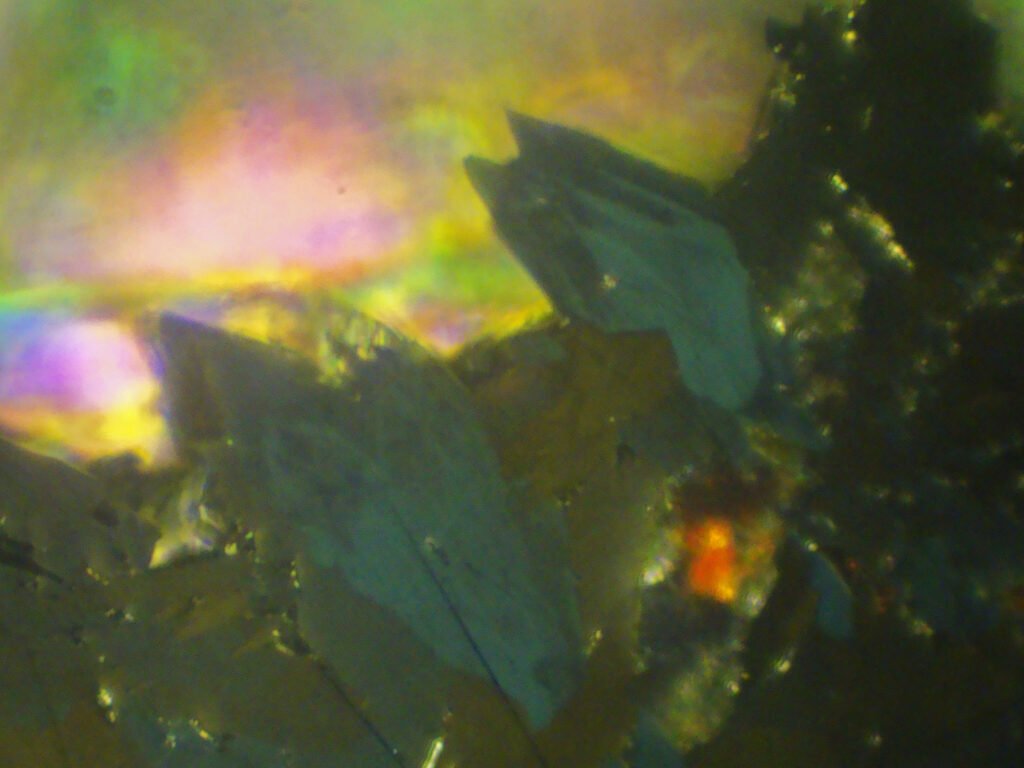
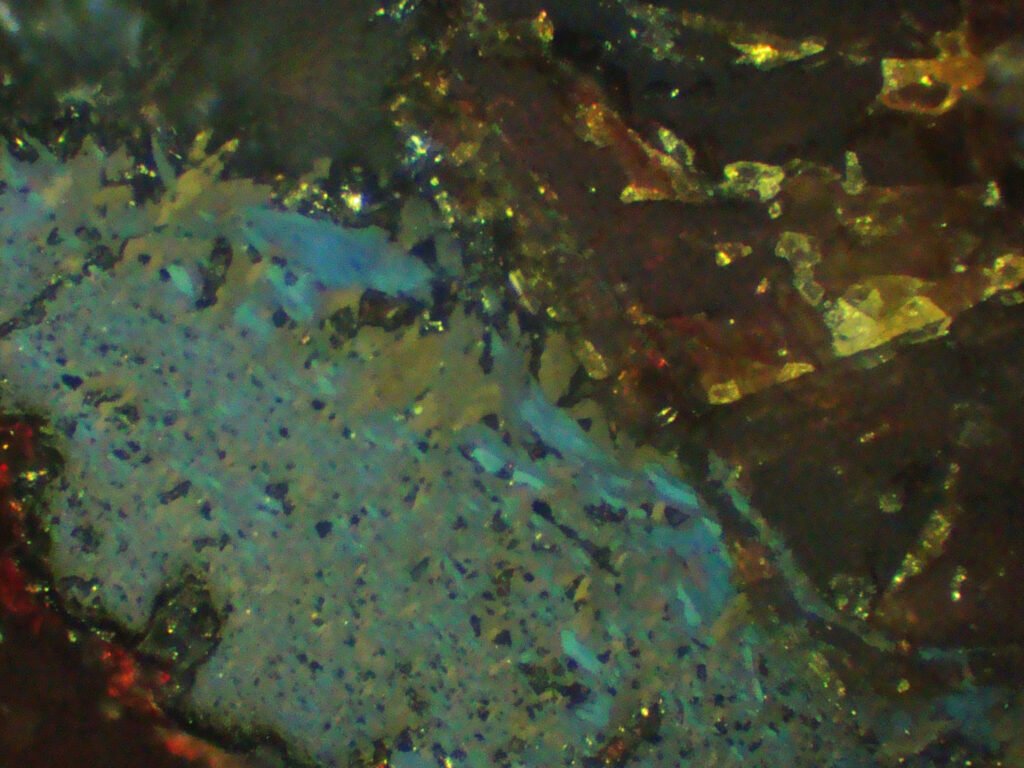
Isotropy / Anisotropy: Very strong anisotropy, with highly distinct colors—browns, greens, blues, and turquoises—depending on the cut. It is one of the strongest known instances of anisotropy.
In high-quality sections, this anisotropy is the primary diagnostic feature of marcasite. The effects are more subtle in sections parallel to (001), stronger parallel to (010), and especially strong parallel to (100).
In marcasite spherulites—which are far rarer than those of pyrite—a type of “stationary cross” appears.
Internal reflections: No.
May be confused with: other white, anisotropic minerals.
Arsenopyrite is whiter.
Pyrite has similar reflectance, but it can only be confused with marcasite if the polished sections are of poor quality, since marcasite’s anisotropy is very strong, whereas pyrite is isotropic.
General Characteristics:
Grain shape: generally exhibits colloform texture with spherical banding, concentric crusts, and textures resembling chalcedony (agate). These textures occur especially in fine-grained masses. Since these textures appear in exactly the same form—and with much greater frequency—in gel-pyrite (a variety of pyrite), they are not diagnostic of marcasite. Euhedral marcasite crystals and aggregates thereof can occur in both hydrothermal deposits and coal. Masses and crusts ranging from coarse- to extremely fine-grained are common. Radial crystal aggregates may occur. However, most spherical aggregates generically termed “marcasite balls” are actually pyrite; distinguishing between them is difficult only in the case of extremely fine-grained aggregates (< 1 micron).
Cleavage (101) is distinct and often visible, especially if the marcasite shows incipient alteration.
Intergranular contacts are often highly intricate, particularly in crystallized gels. The contacts are finely serrated (“toothed”, “verzahnt” in German).
Lamellar twins are abundant and common, resembling the polysynthetic twinning found in plagioclase. Twinning occurs primarily on (101) and less commonly on (011). The lamellae range from broad to very fine, with all intermediate variations. These lamellae are so distinct that they allow for the immediate differentiation of marcasite from pyrite. Incipient alteration does not highlight these twins.
Zoning can sometimes be observed without chemical etching.
Etching almost always reveals a subtle zonal structure, frequently accompanied by a slight color change. Well-developed zonal structures are particularly evident in the tips of crystals projecting into cavities.
Deformation is rare.
Exsolution features have not been observed.
Rhythmic deposition of alternating, very fine layers of pyrite and marcasite is known from various deposits.
Replacements: marcasite and pyrite can replace pyrrhotite in the supergene environment; this replacement is highly characteristic and was termed “*Zwischenprodukt*” (= intermediate product) by German authors, a form that may exhibit the so-called “bird’s-eye” texture. Marcasite can be replaced by pyrite, and vice versa. Structures and textures often indicate that marcasite is secondary, formed through the decomposition of iron-rich sulfides in the presence of acidic, relatively cool solutions. This process creates exact pseudomorphs of the original minerals, which may contain replacement remnants in a wide variety of forms and quantities. In many cases, marcasite deposits as crusts on other ores—such as sphalerite—with which it shares no genetic relationship. Since pyrrhotite is the most readily altered of the common sulfide ores, it is easily replaced by marcasite. In such instances, the marcasite forms a network of lamellae within the pyrrhotite. These lamellae are oriented parallel to (0001) and are individually composed of irregular granular aggregates. In some cases, this replacement of pyrrhotite by marcasite produces a “bird’s-eye” texture, consisting of ellipsoidal aggregates made up of extremely fine grains. Because pyrite forms this exact texture much more frequently, the texture is not diagnostic of marcasite. Other replacement products in pyrrhotite—also oriented parallel to (0001)—can form tabular crystals with basal cleavage and vivid anisotropy, though they differ from marcasite in hardness and color. Marcasite can also form from stannite during incipient alteration, appearing as finely crystalline or cryptocrystalline crusts.
Intergrowths occur with arsenopyrite, pyrite, chalcopyrite, covellite, and proustite.
Transformations to pyrite are frequent, but in many cases, the deposition of pyrite and marcasite occurred concomitantly.
A variant form of marcasite occurs in certain nodules found in lignite (“brown coal”) and in veins; it closely resembles marcasite and exhibits the same anisotropy effects, yet possesses the hardness and color of “Melnikovite” pyrite. Polished sections of this material are extremely susceptible to alteration and tarnish heavily within just a few hours. Even when stored in a very dry environment, the samples rapidly become coated with a crust of sulfate efflorescence. This variant marcasite can occur in mixture with pyrite.