Tantalite is a rare oxide, yet it constitutes the primary ore of tantalum (Ta).
“Tantalite” is currently an obsolete name that was applied to minerals now classified within the Tantalite-(Fe)–Tantalite-(Mn) series. The Mn-rich members are generally more abundant.
Tantalite and columbite share the same structure and similar chemistry, resulting in similar properties.
Within the tantalite series, physical properties vary only slightly withchanges in Fe and Mn content. Tantalite is paramagnetic, may be radioactive due to uraninite inclusions, and is dimorphous with tapiolite-(Fe) (tetragonal), occurring in exsolution intergrowths with it.
Macroscopically, “tantalite” closely resembles ilmenite, hematite, wolframite, and minerals of the Tapiolite-(Fe)–Tapiolite-(Mn) series. Since tantalites are macroscopically indistinguishable from columbites, the collective term “coltan” is used for both minerals, and many texts treat the two as a single entity.
Tantalite ore may contain radioactive minerals!
Crystal system: Orthorhombic bipyramidal.
Color: Iron-black to blue-black.
Habit: Short prismatic or equant. Rectangular prisms with dominant pinacoids. Thin to thick tabular; massive.
Cleavage: {100} distinct, {010} poor. Striations // the [001].
Tenacity: Brittle.
Twinning: Common, contact, or penetration.
Fracture: Subconchoidal to irregular.
Mohs Hardness: 6 – 6.5
Parting: No.
Streak: Black.
Lustre: Metallic to submetallic to sub-adamantine.
Diaphaneity: Opaque.
Density (g/cm³): 6.65 – 7.95
Like columbite, tantalite occurs as an accessory mineral in Li- and P-rich granitic pegmatites. Columbite is concentrated at the margins of the pegmatite, while tantalite is enriched in the center.
Brazil holds 52% of the planet’s known reserves, located in the states of Roraima and Amapá.
It is associated with common pegmatite minerals such as quartz, feldspars (albite, variety cleavelandite), micas (muscovite, biotite), fluorite, beryl, and tourmaline.
Spodumene, lepidolite, lithiophilite, triphylite, and amblygonite are typical of these Li-bearing pegmatites.
It also occurs with stibiotantalite, cookeite, cassiterite, pyrochlore, microlite, uraninite, pitchblende, wolframite, rutile, columbite-(Fe), and tantalite-(Mn).
Tantalite, like columbite, wolframite, and cassiterite, can be found in placers.
Refraction indices: nα: 2.260 nβ: 2.300 nγ: 2.430
PLANE POLARIZED LIGHT – PPL
Color / Pleochroism:Reddish-brown.
Relief: Very high.
Cleavage: {100} distinct.
Habits: Short prismatic, thin to thick tabular, massive.
CROSSED POLARIZED LIGHT – XPL
Birefringence and Interference Colors: Maximum birefringence of 0.170: high-order, pearly colors.
Extinction: Probably paralell.
Elongation sign: No information available.
Twins: Common, both of the interpenetration contact type.
Zoning: May show zoning.
CONVERGENT LIGHT
Character: B(-)
2V angle: No information available.
Alterations: No information available.
May be confused with: No information available.

Sample preparation: Tantalite slowly takes a good polish after careful grinding. Its polishing hardness is comparable to that of cassiterite, but it is less brittle than cassiterite.
PLANE POLARIZED LIGHT – PPL
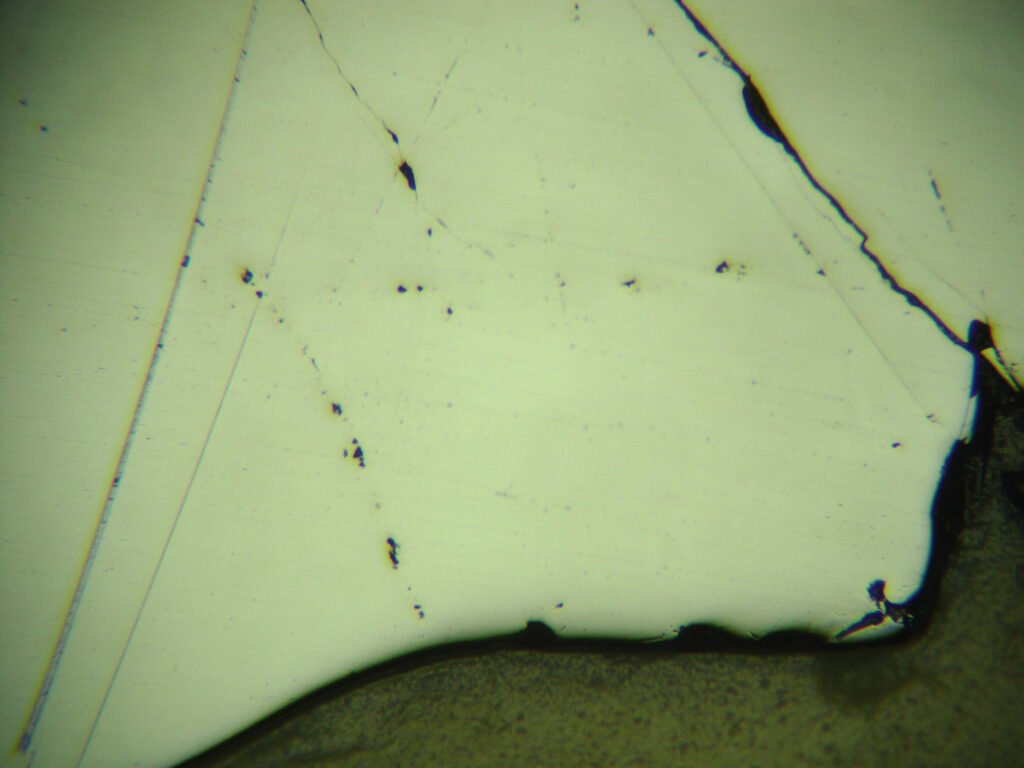
Reflection color: Brownish-gray.
Pleochroism: No.
Reflectivity: ~14%
Bireflectance: No.
CROSSED POLARIZED LIGHT – XPL
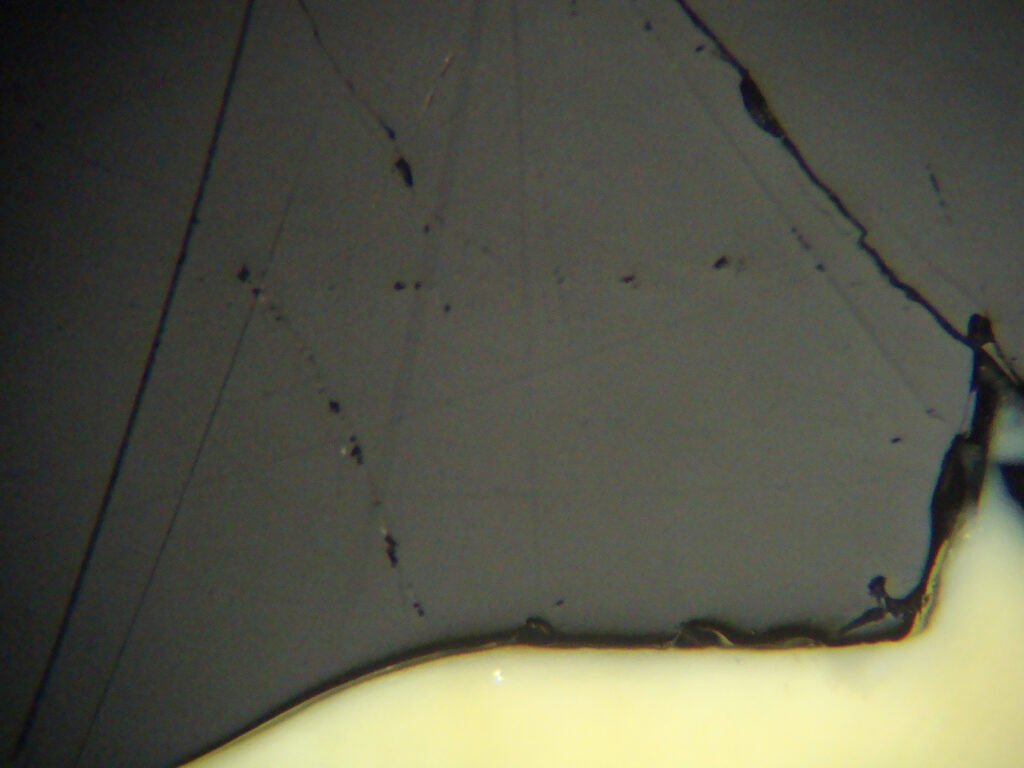
Isotropy / Anisotropy: Weak anisotropy.
Internal reflections: Frequent reddish-brown internal reflections at the edges and along fractures. If the mineral is porous, the reflections are abundant.
May be confused with: various other minerals; considering the paragenesis is important.
Magnetite is isotropic and lacks internal reflections.
Wolframite exhibits more intense reflection pleochroism and anisotropy, oblique extinction, and other types of twinning.
Cassiterite displays much more distinct internal reflections.
Uraninite is isotropic and slightly harder.
General Characteristics:
Grain shape: short prismatic, thin or thick tabular; parallel to sub-parallel groups.
Cleavage may be observed quite frequently, but only locally—especially in somewhat porous, perhaps slightly altered, portions.
Extinction is straight.
Twinning is common (contact or penetration types); twins may be pseudo-hexagonal.
Exsolution of ilmenite and uraninite may occur.
Zoning is to be expected but is rarely visible without chemical etching.
Oriented intergrowths of tantalite and cassiterite occur, with pseudo-hexagonal tantalite twins intergrown with pseudo-hexagonal cassiterite twins.
Pseudomorphs: tantalite pseudomorphs after pyrochlore, and vice versa, occur in pyrochlore deposits.