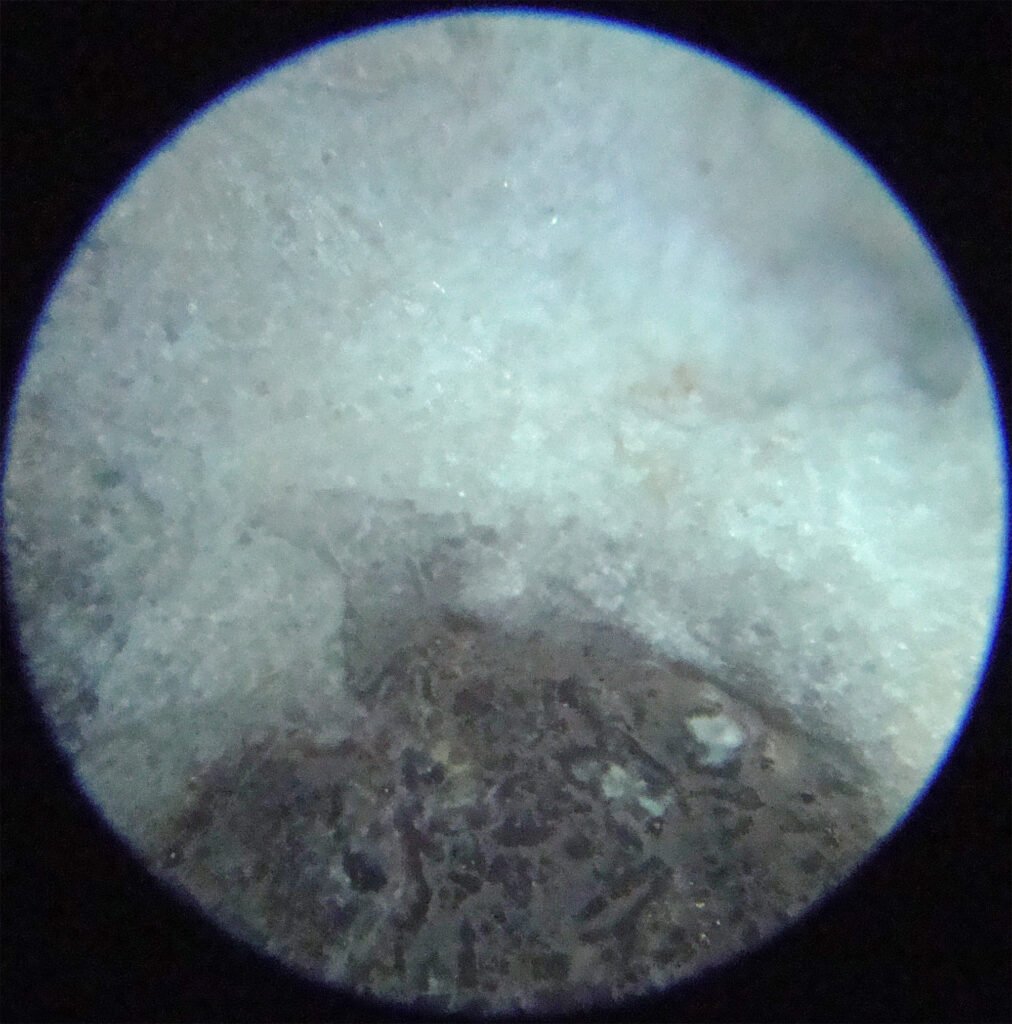
1. Characteristics
Crystal system: Orthorhombic piramidal.
Color: Colorless, white, may be yellowish or pinkish.
Habit: Fibrous, prismatic, acicular. Radial or cotton-like aggregates. Compact, porcelain.
Cleavage: {100} perfect, {010} distinct. Striations parallel to elongation.
Tenacity: Brittle.
Twinning: No.
Fracture: Irregular.
Mohs Hardness: 3 – 4
Parting: No.
Streak: White.
Lustre: Vitreous, silky.
Diaphaneity: Transparent.
Density (g/cm³): 2.12 – 2.15
2. Geology and Deposits
Mordenite typically occurs in cavities and fractures of acid (e.g. rhyolite), intermediate (e.g. andesites) and basic (e.g. basalts, diabases) volcanic rocks. In such cases, it can fill the cavity completely. More frequently, however, are mordenite crusts on the cavity wall. These crusts can reach 2 to 3 cm in thickness and, inside them, other zeolites such as stilbite-(Ca) and heulandite can occur.
It is also formed by the hydration of volcanic glasses and, by autigenesis, in sediments.
A detailed account of the occurrence, forms and other details of mordenite can be found in the book “Zeolites of the World” by Rudy Tschernich, available for download on the internet. Detailed information on the various ways mordenite occurs can be found on the website of the Commission on Natural Zeolites: http://www.iza-online.org/.
3. Mineral Associations
Mordenite associates with the minerals that form the host rocks, generally mafic and intermediate igneous rocks: olivines, clinopyroxenes (augite, pigeonite), plagioclases (labradorite), magnetite, ilmenite, chalcopyrite, pyrite, native copper and alteration minerals such as goethite, covellite, cuprite, malachite and others.
It is part of the assemblage of secondary minerals common in cavities of basic and intermediate rocks (basalts, diabases, rhyolites), such as quartz (including amethyst and pink varieties), chalcedony, calcite, powellite, prehnite, datolite, babingtonite, fluorapophyllite, clay minerals (celadonite ), pentagonite, cavansite and others. Other zeolites such as laumontite, heulandite (Ca), chabazite (Ca), okenite, analcime, stilbite (Ca), clinoptilolite, scolecite and gyrolite can also occur in these cavities.
In sandstones, it occurs with analcime and quartz.
In limestones it is associated with carbonates, glauconite, kaolinite and hydromica.
4. Transmitted Light Microscopy
Refraction indices: nα: 1.472 – 1.483 nβ: 1.475 – 1.485 nγ: 1.477 – 1.487
PLANE POLARIZED LIGHT – PPL
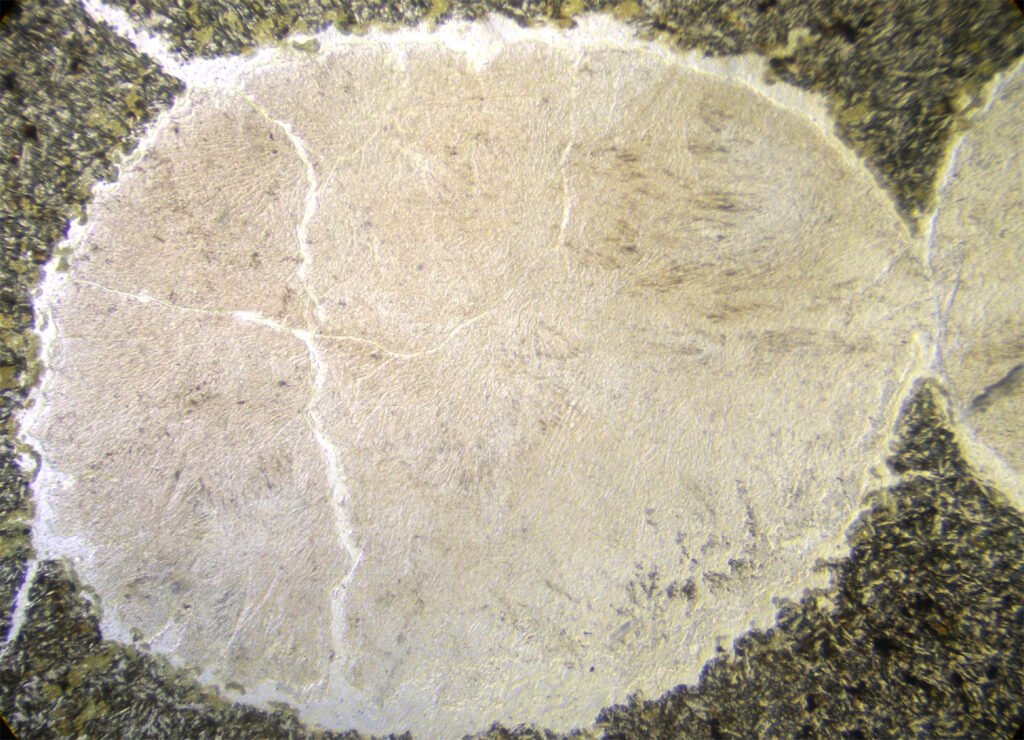
Color / Pleochroism: Colorless, may appear red due to very fine hematite inclusions.
Relief: Moderate.
Cleavage: Perfect in {100} and distinct in {010}, usually not visible due to their typical fibrous habit.
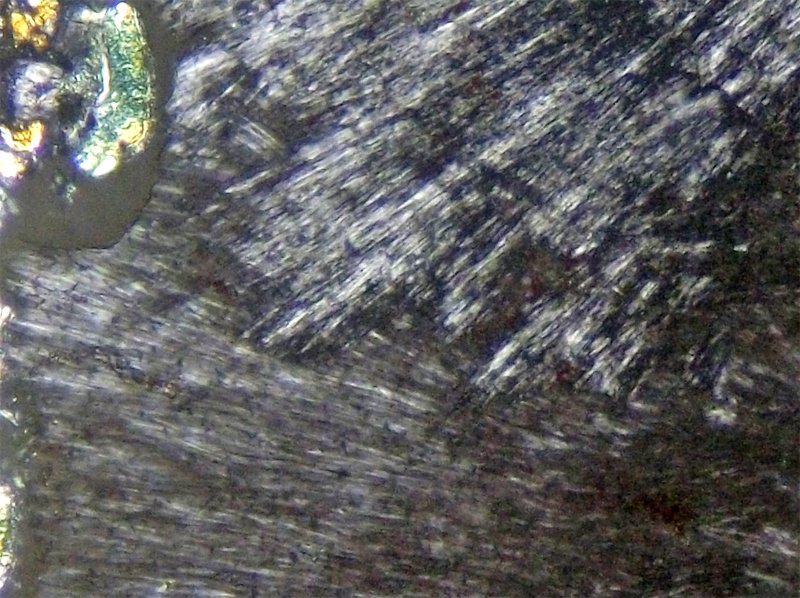
Habits: Normally it is fibrous, forming radiated aggregates. It can be dense when it occupies pores in sediments and sedimentary rocks. It can be compact or in aggregates resembling cotton.
CROSSED POLARIZED LIGHT – XPL
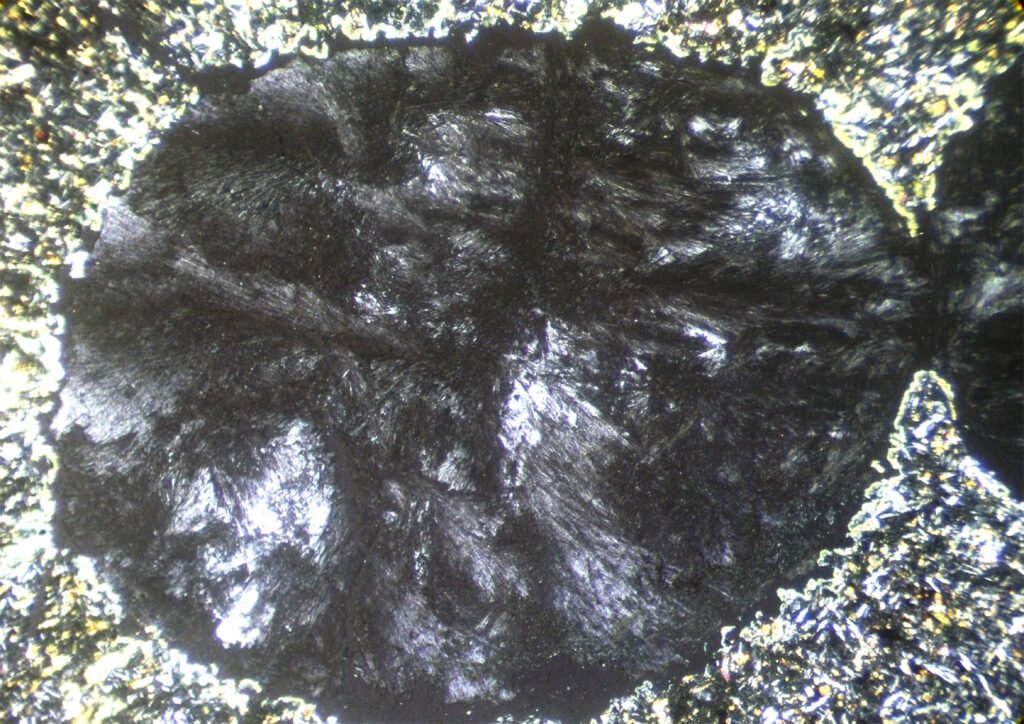
Birefringence and Interference Colors: Maximum birefringence of 0.005, corresponding to 1st order black and dark gray colors. This low birefringence is diagnostic and important as it is a rarer feature.
Extinction: Tends to be parallel.
Elongation sign: ES(+) or ES(-), it is not diagnostic.
Twins: No.
Zoning: No.
CONVERGENT LIGHT
Character: B(+) or B(-).
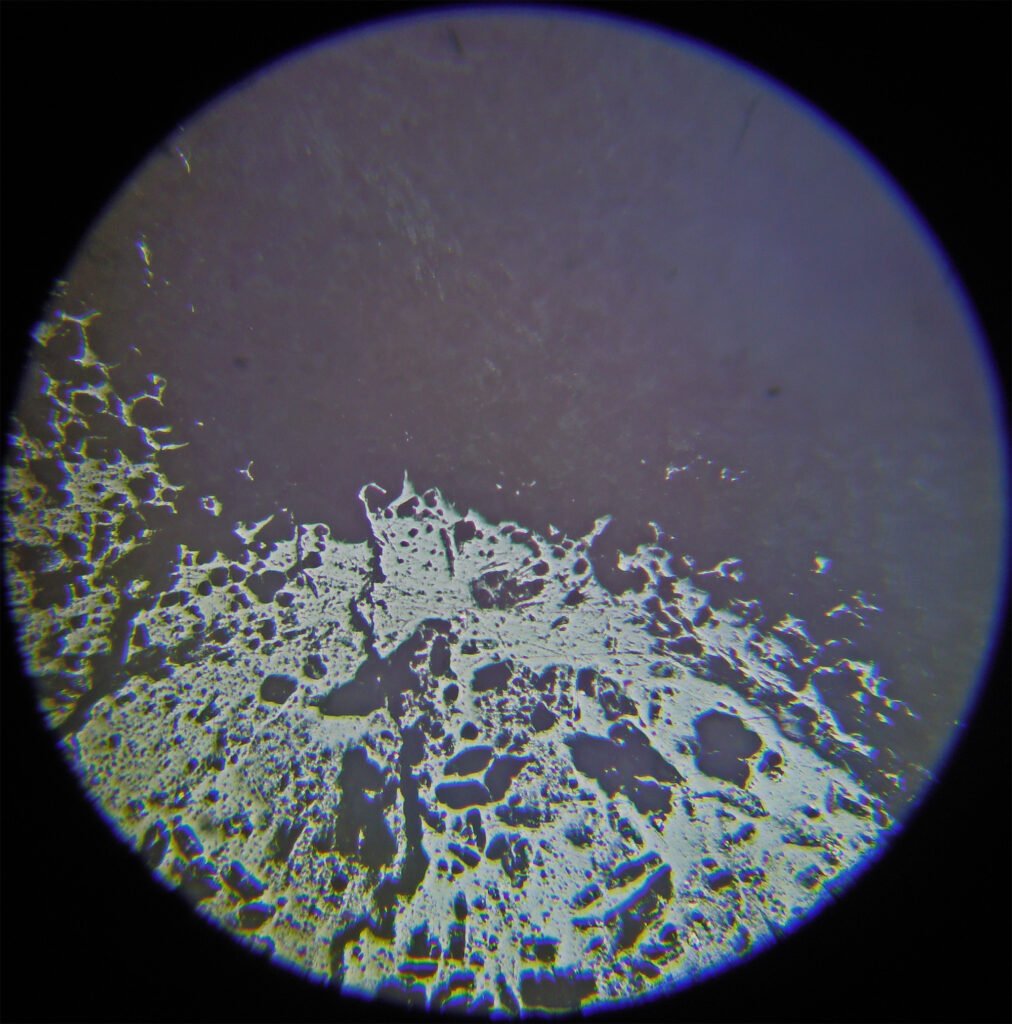
2V angle: 76º a 104º
Alterations: No information available.
May be confused with: other common zeolites exhibit oblique extinction and higher refractive indices.
Phillipsite usually shows twins.
Natrolite and thomsonite have smaller 2V angles and, mainly, higher birefringence.
The fibrous habit is quite typical and diagnostic, but it is not exclusive to mordenite, so it does not identify the mineral by itself. When the mordenite is dense, it is not possible to identify it by optical means. When present in sedimentary rocks, filling spaces between the grains of the framework, its identification is very difficult to impossible. In many cases, due to the very fine fibers that the mineral forms, its conclusive identification needs to be obtained with other analytical methods (X-Ray Diffractometry).