Crystal system: Triclinic, pseudo-monoclinic.
Color: White, colorless, grayish pink.
Habit: Short prismatic, tabular, granular.
Cleavage: {001} perfect, {010} good.
Tenacity: Brittle.
Twinning: It exhibits the characteristic twinning of potassium feldspars, such as Baveno, Carlsbad, and Manebach. Furthermore, it may exhibit a combination of Albite (polysynthetic) twinning with Pericline twinning, forming a very fine checkerboard pattern reminiscent of microcline twinning.
Fracture: Irregular.
Mohs Hardness: 6 – 6.5
Parting: On {100}, {110}, {-110} and {-201}.
Streak: White.
Lustre: Vitreous.
Diaphaneity: Transparent.
Density (g/cm³): 2.57 – 2.60
2. Geology and Deposits
Anorthoclase is a high-temperature (>600ºC) alkali feldspar found in shallow (hypabyssal) alkaline (Na-rich) volcanic and intrusive rocks, such as alkaline rhyolites, trachytes, phonolites, latites, and their hypabyssal equivalents such as syenites and rare granites (caucasites).
It is also found in varieties of diorites (rikotites), varieties of monzodiorites (sörkedalites), and varieties of trachybasalts (anorthoclase-basalt).
Typically, anorthoclase occurs as a matrix constituent, formed by very small crystals, or it occurs as small phenocrysts in the same matrix.
3. Mineral Associations
It occurs associated with quartz, feldspars (sanidine), feldspathoids (nepheline), pyroxenes (aegirine, augite, aegirine-augite, clinoenstatite, ferrosilite), amphiboles (arfvedsonite), volcanic glass, ilmenite, and apatite.
It rarely occurs with muscovite.
4. Transmitted Light Microscopy
Refraction indices: nα: 1,519 – 1,529 nβ: 1,524 – 1,534 nγ: 1,527 – 1,536
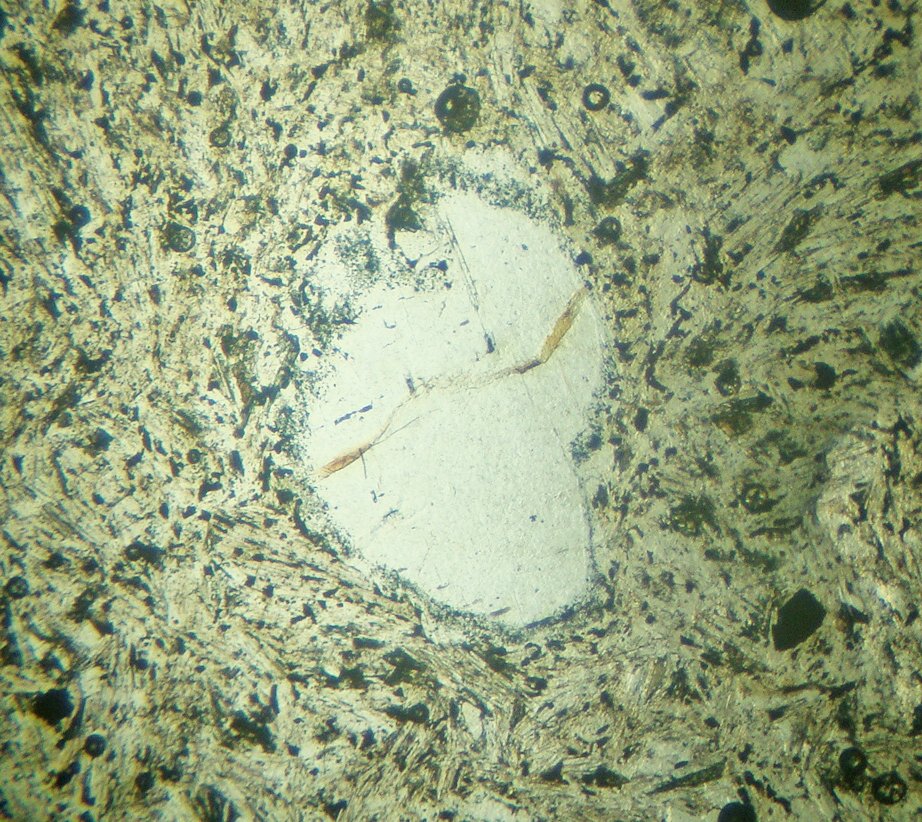
PLANE POLARIZED LIGHT – PPL
Color / Pleochroism: Colorless, it never shows color, much less pleochroism. It may be cloudy (brown, yellowish colors, etc.) due to alteration to clay minerals.
Relief: Very low, negative.
Cleavage: {001} perfect and {010} good, are normally not visible under a microscope due to their low relief. It also exhibits partitions in 4 directions.
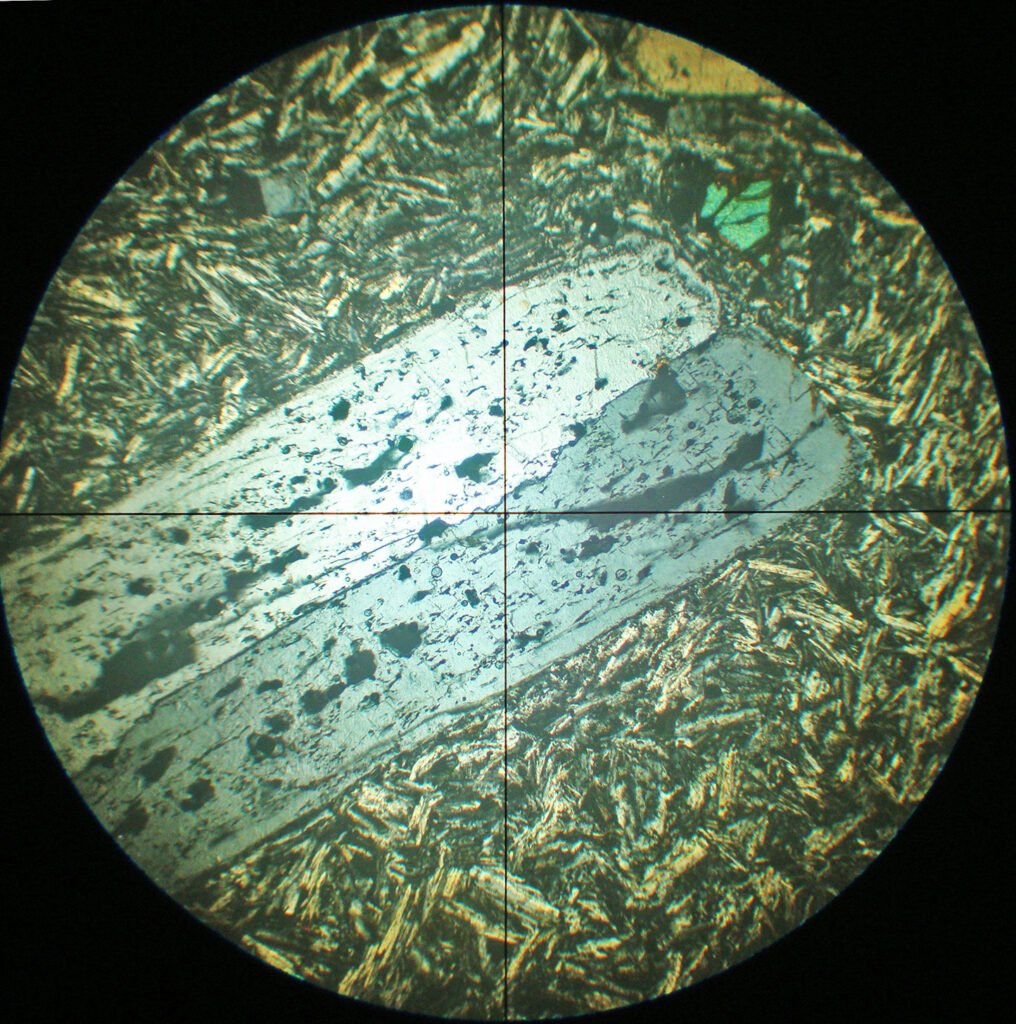
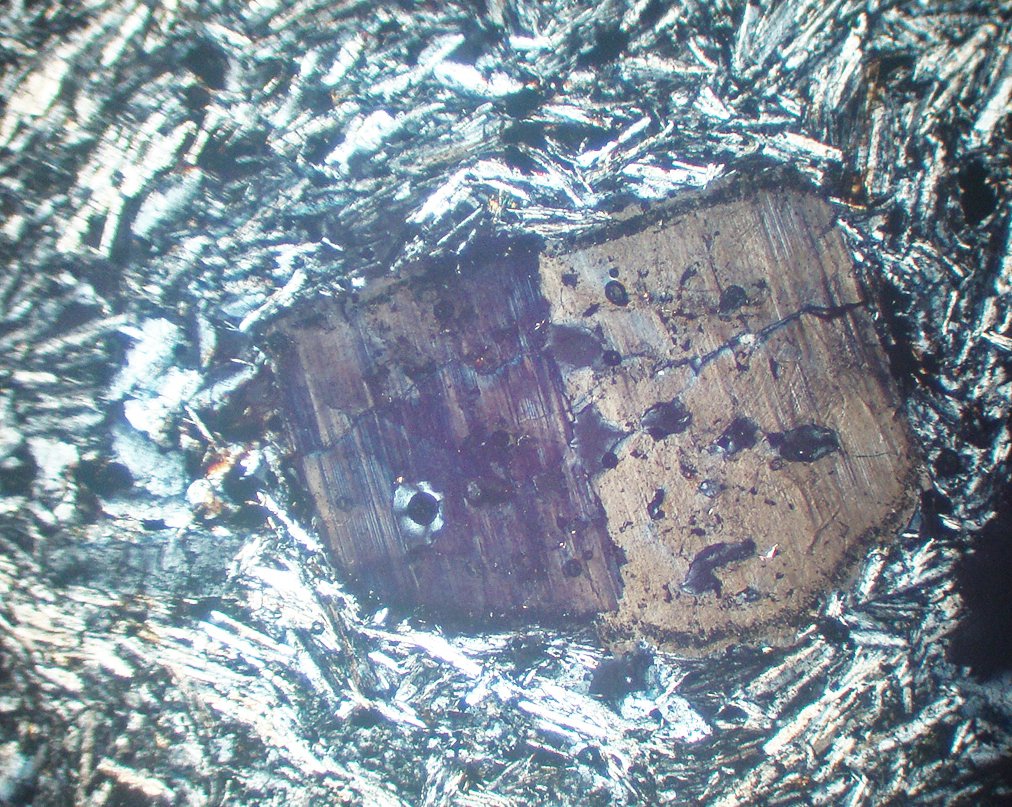
Habits: It typically forms short prismatic crystals elongated along the c-axis and with rhombic (lozenge-shaped) sections. It also occurs in a tabular form and can be anhedral. It is typically found as a euhedral phenocryst in a matrix of very fine grains (porphyritic to porphyritic texture) in volcanic rocks. Antiperthitic demixtures are common.
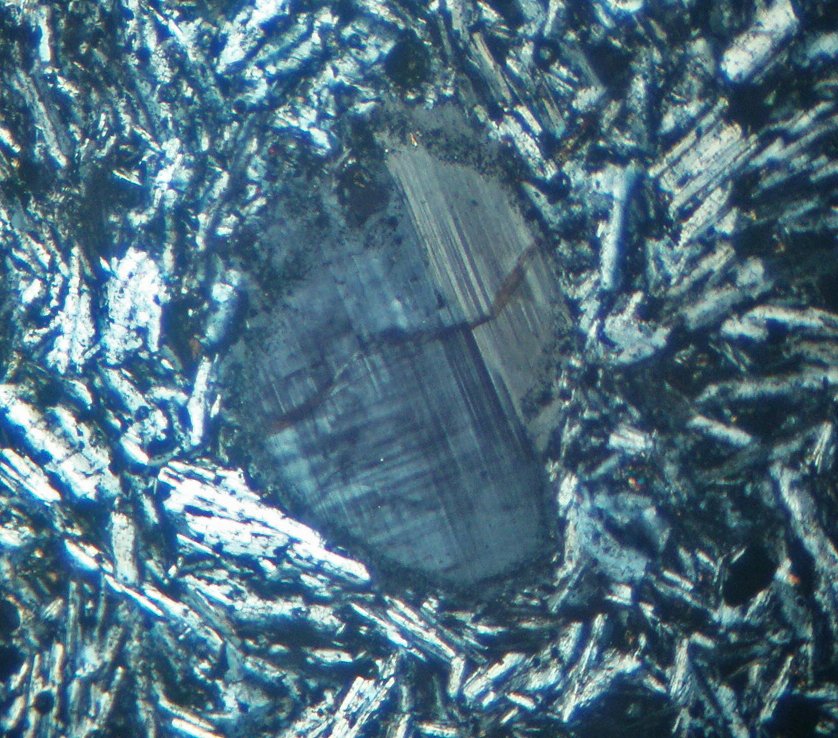
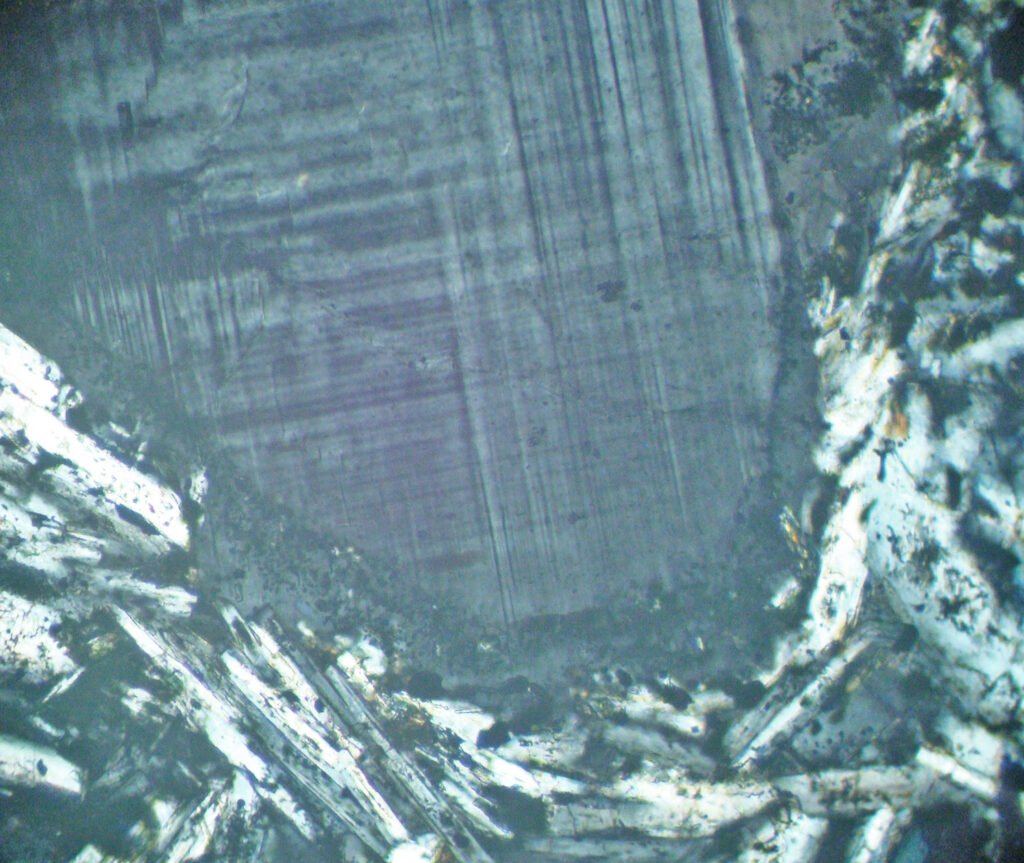
CROSSED POLARIZED LIGHT – XPL
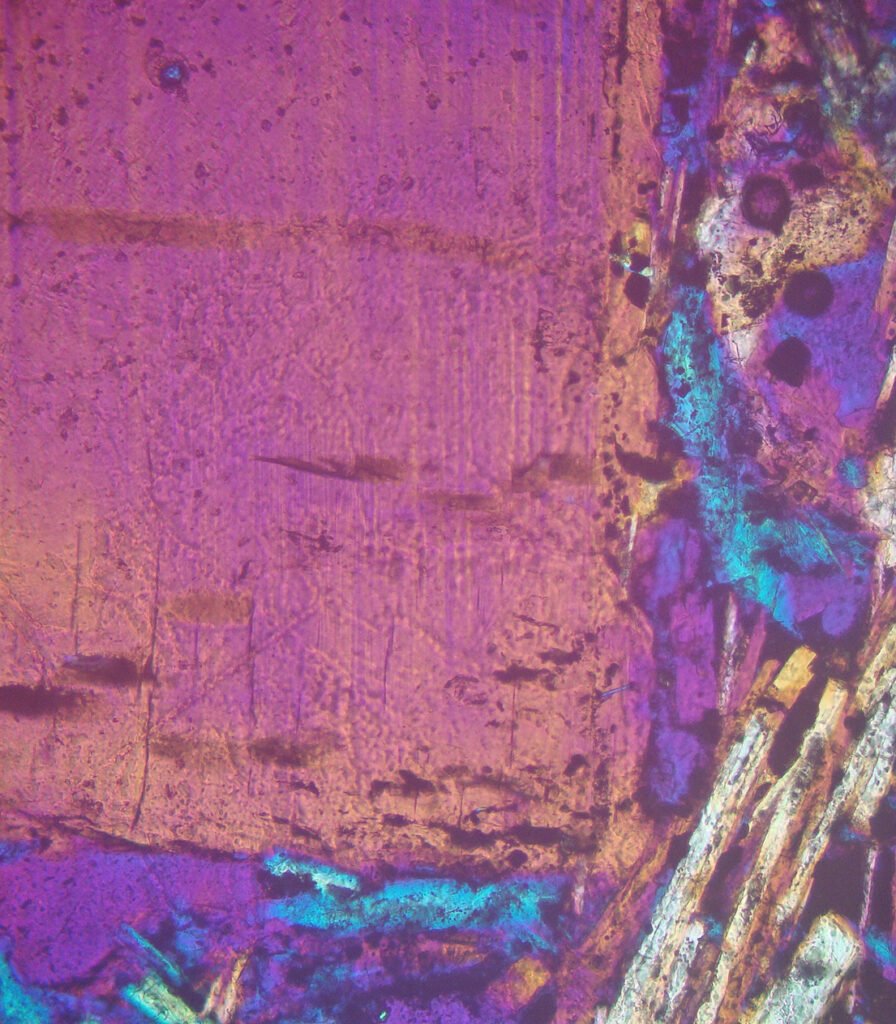
Birefringence and Interference Colors: Birefringence of 0.005 to 0.008: colors from very dark gray to light gray to white (similar to plagioclases, potassium feldspars (microcline, orthoclase, sanidine) and quartz).
Extinction: Oblique of 5 to 20 degrees.
Elongation sign: Not applicable.
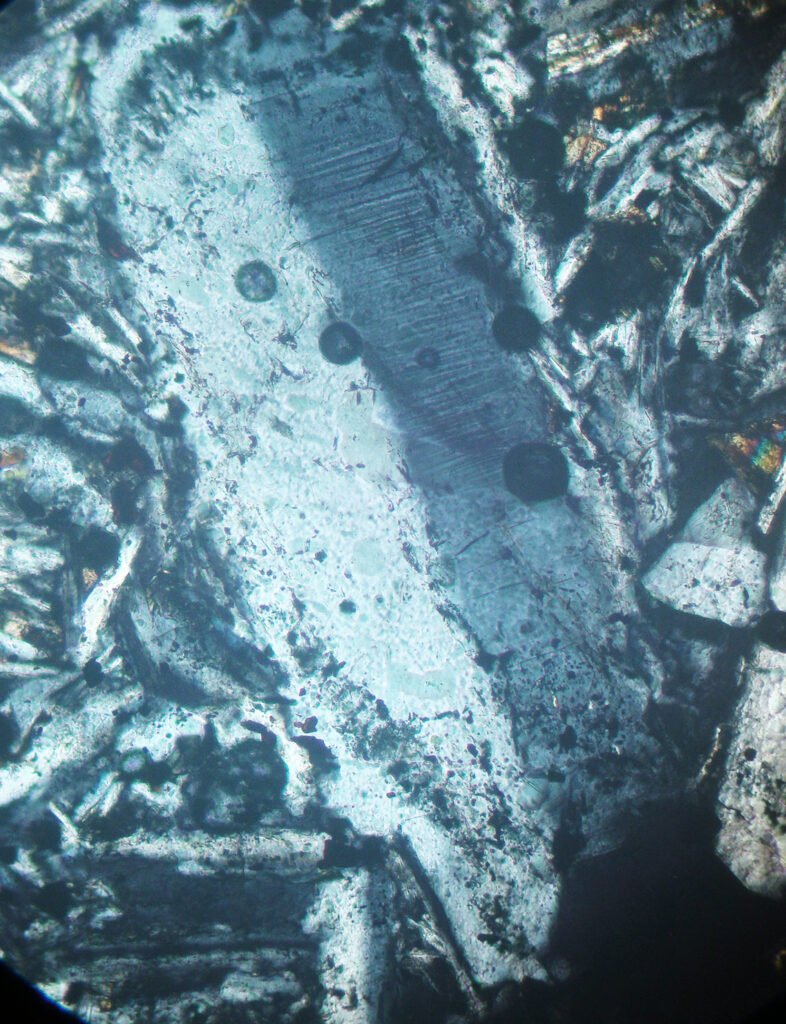
Twins: According to Baveno, Carlsbad, and Manebach, sometimes a combination of albite (polysynthetic) twinning and twinning according to Pericline’s Law produces a checkerboard twinning on {100}, which is very diagnostic. It resembles microcline twinning, but the network that forms the checkerboard is finer, more delicate, and more difficult to visualize.
Zoning: Anorthoclase is very often zoned. It may exhibit an outer zone of sanidine or vice versa.
CONVERGENT LIGHT
Character: B(-)
2V angle: 34 – 60º
Alterations: It alters to sericite and/or clay minerals (kaolinite, etc.), which leaves the mineral cloudy (hazy, creamy, brown in color) in PPL. In rocks of older geological ages, exsolutions may occur.
May be confused with: Several other minerals, both from the paragenesis and others.
Microcline also has checkerboard twinning, but anorthoclase twins are much finer and more delicate than those of microcline. Furthermore, microcline is characteristic of plutonic rocks, and anorthoclase is typical of volcanic and hypabyssal rocks.
Leucite has somewhat similar twinning, but its birefringence is lower and it has different habits.
Nepheline occurs in the same paragenesis and has similar habits, but it is U(-), does not have Carlsbad twinning, and is much more frequent than anorthoclase.
Sanidine, if it occurs associated and also as phenocrysts, showing only Carlsbad twinning, is practically indistinguishable from anorthoclase under the microscope; it is necessary to employ other analytical techniques. But anorthoclase is much rarer than sanidine.