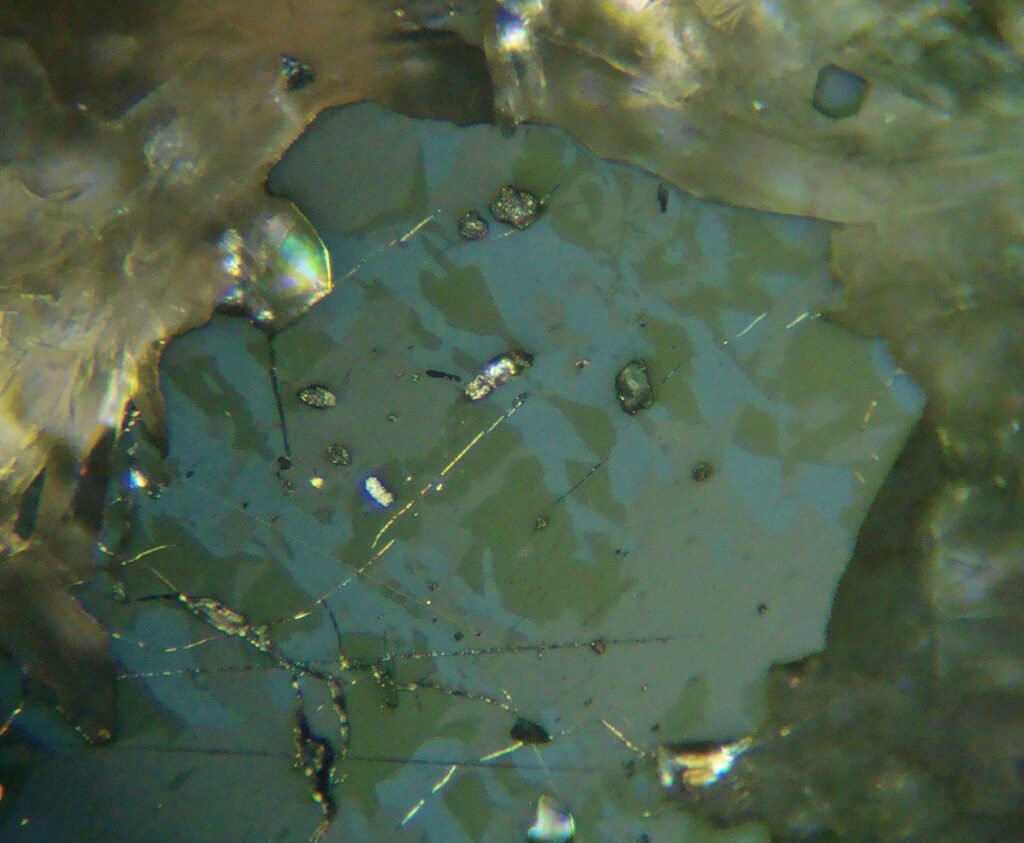
Cobaltite – CoAsS – is a rarer sulfide, characteristic of high-temperature hydrothermal veins. In addition to its historical uses as a pigment, cobalt is now a strategic industrial metal.
Cobaltite can contain Ni, Cu, Pb, and Sb. There are two varieties (with Fe, with Pd). It forms a series with gersdorffite (NiAsS). When heated, it becomes magnetic and releases As2O3, which is a poisonous gas. Cobaltite ores may be radioactive!
Cobaltite occurred associated with Ag ore in the Erzgebirge mining region of Germany in the 14th century. There, at greater depths, the known Ag ores dwindled and were replaced by cobaltite. Since there was no silver in cobaltite, miners called it “silver thief,” “kobolt” (= bewitching gnome, hence the name cobaltite), or “shit ore” (“Scheiss-erz”). But when it was discovered that it was possible to extract the coveted “Cobalt Blue” pigment from cobaltite, a new mining cycle began.
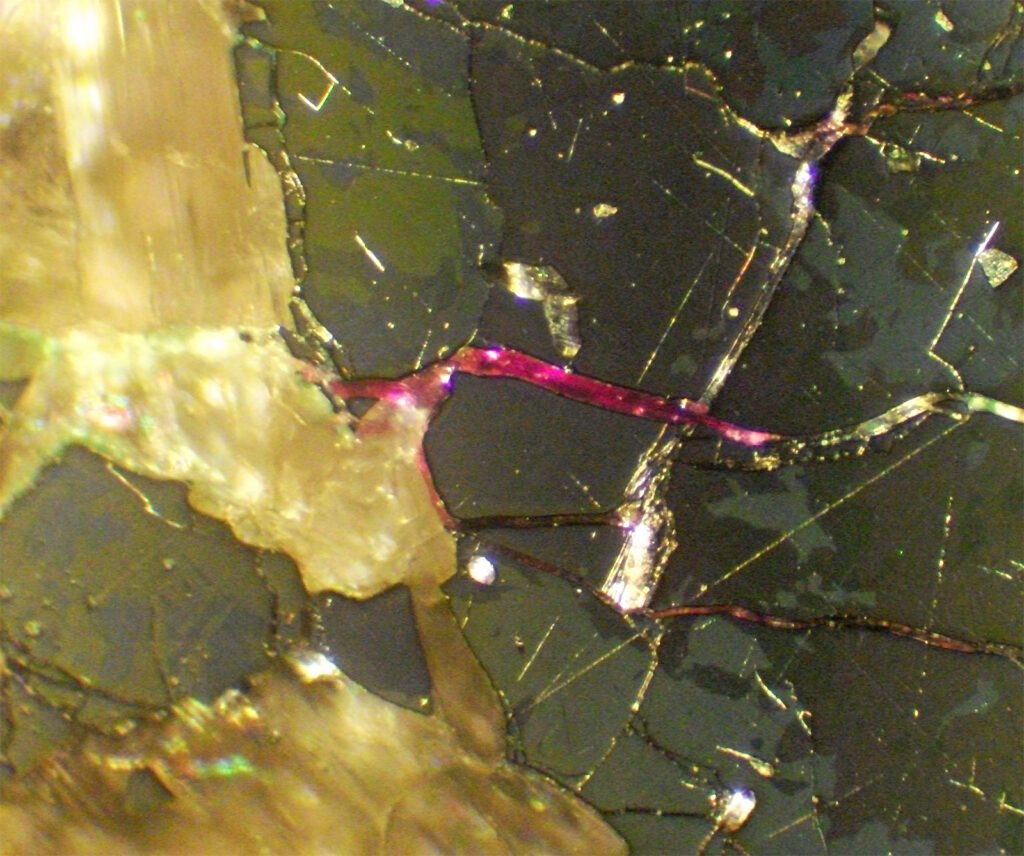
When massive, cobaltite is similar to several other ore minerals with a metallic luster, silvery-gray color, and medium hardness. Well-formed crystals can be confused with pyrite and galena, since cobaltite twins produce pseudocubic, pseudooctahedral, and pseudopentagonododecahedral crystals. Very useful in this context is the fact that cobaltite easily alters to erythrite – Co3(AsO4)2.8(H2O) – which has an extremely characteristic violet-pink color and which “reveals” the existence of a cobalt sulfide from which it was formed.
5. Reflected Light Microscopy
Sample preparation: Polishing cobaltite is very difficult due to its high hardness. The difficulty is similar to that of polishing pyrite, but the final polished cobaltite result is of better quality.
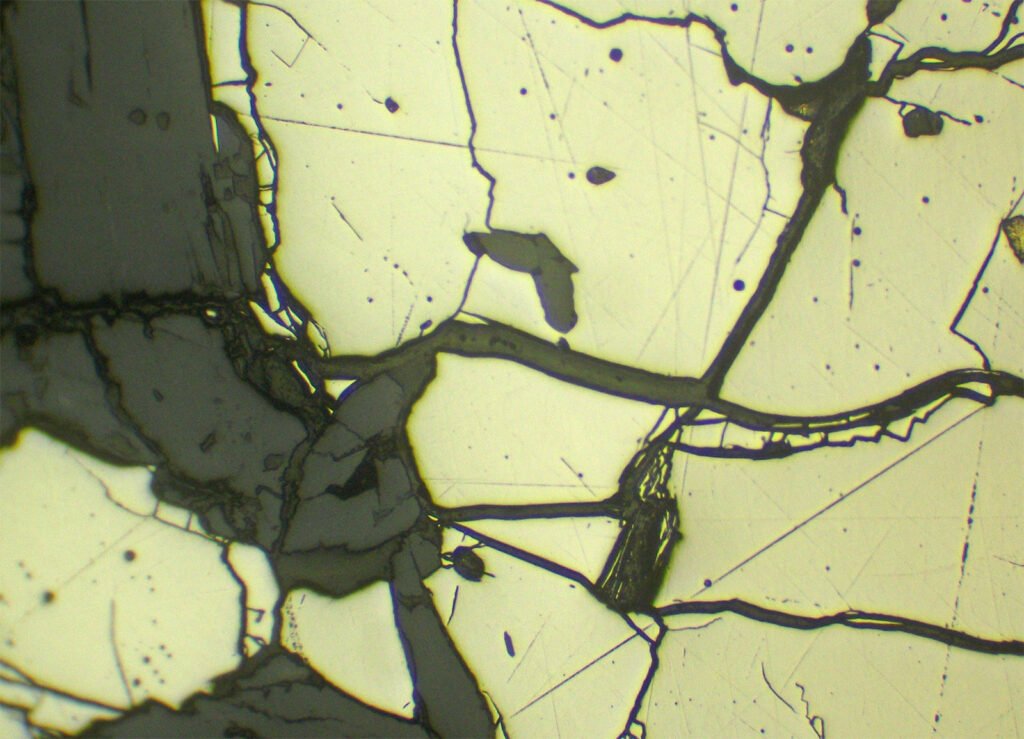
PLANE POLARIZED LIGHT – PPL
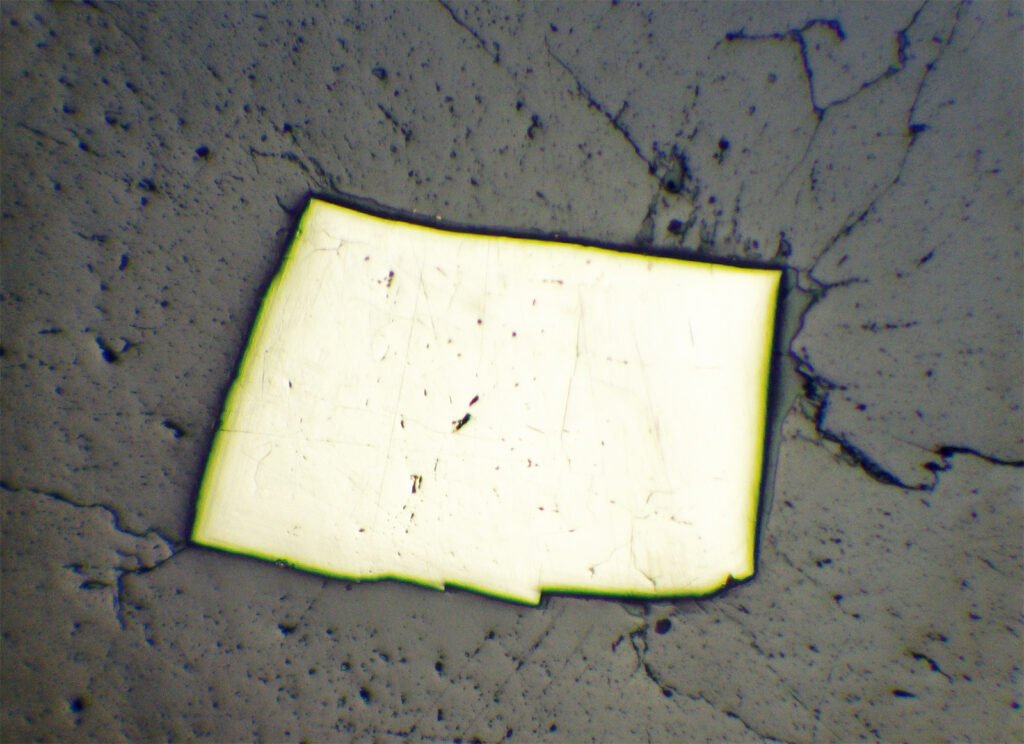
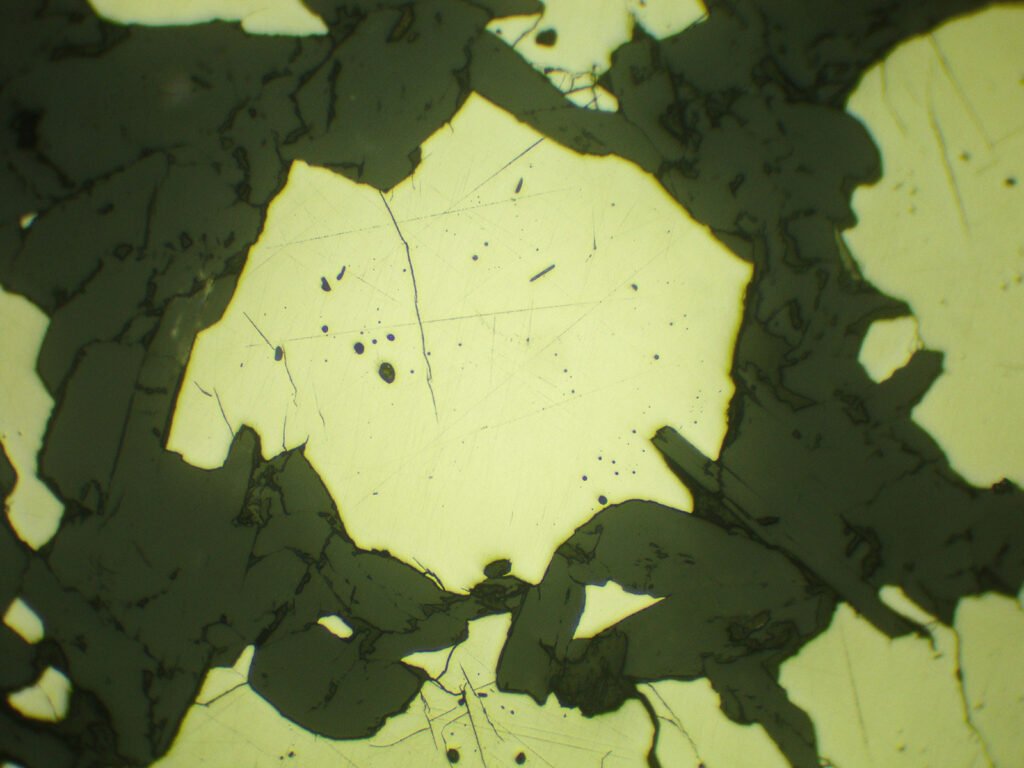
Reflection color: Very light pink or pinkish white.
Over time (days, weeks) the pink tone intensifies slightly, then becomes tarnished.
Compared to the color of arsenopyrite, the color of cobaltite is more pink.
Compared to the color of pyrite, the color of cobaltite is white, without the yellowish tone.
Pleochroism: Very faint, difficult to impossible to observe without immersion in oil.
Reflectivity: 52.71%, quite high, reminiscent of pyrite.
Bireflectance: No.
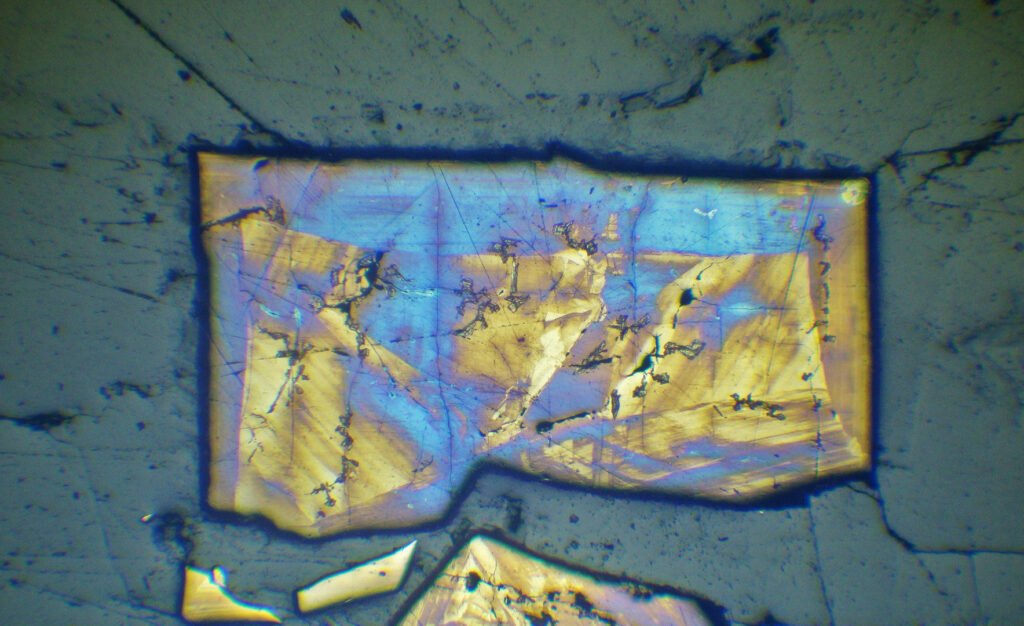
CROSSED POLARIZED LIGHT – XPL
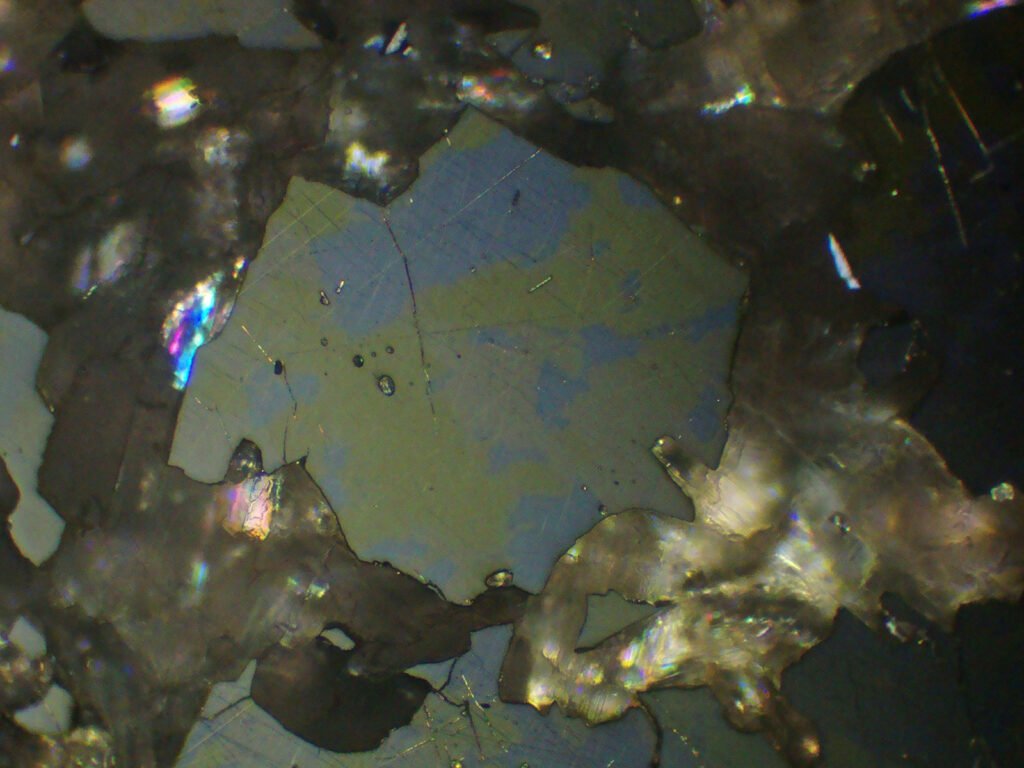
Isotropy / Anisotropy: Weak anisotropy from yellow-brown to blue-gray. Uncrossing the nicols at 2° makes these colors more visible.
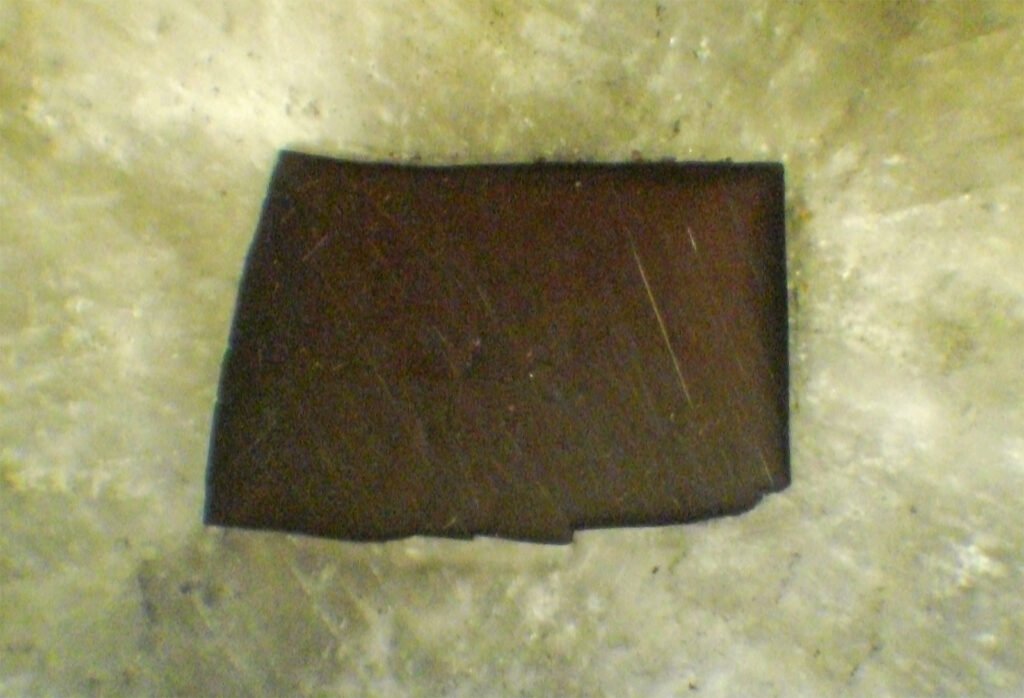
Internal reflections: No.
May be confused with: Pyrite, if it occurs in small grains or in very good polished sections.
Eskutterudite, gersdorffite, linnaeite, and ullmannite, which are also white, are isotropic.
Arsenopyrite, also white, has much more intense anisotropy and does not form cubes.
Nickeline has much stronger anisotropy.
General Characteristics:
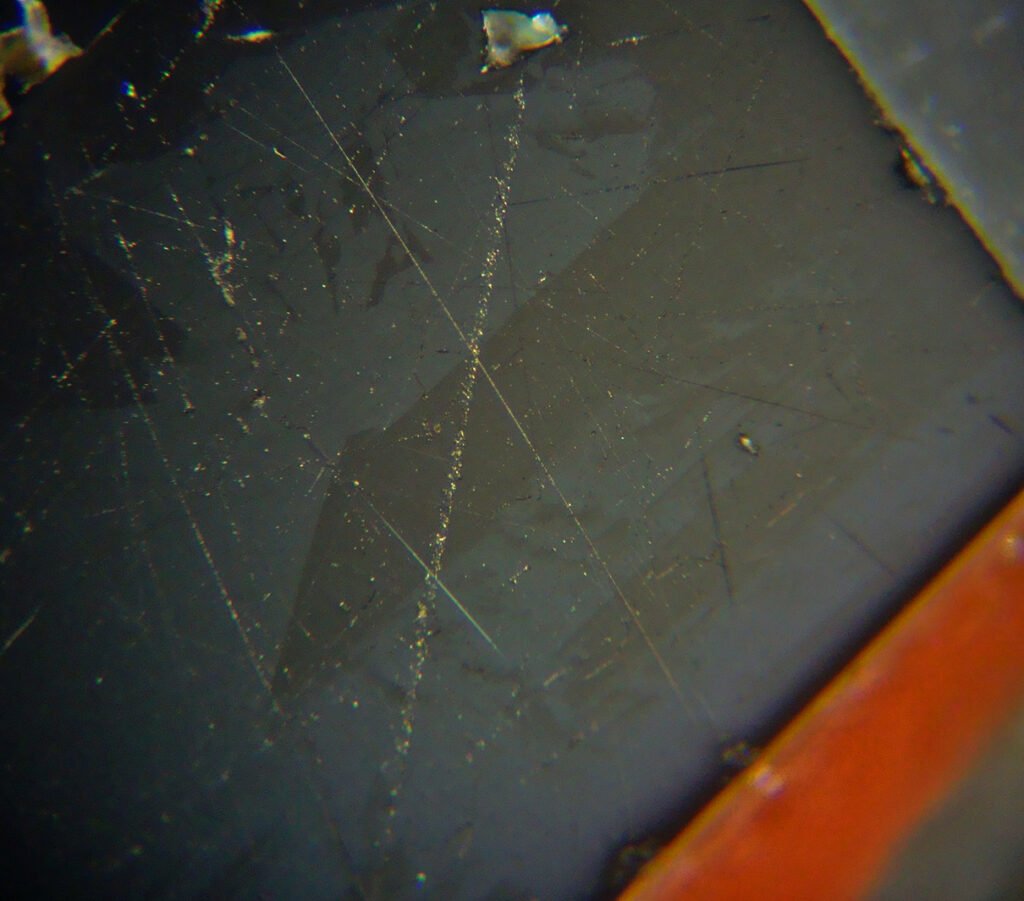
Grain shape is subhedral to euhedral (pseudocubic), which is referred to as “euhedral outlines” in the literature. In reality, the grains are made up of a set of anisotropic lamellae, which may have a certain ordering, constitute fields, or both. Cobaltite has a very strong tendency towards idiomorphism. Even when it occurs in the form of inclusions in pyrite and arsenopyrite, the shapes are euhedral. Only when it occurs in almost monomineralic aggregates are the grain shapes anhedral and poorly intergrown. The grain size is highly variable.
Cleavage can become quite visible, but only in larger grains.
Polysynthetic lamellar twinning is often visible and resembles the checkerboard twinning of microcline. They may appear in flame form.
Zoning is common.
Cataclasis is frequent, indicating that cobaltite is an early-forming mineral.
Substitutions are relatively rare. Cobaltite has been recorded as being replaced by galena, eskutterudite, sphalerite, pyrrhotite, arsenopyrite, tennantite, safflorite, niqueline, pyrite, chalcopyrite, and native silver.
Oriented intergrowths with pyrite are relatively common when the grains are larger. Other possible intergrowths are gersdorffite, chalcopyrite, eskutterudite, and safflorite.
Unmixings are rare. Unmixings of silver minerals, common in other cobalt minerals, are rare in cobaltite.
Inclusions of native gold, native silver, chalcopyrite, niqueline, and loellingite may occur.