1. Characteristics
Crystal system: Trigonal scalenohedral, pseudohexagonal.
Color: Colorless, gray, blue, red, pink, yellow, golden-brown.
Habit: Massive, prismatic, or pyramidal, it can be barrel-shaped. Rarely tabular, rhombohedral, or granular.
Cleavage: No.
Tenacity: Brittle.
Twinning: Lamellar twinning along {101-1} is common, generating a lamellar structure and striations. Interpenetration twinning or spearhead twinning, formed by tabular {1120} crystals, may occur. Pressure twinning may arise along {101-1} and {0001}, and others may be generated by exsolution.
Fracture: Irregular, conchoidal.
Mohs Hardness: 9
Parting: Rhombohedral and basal {0001}, can be perfect, is generated by the exsolution of bohmite (AlO(OH)).
Streak: White.
Lustre: Vitreous, pearly, adamantine.
Diaphaneity: Transparent.
Density (g/cm³): 3.98 – 4.1
2. Geology and Deposits
Corundum occurs in silica-poor, Al-rich alkaline igneous rocks such as nepheline syenites and monzonites; very rarely in associated quartz-free pegmatites.
It also occurs in high-grade metamorphic rocks, of regional or contact metamorphism, rich in aluminum, such as hornfels of aluminous shales and magnesian skarns.
It forms in metamorphosed bauxite deposits (metabauxite – corundite) and can be found in aluminous xenoliths in high-temperature plutonic and hypabyssal rocks such as kimberlites, norites, and tholeites.
Corundum occurs in many ores derived from ultrabasic rocks.
Being hard and resistant, it is a detrital mineral found in sediments and sedimentary rocks.
3. Mineral Associations
In skarns, it occurs with calcite, phlogopite, hornblende, chondrodite, rutile, and spinel.
In syenites, it is associated with andesine, oligoclase, nepheline, magnetite, and scapolite.
In schists, with chlorite, biotite, kyanite, sillimanite, and dumortierite.
In eclogitic xenoliths, it occurs with garnet (pyrope), spinel, phlogopite, omphacitic clinopyroxene, kyanite, rutile, graphite, tourmaline, diamond, and prismatine.
4. Transmitted Light Microscopy
Refraction indices: nω: 1.767 – 1.772 nε: 1.759 – 1.763
PLANE POLARIZED LIGHT – PPL
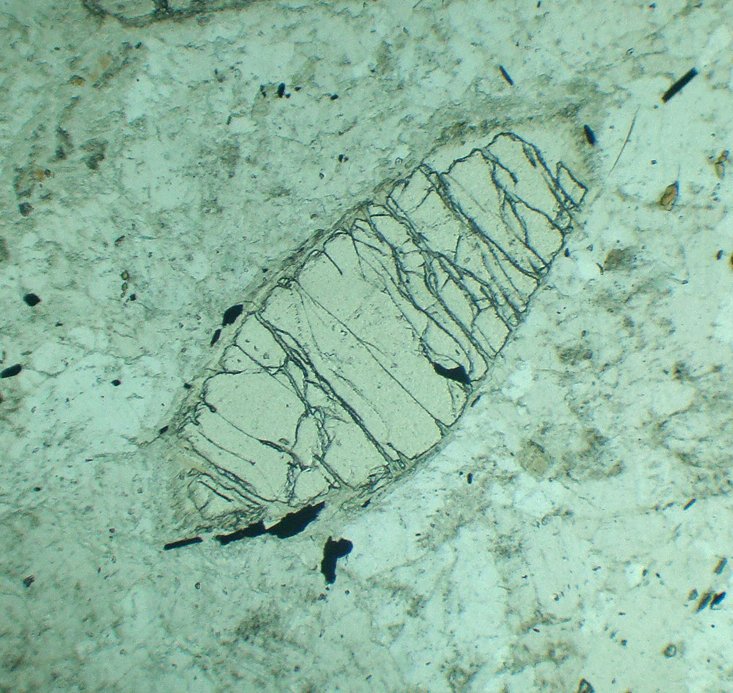
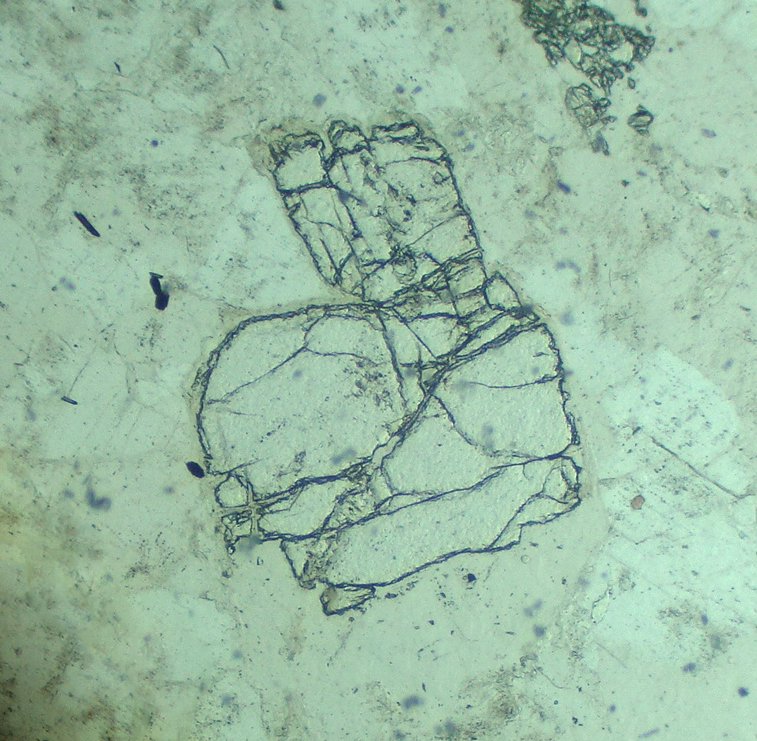
Color / Pleochroism: Normally colorless. Sometimes with colors in bands, stripes, or zones of pale red, pale green, pale yellow, pale blue.
It does not exhibit pleochroism or exhibits weak pleochroism:
X = purplish red, violet, or blue,
Y = yellow, gray-green, pale blue.
Relief: High.
Cleavage: It does not have one. There are two partitions, {0001} and {10-11}, which intersect at an angle of 94º.
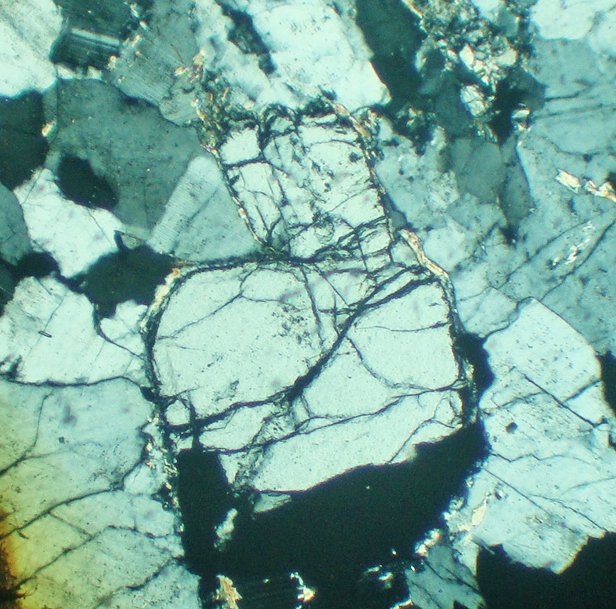
Habits: Prismatic, tabular, sections with 6 sides, may exhibit tabular euhedral crystals. Columnar, barrel-shaped, massive granular crystals (emery).
CROSSED POLARIZED LIGHT – XPL
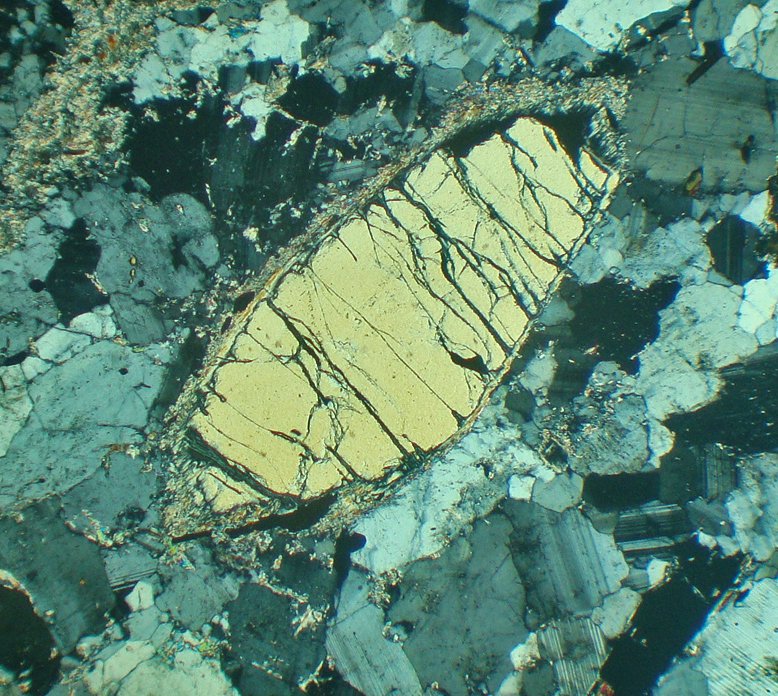
Birefringence and Interference Colors: Low birefringence, up to 0.008: first-order interference colors, gray, at most pale yellow.
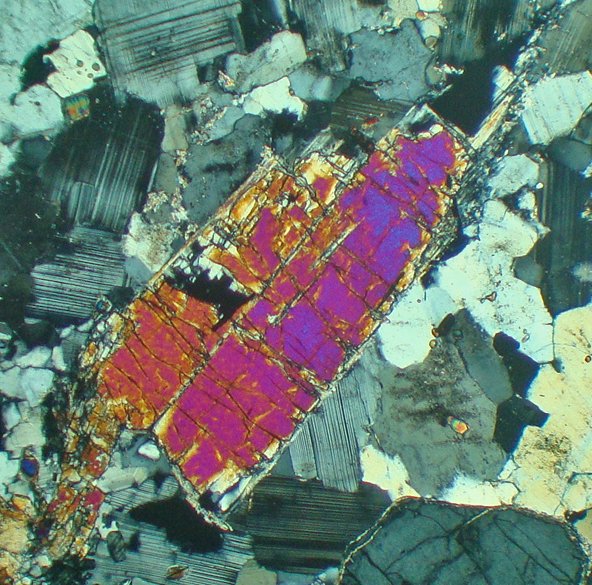
Due to its high hardness, it is possible that the thin section or corundum grain is thicker than 30 microns and, therefore, has higher interference colors (yellow, orange, red).
Extinction: It tends to be parallel.
Elongation sign: ES(-) in prismatic crystals, rarely ES(+) in tabular crystals.
Twins: Simple and lamellar, very common.
Zoning: Often zoned or with colors in stripes or bands.
CONVERGENT LIGHT
Character: U(-), can be anomalous B(-).
2V angle: anomalous 5-7º (up to > 30º).
Alterations: It doesn’t alters; it’s a detrital mineral.
May be confused with: typical are high relief and low interference colors.
Chrysoberyl is B(+).
Vesuvianite has anomalous interference colors.
Apatite has lower relief and tends to be euhedral.
Tourmaline is strongly pleochroic and has higher interference colors.
Beryl is very similar, only the relief is somewhat lower.
Prismatine and kornerupine have perfect (110) cleavage.