5. Reflected Light Microscopy
Sample preparation: Safflorite acquires an excellent polish. Its polishing hardness is high, greater than the hardness of eskutterudite, but lower than the hardnesses of arsenopyrite, cobaltite, glaucodote and löllingite.
Samples that are heavily tarnished as hand samples can remain polished and tarnish-free for a long time in the polished sections. The properties of safflorite in the polished section, especially anisotropy, vary noticeably with variation in chemical composition.
PLANE POLARIZED LIGHT – PPL
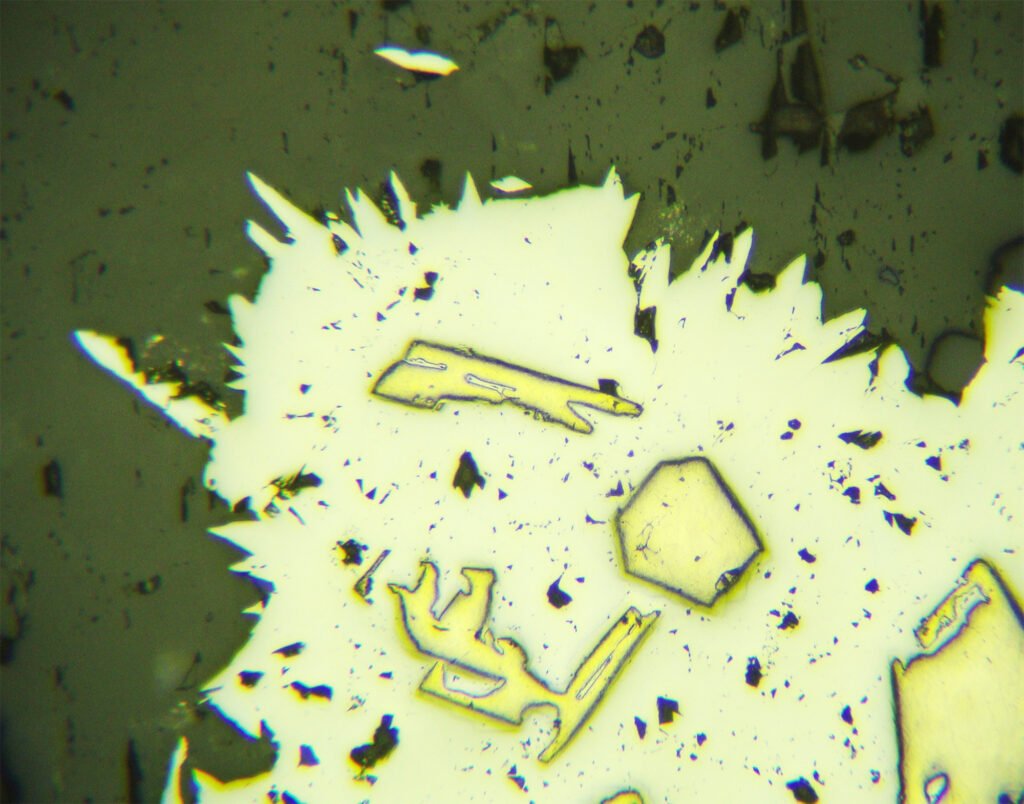
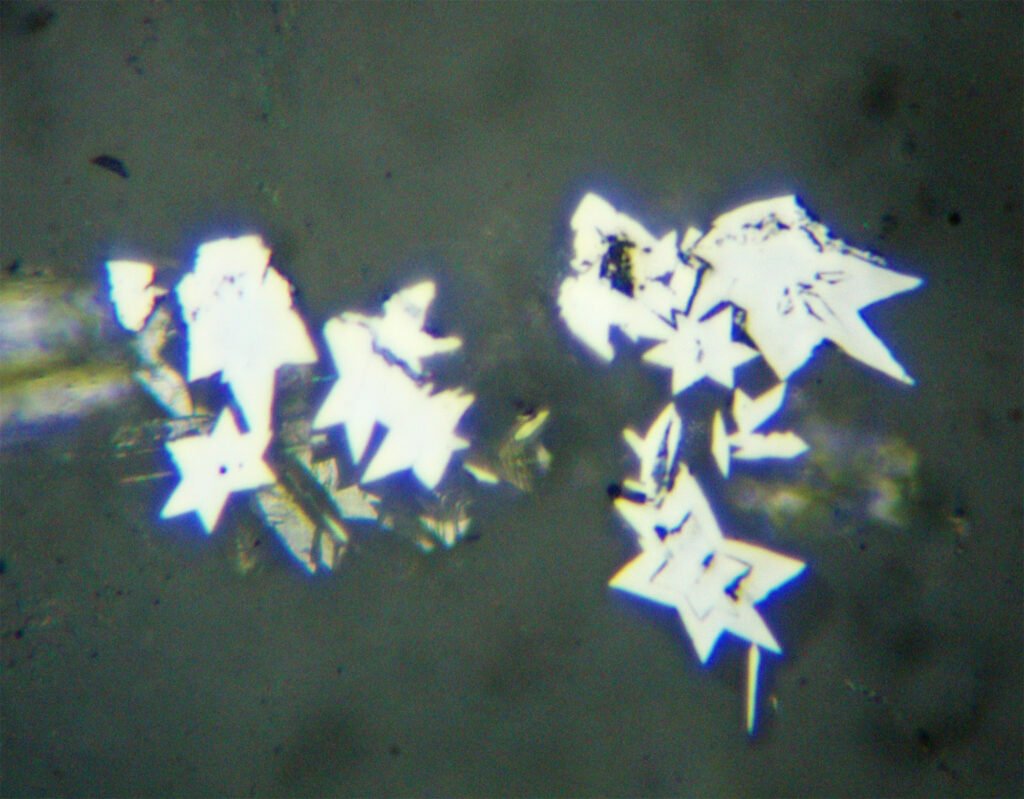
Reflection color: White, often with a bluish tint.
Compared to the color of rammelsbergite, the color of safflorite is white, less yellow.
Compared to the color of native antimony, the color of safflorite is somewhat gray.
Compared to the color of native bismuth, the color of safflorite is bluish.
Compared to the color of native silver, the color of safflorite is grayish-white.
Pleochroism: Very weak, ranging from yellowish to gray and bluish-white, it needs to be observed only at intergranular boundaries.
With increasing Fe content, pleochroism increases.
Reflectivity: 52.02 – 54.46%.
Bireflectance: Minimum.
CROSSED POLARIZED LIGHT – XPL
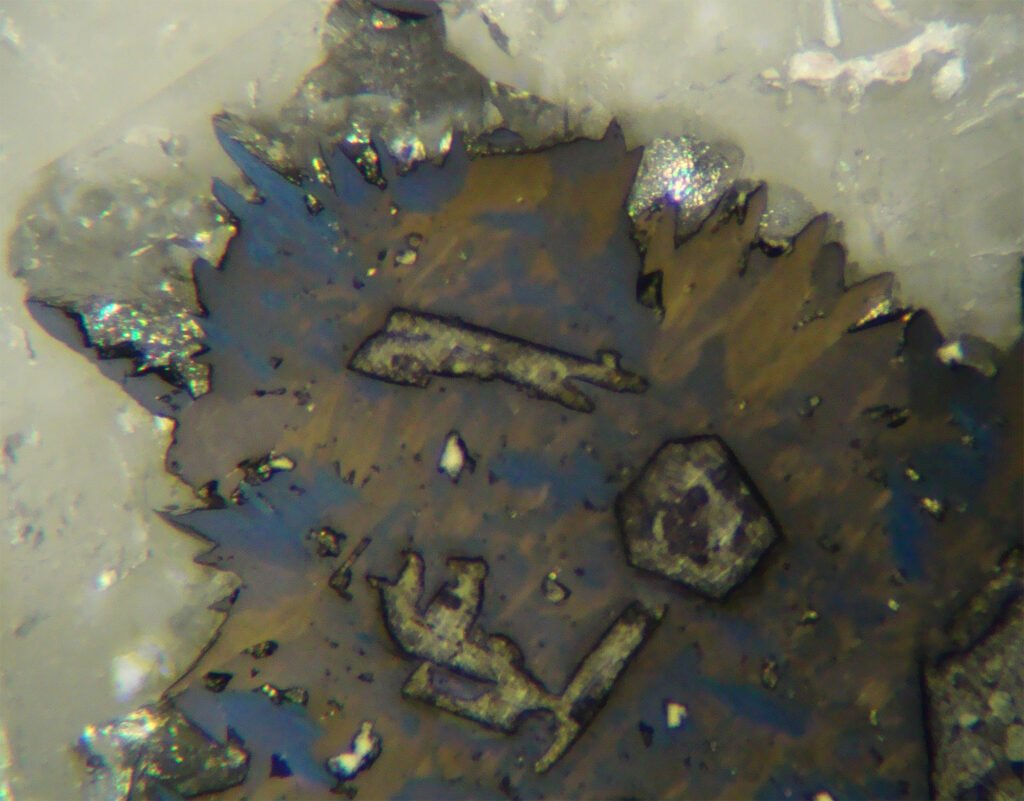
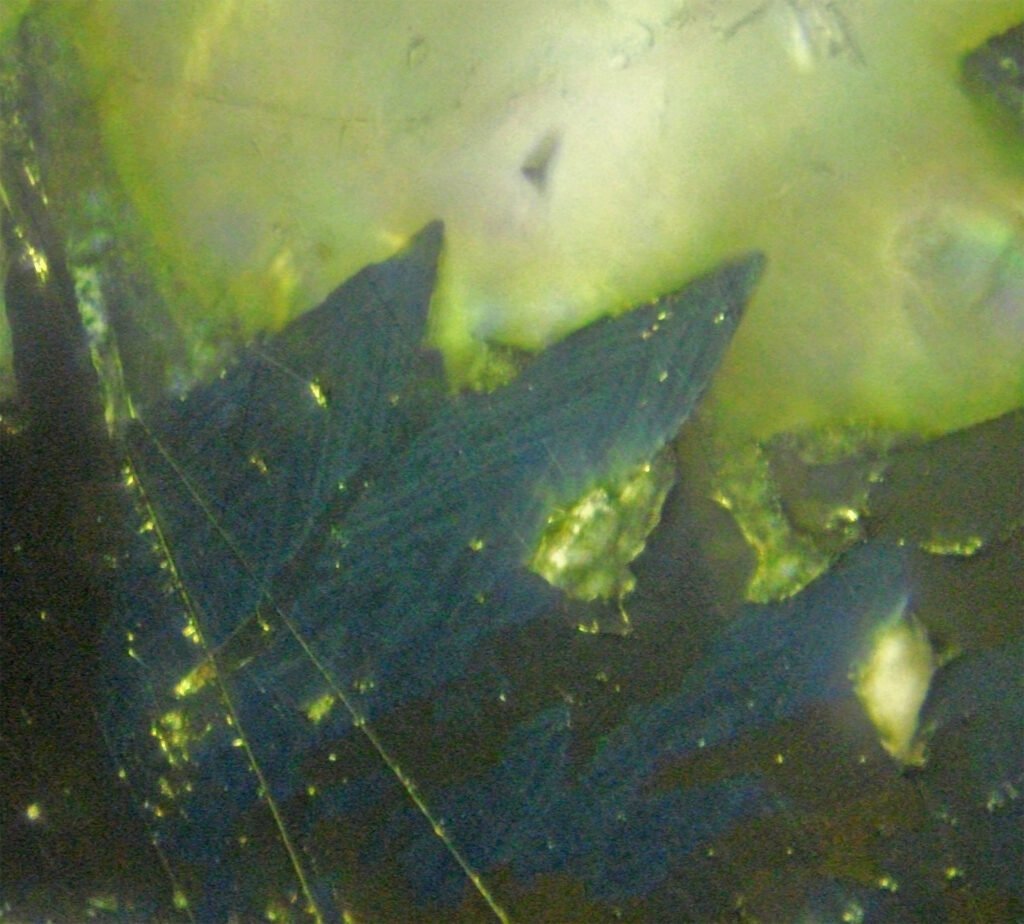
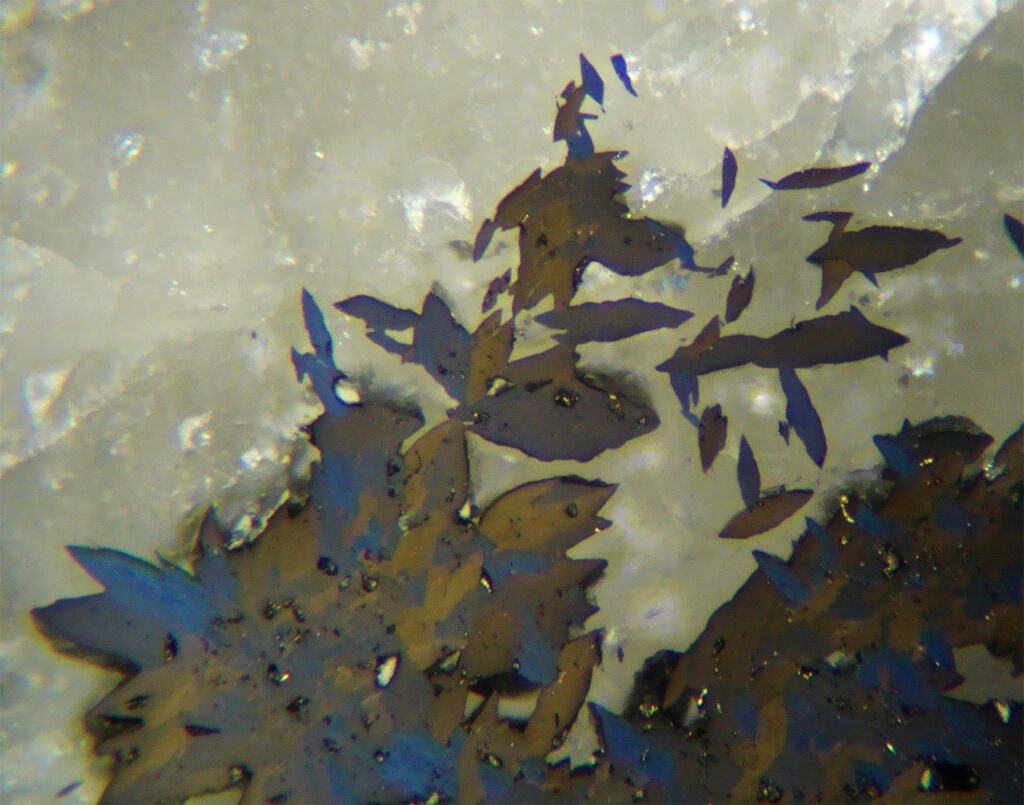
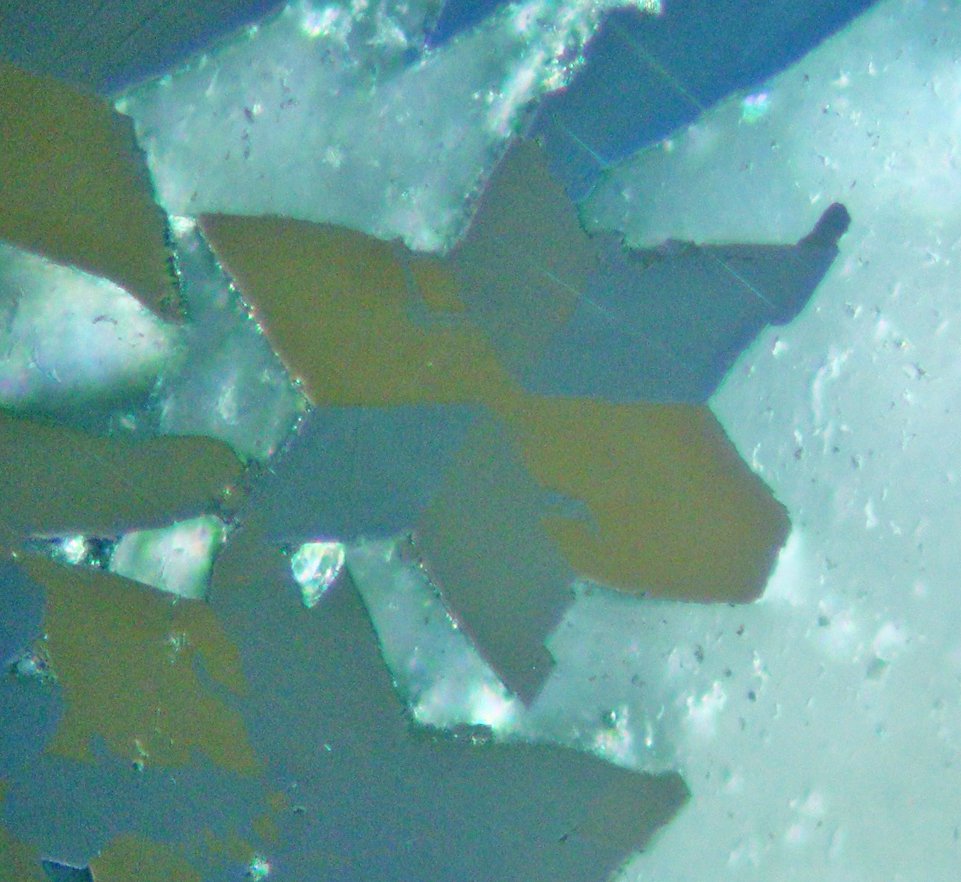
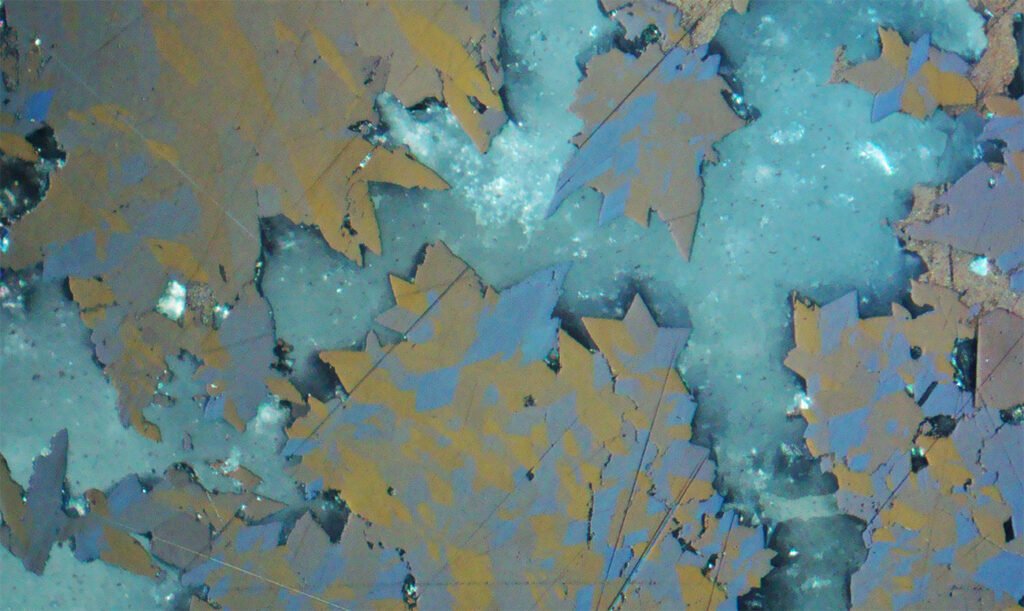
Isotropy / Anisotropy: Anisotropy can be very intense between dark brown and blue, especially in sections parallel to (001), but the color effects and intensity can be highly variable, making the zoning very visible.
Some grains and certain zones can be almost isotropic.
Safflorite is the mineral, among the arsenides, that shows the strongest variations in anisotropy, sometimes within the single crystal itself.
If there are strongly radioactive minerals in the vicinity of the safflorite, the anisotropy changes noticeably, and the differences in color and intensity of the different zones become smaller.
Internal reflections: No.
May be confused with: Several other minerals in the Group, sometimes conclusive identification is impossible.
Arsenopyrite is very similar, but the grain boundaries are straighter and better defined.
Glaucodot exhibits weaker anisotropy.
Löllingite exhibits more pronounced pleochroism and stronger anisotropy.
Rammelsbergite generally shows fine lamellar twinning.
Pararammelsbergite does not show twinning.
General Characteristics:
Grain shape: Safflorite generally exhibits concentric or radial textures with alternating zones of safflorite with other minerals such as glaucodote, nicheline, eskutterudite, etc. It can occur in aggregates of idiomorphic crystals.
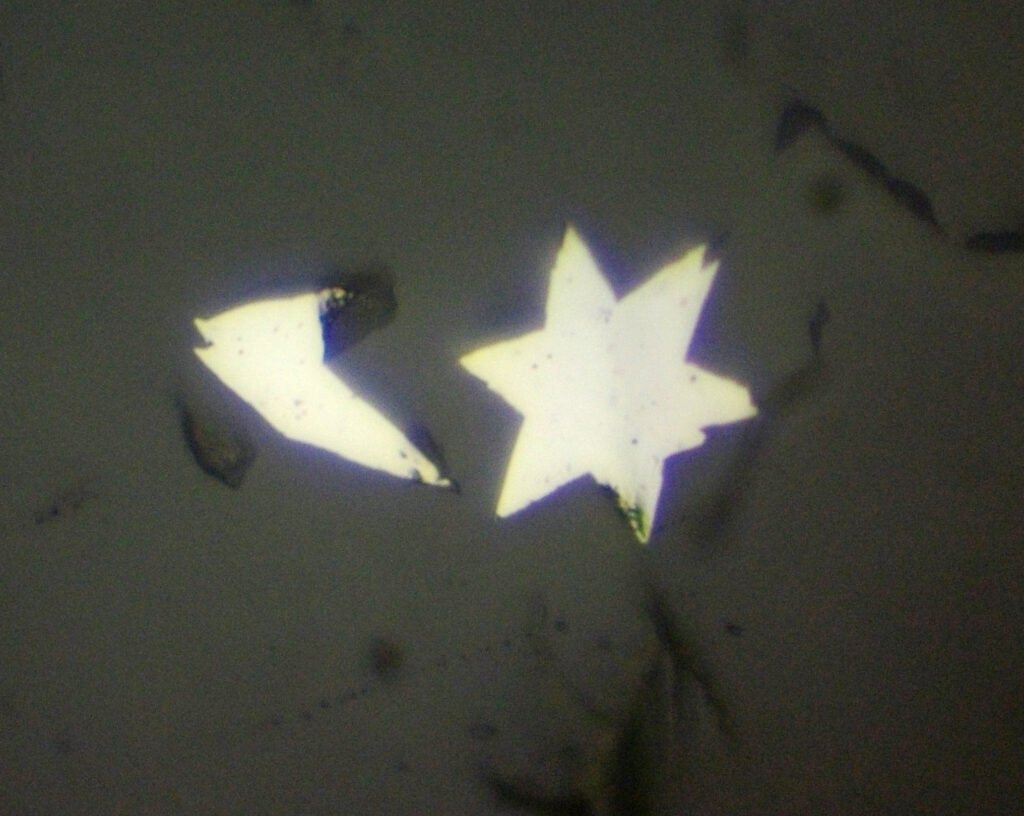
Twinning is the striking characteristic. Twins with 3 individuals (“trillings”) of helical-acicular shape according to (110) generate star-shaped sections (the “safflorite stars”), easily recognizable. Sometimes the twinned sets then intergrown in the form of a knot or form a 12-pointed star through a twin according to (101). In Crossed Nicols the twinning structure is easily recognizable.
Zoning can be very well developed.
Cleavage is not observed.
Substitutions 1: Safflorite replaces eskutterudite, rammelsbergite, native silver, galena, pitchblende, magnetite, chalcopyrite, sphalerite, niqueline, breithauptite, and cobaltite.
Substitutions 2: Safflorite is replaced by arsenopyrite, cobaltite, galena, sphalerite, marcasite, chalcopyrite, and Ag sulfosalts.
Inclusions IN safflorite can be niqueline, breithauptite, and langisite.
Inclusions OF safflorite occur in pyrite.
Intergrowths occur with native gold, arsenopyrite, and löllingite.