STANNITE
Stannnite – Cu2FeSnS4 – is a relatively common sulfide. It is part of polymetallic ores, being primarily an ore of Sn (27.61% by weight), but also of Cu (29.56% by weight). It is sometimes called “bell metal ore” because it was used to obtain Sn for bell casting.
It is classified in the Stannnite Group and often contains Zn replacing Fe. It may contain Ag, Cd, and In, and sometimes traces of Ge. There is a variety with Zn. Stannnite is dimorphic with ferrokësterite, with which it is easily confused macroscopically.
1. Characteristics
Crystal system: Tetragonal scalenohedral.
Color: Steel gray to iron black with an olive-green to brownish or pinkish tint, fading to pale blue.
Habit: Generally massive, disseminated, granular. Rare pseudo-octahedral crystals, up to 6 cm in size.
Cleavage: {110} indistinct, {001} indistinct.
Tenacity: No information available.
Twinning: It can develop penetration twins through {102} by the {101} plane, in addition to polysynthetic twins.
Fracture: Irregular.
Mohs Hardness: 4
Parting: No.
Streak: Black.
Lustre: Metallic.
Diaphaneity: Opaque.
Density (g/cm³): 4.3 – 4.5
2. Geology and Deposits
Stannite occurs in high-temperature hydrothermal vein deposits that contain Sn. In these deposits it is not rare. Quite the contrary, it is present in a constant and relatively high form among the sulfides of this type of occurrence.
It also occasionally occurs in the pegmatitic-pneumatolytic phase, but the quantities are generally small; Only in some cases does its volume make it economically profitable.
Furthermore, stannite occurs, generally also in very small quantities, in some high-temperature deposits that are unrelated to the paragenesis of cassiterite.
3. Mineral Associations
Stannit occur associated with common gangue minerals (quartz, calcite, siderite), and with silicates characteristic of lithium-bearing pegmatites (muscovite, lithium-bearing micas (“zinnwaldite”), fluorite).
It occurs with common sulfides such as pyrite, chalcopyrite, arsenopyrite, pyrrhotite, galena, sphalerite, and molybdenite.
In the specific paragenesis, with tetrahedrite-tennantite, cassiterite, montebrasite, wolframite (ferberite), native bismuth, andorite, argyrodite, acanthite, cubanite, bornite, parkerite, pentlandite, tetradymite, jamesonite, zinkenite, kësterite, owyheeite, enargite, mawsonite, wurtzite, boulangerite, bournonite, geochronite, teallite, herzenbergite, native silver, scheelite, hematite, and cylindrite.
Also with secondary minerals such as malachite and covellite.
4. Transmitted Light Microscopy
This does not apply, as stannite is completely opaque.
5. Reflected Light Microscopy
Sample preparation: Stannnite acquires a good polish quickly and easily. When incipiently altered, polishing becomes more difficult because the cassiterite that forms is very splintery; its fragments detach from the polished section during polishing and create polishing grooves.
The polishing hardness of stannnite is moderate:
– greater than the hardness of chalcopyrite,
– approximately the same hardness as tetrahedrite,
– less than the hardness of sphalerite, and
– much less than the hardness of arsenopyrite.
Basal sections acquire a lower quality polish than longitudinal sections.
PLANE POLARIZED LIGHT – PPL
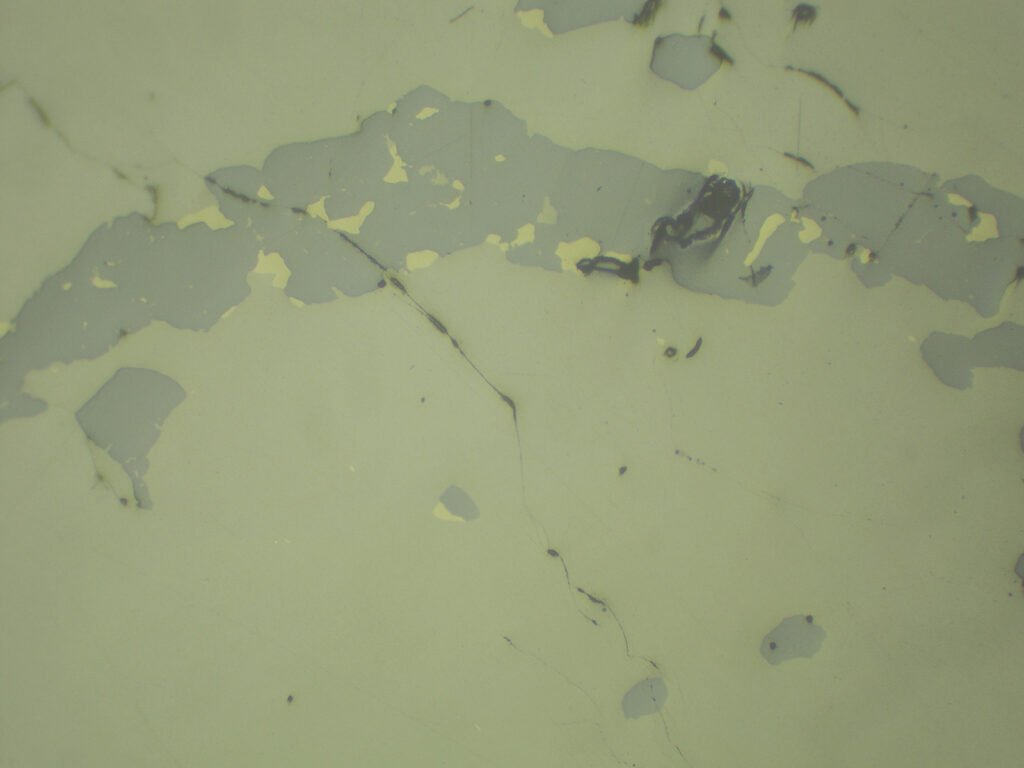
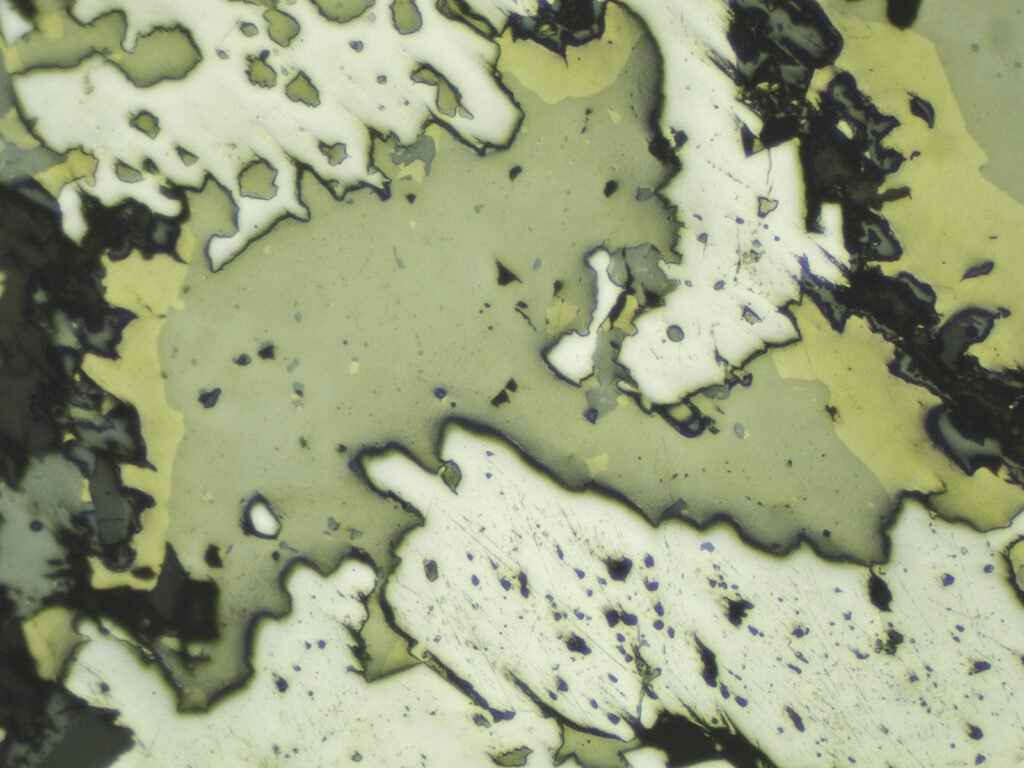
Reflection color: Medium brownish-gray with a strong olive-green tint, very similar to the macroscopic color in fresh fracture (without haze).
Compared to the color of chalcopyrite, the color of stannite is much darker, in a greenish-brown.
Compared to the color of tetrahedrite, the color of stannite is slightly darker, in a brownish-gray.
Compared to the color of sphalerite, the color of stannite is lighter, yellowish-brown to olive-green.
Compared to the color of cassiterite, the color of stannite is brownish-olive green.
Compared to the color of cylindrite, the color of stannite is brown with a pinkish tint.
Compared to the color of franckeite, the color of stannite is yellowish-brown.
Pleochroism: Very faint, usually imperceptible, sometimes more easily visible, ranging from light brown to brownish olive green.
Reflectivity: 28.69 – 29.45%.
Bireflectance: No.
CROSSED POLARIZED LIGHT – XPL
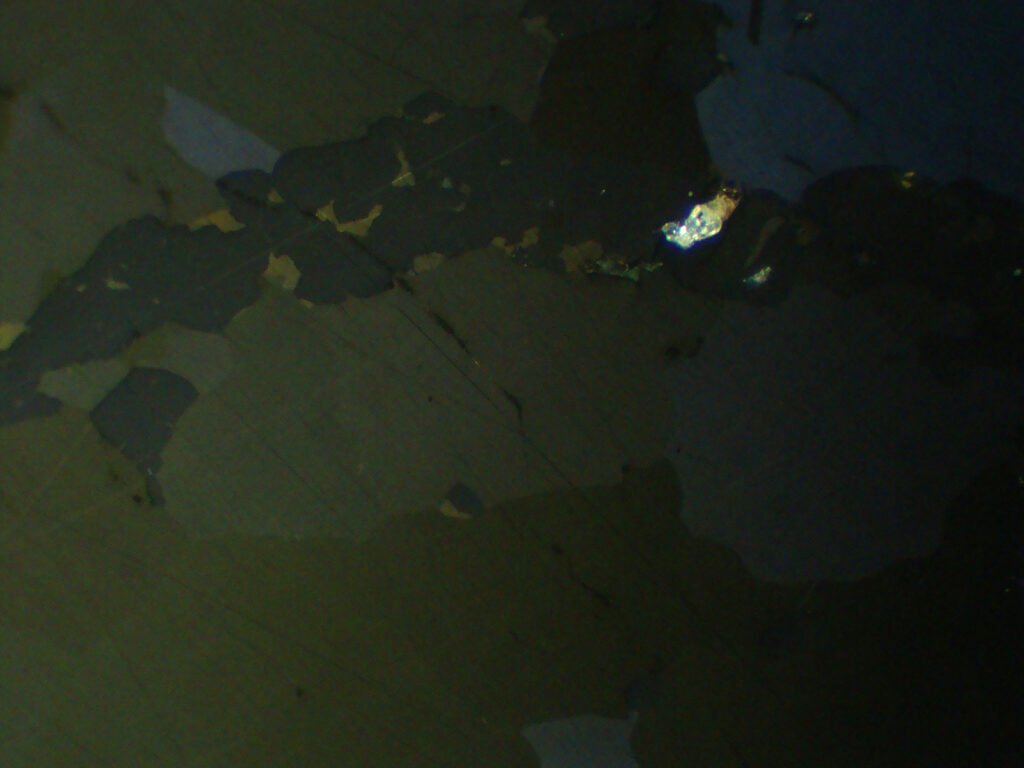
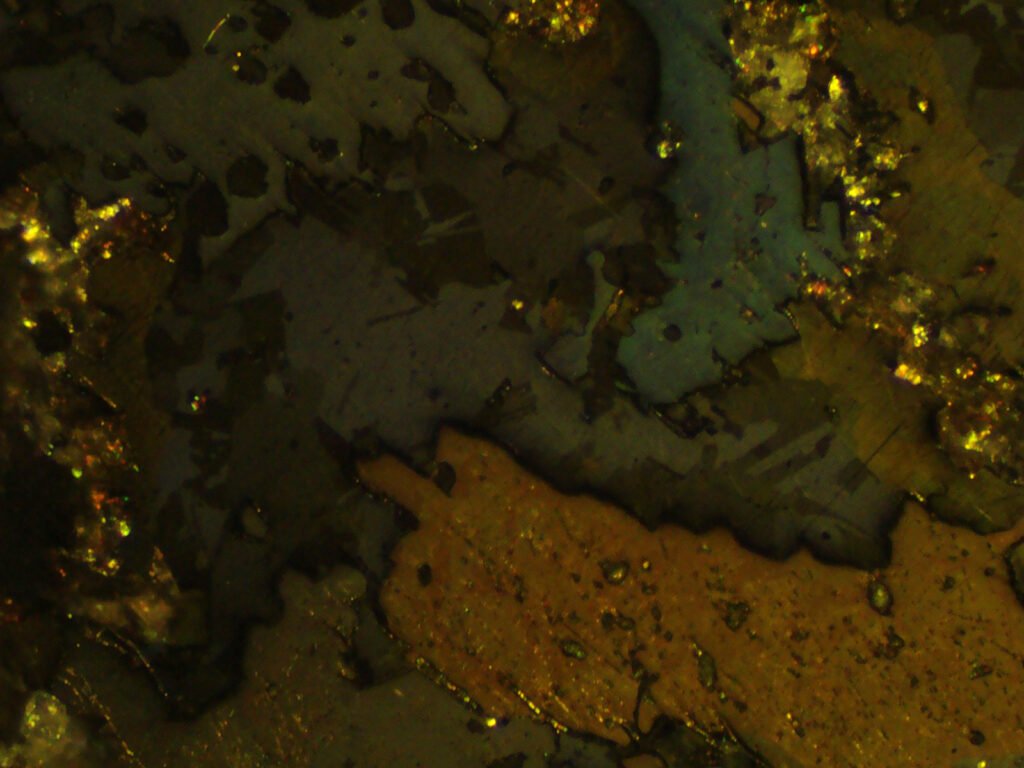
Isotropy / Anisotropy: Distinct to strong anisotropy between violet and slate green, very useful for recognizing structures. Other colors mentioned in the literature are yellowish brown, grayish olive green, bluish, or violet gray.
In the diagonal position, the colors are intense, especially violet and slate green. In zoned grains, the portions poor in CuFeS2 are the most anisotropic.
Internal reflections: No.
May be confused with: Tetrahedrite-tennantite, especially the iron-rich, low-reflectivity Cu-Sb varieties, is also similar to some very rare ores. However, tetrahedrite-tennantite has higher reflectivity and, most importantly, is isotropic.
General Characteristics:
Grain shape: Stannnite forms well-developed crystals only in very rare cases. It generally occurs as a filling of interstices between older minerals or forms thin films between them. When it occurs in greater quantity, it forms granular aggregates with slightly dentate contacts. Grain sizes are highly variable, generally ranging from 0.05 – 0.2 mm, and can reach 2 cm.
Cleavage along (110), and more rarely also along (001), becomes noticeable in poor quality sections due to the triangular polishing pits that are formed. Generally, cleavages are not visible.
Transformation lamellae: high-temperature cubic stannite transformation lamellae to low-temperature tetragonal stannite are often very conspicuous. These lamellae are arranged parallel to (001) and (100), vaguely resembling microcline twins. They are thin lamellae in a checkerboard pattern.
Inclusions 1: inclusions in stannite form during the transformation from high-temperature stannite to low-temperature stannite. Excess sphalerite (ZnS) and chalcopyrite (CuFeS2) unmix and form very small grains (inclusions) in stannite. Other inclusions that may occur in stannite are arsenopyrite, pyrite, cassiterite, tetrahedrite, native bismuth, bismuthinite, boulangerite, rutile, native gold, and galena.
Inclusions 2: Stannite can occur as inclusions in sphalerite, pyrrhotite, and galena.
Twins form as in sphalerite and chalcopyrite, but are much rarer. The twins are pseudo-cubic according to (111) and are usually growth twins, often with pressure lamellae.
Zoning can occur in some cases. Sometimes it is possible to recognize it by color variations; more often by an irregular distribution of small unmixing grains of chalcopyrite and sphalerite (e.g., more frequent in the center and rarer in the lateral portions of the grains).
Deformations are rarer. In some cases there are signs of recrystallization (fine granular texture).
Cataclasis is apparently very rare.
Unmixing structures are very common and very complicated. In fact, there is always chalcopyrite present in very small grains, but the size of these grains is so minute that they go unnoticed. They are small oval discs, generally of uniform size, in many cases arranged parallel to (001). Unmixing also occurs arranged parallel to (100). If the unmixing grains are arranged parallel to (001) and (100) and with the same development – which is frequent – the unmixing occurred before the transformation of high-temperature stannite to low-temperature stannite, when (100) and (001) were still cubic faces of the same type. The same must have occurred when small, typically cubic unmixing bodies are arranged in a completely disordered aggregate of small stannite grains, which apparently represent a recrystallization of pseudo-cubic lamellae. The unmixing must have occurred at T < 250ºC, since occasionally unmixing of cubanite is observed in the unmixing grains of chalcopyrite.
Substitutions 1: Stannnite can replace galena, sphalerite, chalcopyrite, pyrite, pyrrhotite, cassiterite, arsenopyrite, bismuthinite, Co-Ni-Fe arsenides, quartz, and nordenskiöldine.
Substitutions 2: Stannnite is replaced by native bismuth, bismuthinite, tetrahedrite-tennantite, marcasite, sphalerite, zinkenite, franckeite, galena, andorite, covellite, silver minerals, chalcopyrite, and stannoidite.
Alterations of stannnite generate very complex and variable aggregates of cassiterite, covellite, or bornite/marcasite. Sometimes marcasite develops a well-formed network, arranged parallel to the structural planes of stannnite.
Oriented intergrowths occur especially with chalcopyrite and sphalerite. In many cases, chalcopyrite fills the fractures within the stannite grains and between the stannite grains – these fillings are also orientedally intergrown with stannite. Similarly, the stannite films that occur between chalcopyrite and sphalerite grains are orientedally intergrown with chalcopyrite. Oriented intergrowths also occur with tetrahedrite, stannoidite, and kösterite.
Reaction rims of stannite can form between cassiterite and the following minerals: pyrrhotite, chalcopyrite, tetrahedrite, and sphalerite. Canfieldite and franckeite reaction rims can occur on stannite.
Myrmequites of stannite with chalcopyrite, in highly variable grain sizes, are quite common. Myrmequites of chalcopyrite and cassiterite are likely formed from stannite through oxidation.
Rhythmic deposits have been observed in some stannites: these are crusts formed alternately by coarser and finer grains. These delicate structures probably formed at much lower temperatures than common stannites, as they are always free of demixing bodies.