AMBLYGONITE

Amblygonite – (Li,Na)AlPO4(F,OH) – is a fairly rare phosphate that occurs mainly in pegmatites rich in Li and PO4. It constitutes an important Li ore, included in the “hard rock lithium ore” type minerals, in contrast to Li extracted from salt flat brines.

Amblygonite (more F than OH) forms a series with montebrasite (more OH than F), but amblygonite is much rarer than montebrasite.

Macroscopically, it is easily confused with other minerals, despite its somewhat higher density. It is possible to confuse amblygonite with montebrasite, as they are practically identical in appearance. In many collections, the “amblygonites” from pegmatite cavities are, in reality, montebrasites. Furthermore, amblygonite and montebrasite can be confused with several other massive, transparent, colorless to milky minerals that occur in the same pegmatites, such as quartz, orthoclase, microcline, petalite, pollucite, spodumene, and beryl, and it is also possible to confuse them, at least theoretically, with massive white rocks such as marbles, limestones, carbonatites, and anorthosites.

One test for recognizing amblygonite is its fusibility. On the von Kobell scale, the fusibility of amblygonite is 2. This means that the mineral melts under a common candle, forming an opaque white pearl. This test differentiates it from quartz and feldspars.

Amblygonite is very faintly green under long UV waves. It exhibits light blue phosphorescence under short and long UV waves. There is a variety, “hebronite,” with a low Na content.

1. Characteristics

Crystal system: Triclinic pinacoidal.

Color: White or cream, it can be colorless, pale yellow, pale green, light blue, beige, brown, gray, or salmon pink. 

Habit: Typically massive, also columnar, prismatic or granular. Complex crystals up to 1.5 meters.

Cleavage: [100] perfect, [110] good, [011] distinct.

Tenacity: Brittle.        

Twinning: According to several laws. Polysynthetic twins are common.  

Fracture: Irregular to subconchoidal.       

Mohs Hardness: 5.5 – 6

Parting: No.         

Streak: White.         

Lustre:  Vitreous to pearly.         

Diaphaneity: Transparent.           

Density (g/cm³): 2.98 – 3.11


2. Geology and Deposits

Amblygonite typically occurs in zoned granitic pegmatites rich in Li and PO4.

It can occur in high-temperature Sn hydrothermal veins and in greisens.


3. Mineral Associations

It is associated with the characteristic minerals of lithium-bearing pegmatites: quartz, microcline, beryl, tourmaline, lacroixite, other Li minerals (spodumene, petalite, pollucite and lepidolite), other lithium-bearing phosphates (lithiophyllite and triphyllite) and non-Li phosphates (fluorapatite, turquoise, wavellite, planerite).

In greisens it is associated with various Sn minerals (cassiterite, mushistonite, kesterite, varlamoffite), topaz, mica and quartz. In some situations it occurs with acanthite and arthurite.


4. Transmitted Light Microscopy

Refraction indices: nα: 1.577 – 1.591      nβ: 1.592 – 1.605    nγ: 1.596 – 1.613

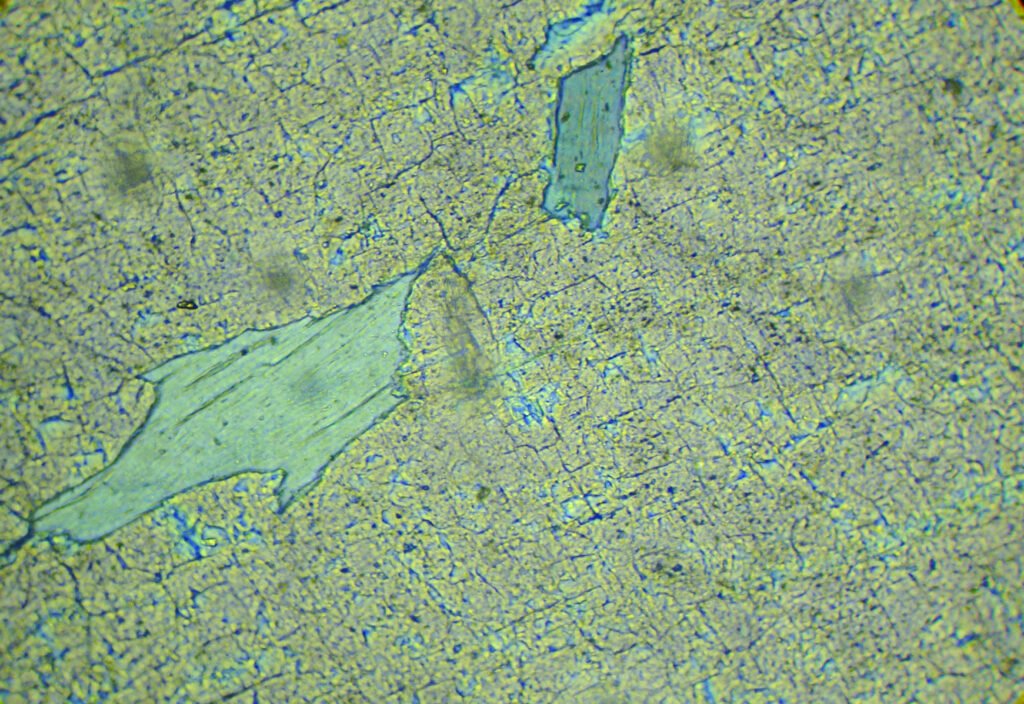
PLANE POLARIZED LIGHT – PPL

Color / Pleochroism: Colorless, without pleochroism. 

Relief: Moderate.           

Cleavage: [100] perfect, [110] good and [011] distinct; can form a lattice.  

Habits: massive, usually large crystals where the habit cannot be determined.            

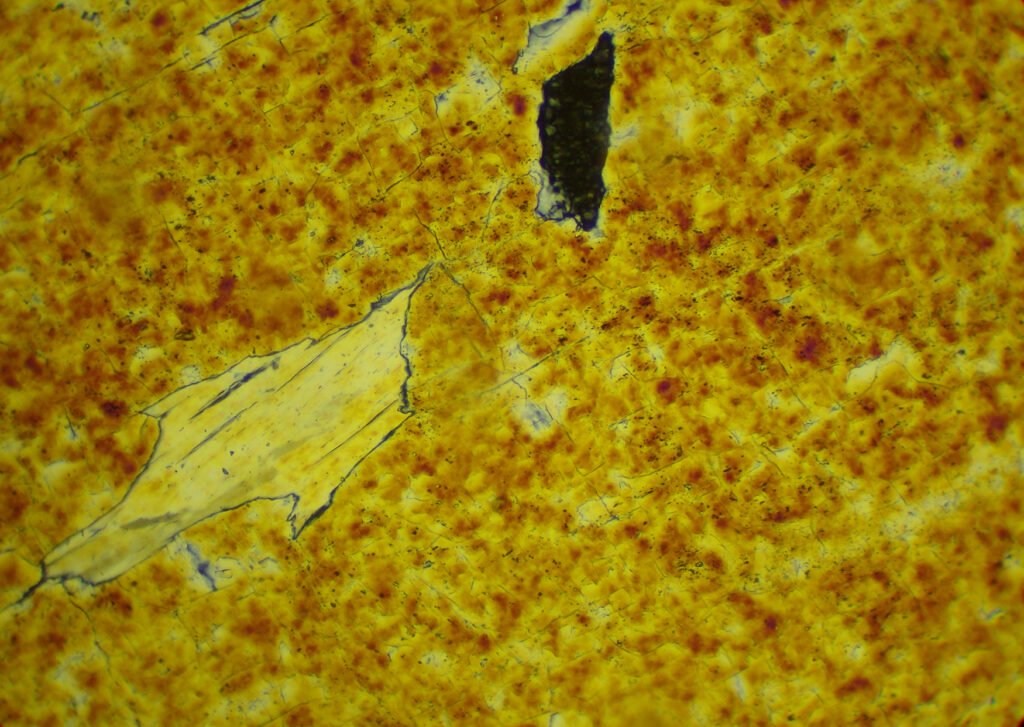
CROSSED POLARIZED LIGHT – XPL

Birefringence and Interference Colors: Maximum birefringence of 0.019 to 0.022, corresponding to interference colors up to first-order blue.           

Extinction: oblique, as expected of a triclinic mineral.           

Elongation sign: No information available.            

Twins: Polysynthetic twins are common.         

Zoning: No.             

CONVERGENT LIGHT

Character: B(-)          

2V angle:  107 – 129,5º.        

Alterations: No information available.                

May be confused with: many other minerals, especially pyroxenes.
5. Reflected Light Microscopy

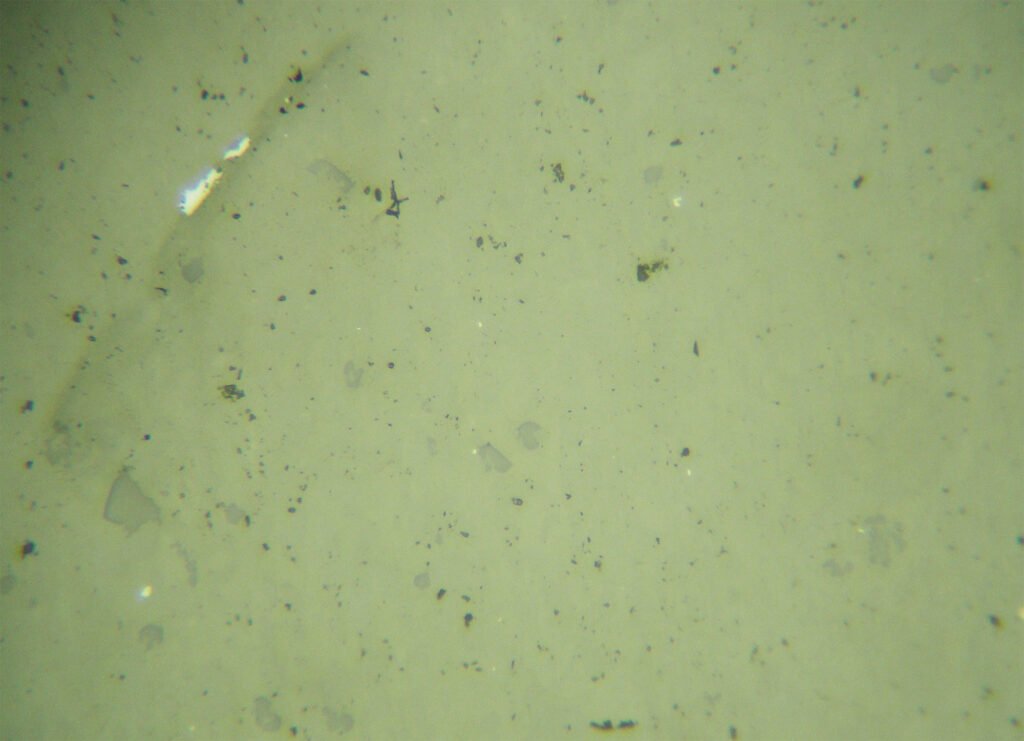
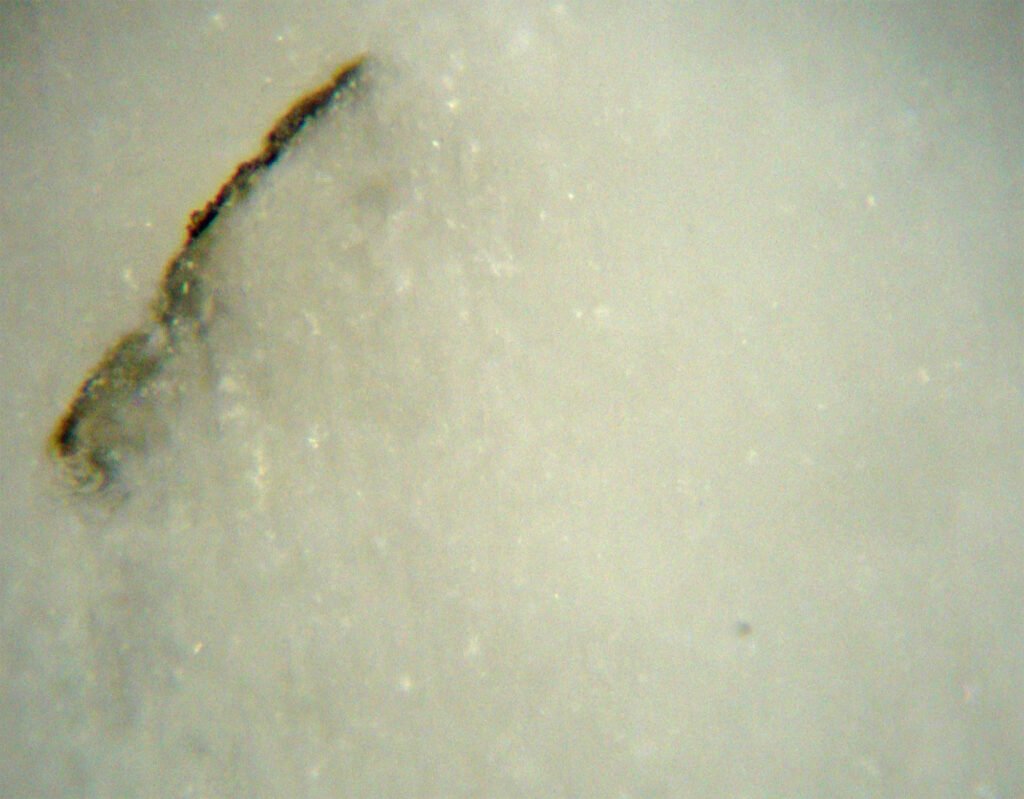
Reflected light microscopy is clearly not the recommended analytical method for identifying amblygonite. However, it is important to prepare a polished slide or section to identify the opaque minerals that may occur associated with amblygonite. This task is made difficult by the generally very large size of the minerals that make up the pegmatites where amblygonite occurs.

Sample preparation: Amblygonite is easy to polish and produces a good quality finish, with only a few polishing grooves, because of its higher hardness.       

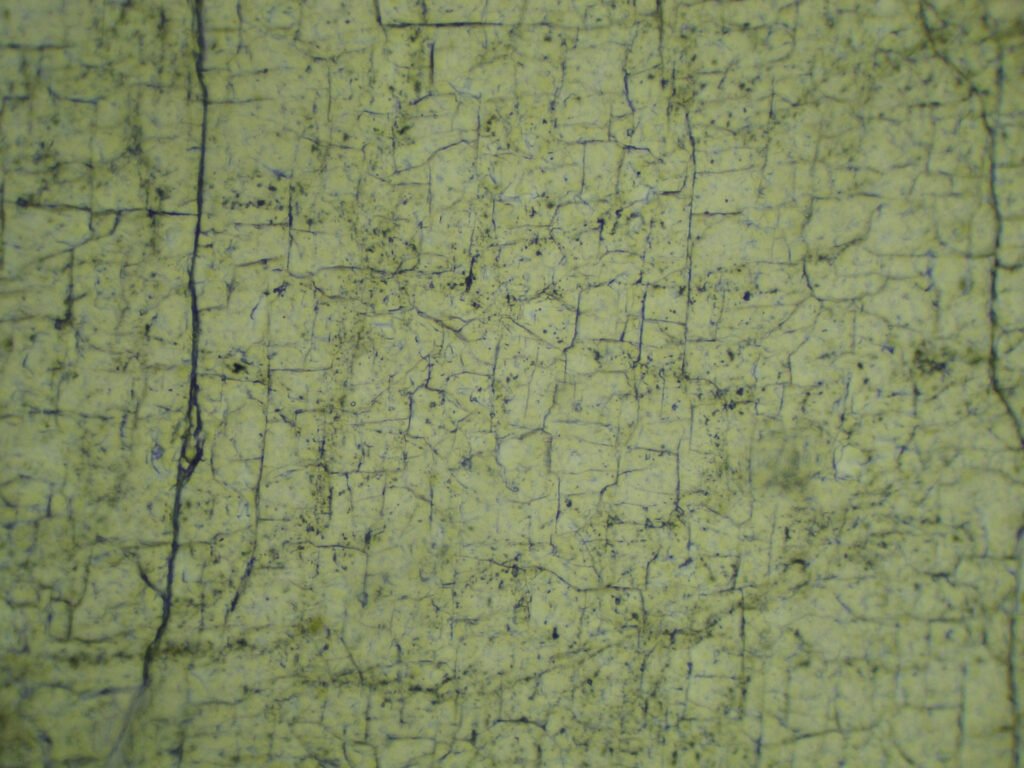
PLANE POLARIZED LIGHT – PPL

Reflection color:  Dark gray.      

Pleochroism: No.      

Reflectivity: Low (<10%)        

Bireflectance: No.       

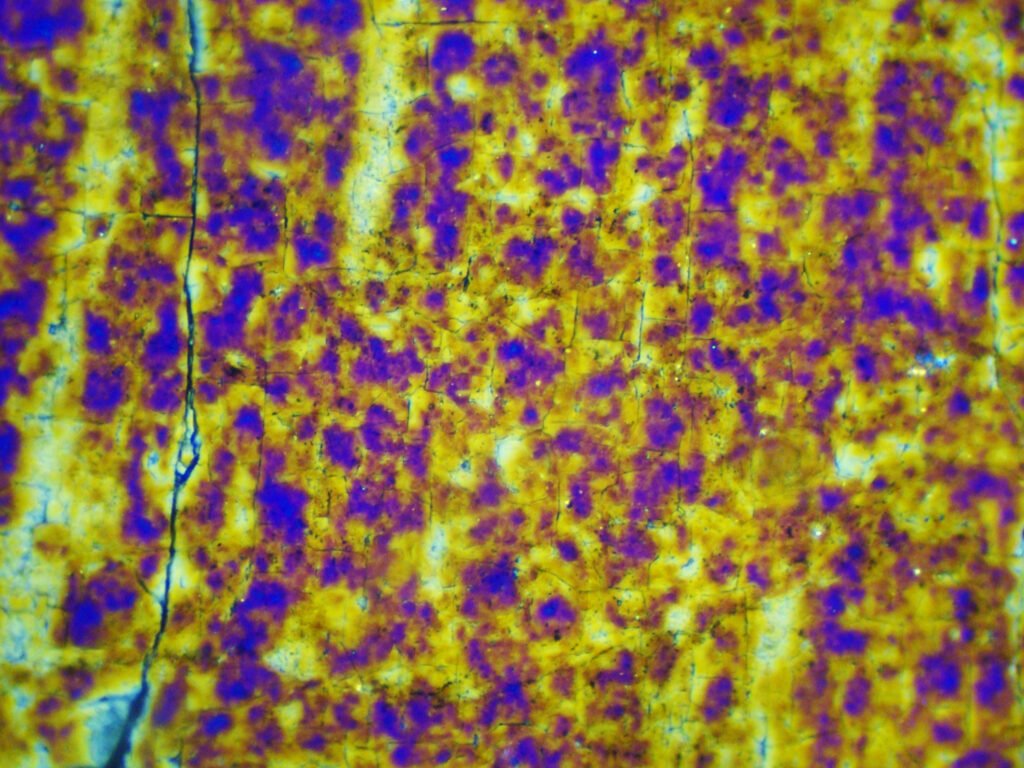
CROSSED POLARIZED LIGHT – XPL

Isotropy / Anisotropy: Anisotropy was not observed.        

Internal reflections: Light to white, widespread.

May be confused with: Many other transparent minerals of light colors. Amblygonite cannot be identified by reflected light.       

General Characteristics: 

Polishing pits are possible because there is cleavage.