Miargyrite – AgSbS2 – is a relatively rare sulfide that occurs in subordinate quantities in low-temperature epithermal hydrothermal veins with Ag sulfides. It is an Ag ore.
Miargyrite is the monoclinic trimorph of cuboargyrite (isometric AgSbS2) and baumstarkite (Ag3Sb3S6 , triclinic). It may contain As and Fe as impurities.
Crystal system: Monoclinic prismatic.
Color: Black as iron to gray as steel, with internal reflections in deep red.
Habit: Generally thick tabular crystals according to {001}, {100} or {-101}. Massive.
Cleavage: {010} imperfect, rare on {100} and {101}. Striations parallel to {010} and {0-11}.
Tenacity: Brittle.
Twinning: Polysinthetic.
Fracture: Subconchoidal.
Mohs Hardness: 2.5
Parting: No.
Streak: Cherry red (Important! Very diagnostic!)
Lustre: Adamantine metallic.
Diaphaneity: Almost opaque, translucent in fine fragments.
Density (g/cm³): 5.25
The typical environment for miargyrite occurrences is low-temperature epithermal hydrothermal veins of Ag sulfides.
Generally, the amount of miargyrite that occurs in the veins is small, only in some cases forming the main ore mineral of silver. It easily goes unnoticed or is confused with minerals of the tetrahedrite-tennantite series.
It occurs associated with several typical gangue minerals such as quartz, barite, and carbonates (calcite, siderite).
It occurs with common sulfides such as galena, sphalerite, and pyrite.
It is also associated with many other Ag minerals, such as native silver, acanthite, stephanite, pyrargyrite-proustite, andorite, “freibergite,” polybasite, baumstarkite, and pyrostilpnite.
Miargyrite is translucent in thin fragments, an observation that is difficult to make.
Under the microscope, it exhibits nα = 2.720 – 2.800, a maximum birefringence of 2.720 (extremely high, corresponding to black colors), moderate relief, and deep red internal reflections.
Sample preparation: Miargyrite polishes easily, as does pyrargyrite. Its hardness upon polishing is very low, even lower than galena.
PLANE POLARIZED LIGHT – PPL
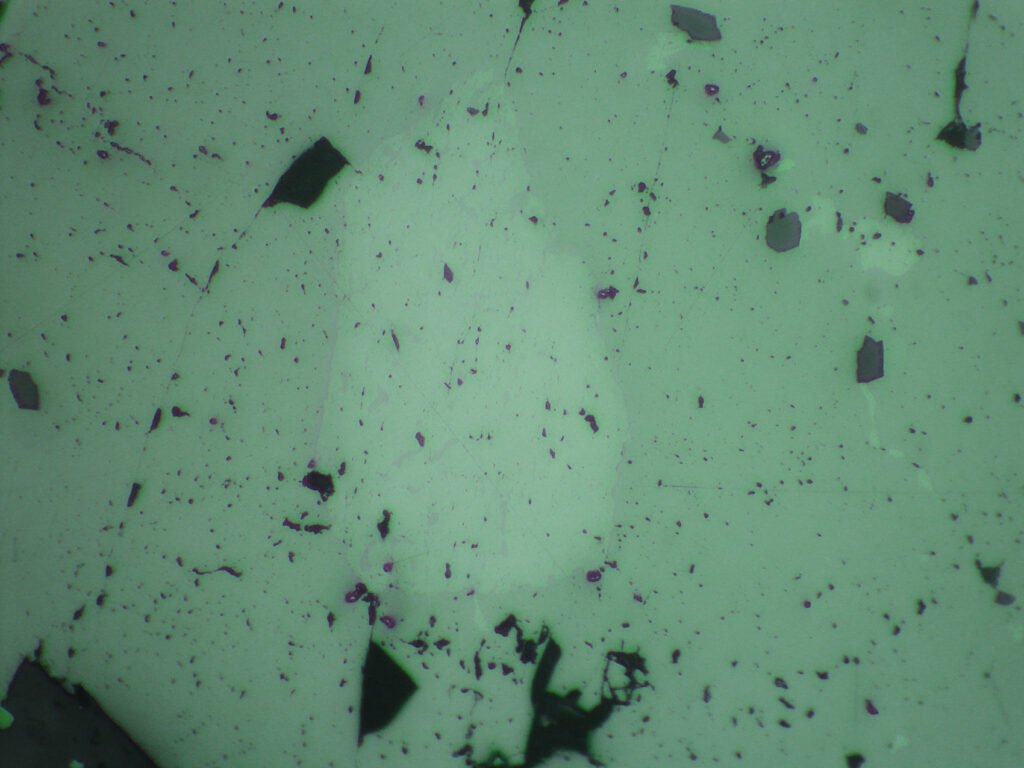
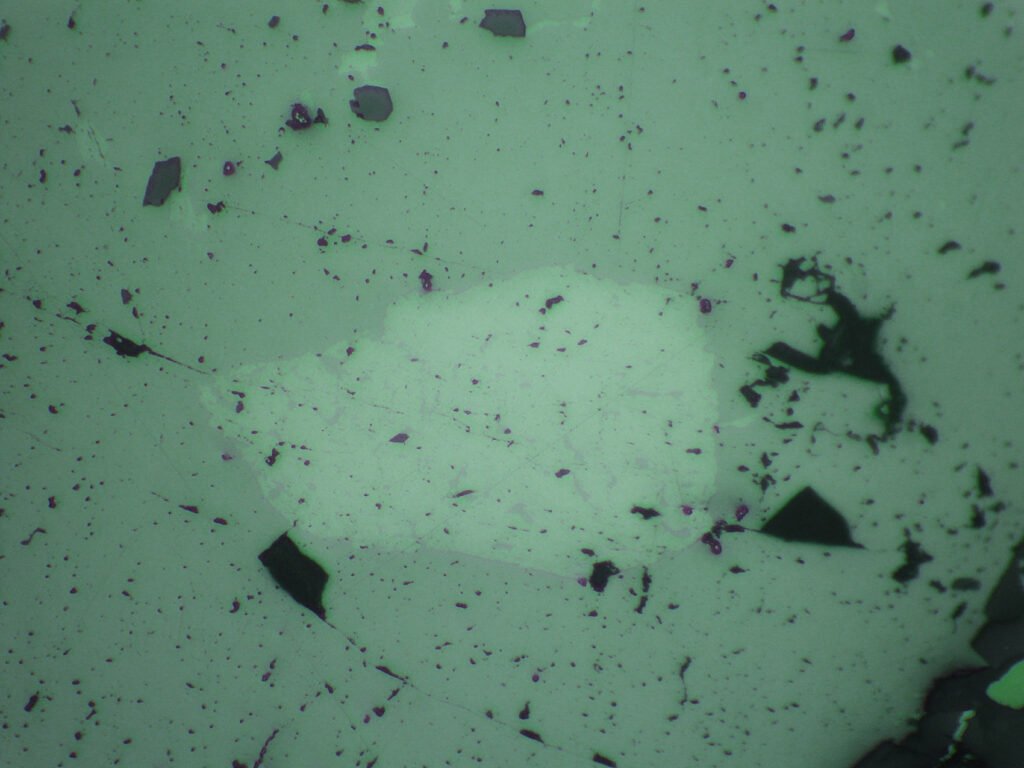
Reflection color: Shades of greenish-gray.
Pleochroism: Distinct in white, light gray white and white gray. The intensity of pleochroism varies according to the section.
Reflectivity: 31,74 – 35.05%
Bireflectance: Weak.
CROSSED POLARIZED LIGHT – XPL
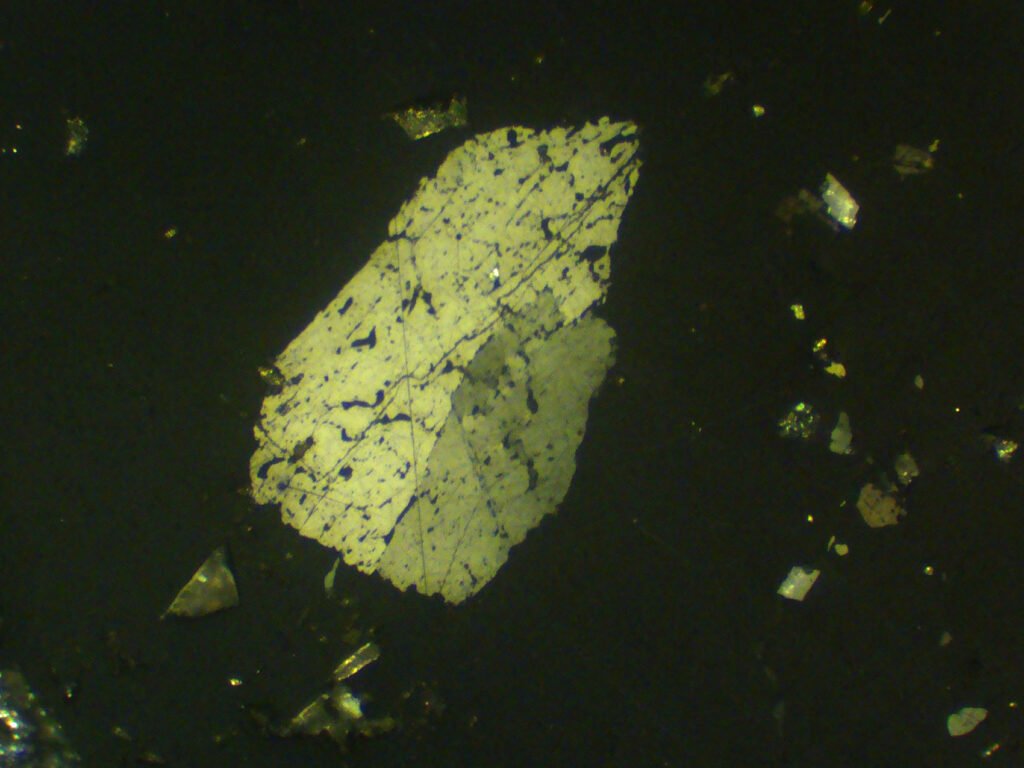
Isotropy / Anisotropy: Strong anisotropy in greenish grays, but the colors are not very vibrant.
Internal reflections: Cherry-red hues can occur when there is an aggregate of small grains, resembling the reflection colors of pirargyrite and proustite.
May be confused with: Miargyrite easily goes unnoticed. It is very similar to freibergite, polybasite, pyragyrite, and stephanite. Easily confused with “fahlores” (tetrahedrite-tennantite).
General Characteristics:
Grain shape varies from coarse to fine, generally with little intergrowth. Miargyrite occupies replacement spaces.
Polishing scratches, due to the low hardness of the mineral, should be expected.
Extinction in non-oriented sections is not complete.
Polysynthetic twinning occurs, but is frequently absent.
Replacement of miargyrite by pirargyrite is frequent.
Myrmekitic intergrowths of miargyrite with proustite and pirargyrite may occur.
Ellipsoidal inclusions of miargyrite may occur in galena, with polybasite and freibergite.
Deformations, despite the low hardness, are not observed.