1. Characteristics
Crystal system: Monoclinic prismatic.
Color: Blue-green, green, dark green, greenish-black.
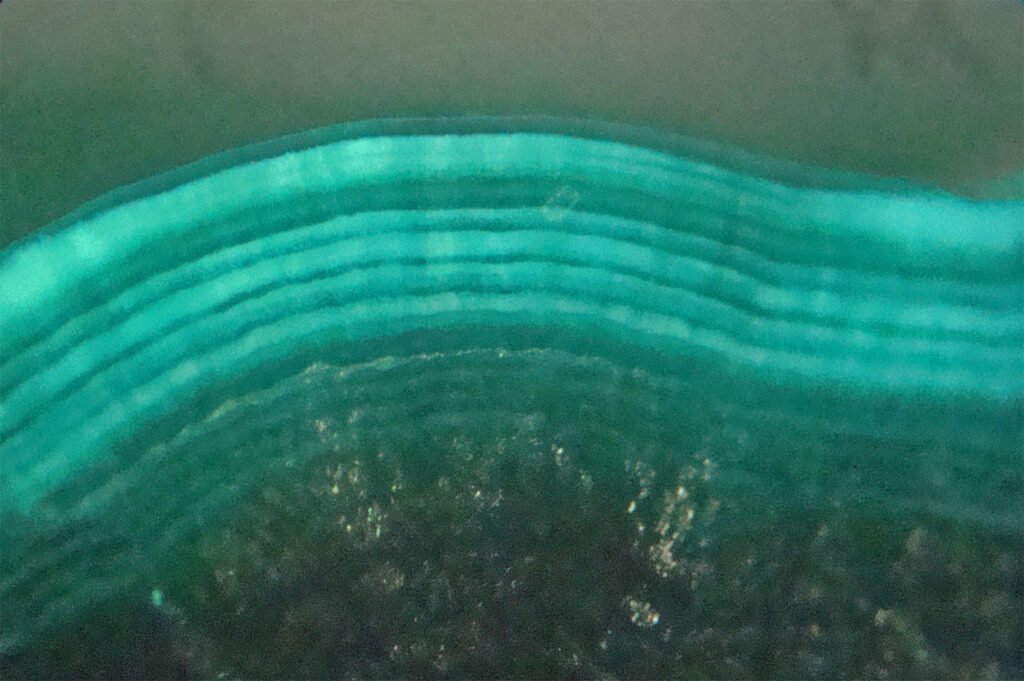
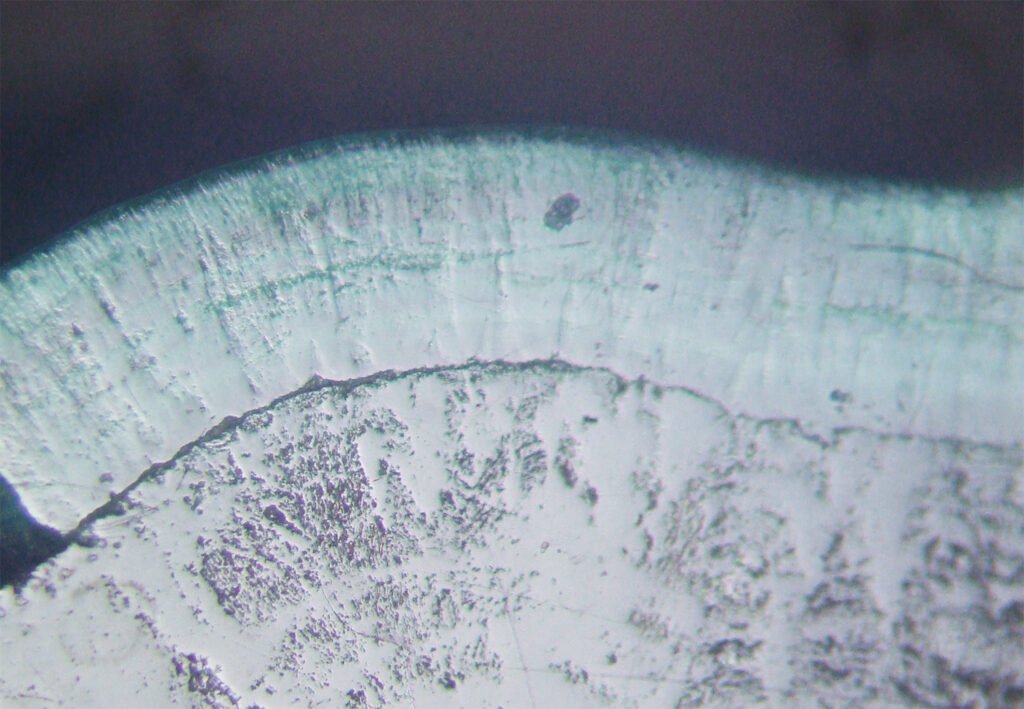
Habit: Pseudomalachite generally occurs as mammillary to botryoidal crusts formed by radial aggregates of microscopic to submicroscopic crystals. The crusts resemble thick green paint. Isolated crystals are rare; they are prismatic to tabular, up to 6 mm in size, rough to rounded, and exhibit many crystal forms. It can form reniform or massive aggregates with a radial fibrous, banded internal structure—strongly resembling that of chalcedony—with fibers elongated along the [010] axis. It also occurs in dense, microcrystalline, or colloform habits.
Cleavage: {100} perfect.
Tenacity: Brittle.
Twinning: On {100}.
Fracture: Splintery, conchoidal.
Mohs Hardness: 4 – 4.5
Parting: No.
Streak: Pale green; it can be bluish.
Lustre: Vitreous, resinous.
Diaphaneity: Transparent.
Density (g/cm³): 3.6 – 4.34
2. Geology and Deposits
Pseudomalachite is characteristic of the oxidation zones of hydrothermal copper deposits. It occurs in many localities, but always in very minor amounts.
3. Mineral Associations
It occurs associated with gangue minerals characteristic of oxidation zones, such as quartz (including the chalcedony variety), limonite (goethite), and halloysite.
Naturally, it is associated with many other secondary Cu minerals, such as carbonates (malachite, azurite), oxides (cuprite, tenorite), silicates (chrysocolla), other phosphates (libethenite, cornetite, reichenbachite, sampleite, apatite), and halides (atacamite).
It is also associated with secondary Pb minerals (pyromorphite, cerussite, mimetite), secondary Co minerals (heterogenite), and Fe oxides (hematite).
4. Transmitted Light Microscopy
Refraction indices: nα: 1.791 nβ: 1.856 nγ: 1.867
PLANE POLARIZED LIGHT – PPL
Color / Pleochroism: Green to bluish green, with weak pleochroism between:
X = bluish green to pale green,
Y = yellowish green
Z = deep bluish green to blue green.
Relief: Very high.
Cleavage: {100} perfect, but the cleavage will hardly be visible because the crystals are fibrous and very small.
Habits: Generally occurring in crusts, it may be banded, with radially arranged microfibers. It strongly resembles the structure of chalcedony.
CROSSED POLARIZED LIGHT – XPL
Birefringence and Interference Colors: Maximum birefringence of 0.076, corresponding to intense, vivid interference colors up to the fourth order, though masked by the mineral’s intense body color.
Extinction: Oblique, between 21 and 23º.
Elongation sign: No information available.
Twins: On {100}, visible only on larger, isolated crystals, which are rare.
Zoning: No information available.
CONVERGENT LIGHT
Character: B(-) or B(+)
2V angle: 48º
Alterations: No information available.
May be confused with: Other green secondary Cu minerals.