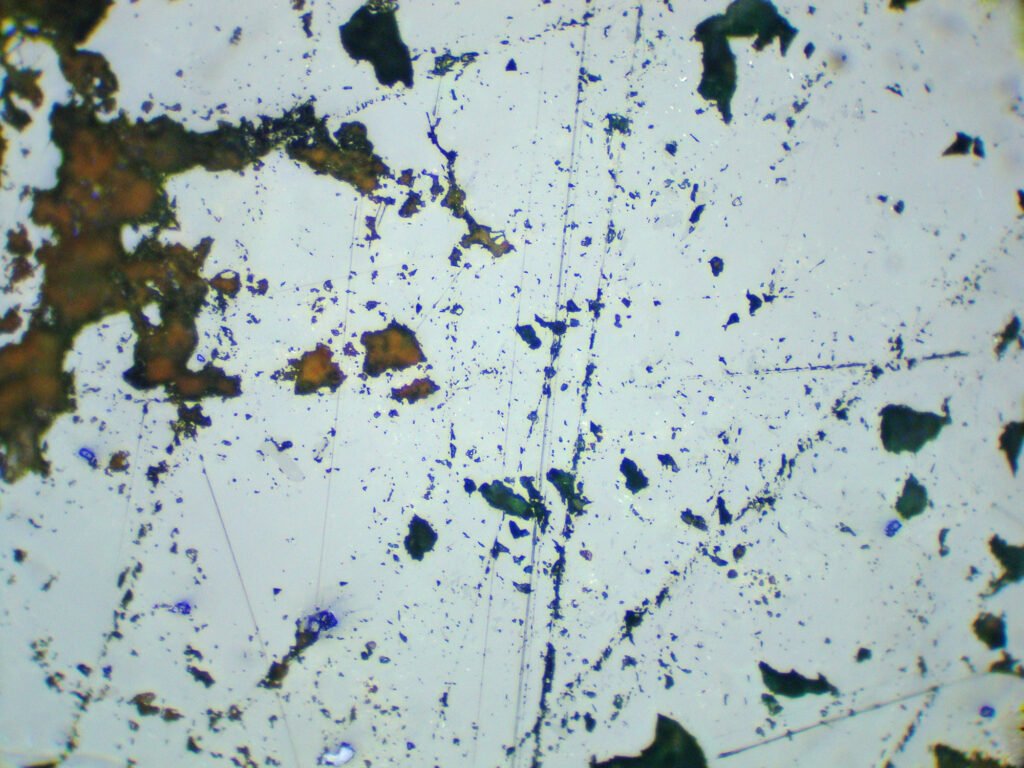
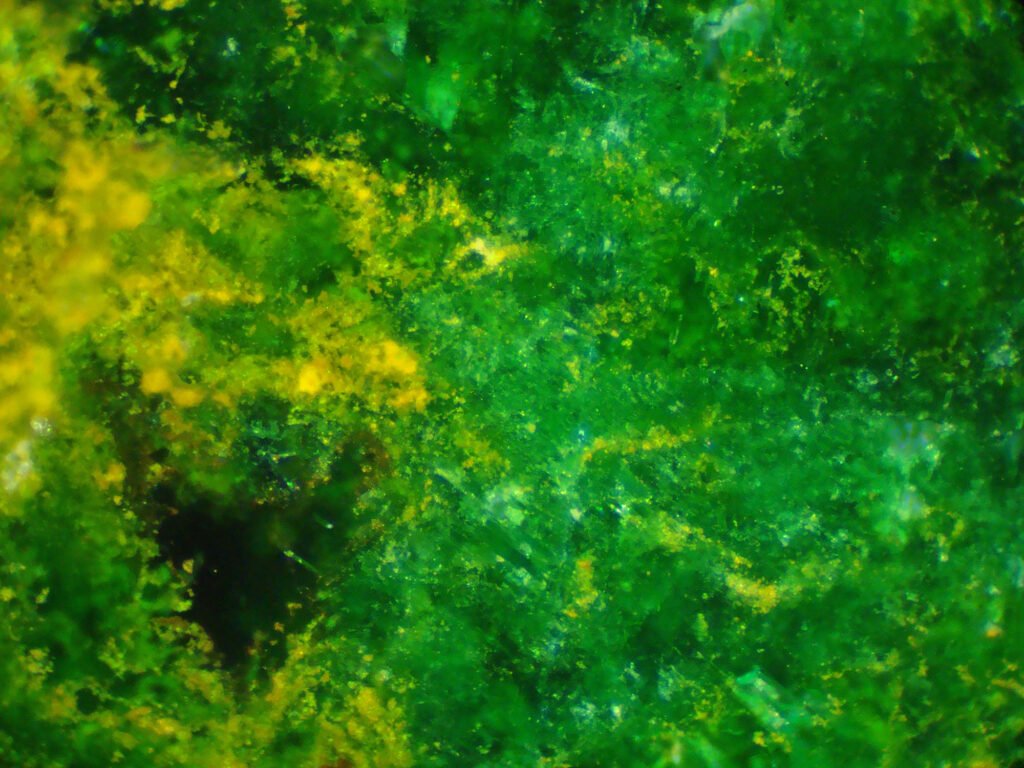
1. Characteristics
Crystal system: Orthorhombic dipyramidal.
Color: Light green, deep emerald green, and greenish-black.
Habit: Its crystals can reach up to 10 cm in length and are generally tabular or pseudo-octahedral in habit.
Cleavage: {010} perfect, {101} good. Striations in 2 directions.
Tenacity: Brittle.
Twinning: Twinning is rare; it may occur as contact or penetration twins, sometimes forming “doublets” and “triplets” or complex twinned aggregates.
Fracture: Conchoidal.
Mohs Hardness: 3 – 3.5
Parting: No.
Streak: Apple green.
Lustre: Adamantine to vitreous.
Diaphaneity: Transparent.
Density (g/cm³): 3.74 – 3.77
2. Geology and Deposits
Atacamite is relatively rare; it forms from primary copper minerals within the oxidation or weathering zone – particularly under arid, saline conditions and in the absence of carbonates.
It also occurs as an alteration product of sulfides found in “black smokers” (submarine hydrothermal vents), as well as an alteration product on ancient bronze and copper artifacts.
It has been used as a pigment in sculptures, manuscripts, maps, and frescoes.
Atacamite is a component of the tooth structures found in worms of the genus Glycera.
3. Mineral Associations
It occurs associated with quartz, gypsum, halloysite, and goethite.
It associates with a series of secondary copper minerals. Secondary Cu minerals in various shades of green include malachite, pseudomalachite, dioptase, botallackite, antlerite, brochantite, paratacamite, natrochalcite, libethenite, duftite, and olivenite.
Secondary minerals in various shades of blue include azurite, chrysocolla, cyanotrichite, plancheite, sampleite, linarite, caledonite, chalcanthite, kröhnkite, shattuckite, liroconite, connellite, and mrázekite.
Other colors include cuprite (red) and tenorite (black).
4. Transmitted Light Microscopy
Refraction indices: nα: 1.831 nβ: 1.861 nγ: 1.880
PLANE POLARIZED LIGHT – PPL
Color / Pleochroism: Weakly pleochroic, with x = pale green, y = yellowish-green, z = grass green.
Relief: Very high.
Cleavage: {010} perfect and {101} good.
Habits: Tabular, prismatic, granular, pseudo-octahedral crystals.
CROSSED POLARIZED LIGHT – XPL
Birefringence and Interference Colors: Maximum birefringence of 0.049, corresponding to colors of up to the 3rd order, masked by the mineral’s strong inherent color.
Extinction: No information is available, but it should be parallel to the prism.
Elongation sign: No information available.
Twins: Rare, several types, may be complex.
Zoning: No information available.
CONVERGENT LIGHT
Character: B(-)
2V angle: 74º
Alterations: It is an alteration product, but it can alter malachite and chrysocolla.
May be confused with: Various other secondary Cu minerals in shades of green.