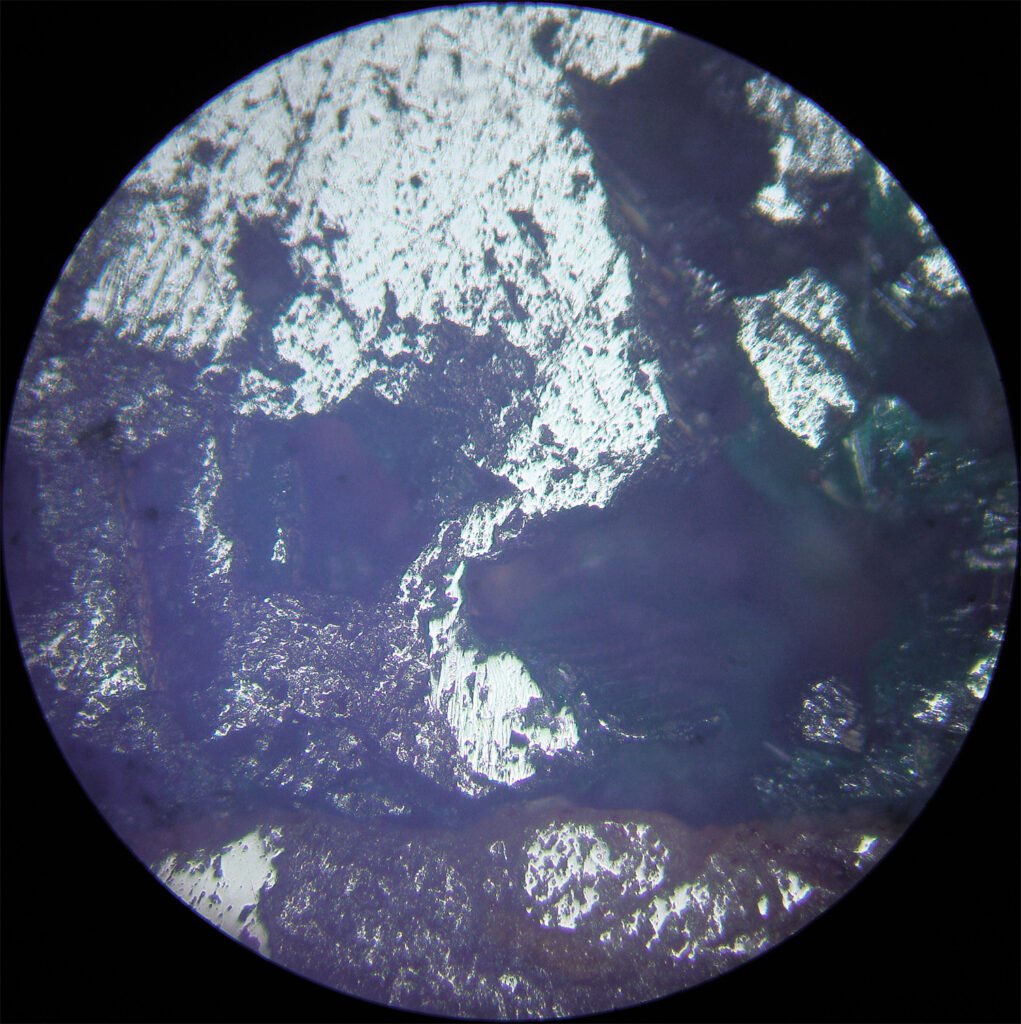
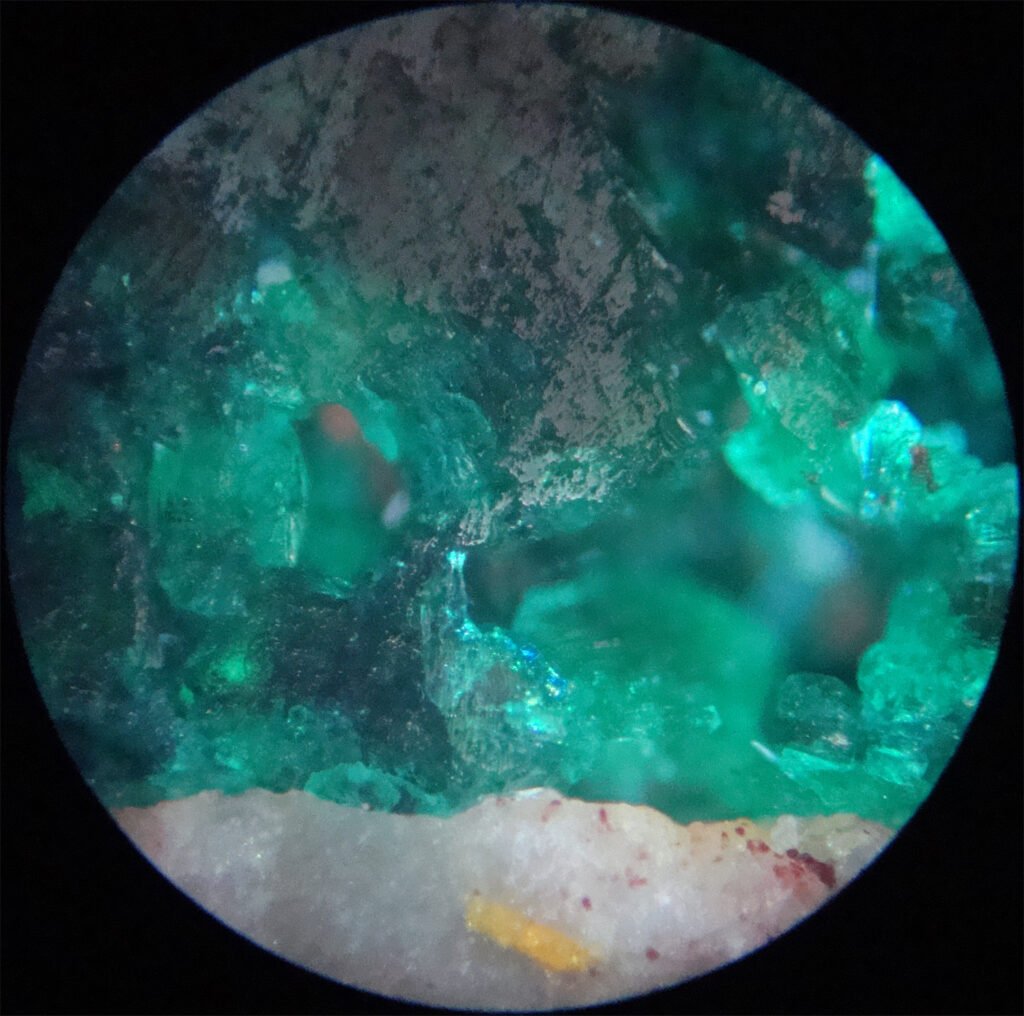
1. Characteristics
Crystal system: Trigonal scalenohedral.
Color: Green to dark green; it may be greenish-black.
Habit: Massive, granular, powdery, crusts. Rhombohedral crystals up to 1.5 cm.
Cleavage: {10-11} distinct to good.
Tenacity: Brittle.
Twinning: Twinning is common – occurring on the {10-11} plane – and can sometimes be polysynthetic.
Fracture: Conchoidal to irregular.
Mohs Hardness: 3
Parting: No.
Streak: No information available.
Lustre: Vitreous.
Diaphaneity: Transparent.
Density (g/cm³): 3.74
2. Geology and Deposits
Paratacamite is one of many secondary copper minerals that develop within the oxidation zones of copper deposits. It forms primarily in arid climates and saline conditions (in the absence of carbonates), though it can also occur in deposits located in regions with different climatic conditions.
It may be found in fumarolic deposits. It also forms as an alteration product of sulfides in submarine fumarolic deposits (“black smokers”).
3. Mineral Associations
It occurs with common gangue minerals found in oxidized deposits, such as quartz, goethite, and gypsum.
It is associated with copper sulfides, such as chalcocite, and, naturally, with many other secondary copper minerals – including copper oxides (cuprite, tenorite), copper carbonates (malachite), various green or blue copper halides (atacamite, boleite, pseudoboleite, botallackite, eriochalcite, cumengeite), copper sulfates (christelite, caracolite, natrochalcite, linarite, leightonite), and copper silicates (chrysocolla).
It is associated with secondary lead minerals, such as schwartzembergite, cerussite, and anglesite.
It also occurs with zeolites (natrolite) and manganese oxides (ranciéite).
4. Transmitted Light Microscopy
Data on the characteristics of paratacamite under a transmitted-light microscope are scarce and fragmentary.
Refraction indices: nω = 1,843 e nε = 1,848
PLANE POLARIZED LIGHT – PPL
Color / Pleochroism: Green, without pleochroism.
Relief: Very high.
Cleavage: {10-11} distinct to good.
Habits: Massive, granular, crusts.
CROSSED POLARIZED LIGHT – XPL
Birefringence and Interference Colors: The maximum birefringence is 0.005, corresponding to gray colors; it does not reach the first-order white, but these colors are masked by the mineral’s intense inherent color (green).
Extinction: Probably paralell.
Elongation sign: No information available.
Twins: Common, may be polysynthetic.
Zoning: No information available.
CONVERGENT LIGHT
Character: U(+), usually anomalously biaixal.
2V angle: equal to or less than 50º.
Alterations: No information available.
May be confused with: Other green transparent secondary Cu minerals.