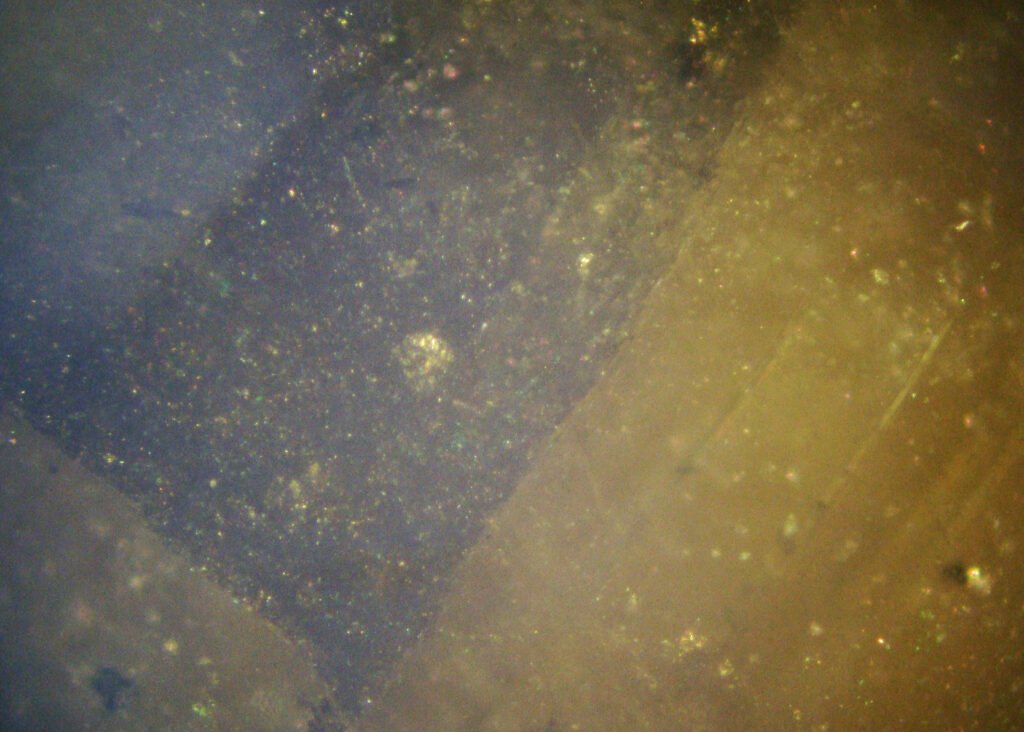
Crystal system: Orthorhombic bipiramidal.
Color: Reddish brown, yellowish, can be pink, yellow, green, gray and white. Rarely violet.
Habit: Idiomorphic prismatic crystals or in columnar aggregates. Fibrous, compact, massive.
Cleavage: {110} good, {100} poor.
Tenacity: Brittle
Twinning: On {101}, rare.
Fracture: Irregular
Mohs Hardness: 6.5 – 7.5
Parting: No.
Streak: White.
Lustre: Vitreous to sub-vitreous.
Diaphaneity: Transparente.
Density (g/cm³): 3.1 – 3.2
2. Geology and Deposits
Andalusite is characteristic of Al-rich metamorphic rocks generated by contact metamorphism and by low to medium grade regional metamorphism such as shales, phyllites and slates, formed under low pressures and medium temperatures.
More rarely, it occurs in granites and associated rocks, such as pegmatites and greisens.
Due to its high hardness and resistance to alteration, it can be found as a detritic mineral in some sands and sandstones.
3. Mineral Associations
Andalusite occurs with quartz, feldspar (plagioclase), micas (biotite, muscovite (sericite), chlorite, “zinnwaldite”), pyrophillite, other members of the Al2SiO5 Group (kyanite, sillimanite), cordierite, staurolite, garnet, corundum, tourmaline, minerals of the Spinel Subgroup and diaspore.
4. Transmitted Light Microscopy
Refraction indices: nα: 1,632 nβ: 1,636 nγ: 1,643
PLANE POLARIZED LIGHT – PPL
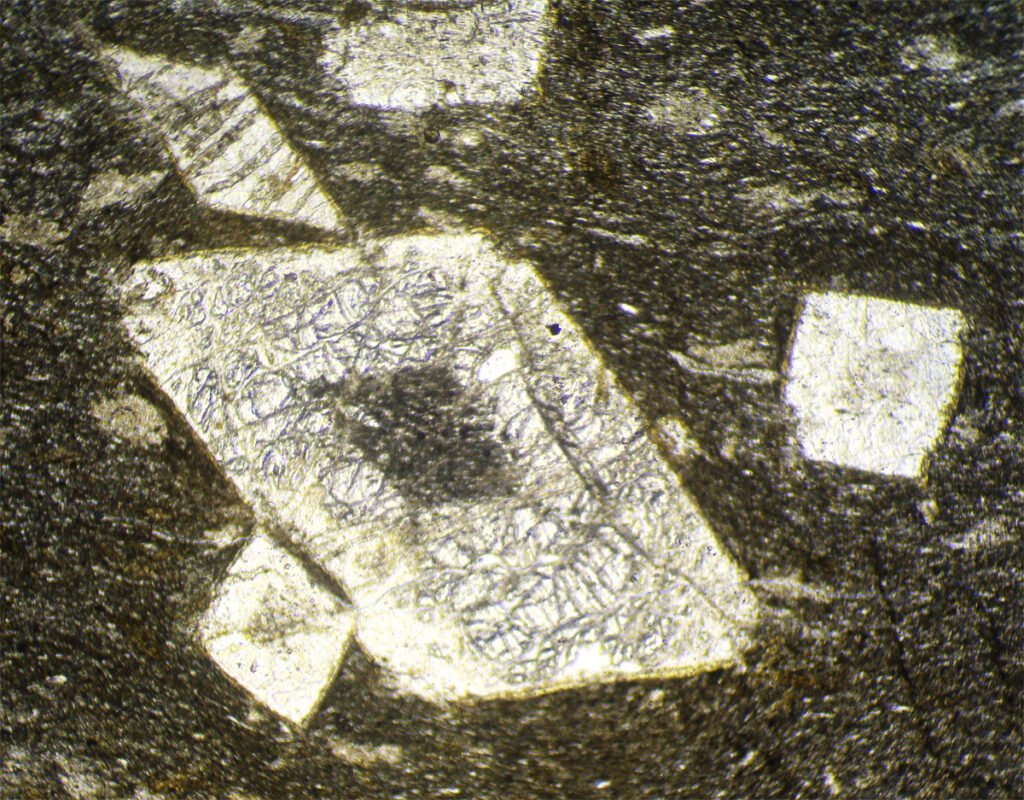
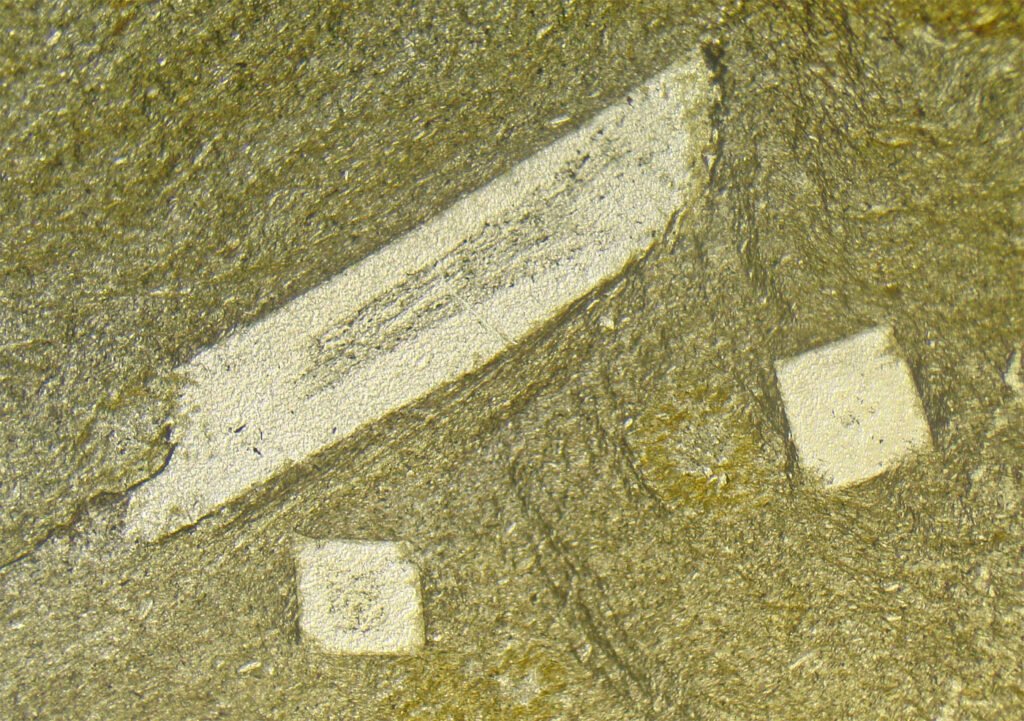
Color / Pleochroism: Usually colorless. More rarely faintly colored, in this case sligthly pleochroic:
X = pale pink in bands or zones,
Y,Z = colorless or pale green.
Mn contents result in greenish colors, Fe contents in pinkish colors and much higher refractive and birefringence indices.
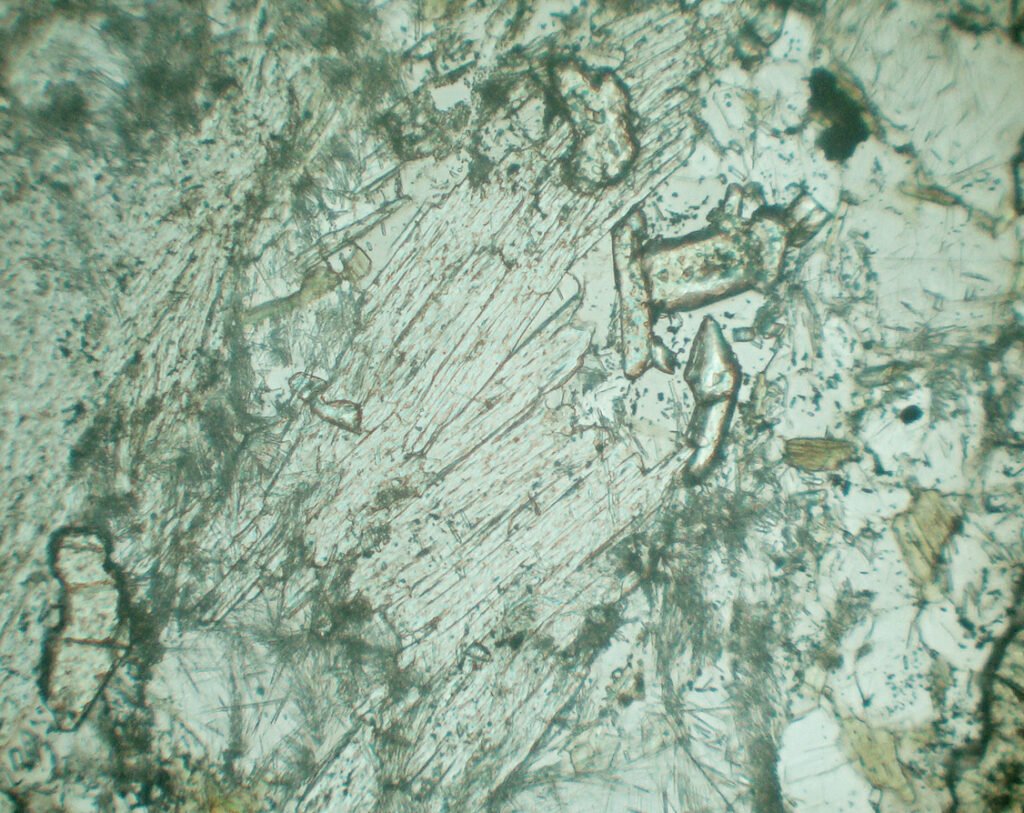
Relief: Moderate to high.
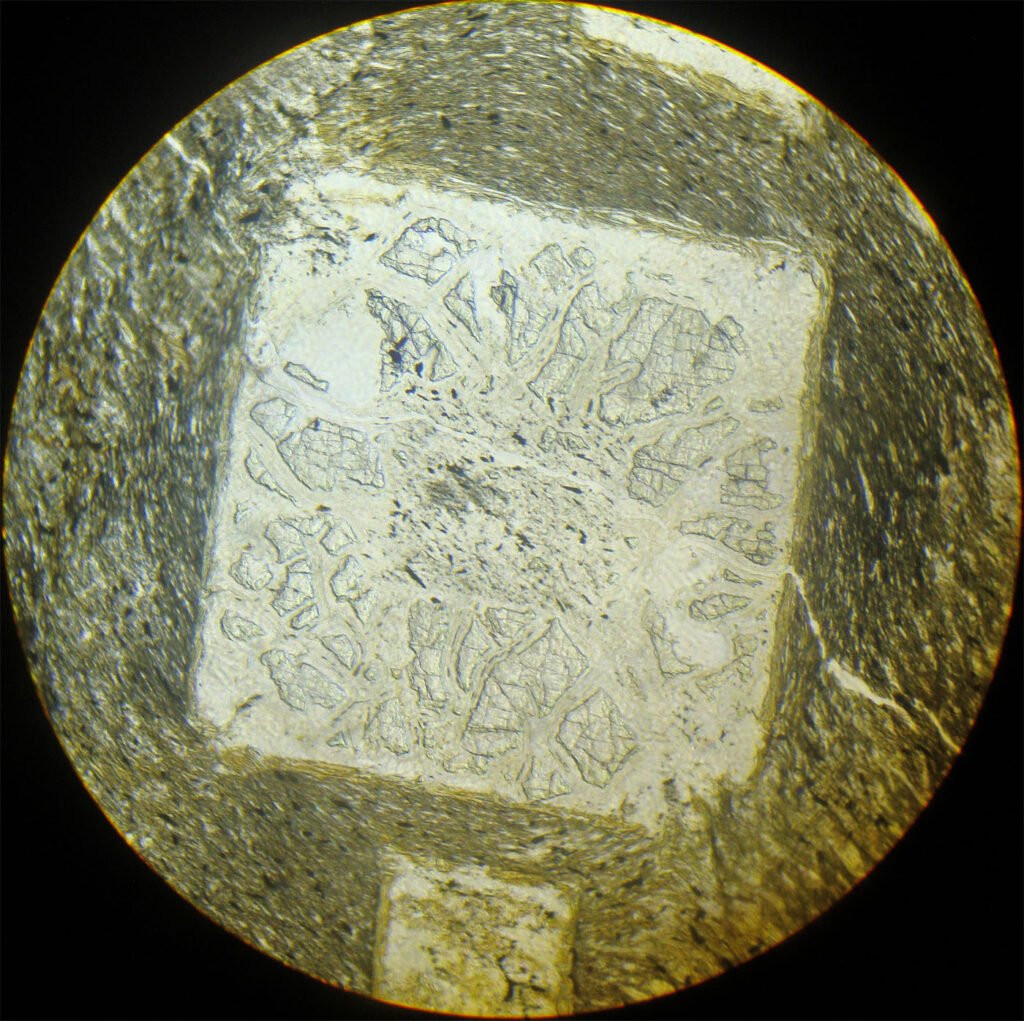
Cleavage: {110} perfect: longitudinal (prismatic) sections have only one direction, in the basal sections there are two cleavages almost perpendicular to each other (angle of 89º), but generally these cleavages are not visible, they are only visible in very large grains.
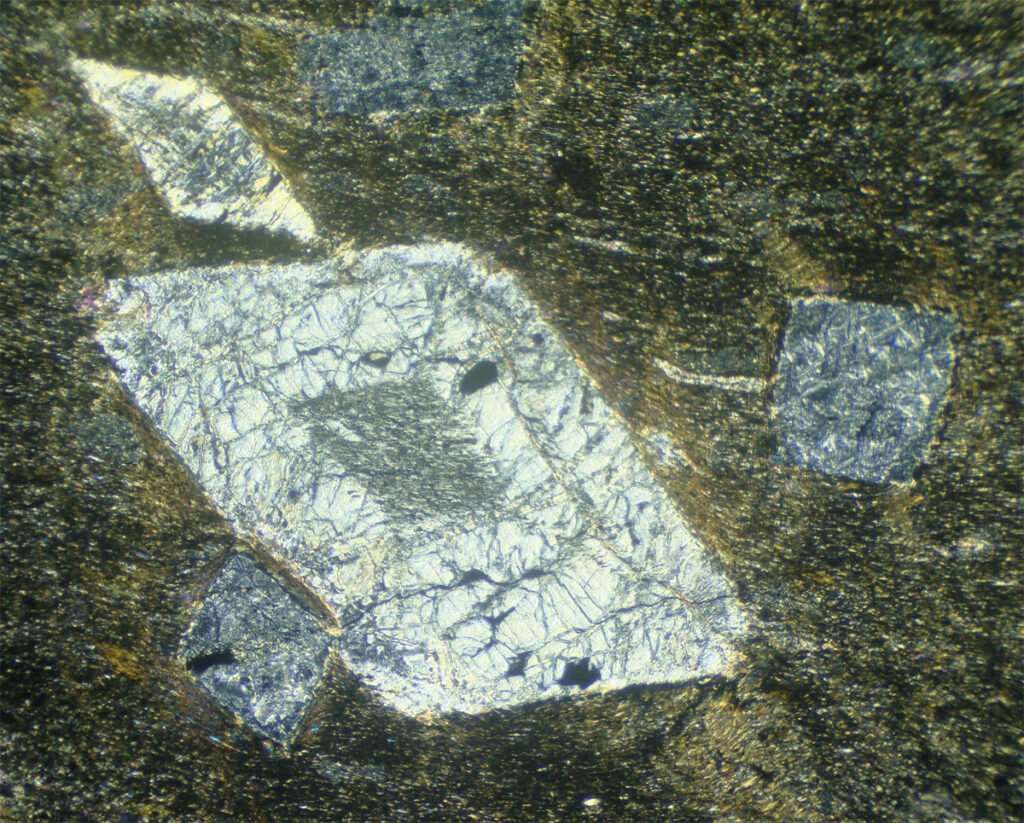
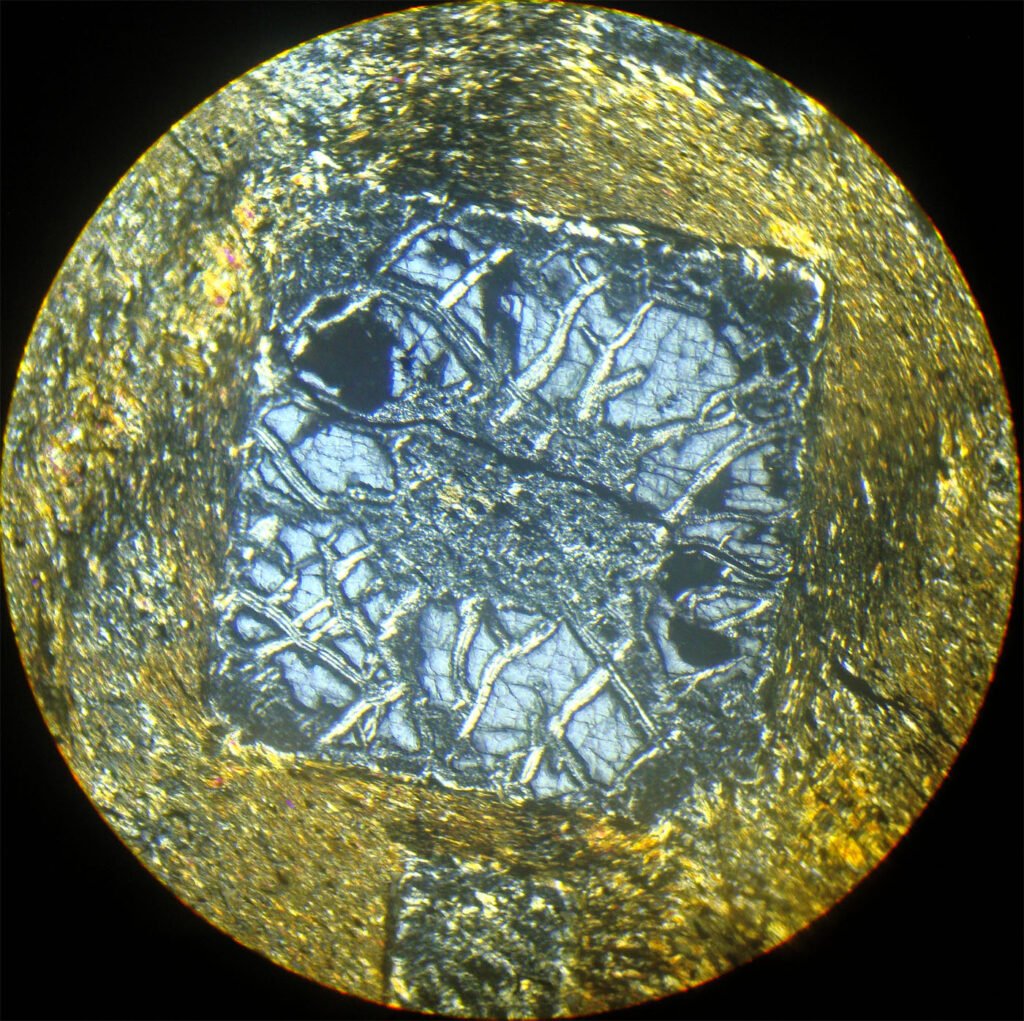
Habits: Euhedral granular crystals, short prisms with almost square section with diagonal extinction (very characteristic!).
Also fibrous, compact, massive or porphyroblastic.
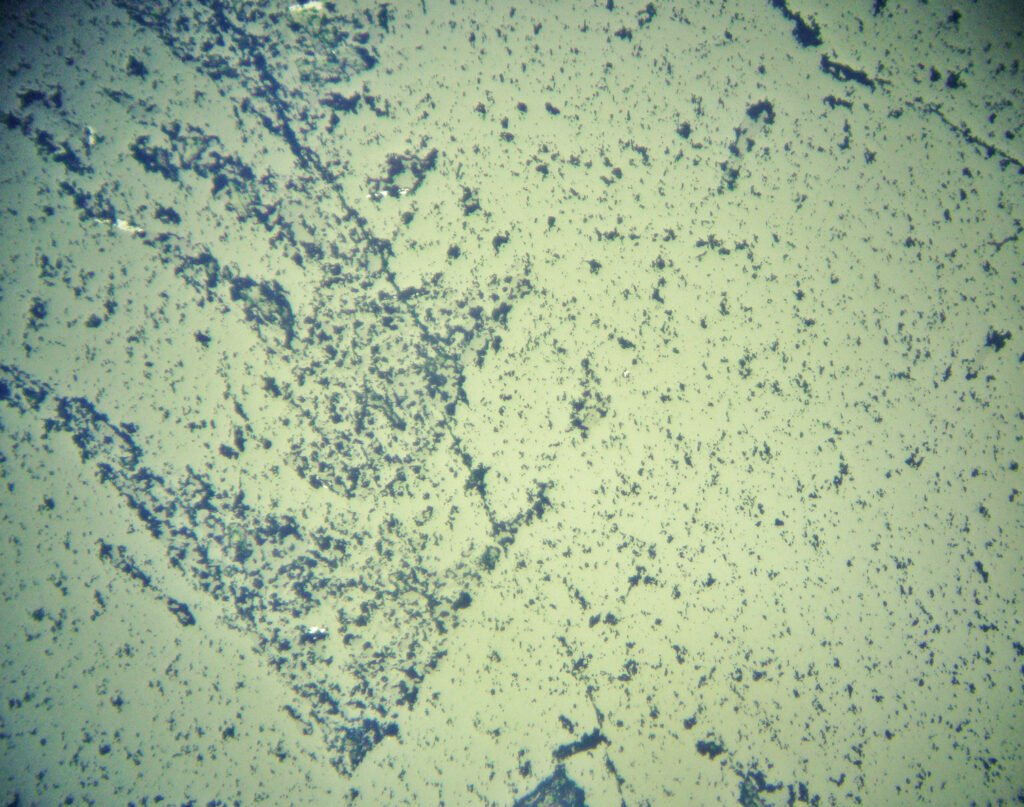
In the chiastolite variety there are black carbon inclusions along two perpendicular directions, forming a cross.
May show pleochroic (black) halos around radioactive mineral inclusions.
CROSSED POLARIZED LIGHT – XPL
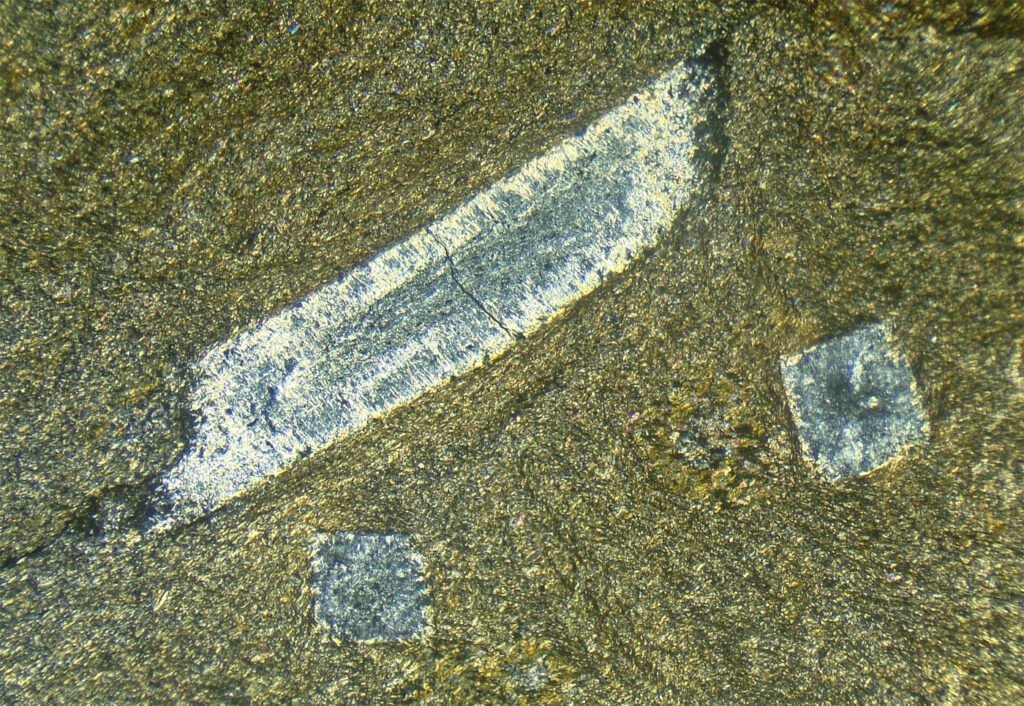
Birefringence and Interference Colors: Birefringence is low, from 0.007 to 0.013, resulting in 1st order gray colors, at most first order straw yellow.
Extinction: Parallel in the longitudinal sections (prismatic, parallel to the cleavage). Symmetrical in basal sections (which show two cleavage directions when the grains are very large).
Elongation sign: ES(-) in the longitudinal sections. Diagnostic!
Twins: Rarely show cross-shaped interpenetration twins.
Zoning: No.
CONVERGENT LIGHT
Character: B(-). The green variety of andalusite, with Mn, called viridine, is B(+).
2V angle: 71º – 86º
Alterations: andalusite alters to damourite and other phyllosilicates, generating complete pseudomorphs of pinite (= sericite and clay minerals). With increased pressure and temperature, it has relationships with cordierite, staurolite, garnet, sillimanite and kyanite.
May be confused with: several other minerals.
Sillimanite has much higher birefringence (it is more colorful), ES(+) and a smaller 2V angle.
Kyanite has oblique extinction.
Dumortierite (which can be pink!) and tourmaline (which can be colorless!) have ES(-) as well, but their interference colors are much more colorful (higher birefringence).
Orthopyroxenes have ES(+).