5. Reflected Light Microscopy
Sample preparation: polishing arsenopyrite requires a bit of effort, with a longer lasting polish, but it turns out to be of excellent quality. Its polishing hardness is much lower than that of pyrite and cobaltite, but greater than the hardness of magnetite, pyrrhotite and löllingite.
PLANE POLARIZED LIGHT – PPL
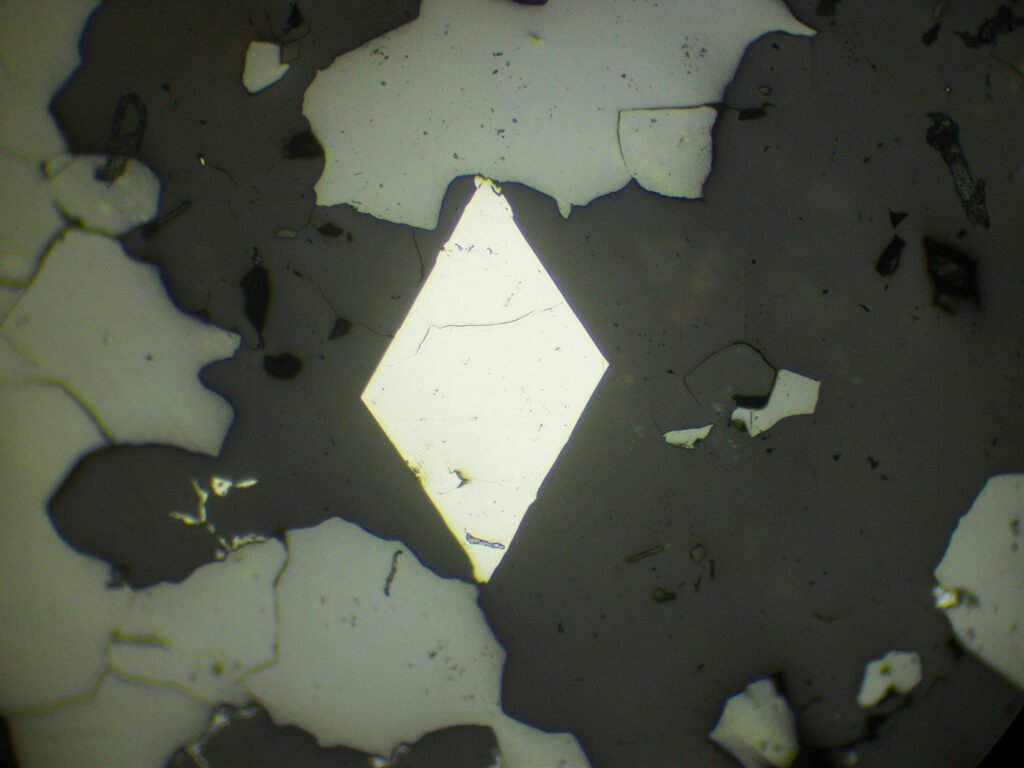
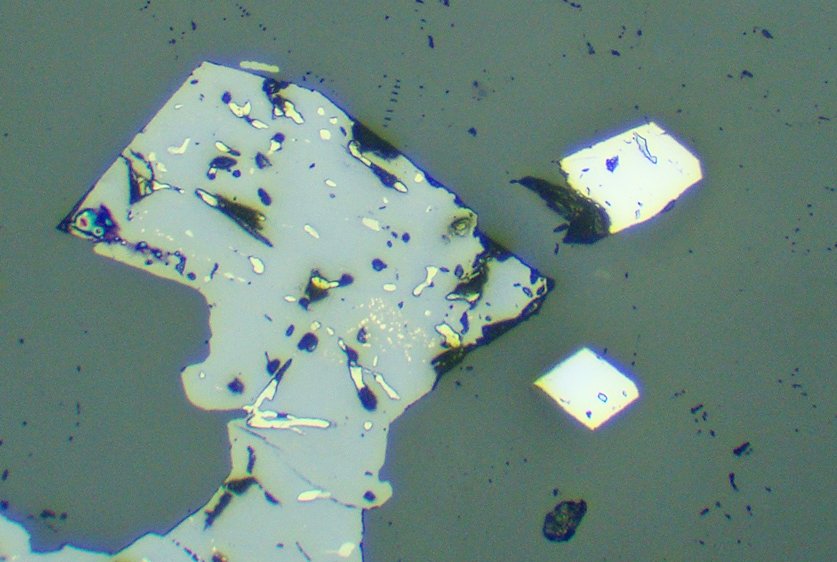
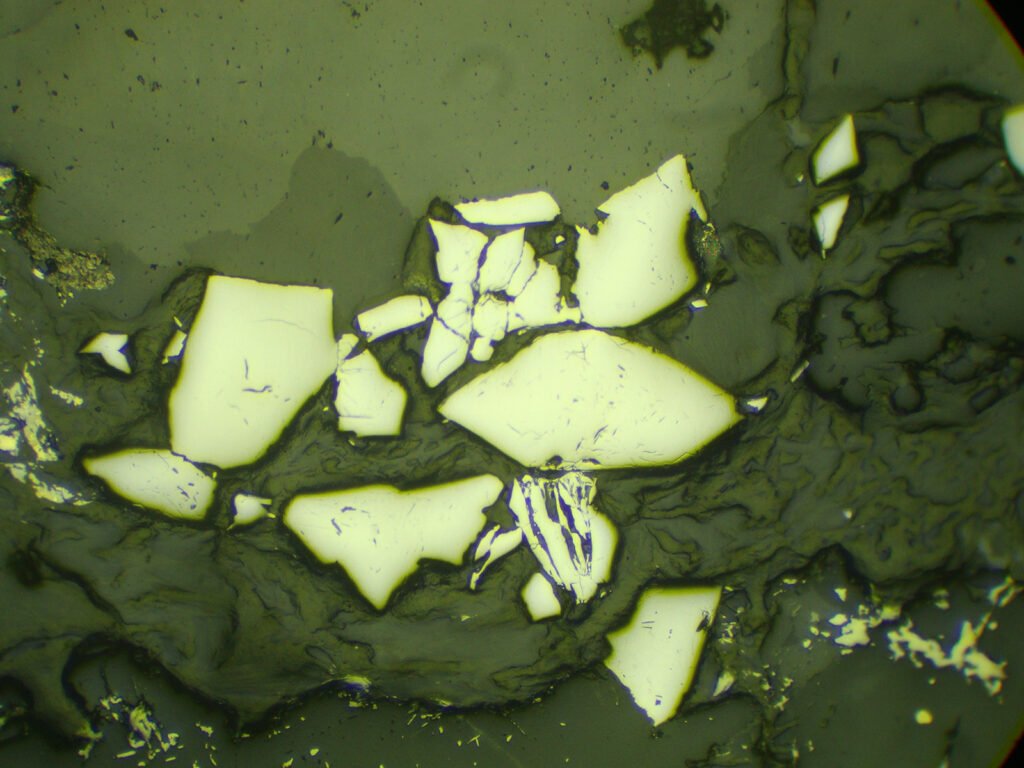
Reflection color: White, slightly yellowish or pink, which is only recognized when the mineral is in the vicinity of others that allow comparisons. Generally, the color impression is pure white, very reminiscent of the white of galena.
Compared to the color of pyrite, the color of arsenopyrite is almost white, as pyrite is cream-yellow with a brown tint.
Compared to the color of löllingite, the color of arsenopyrite is cream.
Compared with the color of safflorite, the color of arsenopyrite is cream.
Compared to the color of galena, the color of arsenopyrite is a very pale yellow.
Compared to the color of sphalerite, the color of arsenopyrite is very pale yellow.
Compared to the native silver color, the color of arsenopyrite is much darker and whiter.
Compared with the color of cobaltite, the color of arsenopyrite is lighter and whiter.
Pleochroism: Weak, only visible in intergranular contacts.
Reflectivity: 50.36 – 51.21% – very bright.
It rises to 53.6% if it contains Co.
Bireflectance: No.
CROSSED POLARIZED LIGHT – XPL
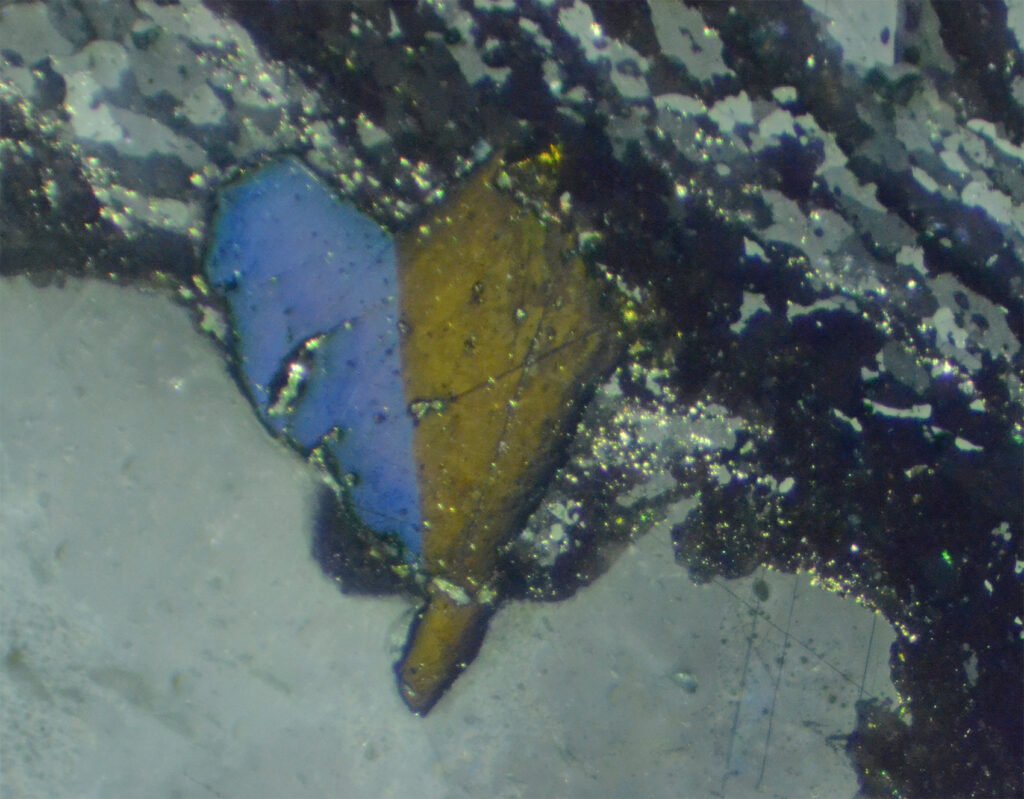
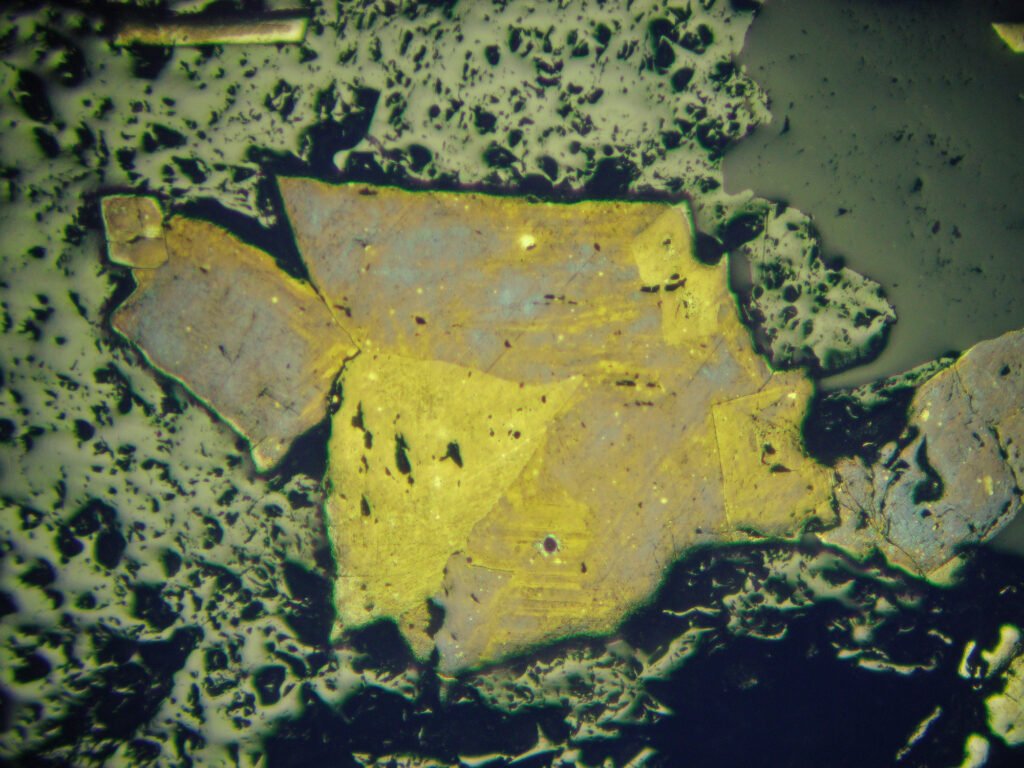
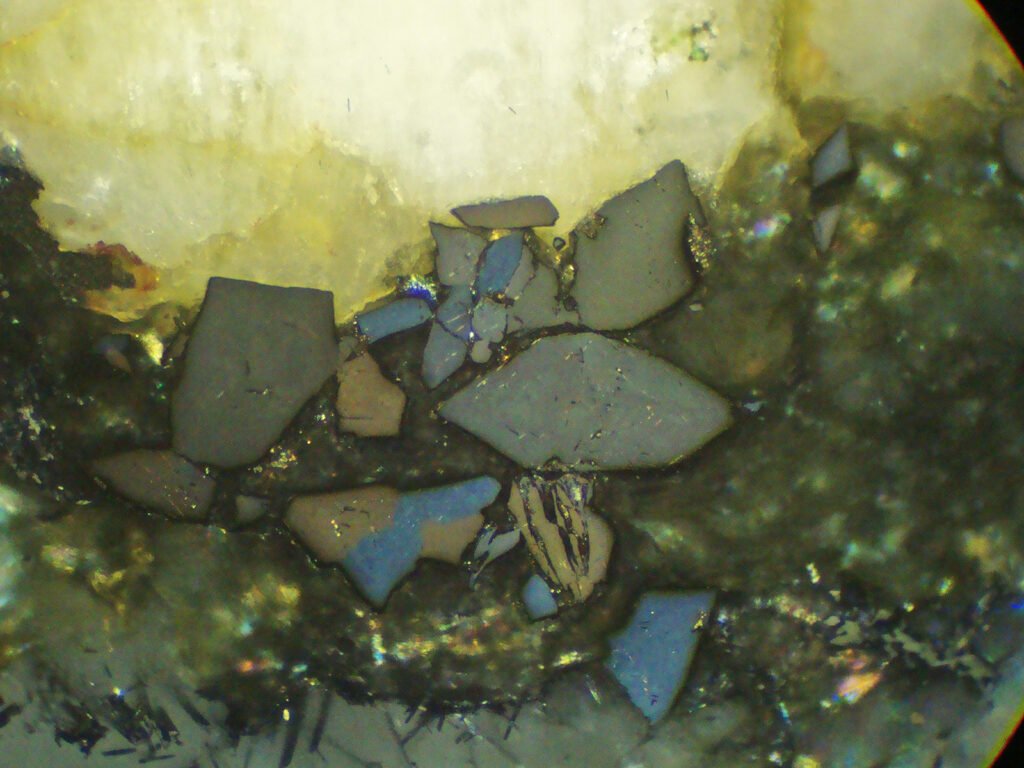
Isotropy / Anisotropy: Strong anisotropy, varying according to the section between strong blue (“Prussian Blue”, resembles jeans) and brown (with a strong orange tinge), can be green.
Internal reflections: No.
May be confused with:
a series of similar minerals that are associated with arsenopyrite. When in very small grains, arsenopyrite can be confused with the minerals of the Pyrite Group and Marcasite.
See table at the end of this sheet!
Safflorite has pleochroism and is softer, with other habits (radial diamond crystals).
Löllingite is very similar, but its reflection color has a slight bluish tinge.
Rammelsbergite has very similar anisotropy colors.
Glaucodote has similar anisotropy, but the colors are fainter.
Gudmundite is another very similar mineral, but it is softer and pleochroism stronger.
Marcassite has a more yellowish reflection color.
General Characteristics:
Grain shape: there is a strong tendency to idiomorphy. Polygonal outlines are frequent, with well-defined edges and perfect vertices, which can evolve into perfect rhombs in basal sections. Usually the crystals are small, with sizes of less than one centimeter. It can be skeletal, granular, subhedral, elongated into spherulites, fine-grained or very fine-grained. Idioblastic texture is possible.
Cleavage only is noticeable when the crystals are slightly altered.
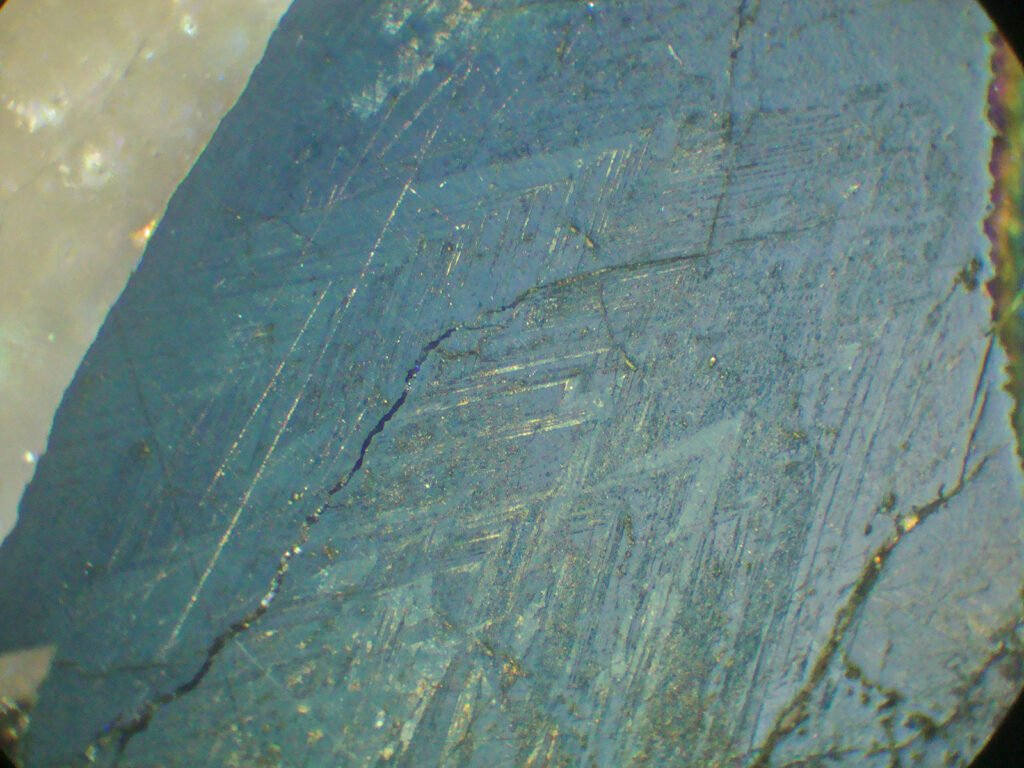
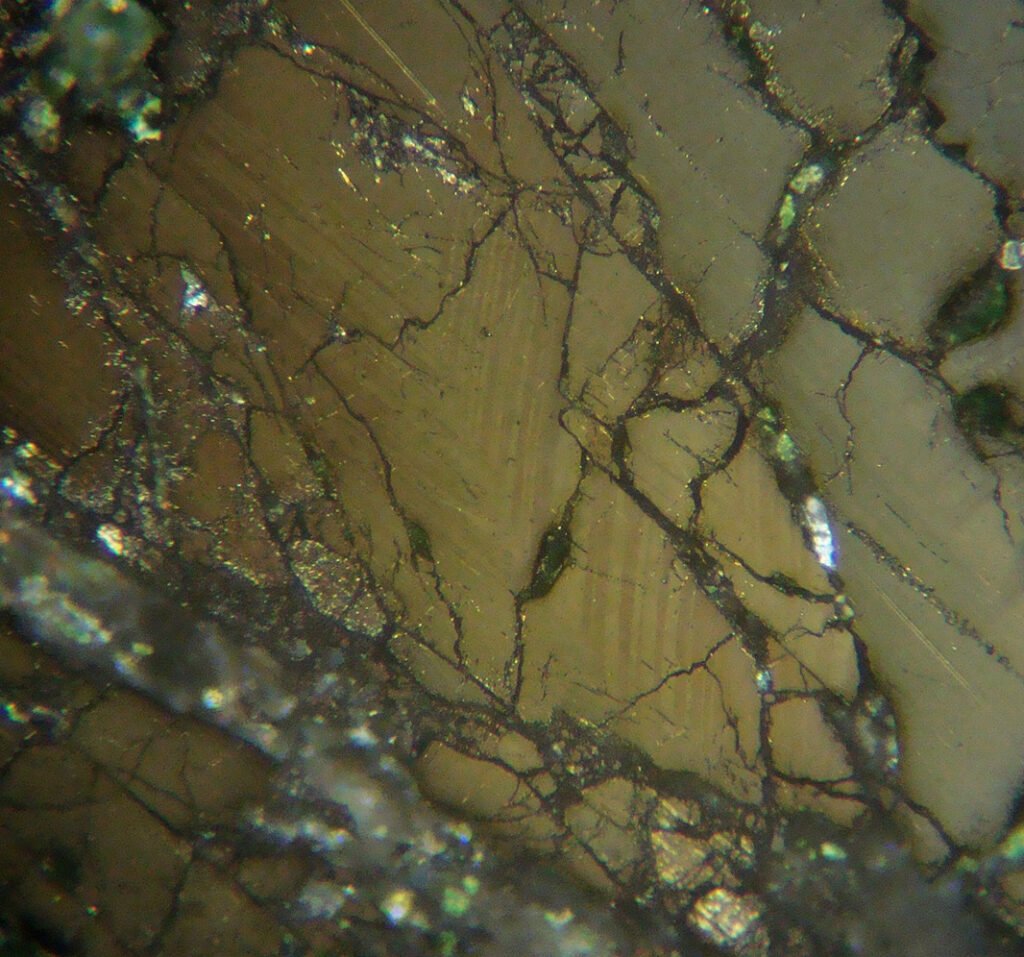
Twins are very common; they can be simple or lamellar. Lamellae can occur in two systems. Mimetic twins are possible. Cross twins produce radial clusters, macroscopically and microscopically.
Cataclasis is very common, concentrated in zones, whose fractures may contain other minerals.
Zonation can occur and can be confused with mimetic twins.
Exsolution lamellae of glaucodote may occur.
Substitutions 1: Arsenopyrite is replaced by chalcopyrite, sphalerite, cassiterite, tetrahedrite, stannite, ilmenite, chalcocite, acanthite and other silver ores, in addition to magnetite and löllingite.
Substitutions 2: Arsenopyrite replaces pyrite, cobaltite, löllingite, molybdenite, wolframite and galena, more rarely magnetite.
Inclusions 1: Inclusions in arsenopyrite can be gold and molybdenite, as well as gold in fractures.
Inclusions 2: Arsenopyrite inclusions occur in pyrite, tetrahedrite and pyrrhotite.
Intergrowths with other minerals, oriented or not, occur frequently. They can be with löllingite, safflorite, cobaltite, pyrite, tetrahedrite, galena, pyrrhotite and skutterudita.
Alteration of arsenopyrite produces soluble compounds with or without limonite.
Isotropic borders can be generated as a function of neighboring pitchblende or brannerite grains.