5. Reflected Light Microscopy
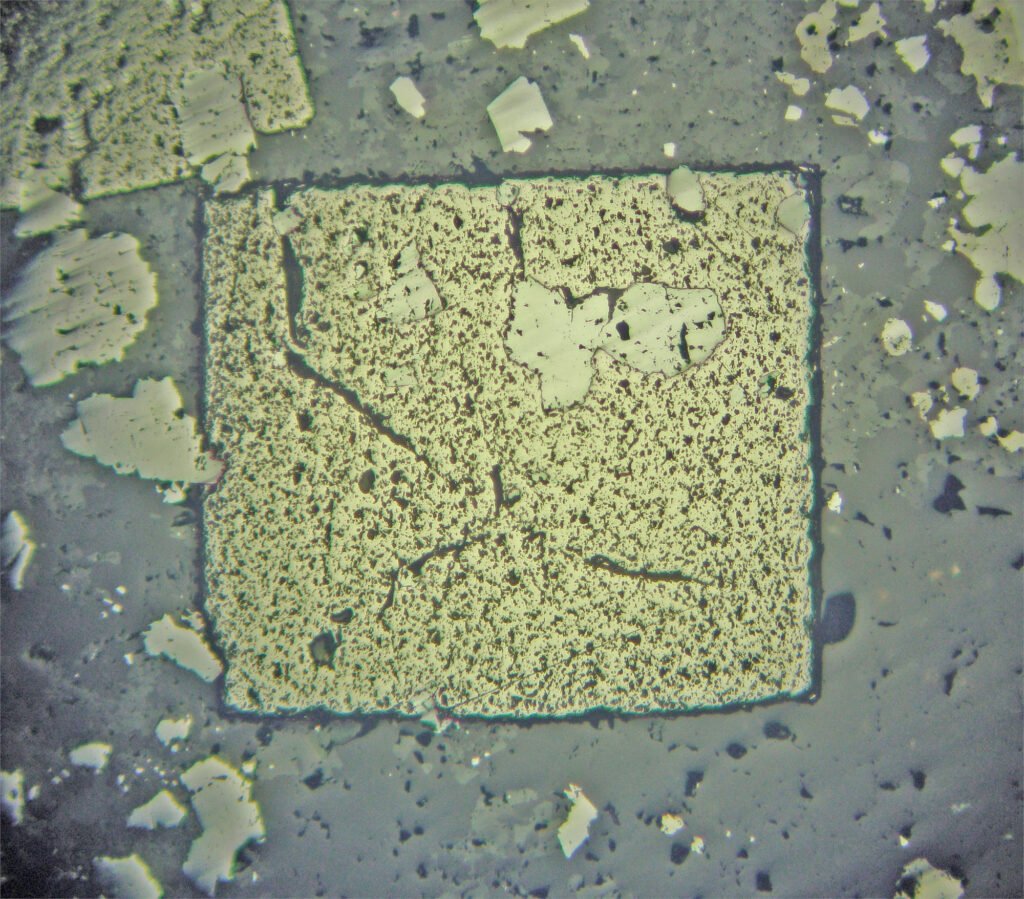
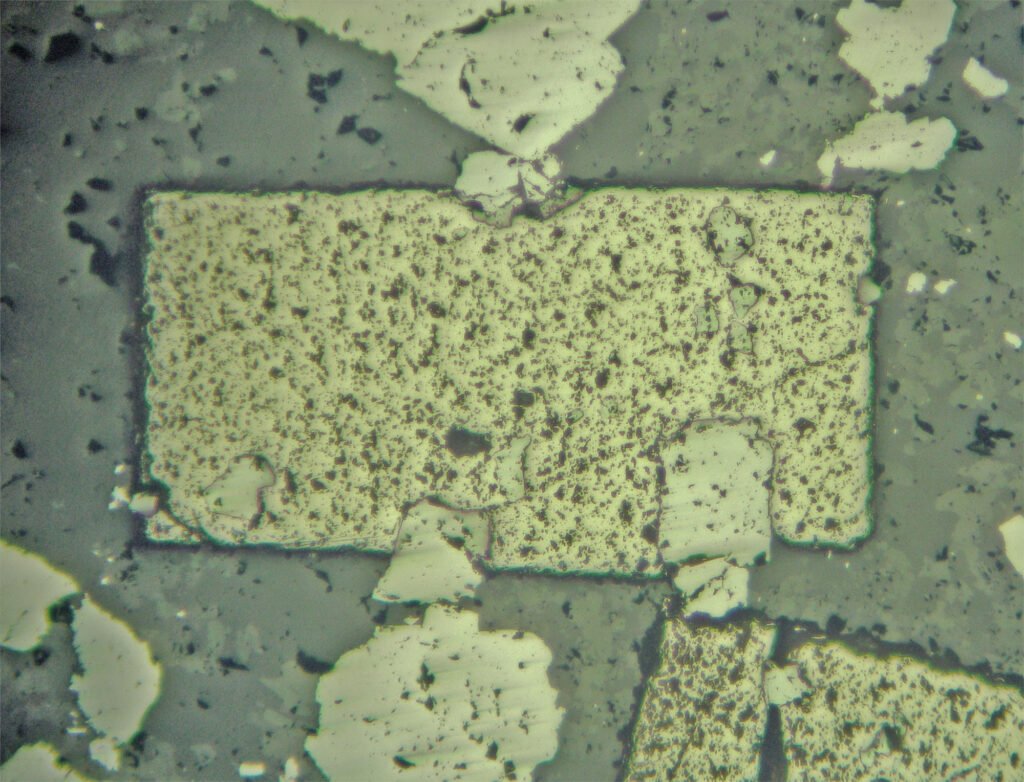
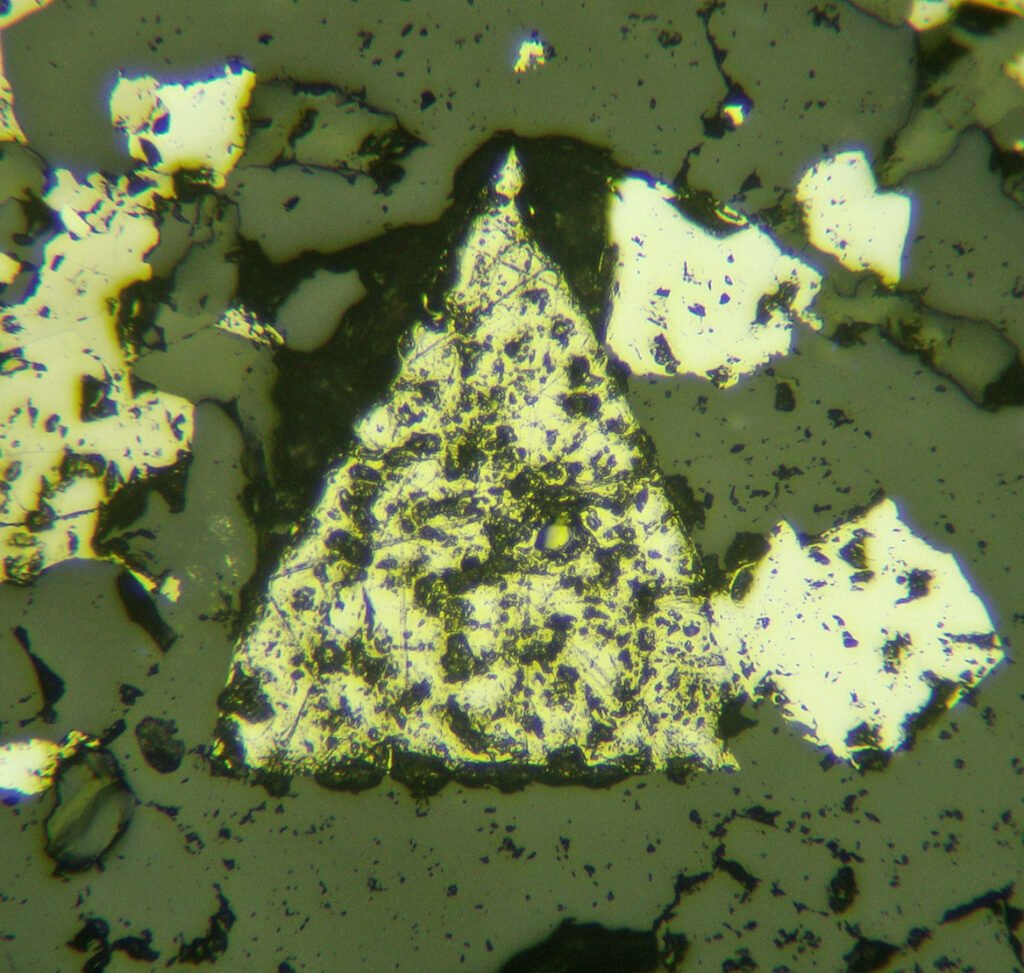
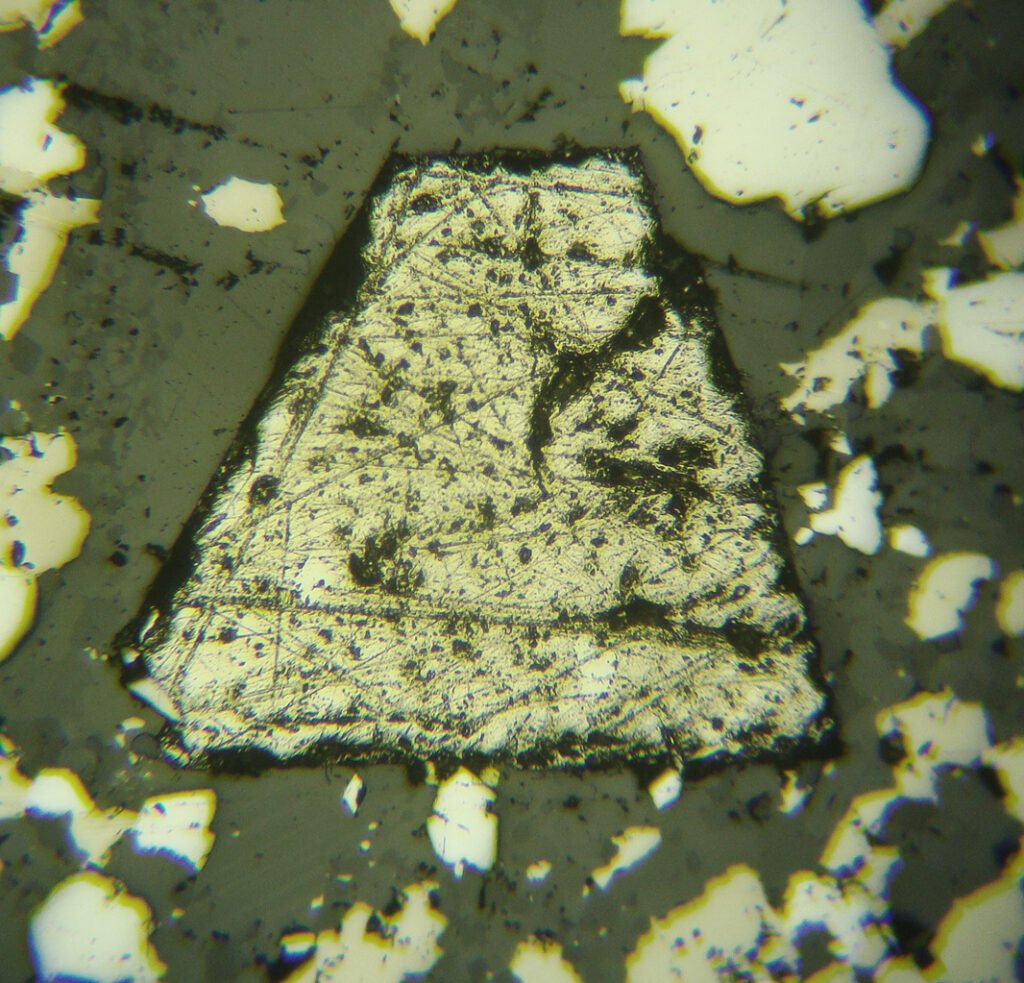
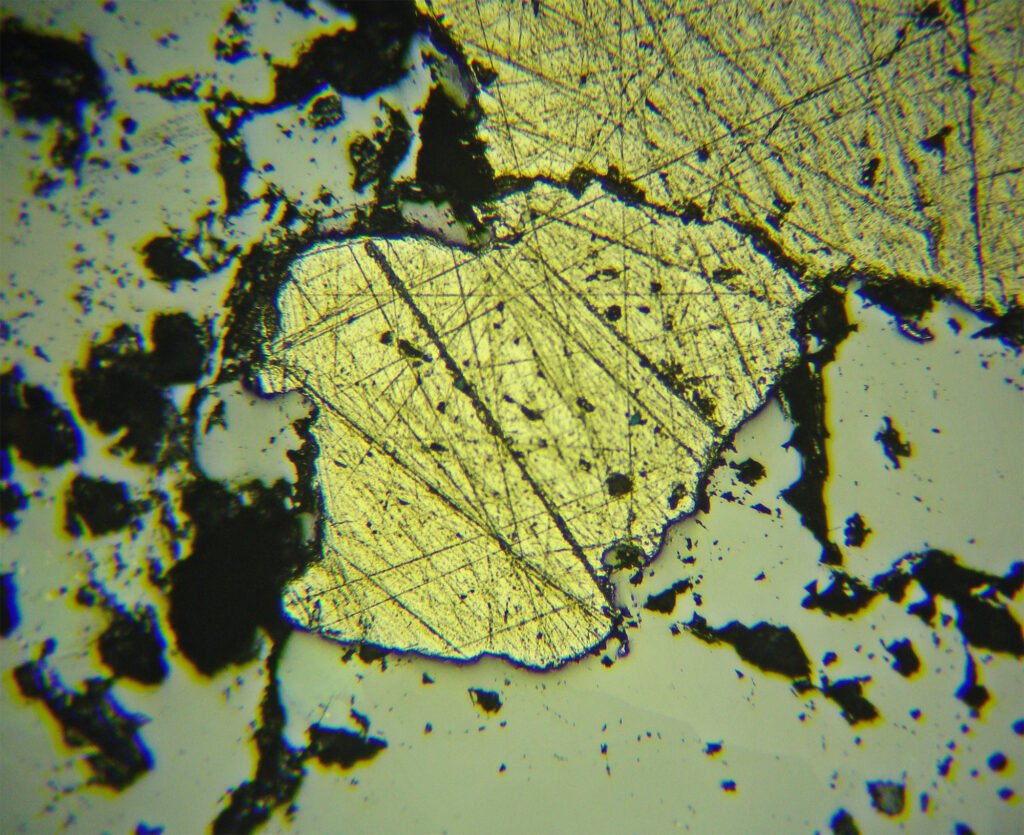
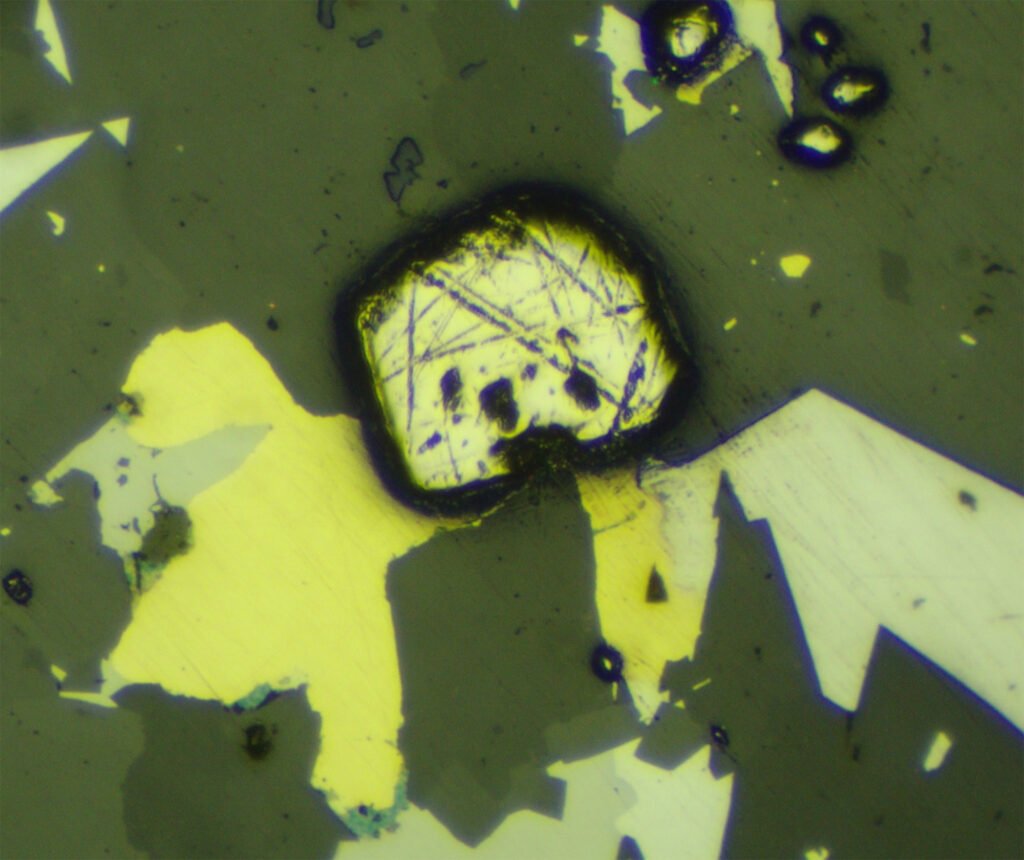
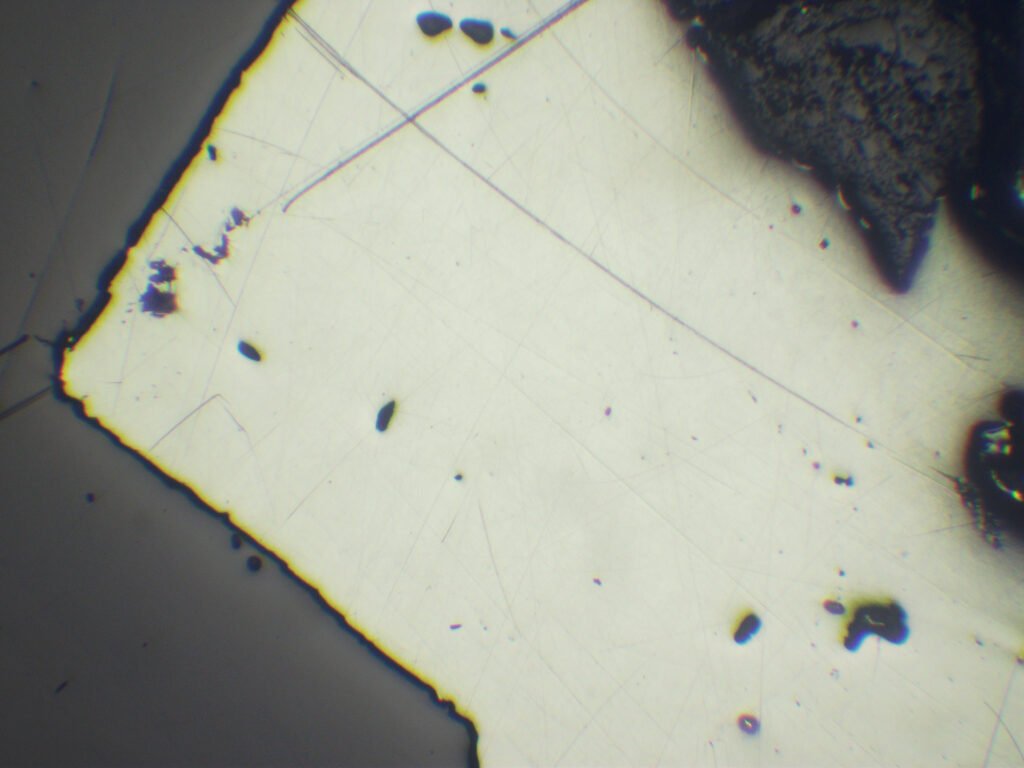
Sample preparation: pyrite, due to its high hardness, is a difficult mineral to polish. It’s almost as hard as magnetite, but not so hard as hematite. While the other silicates in the rock or the sulfides in the ore are already polished to a good standard, pyrite still has a horrible polish, is scratched and pitted.
In this situation you have basically three options:
Leave the pyrite with a poor polish and see this as a diagnostic feature.
Improve the polishing of the pyrite a little more, however without being perfect, which will cause a high relief in the pyrite grain, which stands out in the polished section like an “inselberg” in the geomorphology, making the polished section of poor quality.
Use special techniques with specific materials, a lot of time, a lot of patience and a lot of practice to obtain an optimal polishing of the pyrite without creating relief. In this case, you get… a polished pyrite, which generally does not show features of great petrographic interest.
PLANE POLARIZED LIGHT – PPL
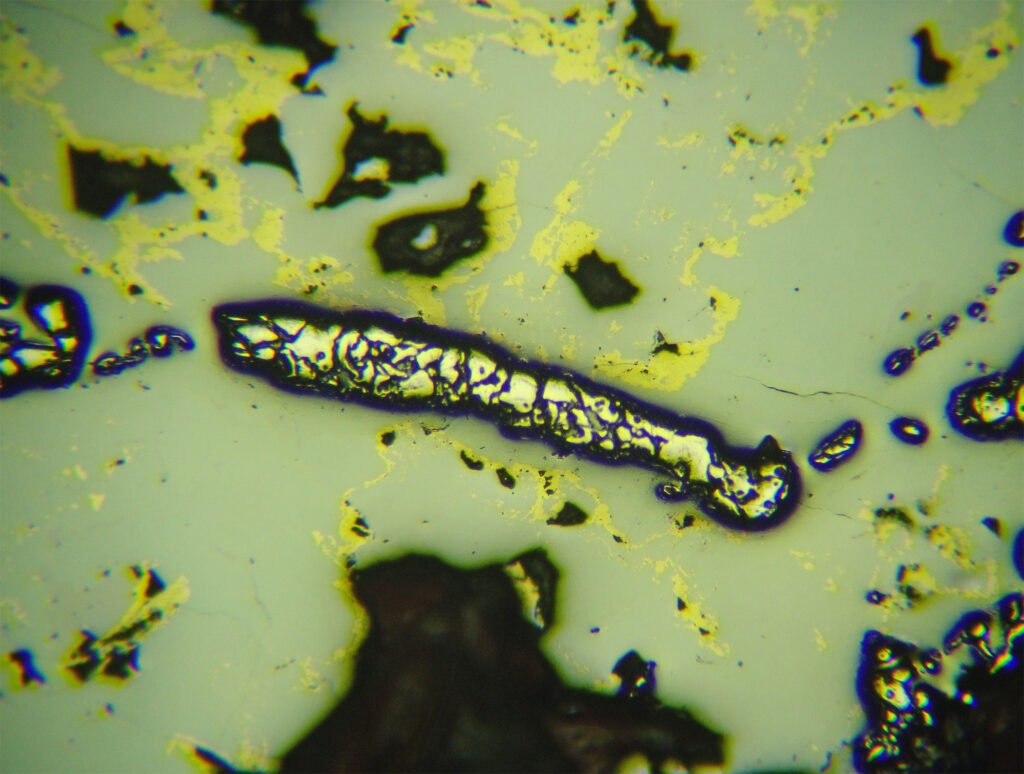
Reflection color: Yellowish-white or creamy-white color. Depending on the neighboring minerals, the color impression changes.
Compared with the colors of millerite or pentlandite, the color of the pyrite appears to have an anomalous greenish hue.
Compared with the color of galena, the color of pyrite looks pale yellow.
Compared with the color of chalcopyrite, the color of pyrite is much lighter.
Compared with the color of marcasite, the color of pyrite is much more yellow, etc.
Pleochroism: No
Reflectivity: 55.09 (very high!)
Bireflectance: No
CROSSED POLARIZED LIGHT – XPL
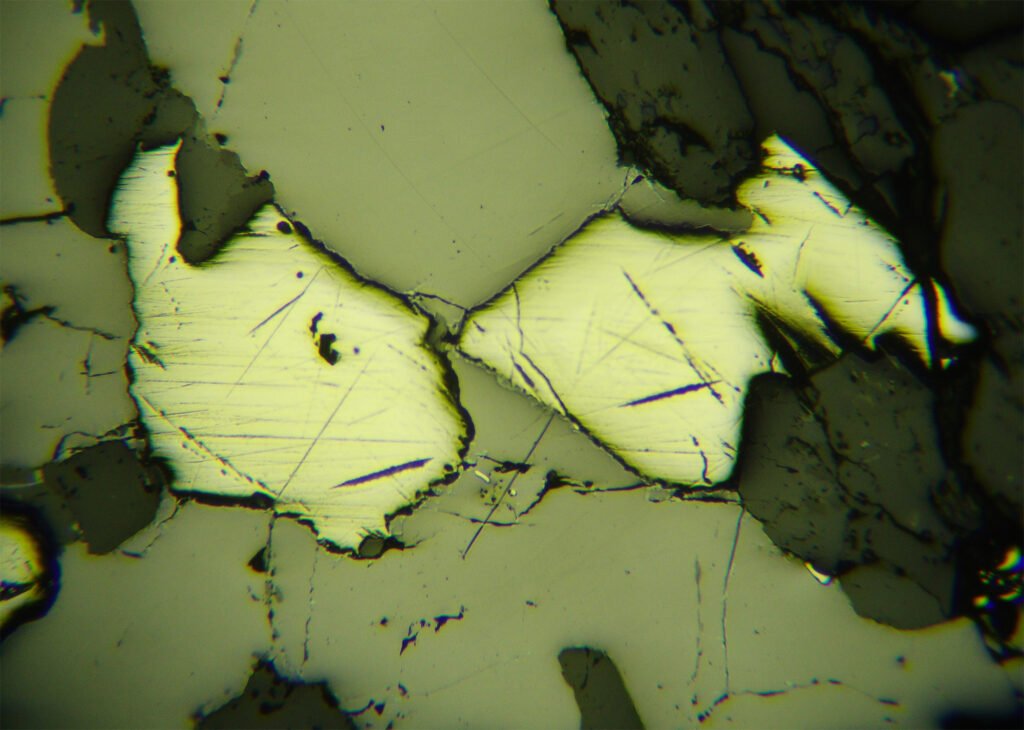
Isotropy / Anisotropy: Isotropic. However, it frequently presents anomalous anisotropy in violet, brown and turquoise tones, due to impurity (As) contents or polishing problems.
It is possible that anisotropy is very common, but covered up by some polishing methods. Due to the high relief that pyrite can obtain alongside soft minerals, depolarization is frequent, simulating an anisotropy in the grain.
Internal reflections: Never presents internal reflections.
May be confused with: Pyrite usually is easy to recognize. However, when in very small grains, it is easily confused with many other minerals, including native gold.
Marcasite has reflective pleochroism, is slightly whiter and strongly anisotropic.
Cobaltite is similar, pinker, a little softer and a little anisotropic.
Skutterudite, gersdorffite and ullmannite are whiter in PPL and less harder (better polished).
Sperrylite is distinctly more euhedral, has greater reflectivity, and is rare.
When pyrite is associated with hard and poorly reflecting minerals, such as cassiterite and quartz, it is possible to confuse it with a native metal.
General Characteristics:
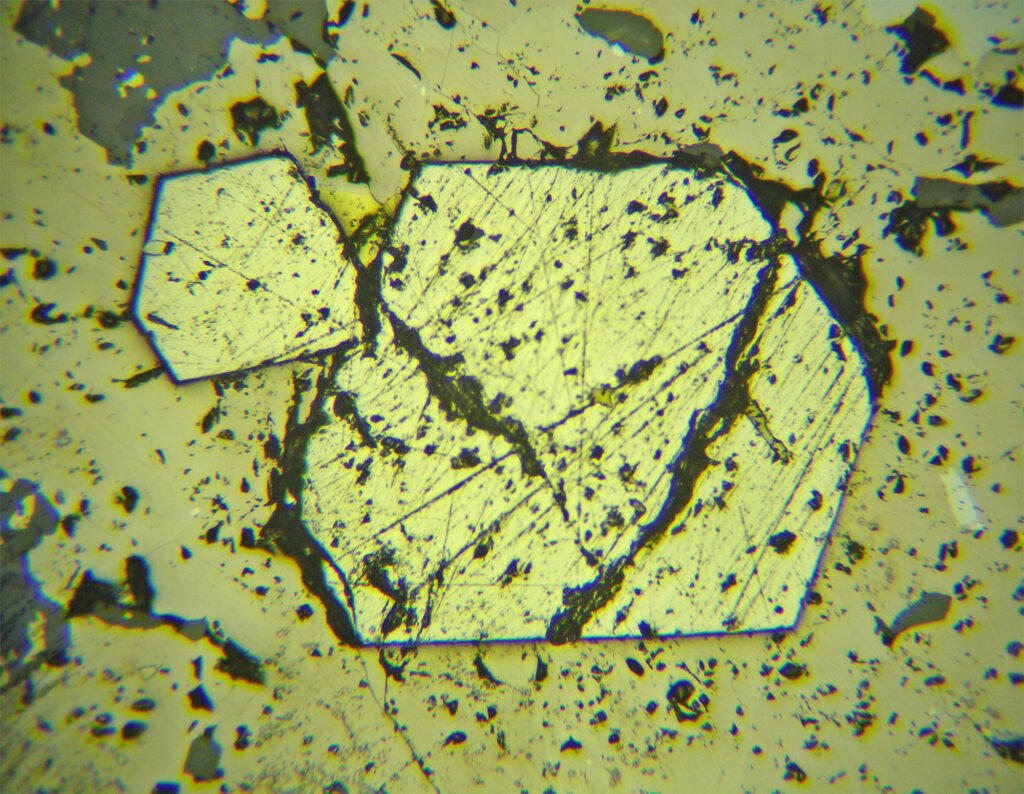
Grain shape: Pyrite has a strong tendency to idiomorphic development, forming cubes. This is why pyrite is often interpreted as the oldest mineral in the paragenesis where it occurs, which is a misnomer because idioblastic pyrite easily forms as a porphyroblast. Even when pyrite forms at the same time as the other minerals of the paragenesis, it is idiomorphic, as in hydrothermal veins of quartz with gold: pyrite is euhedral and quartz is anhedral. The growth of these large pyrite crystals often involves the incorporation of many other mineral grains as inclusions.
Framboid or coloform textures are common in those pyrites formed at low temperatures. The formation takes place from gels, whose forms are partially preserved. The framboid textures are quite characteristic. Pyrites with these relict structures often contain less sulfur than stated in the formula and are much more easily altered, as well as being able to contain arsenic.
Grain size ranges from less than a micron to 25 cm.
Intergranular contacts in pyrite-only aggregates are quite variable, often just polygonal or loosely packed, so that the aggregates disaggregate easily. Toothed contacts are much rarer. Very often, another mineral of the paragenesis, occurring in small amounts, has taken on the role of cementing the pyrite grains.
Skeletal growth sometimes occurs, with growth acceleration parallel to (111) in association with marcasite or parallel to (100) in association with pyrrhotite.
Cleavage is usually not visible. In crystals that have been stressed, also due to oxidation and cementation (replacement by chalcocite), the cleavage {001} may be distinct.
Partition {011} is more often observable, the partition on {111} only rarely.
Twins according to (110) are well known from macroscopic samples, but in polished sections only very rarely are any signs of twins noticeable.
Zonation on pyrites from the most varied origins is observable very well developed. Can be created by (1) changes in chemical composition, especially with Ni contents, (2) incorporation of inclusions, (3) zones with different porosities, (4) interruptions in grain growth. In some cases, zonation appears due to changes in color and hardness, in other cases a chemical attack is necessary for its observation. The zonation often shows that the grain’s habit changed during growth, starting as an octahedron and ending as a cube.
Zonation with bravoite (pyrite with Co and Ni) may be present forming darker, brownish or violet patches, often with euhedral outlines.
Zonation with linneaite zones may be present.
Deformation by tectonic pressure always lead to grain cataclasis, causing cleavage and partitions to appear. Translations and pressurized twin lamellae do not occur in pyrite.
Cataclasis is often visible in pyrite even when neighboring minerals show no sign of it. Fragments generated by cataclasis can shift appreciably relative to one another if hosted in relatively plastic ores such as those with galena and chalcopyrite.
Unmixing occur almost never. The frequent small inclusions with dimensions of unmixing bodies are always replacement debris, inclusions in pyrites that grew porphyroblastically or infiltrations after the formation of the grain. Especially chalcopyrite is present forming bodies that were certainly not formed by unmixing.
Substitutions are extraordinarily frequent; pyrite is replaced and in turn replaces a multitude of other minerals. As one of the first minerals to form, pyrite has many opportunities for replacement, with arsenopyrite, chalcopyrite, galena, sphalerite, bornite, enargite, chalcocite, covellite and silver minerals. Replacement often occurs and is accelerated by cataclase-generated fractures in the pyrite. The replacement of pyrite by other minerals can show zonations (selective replacement) and form skeletons. A special case is the substitution by pyrrhotite, which occurs by contact metamorphism especially in basalts. As a substituting mineral, pyrite is very active, the processes are often difficult to explain. Final volcanic processes can lead to a pyritization of rocks, as occurs in diabases, gabbros and other rocks. This pyritization can transform the iron oxides formed at first, as hematite, titanomagnetite and ilmenite, forming in these last two cases pyrite with rutile, sometimes titanite, preserving the ilmenite skeleton of the titanomagnetites. Replacement pyrites with rutile skeletons form in this way. The transformation of pyrrhotite into pyrite is also not uncommon and may be accompanied by the formation of marcasite. The color of these pyrites formed from pyrrhotite may be distinctly greenish due to extremely fine intergrowth with marcasite. Pyrites formed from pyrrhotite tend, especially if wet, to spontaneous combustion. Sphalerite and alabandite are often replaced by pyrite; but the processes are not extensive and occur only in a restricted way.
Intergrowths as myrmekitic structures practically do not occur. Extremely fine intergrowths with chalcopyrite, within the limits of microscope visualization, occur very rarely. These intergrowths can only be noticed with very high magnifications and oil immersion techniques. Gold contents are due to native gold grains in fractures and intergranular boundaries or as gold grains inside pyrites, such as inclusions.
Recrystallization occurs in pyrite with difficulty. In tectonized deposits, pyrites remain cataclastic long after the other minerals have already recrystallized. In zones with a high degree of metamorphism, pyrites recrystallize, showing a granoblastic panidiomorphic texture (all grains euhedral). When there are not enough other minerals to cement the pyrite crystals together, a very friable aggregate form, which crumbles under light stress like sand.
Alteration: all pyrites exposed to atmospheric agents are transformed, at the edges, into limonite. The process releases so much sulfuric acid that all the iron can be removed as iron sulfate. In some pyrite rich deposits there are patches of spongy quartz (formerly containing pyrite in the pores of the “sponge”) with no trace of limonite. Only the presence of other substances, which retain the sulfuric acid, generates conditions for the formation of limonite, which can have several different textures.