MILLERITE
Millerite – NiS – is a very rare sulfide that integrates Ni-Co-Ag ores.
It has a very typical habit, almost always forming radial aggregates of acicular crystals, elongated parallel to (0001). Due to its resemblance to pyrite, the mineral has been nicknamed “hair pyrite”. Isolated crystals can be helicoidal or form rings. When massive, it forms cleavable masses with several centimeters in diameter. May contain Co, Fe and Cu. Millerite is magnetic when heated.
1. Characteristics
Crystal system: Trigonal, piramidal ditrigonal.
Color: Yellow-brass to yellow-bronze. Blurs forming an iridescent or gray film.
Habit: Acicular, capillary, fibrous, rarely granular or massive. Crystals up to 7 cm. See above.
Cleavage: {10-11} perfect. {01-12} perfect. Difficult to visualize due to acicular habit.
Tenacity: Brittle; acicular crystals are elastic.
Twinning: On {01-12}, pressure twins.
Fracture: Irregular.
Mohs Hardness: 3 – 3.5
Parting: No.
Streak: Dark green, black.
Lustre: Strong metallic.
Diaphaneity: Opaque.
Density (g/cm³): 5.3 – 5.5
2. Geology and Deposits
Millerite occurs in various geological environments and is a mineral that practically always forms at low temperatures. In high temperature paragenesis there is usually enough Fe to form pentlandite as a carrier for the Ni present there.
It also occurs in the oxidation zone of sulphide mineral deposits, in the limits between the oxidation zone and the cementation zone, with remains of primary ore minerals and neoformations.
Forms in cavities in barite and in S-rich limestones and dolomites. It was initially found in coal seams. It is also present in some Fe-Ni meteorites.
Very rarely millerite occurs in ultramafic serpentinites, when it forms during metamorphism, replacing pentlandite. It is also very rare in S-poor olivine cumulates, probably from S and Ni that occur in traces in the olivines. Sometimes it occurs in the fumaroles of the Vesuvius volcano.
3. Mineral Associations
Millerite occurs associated with common gangue minerals (quartz, fluorite, barite and carbonates (calcite, dolomite, siderite, ankerite)) and common sulphides (pyrite, chalcopyrite, marcasite, sphalerite, galena, pyrrhotite).
Evidently it occurs with other Ni minerals such as linneaite, pentlandite, bravoite (Ni-pyrite), gersdorffite, ullmannite, hauchecornite, jamborite and violarite.
Also with native platinum and Pt minerals, gold, Bi minerals, various Fe oxides (magnetite, hematite, ilmenite), Cu minerals (chalcocite, covellite, valleriite), Hg minerals (cinnabar, metacinnabarite), chalcedony, garnet (grossular), and chromite.
4. Transmitted Light Microscopy
Does not apply, as millerite is completely opaque.
5. Reflected Light Microscopy
Sample preparation: It acquires an excellent polish due to its medium hardness. Its polishing hardness is greater than the hardness of chalcopyrite, but less than the hardness of pentlandite, linnaeite and sphalerite. The characteristic needles can cause problems because they break during polishing, requiring impregnation of the sample with resin.
PLANE POLARIZED LIGHT – PPL
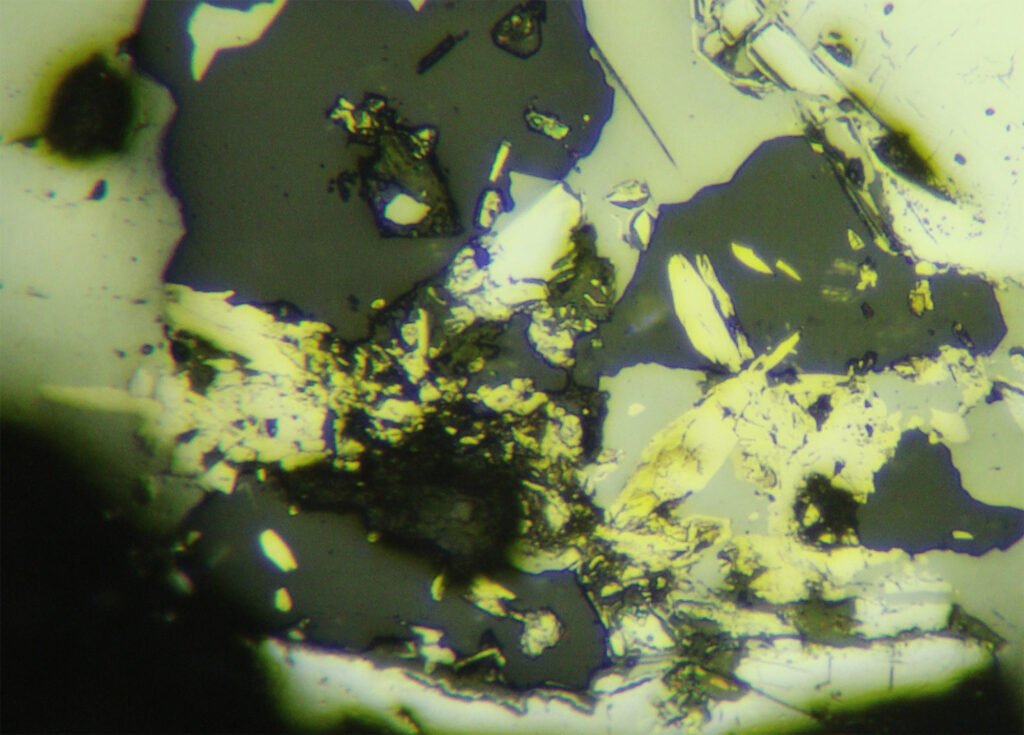
Reflection color: Pale yellow, bright yellow or yellow with a cream tint.
Compared to the color of pyrite, the color of millerite is a little more yellow.
Compared to the color of chalcopyrite, the color of millerite is slightly lighter, creamier and less yellow-green.
Compared to the color of pentlandite, the color of millerite is more yellow and less brown.
Compared to the color of linnaeite, the color of millerite is more yellow and less pink.
Pleochroism: Weak, pale yellow to brownish yellow. It should be observed in intergranular contacts.
Reflectivity: 57,56 to 55,16%.
Bireflectance: Very weak.
CROSSED POLARIZED LIGHT – XPL
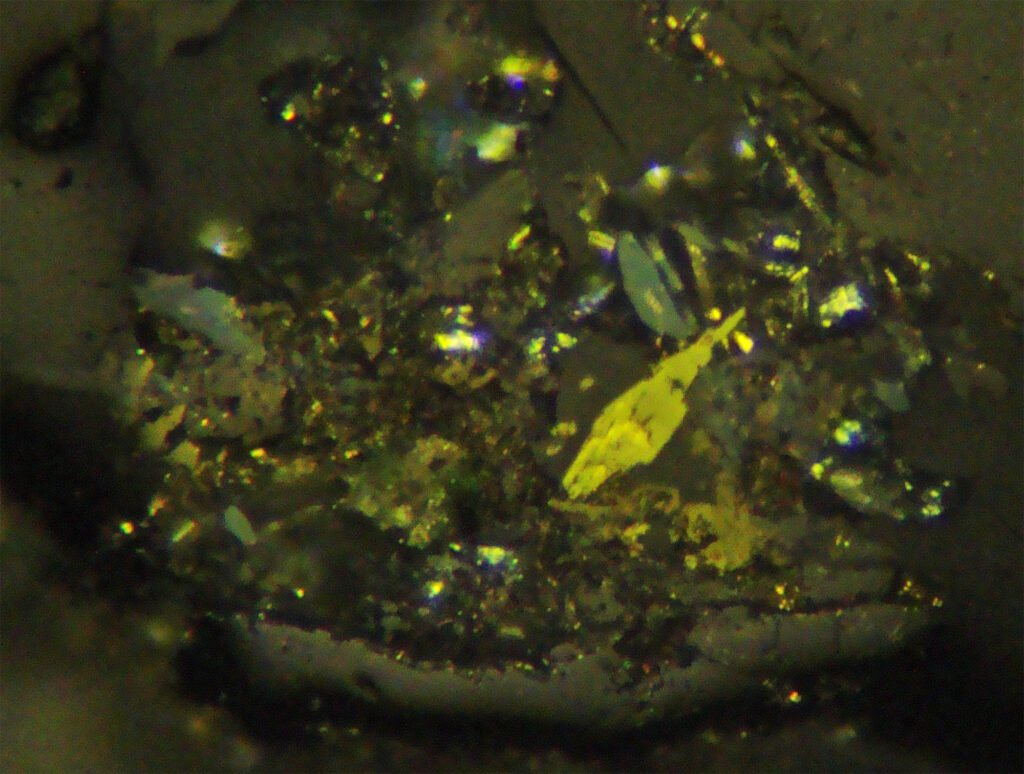
Isotropy / Anisotropy: Strong anisotropy from yellowish to bluish or slate blue gray.
Internal reflections: No.
May be confused with: considering the unusual habit, yellow color and higher hardness, millerite is easy to recognize. However, granular aggregates are easy to confuse with other minerals.
Chalcopyrite has a similar color, but is hardly euhedral, hardly (never!) acicular. Also, its anisotropy is much weaker.
Pyrite can be acicular when associated with coal seams, but it has greater hardness and is isotropic.
Jamesonite forms acicular crystals as well, but its color is gray.
Boulangerite also forms acicular crystals, but these are flexible.
Rutile and elbaite (tourmaline variety) may have similar acicular habits, but the paragenesis is different.
General Characteristics:
Grain shape: almost always acicular, forming subparallel or radial tufts (aggregates). Rarely forms larger masses in crusts. Needles are normally no more than 1 cm long and are fractions of a millimeter thick. Basal sections are often explicitly trigonal. It is rarely completely anhedral, forming granular masses.
Cleavage (10-11) often can be easily seen. The characteristic habit of millerite, typically acicular, makes this observation difficult.
Extinction is straight, but not complete. Basal sections are isotropic.
Anomalous greenish hues sometimes occur in pyrites and chalcopyrites associated with millerite and pentlandite.
Twins are very common, in the form of isolated individual lamellae, may occur in larger quantities. Often these twins are due to pressure. Many individuals are very twisted. Helical twins parallel to the C axis are locally frequent.
Zonation is not rare, it becomes visible especially in basal sections.
Millerite reaction edges occur between violarite and pyrrhotite.
Replacement of heazlewoodite (Ni3S2) by millerite produces tabular millerite crystals according to (0001) and in this case the identification of millerite is only possible by X-Ray Diffractometry. Replacement of millerite by violarite (FeNi2S4) occurs rarely. Many substitutions were possibly not recognized because they occur in very porous ores in the oxidation zone that offer great difficulties in making polished sections.
Intergrowths with violarite and pentlandite are common. Other intergrowths occur with sphalerite, heazlewoodite, galena and linnaeite.
Millerite exsolutions, in the form of oriented lamellae enclosed or intergrown with linnaeite, may occur.
Substitutions 1: Millerite replaces linnaeite, hauchecornite, pyrite, heazlewoodite and pentlandite.
Substitutions 2: Millerite is replaced by violarite, bravoite (Ni-pyrite), gersdorffite and chalcopyrite.
Alteration of millerite leads to the formation of bravoite (pyrite-Ni) and violarite.