Goethite – FeO(OH) – is a very common oxide, abundant in various types of rocks and in soils. It participates in the composition of many Fe and Mn ores.
Goethite can form prismatic crystals, striated parallel to [001], up to 45 cm long. Tabular crystals according to {010} also occur. However, the most common habit of goethite is capillary to acicular aggregates, forming divergent tufts or reniform to botryoidal masses, banded or not. Stalagtite masses with a concentric or radial fibrous internal structure are also common. In quartz crystals, goethite very often forms radial tuft inclusions of dark brown acicular crystals. In “limonite” (see below), goethite is almost cryptocrystalline.
Goethite is trimorphic with feroxyhyte and lepidocrocite. In the aggregates it can be intensely contaminated, it can contain Al2O3, CaO, BaO, SiO2 and others. It is magnetic if heated and has 6 varieties.
“Limonite” was considered a mineral, but in reality it is a mixture of goethite, akaganeite, lepidocrocite and jarosite. Only with X-Ray Diffractometry it is possible to confirm these mineral species.
Crystal system: Orthorhombic bipiramidal.
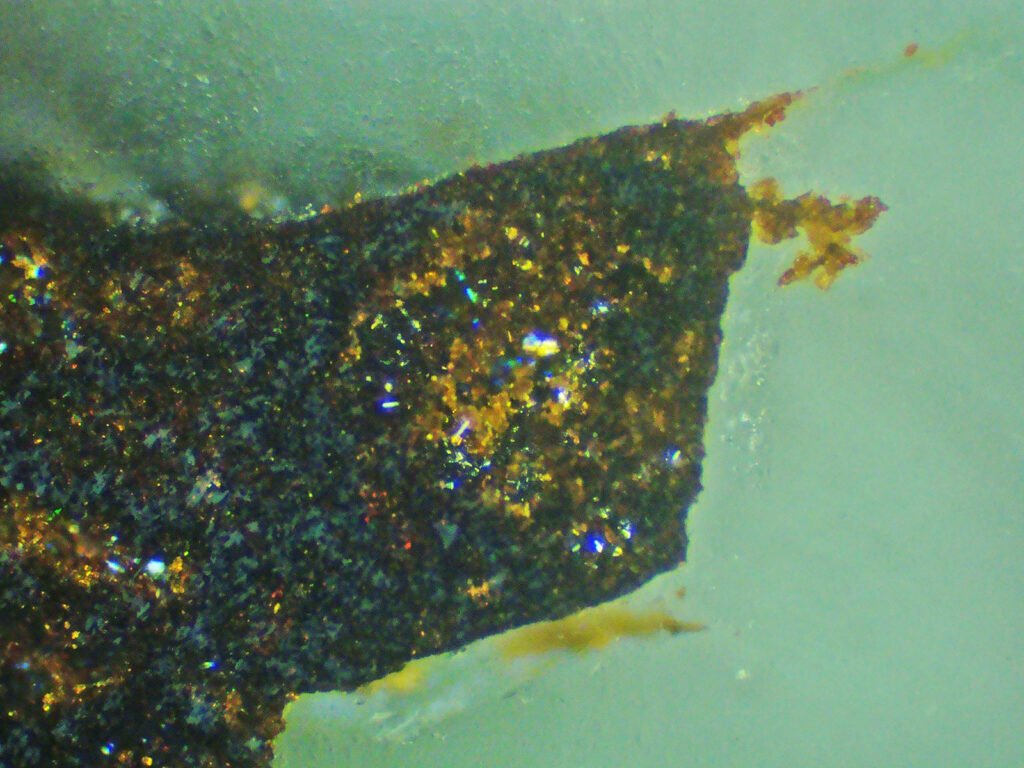
Color: Black, brown, yellow to red-brown, yellow. It can be iridescent.
Habit: Prismatic, tabular, scales, massive, reniform, botryoidal, stalagtite, etc.
Cleavage: {010} perfect, {100} less perfect.
Tenacity: Brittle.
Twinning: No.
Fracture: Irregular, fibrous.
Mohs Hardness: 5 – 5.6
Parting: No.
Streak: Brown, yellow brown or yellowish orange.
Lustre: Adamantine, metallic, matte, earthy. Silky when fibrous.
Diaphaneity: Transparent.
Density (g/cm³): 3.3 – 4.3
Goethite can occur in igneous, metamorphic and sedimentary rocks. It forms in oxidized environments by the alteration of iron-rich minerals such as pyrite, siderite and magnetite, generating pseudomorphoses. It is typical for the iron hats (“gossan”) developed over sulphide metalliferous deposits. It forms in soils and other low-temperature environments such as bauxites. Nanoparticulate autigenic goethite is the most common diagenetic iron hydroxide in marine and lake sediments.
Goethite precipitates in stagnant surface waters (swamps), where it forms the “bog iron ore”. Also occurs at the bottom of lakes and small streams. It forms in caves and, as a primary mineral, in hydrothermal deposits. Since prehistoric times, it has been used as a pigment in cave paintings and ceramics. Nowadays its biggest use is as iron ore, called “brown iron ore”.
It occurs associated with sulfides such as pyrite, chalcopyrite, pyrrhotite, sphalerite, galena, boulangerite and tetrahedrite.
Also with Fe and Mn oxides such as hematite, magnetite,lepidocrocite, maghemite, jarosite, pyrolusite, manganite, wurtzite and others.
Also with quartz, barite, fluorite, carbonates (calcite, siderite, malachite), Cu oxides, vanadinite and many other minerals.
Refraction indices: nα: 2.260 – 2.275 nβ: 2.393 – 2.409 nγ: 2.393 – 2.409
PLANE POLARIZED LIGHT – PPL
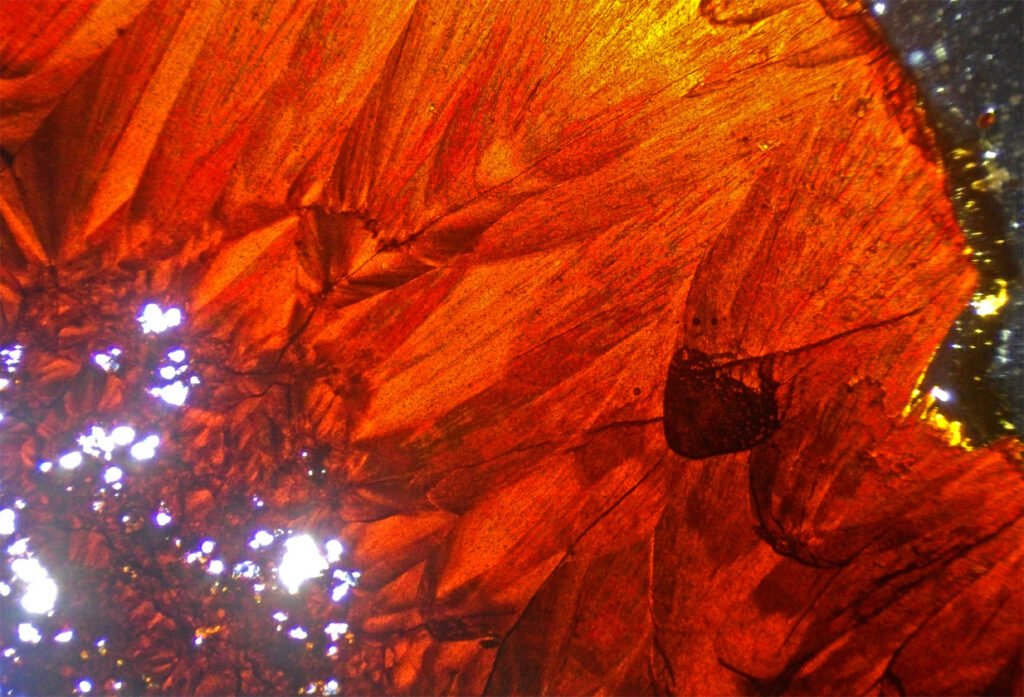
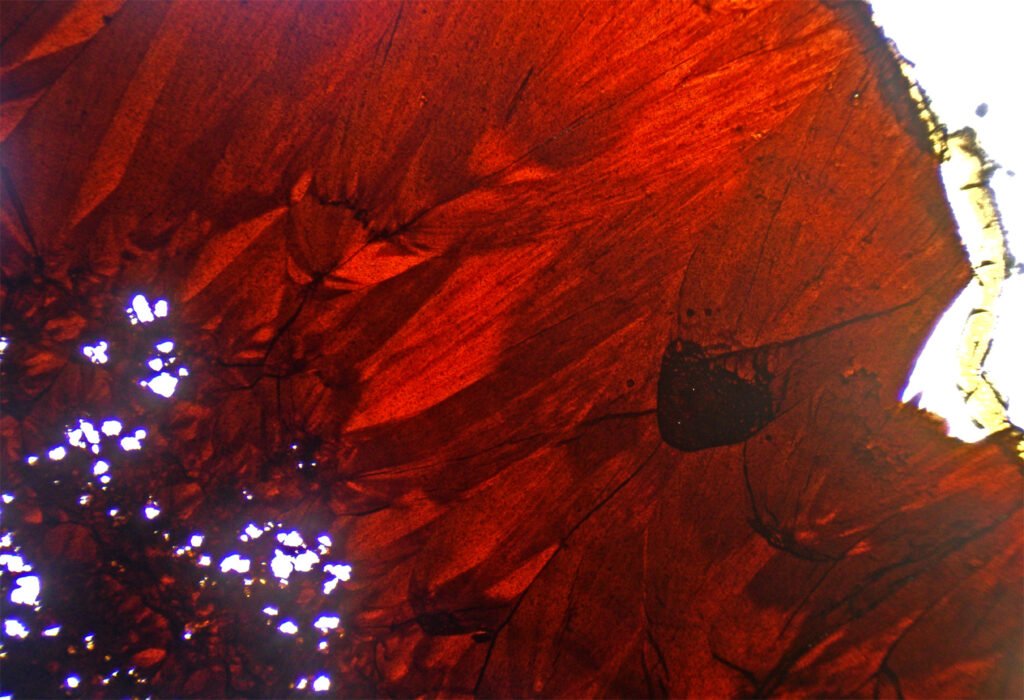
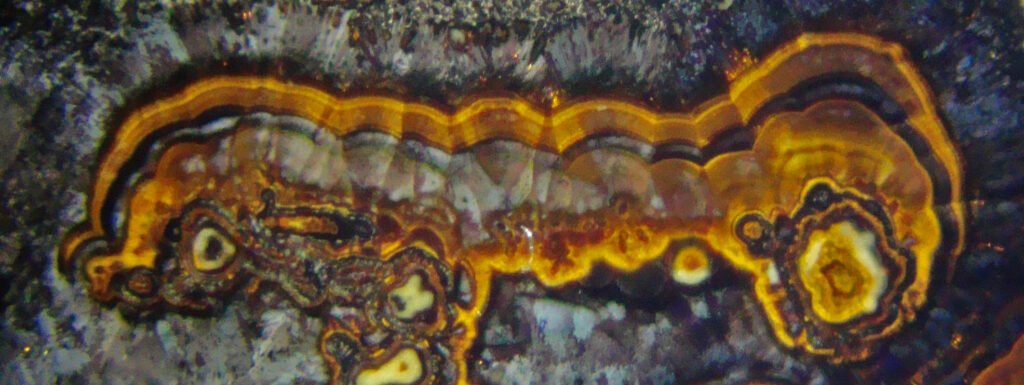
Color / Pleochroism: Strongly pleochroic:
X = colorless to yellow,
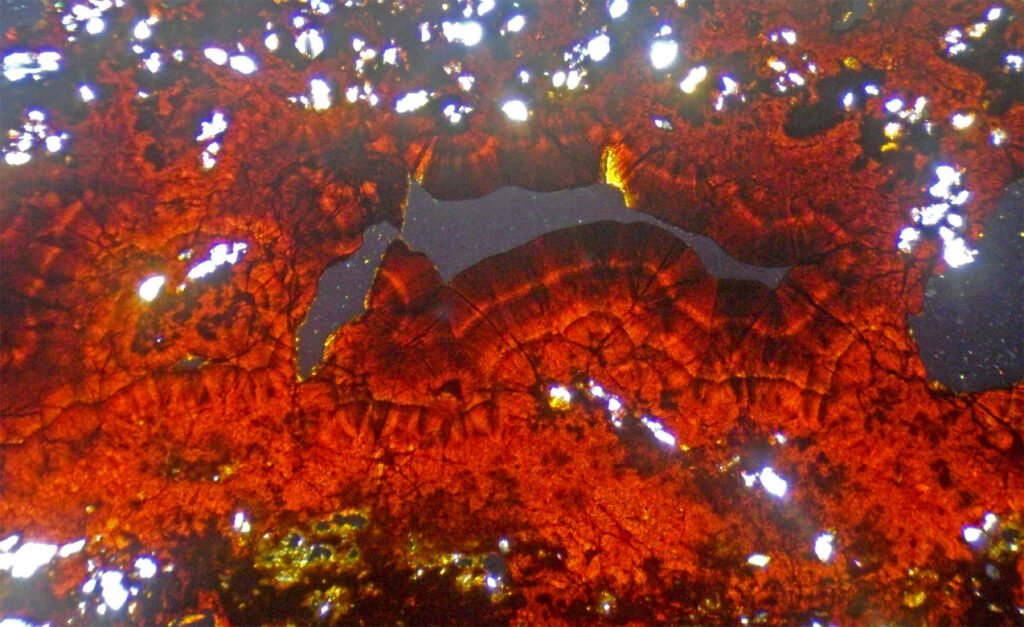
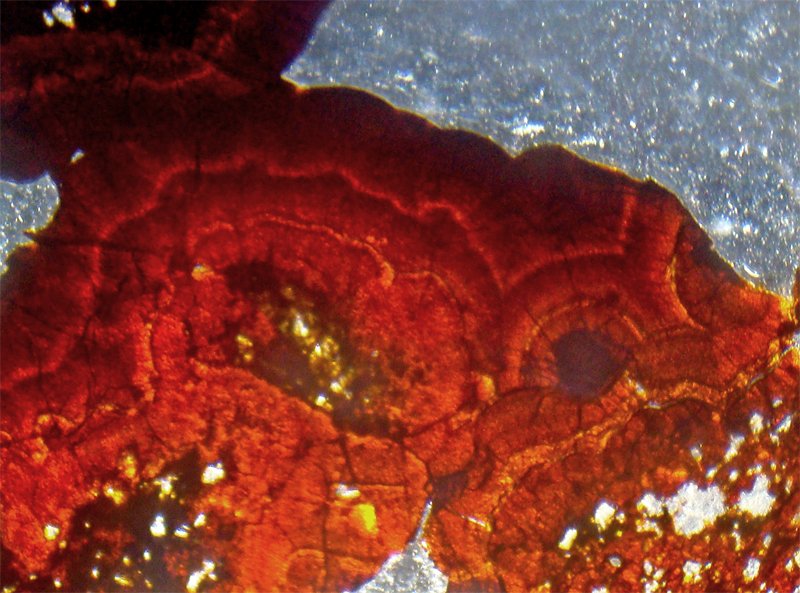
Y = yellowish brown to reddish-orange, and
Z = yellowish orange and deep red brown.
When in small crystals, pleochroism is difficult to observe.
Relief: Very high.
Cleavage: {010} perfect and {100} less perfect. Due to the tiny size of the crystals, these cleavages are usually not visible.
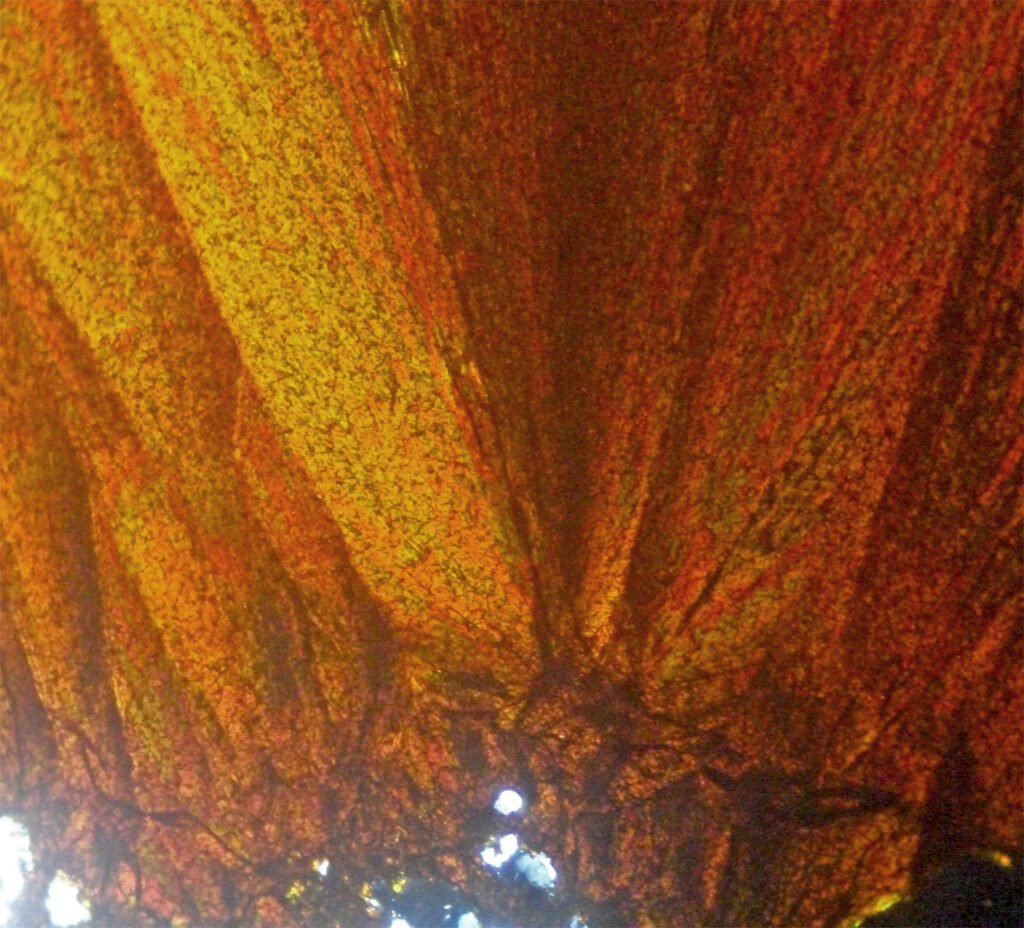
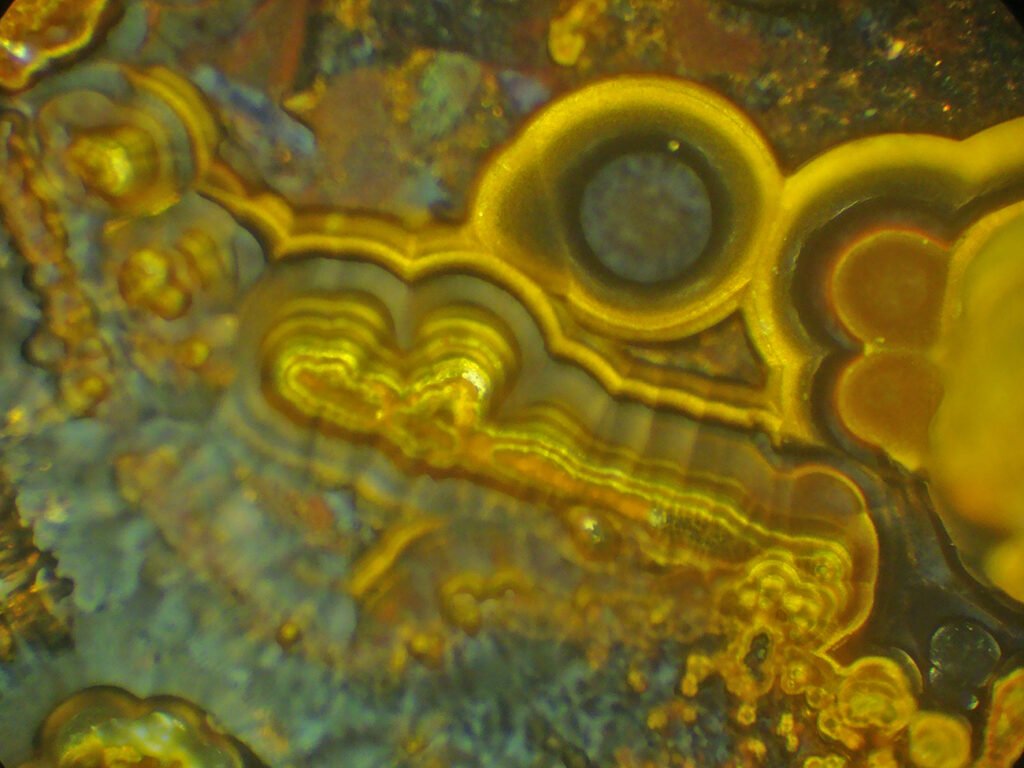
Habits: Acicular parallel to the z axis. Forms divergent fibers in radial or concentric aggregates. It can be prismatic, tabular, massive, spherulitic, banded, reniform, botryoidal or stalagtitic.
CROSSED POLARIZED LIGHT – XPL
Birefringence and Interference Colors: Birefringence from 0.133 to 0.134. Very high, 6th or 7th order. Interference colors vary according to the H2O content and cannot be identified due to the strong color of the goethite.
Extinction: Parallel in longitudinal sections, like chalcedony.
Elongation sign: No information available. Probably difficult to determine due to the small size of the crystals and the strong own color of goethite.
Twins: No.
Zoning: No.
CONVERGENT LIGHT
Character: B(-). Due to the high dispersion it is U(-) when ʎ = 605 – 620 nm.
2V angle: 0 – 27º, depending on the wavelength of the light.
Alterations: does not alter, it is a product of alteration of iron minerals.
May be confused with: some other minerals with red colors in thin section.
Hematite is U(-) and has brown-red predominant colors.
Brookite may be similar.
Lepidocrocite is very similar, but has a more tabular habit and tends to be idiomorphic.
Sample preparation: the polishing behavior of goethite varies with grain size, porosity, type of intergrowth and other minerals present in the sample. Large crystals acquire a good polish; powdery and/or porous masses cannot be polished. Fibrous aggregates break down easily during grinding and polishing. The hardness is markedly higher perpendicular to the elongation of the fibers. Hardness, therefore, varies within wide limits; the indication of 5-5.5 is only valid for coarse-grained material.
PLANE POLARIZED LIGHT – PPL
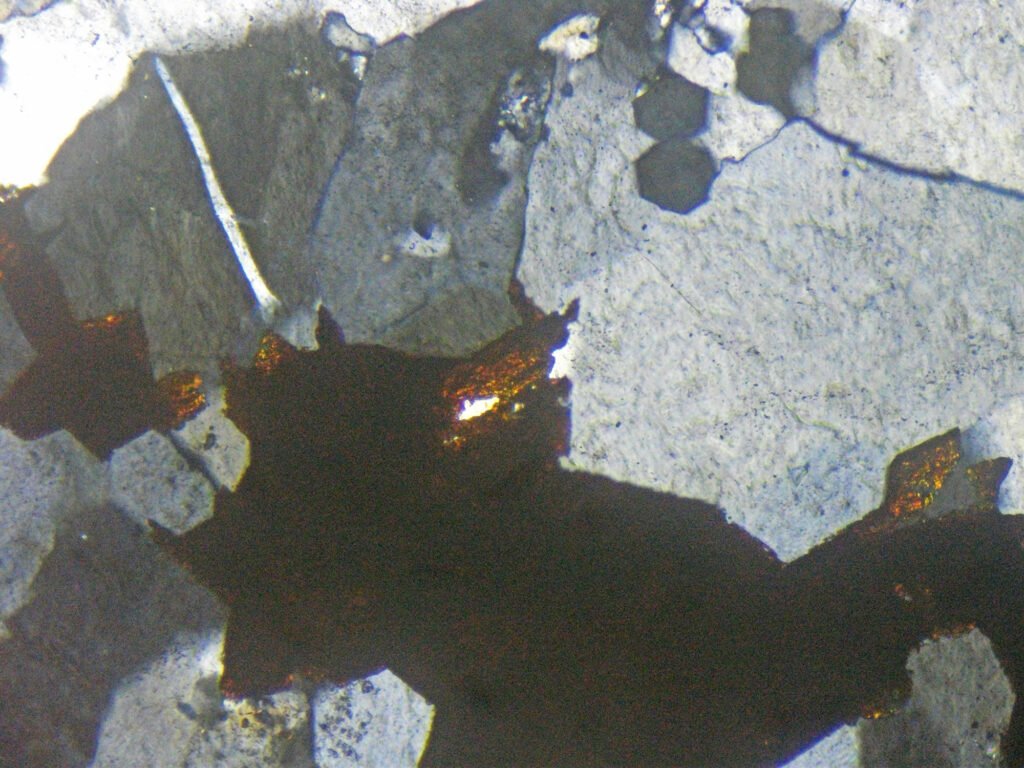
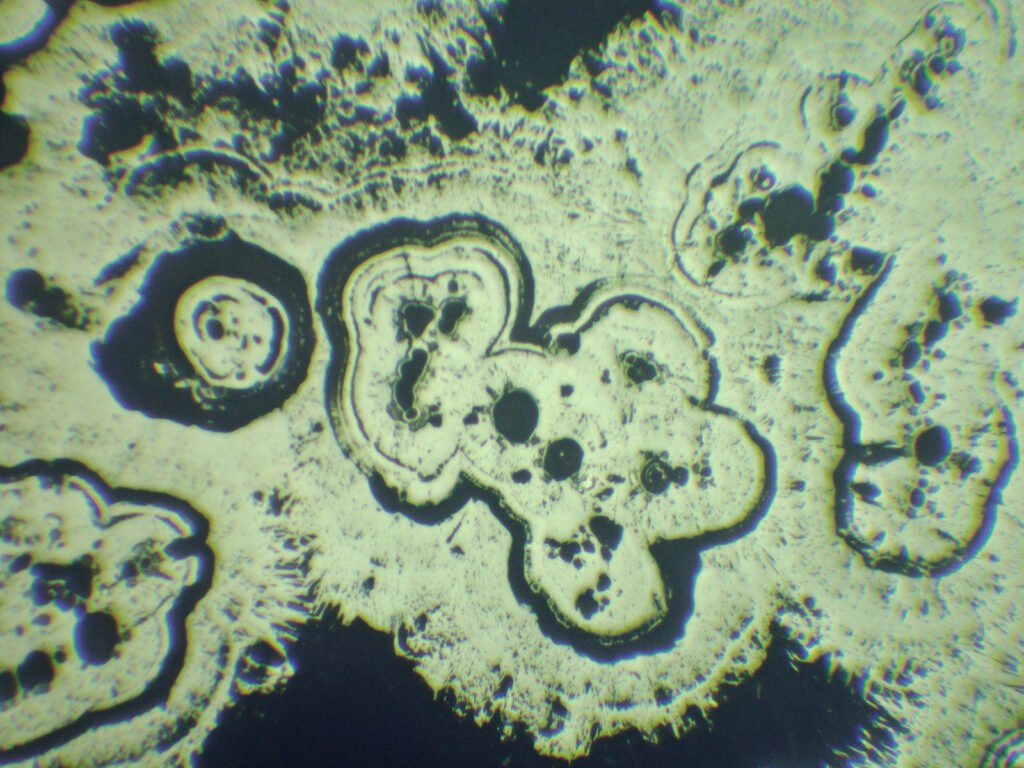
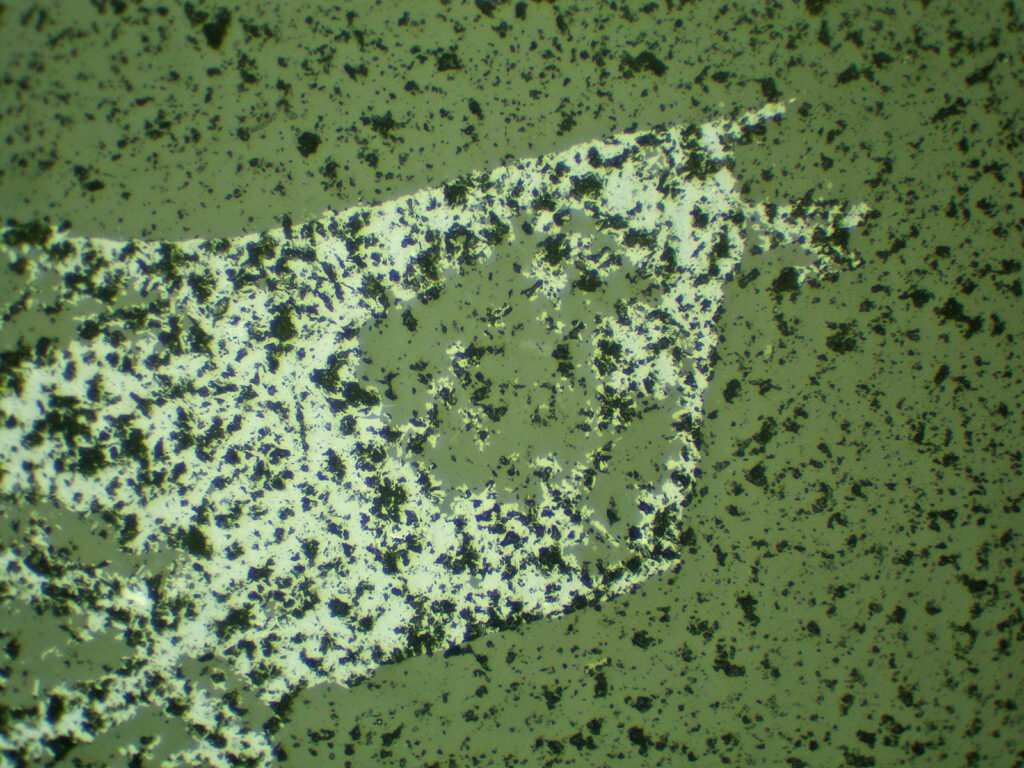
Reflection color: Gray with a blue tint, but can vary within wide limits, between dark gray and very luminous gray. Color depends on texture and orientation: large grains are lighter than cryptocrystalline aggregates.
Pleochroism: Weak, but always distinct in large-grain aggregates, varies with the amount of water adsorbed. Colors range from yellow or colorless to brownish yellow or orange yellow. Parallel to the fiber the goethite is lighter and grey-brown, perpendicular to the fiber almost as light or distinctly darker, with brown tones in both cases. Basal sections are less pleochroic.
Reflectivity: 12.67 – 13.87%
Bireflectance: No.
CROSSED POLARIZED LIGHT – XPL
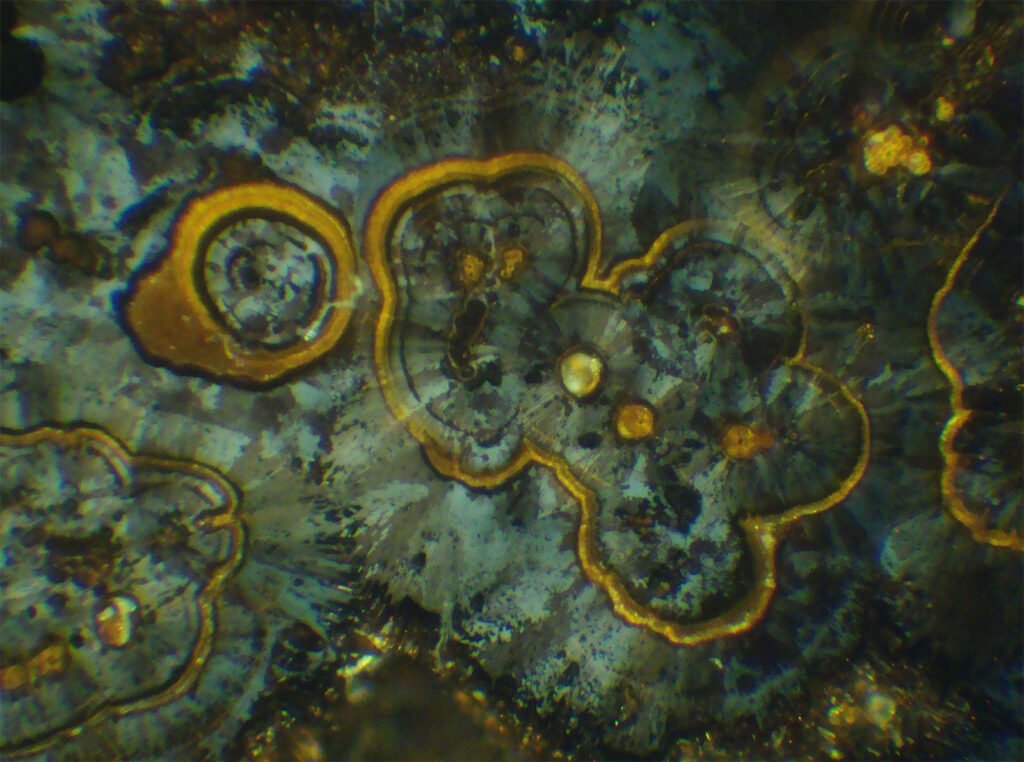
Isotropy / Anisotropy: Strong to slight anisotropy in aggregates of larger grains, ranging from gray-blue, gray-yellow, brownish, and gray-green. In large grains it is stronger than in cryptocrystalline aggregates.
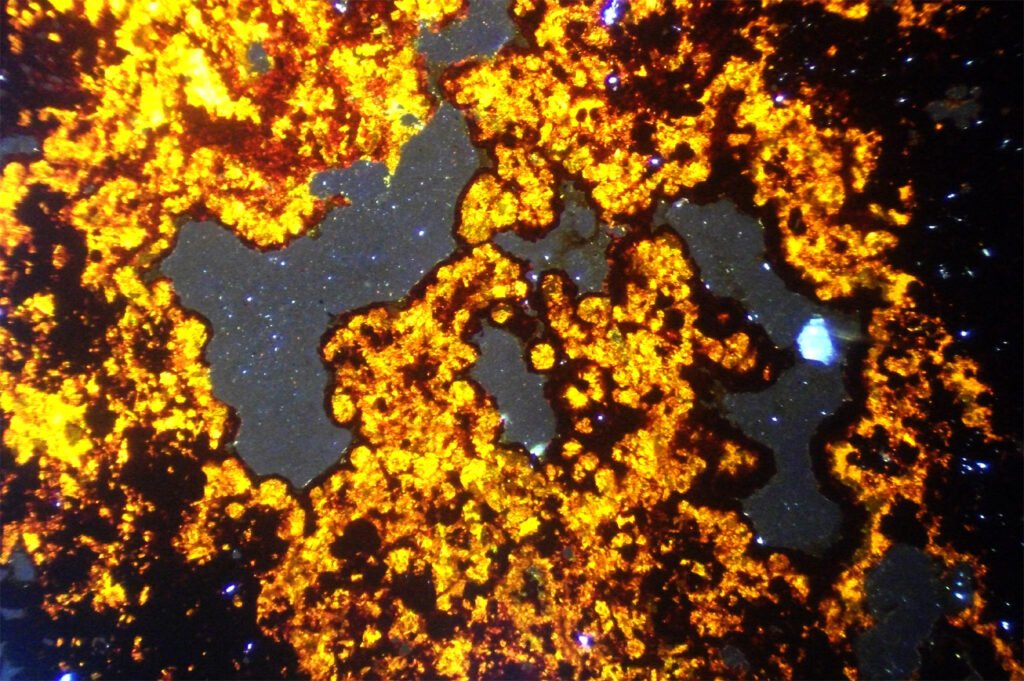
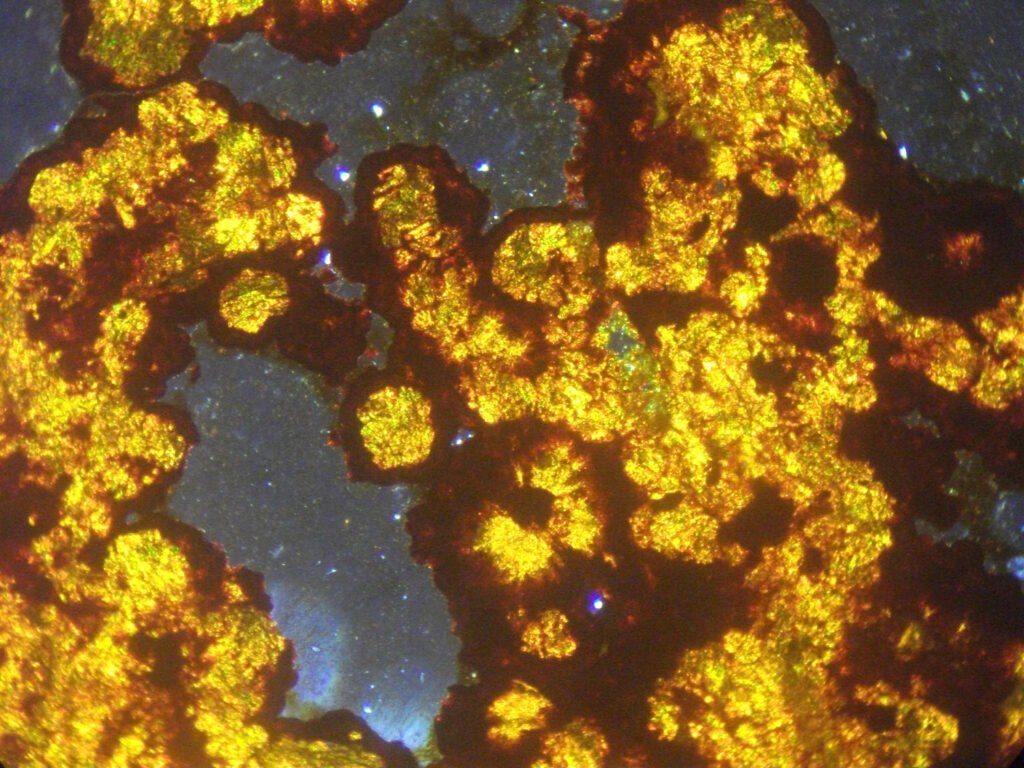
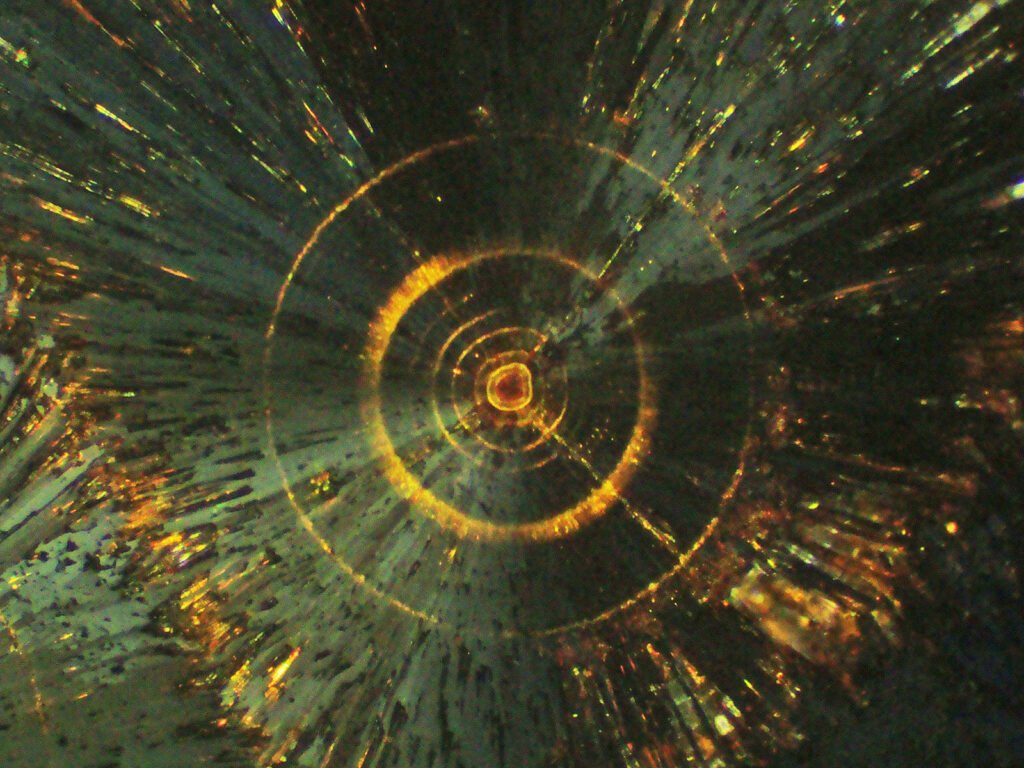
Internal reflections: Abundant in yellow, orange, red to red-brown colors; its quantity depends on the grain size, porosity and polishing quality. In cryptocrystalline aggregates the internal reflections are more abundant.
May be confused with: lepidocrocite, which has lighter colors, lighter internal reflections, and lower reflectivity.
General Characteristics:
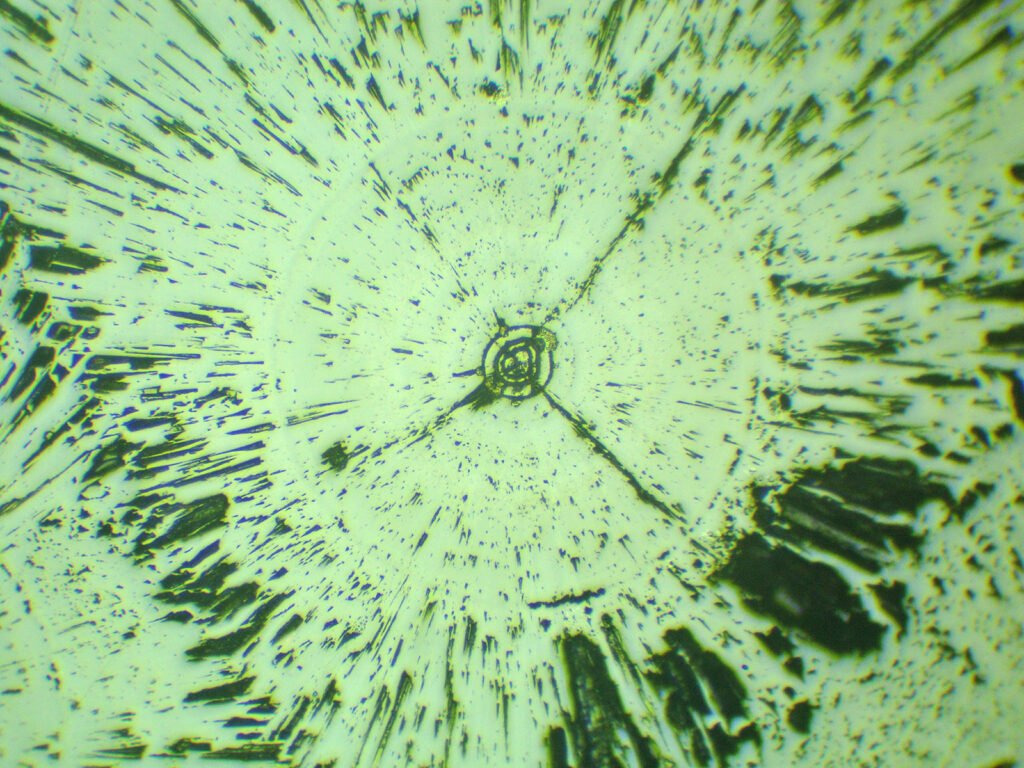
Grain shape: almost always forms submicroscopic needle crystals in radial aggregates. Large isolated crystals were rarely observed. Microscopic needles abound in “brown iron ore” that is apparently massive. Yellow and brown earth masses are frequent, and some of these may still be in the form of a gel.
Cleavage is only rarely observed.
Twins were not observed.
Zonation only occurs in large crystals.
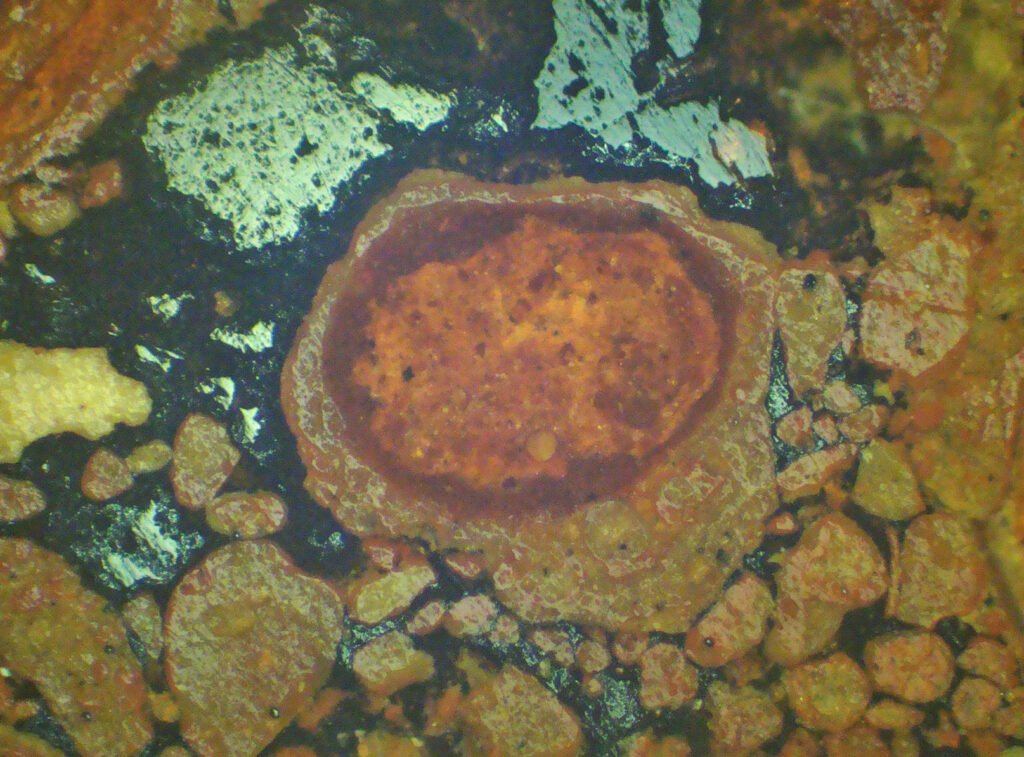
Predominant textures and structures are those of materials that crystallized from gels, such as coloform textures and spherulitic aggregates. The acicular or fibrous crystals are always arranged perpendicular to the surface on which the mamelonate or botryoidal aggregates have developed, somewhat reminiscent of chalcedony. Parallel to the surface of the aggregates, there are often very well-defined concentric bands, which alternate in regular rhythms. The bands are distinguished by small variations in grain size and polishing behavior. The fibers are often radially arranged.
Pseudomorphs of goethite can be on pyrite, marcasite and siderite.
Substitutions: goethite forms from the alteration of iron-containing minerals. Thus, it replaces pyrite, chalcopyrite, siderite, hübnerite (wolframite), magnetite, ilmenite, hematite, other Fe sulfides and pyrrhotite. The features developed allow conclusions about the original minerals of the deposit. The masses of goethite, formed from pyrrhotite following the sequence pyrite, marcasite and pyrite-gel, under the microscope allow us to observe the basal cleavage of pyrrhotite, the bird’s eye structure of the initial pyritization and its lamellar detachment. The goethite masses of these pseudomorphoses almost always have a well-developed rhythmic structure.
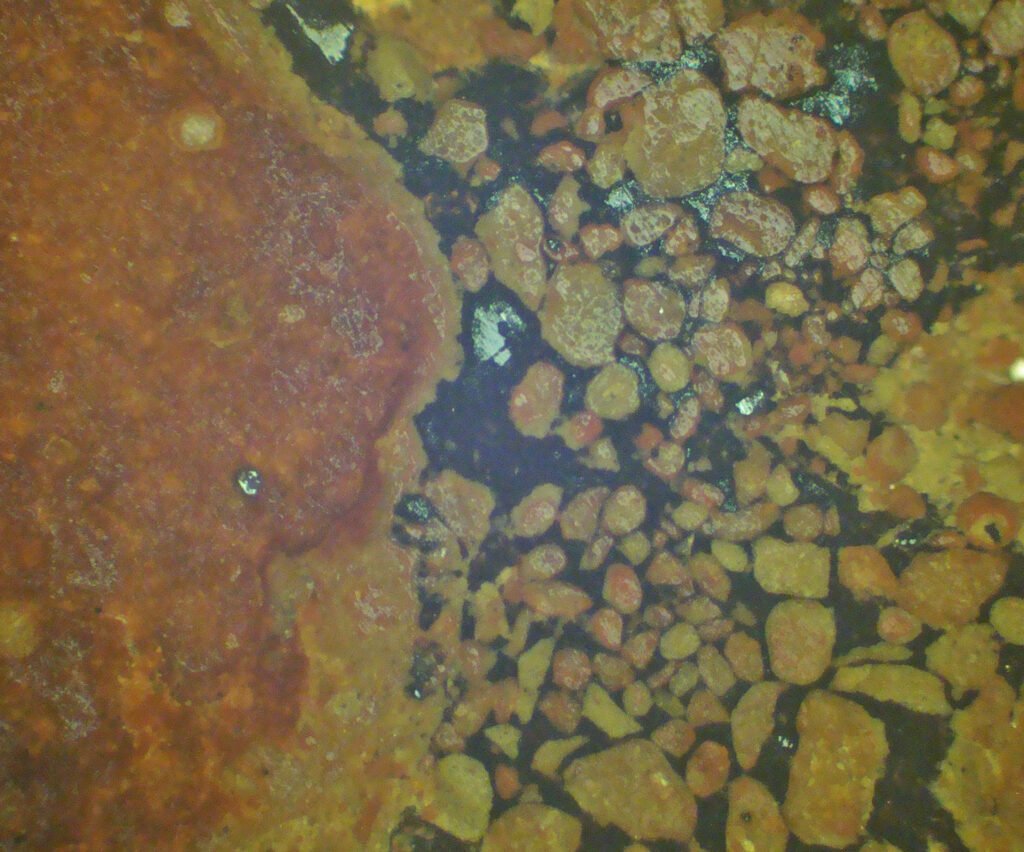
Different structures are formed in those goethites that were formed from the precipitation of iron contained in surface waters, such as goethite from lakes, from swamps, from lawns, in geodes and especially the goethite oolites with their characteristic texture.