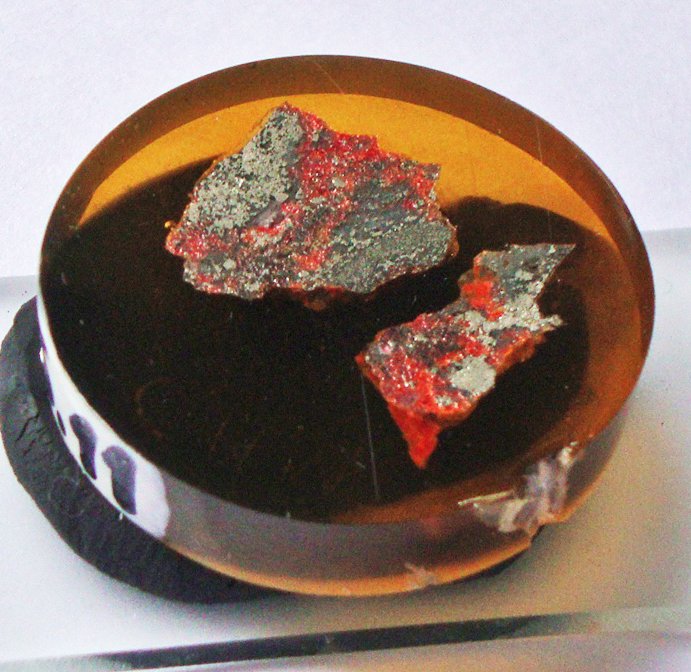
Realgar – As4S4 – is a rarer sulfide. It has some importance as an As ore, along with arsenopyrite and orpiment.
It normally occurs very pure. It is trimorph with alacránite and pararealgar. Sometimes it’s fluorescent. Macroscopically it can be confused with sarawaite and other red As-S minerals.
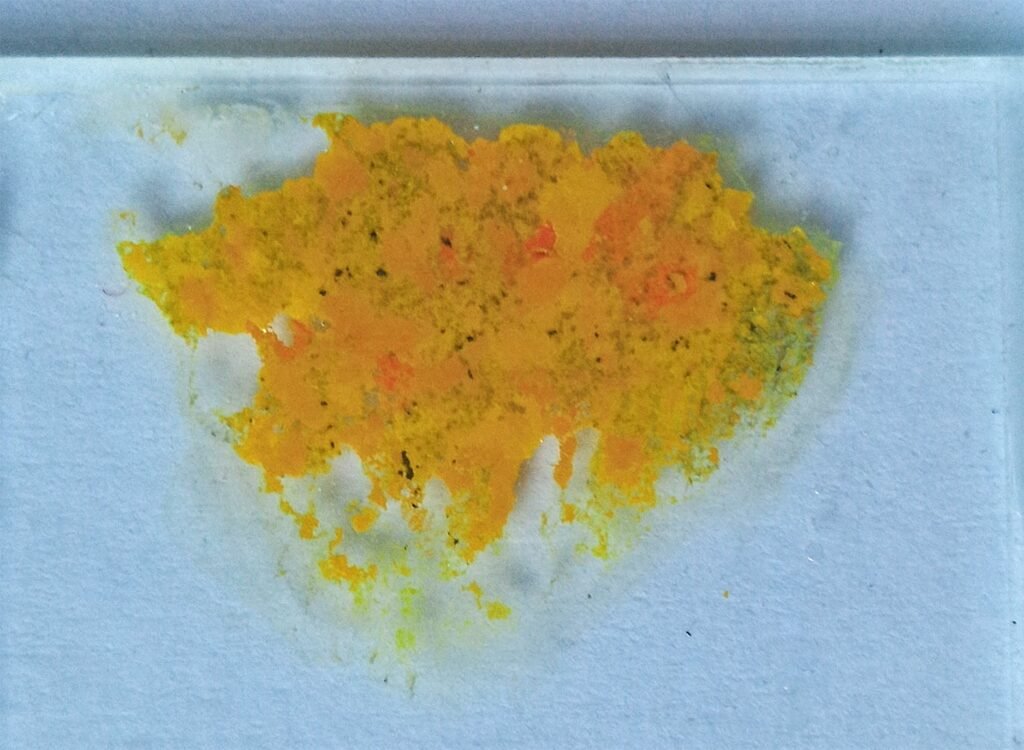
As realgar is photosensitive, it changes to a yellow powder composed of pararealgar. The alteration starts at the edges of the crystals, often only after the deposition of these crystals in mineralogy collections. This yellow change was long believed to be for orpiment, so information in the literature on “realgar with orpiment” should be evaluated carefully!
Realgar is poisonous and carcinogenic and is even used today, in some cases, as a rodenticide and insecticide. Therefore, wash your hands after handling realgar, especially if it is powdery. Avoid inhaling dust while handling it. Never lick, do not ingest, do not consume food while handling the mineral. Heated realgar releases a garlic smell, corresponding to toxic As fumes.
5. Reflected Light Microscopy
Sample preparation: the low hardness of realgar requires some special care, such as avoiding very coarse abrasives at the beginning of the grinding process, otherwise deep polishing grooves are generated that will be difficult to eliminate afterwards. Polishing hardness is less than the hardness of orpiment and much less than stibnite hardness. Also, realgar is very brittle, so its polishing in the presence of harder minerals is not good. With very careful polishing it is possible to obtain reasonable sections. Remember: realgar is poisonous, use gloves, mask and safety glasses.
PLANE POLARIZED LIGHT – PPL
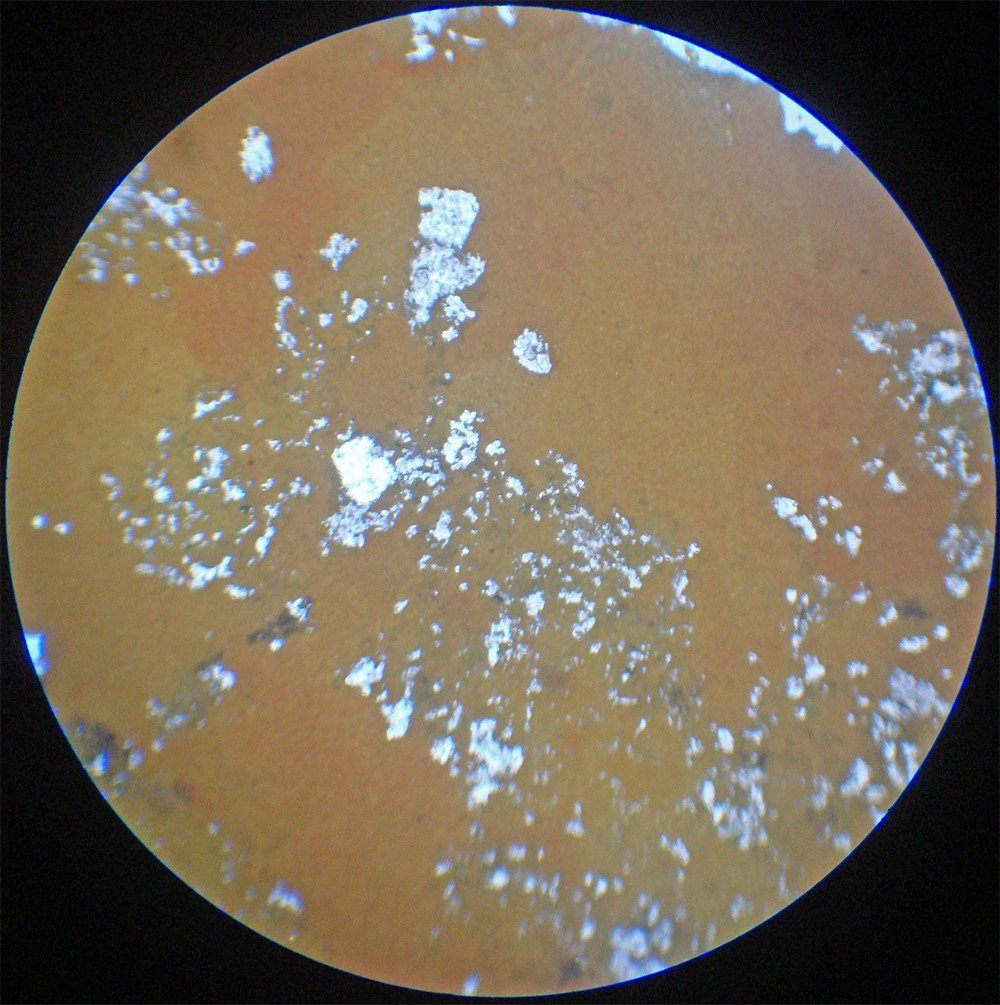
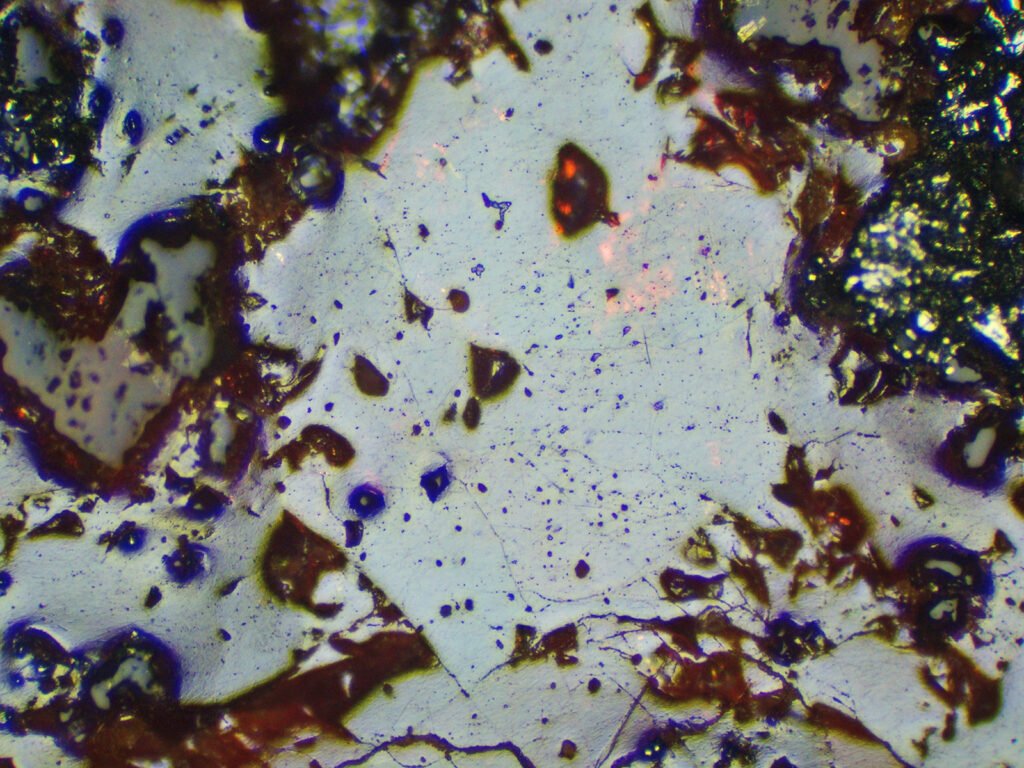
Reflection color: Gray-white to gray-brown with a soft violet or purple hue.
Compared with goldpigment color, realgar color is a little darker.
Compared to the color of sphalerite, the color of realgar is almost the same, a little lighter.
Compared to the color of cinnabar, the color of realgar is much darker.
Pleochroism: Very discrete, best observable at intergranular boundaries. The colors are a gray with a reddish tinge varying to a gray with a bluish tinge.
The internal reflections visible even in PPL hinder the perception of this pleochroism.
Reflectivity: 19.27%
Bireflectance: No.
CROSSED POLARIZED LIGHT – XPL
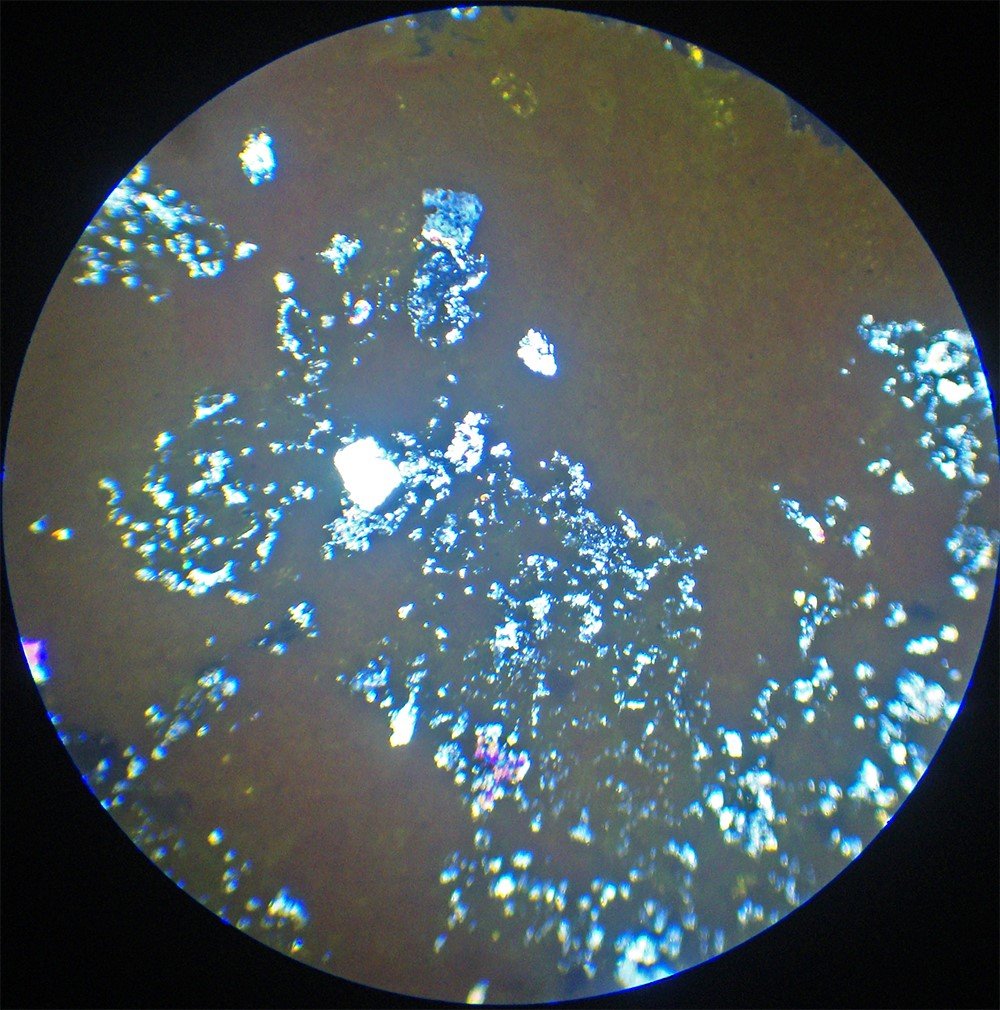
Isotropy / Anisotropy: Moderate to strong anisotropy, masked by internal reflections. Uncrossing the nicols a little (2o) it is possible to perceive the anisotropy despite the internal reflections.
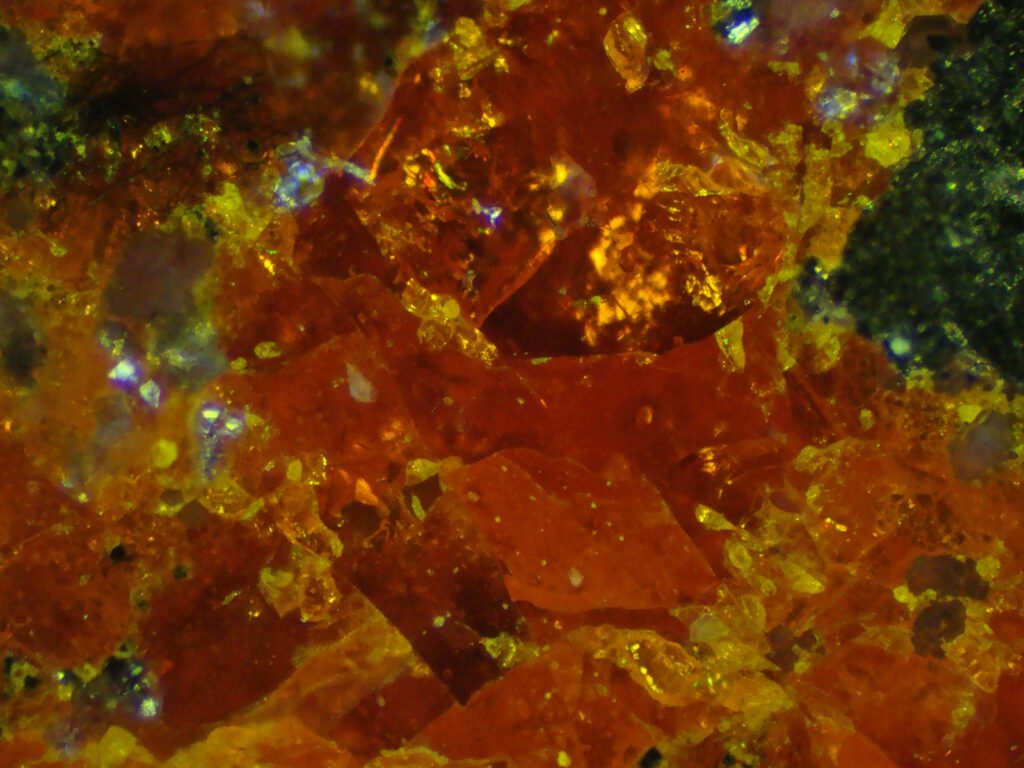
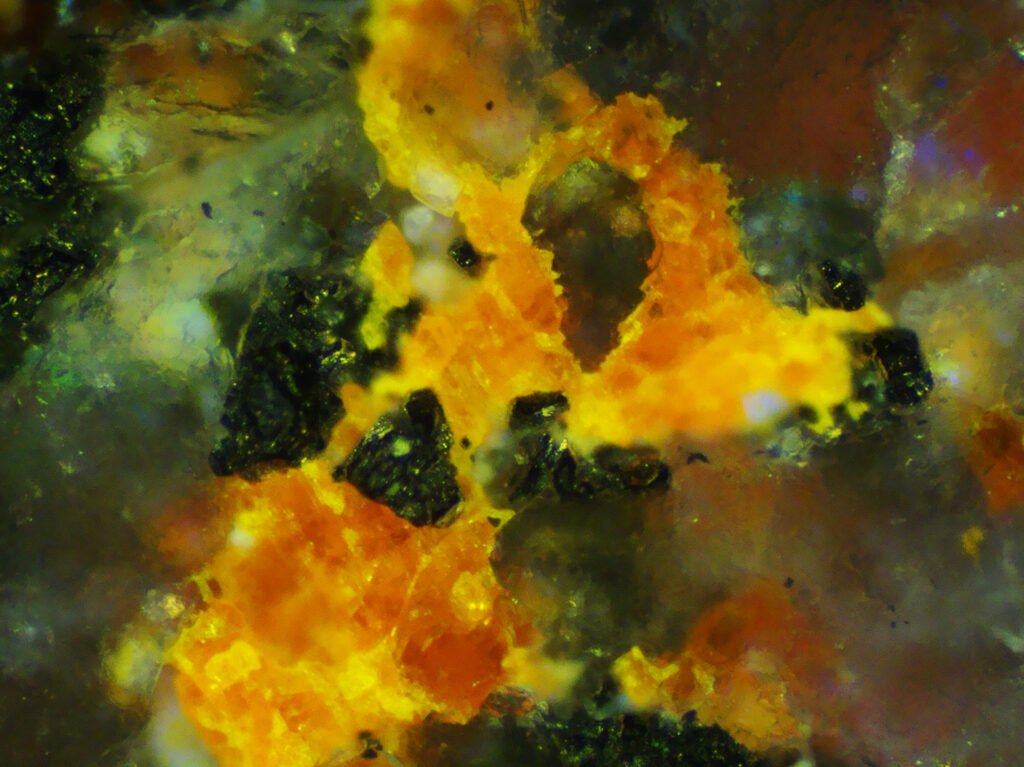
Internal reflections: Abundant internal reflections in intense red, yellow-red, orange-red and orange.
May be confused with: few other minerals, because even in tiny grains it is very conspicuous already in a hand sample. Its very low hardness and its very sharp internal reflections exclude, a priori, any possibility of confusion under the reflected light microscope.
Cinnabar has internal reflections only in shades of red, while realgar has internal reflections in colors of yellow-red and orange-red.
General Characteristics:
Grain shape: As it was usually the last mineral to form, it fills the interstices between grains of other minerals formed before it. Even completely anhedral masses have an overall uniform orientation, despite the lamellar crystals of very jagged contacts.
Polishing scratches will always be present due to the low hardness of the realgar and constitute an important diagnostic aspect. With careful polishing, the amount of grooves can be reduced.
Cleavage is not noticeable.
Twins are not visible.
Inclusions of realgar in orpiment may occur.
Oriented intergrowths with orpiment may occur.
Alteration occurs to a yellow powder, which is pararealgar. In older literature this yellow material was called orpiment, a mistake that has been undone in recent decades.