WOLFRAMITE
Wolframite – (Fe,Mn)WO4 – is a relatively common oxide and constitutes the most important tungsten ore as it contains >75% WO3. The other important ore of tungsten is scheelite. Tungsten is a strategic metal.
Wolframite is actually not a mineral, but a term that refers to intermediate compositions between the minerals ferberite (FeWO4) and hübnerite (MnWO4). The most common compositions of the members of this series are between 20 – 80% Fe-Mn. Minerals are classified in the Wolframite Group, forming the Ferberite-Hübnerite Series. Some varieties are weakly magnetic.
In microscopy, we usually work only with “wolframite”, as intermediate terms usually occur between the two extremes and the exact determination of the proportions of Fe and Mn must be obtained with other analytical methods.
1. Characteristics of Ferberite:
Crystal system: Monoclinic prismatic.
Color: Black.
Habit: Crystals as wedges, flattened, elongated. Also short, massive, prismatic.
Cleavage: {010} perfect. Striations paralell to {001} or {010}.
Tenacity: Brittle.
Twinning: Common, contact, interpenetrating and lamellar.
Fracture: Subconchoidal.
Mohs Hardness: 4 – 4.5
Parting: On {100} and {102}.
Streak: Brownish black to black.
Lustre: Metallic.
Diaphaneity: Transparent.
Density (g/cm³): 7.58
1. Characteristics of Hübnerite:
Crystal system: Monoclinic prismatic.
Color: Yellow-brown, reddish-brown, brown-black, black, red (rare).
Habit: Prismatic, tabular, flattened, with many shapes. Radial groups or parallel crystals.
Cleavage: {010} perfect. Striations paralell to {001}.
Tenacity: Brittle.
Twinning: Common, contact, interpenetrating and lamellar.
Fracture: Irregular.
Mohs Hardness: 4 – 4.5
Parting: On {100} and {102}.
Streak: Greenish gray, yellow to reddish brown
Lustre: Adamantine, resinous, metallic.
Diaphaneity: Transparent.
Density (g/cm³): 7.12 – 7.18
2. Geology and Deposits
Wolframite is typically a pneumatolytic mineral, formed by the very volatile components of acidic magmas. Thus, it occurs associated with granitic intrusives, in quartz veins and pegmatites. It is usually of very early genesis, but in some cases, especially in the case of Mn-rich representatives, its formation extends to the hydrothermal phase of the deposit formation.
Pegmatites in which wolframite is the main mineral are not rare; in other cases wolframite occurs in very subordinate amounts. Very similar are the pneumatolithic veins in which wolframite forms large masses immersed in quartz. Wolframite often occurs together with cassiterite. This type of deposit is very common and constitutes the most important deposits. In limestone contact metasomatism deposits (skarnites), wolframite is rarer and generally does not constitute economic volumes – in these cases tungsten occurs in the form of scheelite.
Wolframite also occurs in greisen and in Mo-porphyry deposits.
Hydrothermal wolframite formations occur in veins with stannite, arsenopyrite, sphalerite and chalcopyrite. In other cases the veins carry intrusive gold paragenesis. Formed at even lower temperatures, wolframite occurs with siderite and galena or with enargite. In subvolcanic deposits, with veins of bismuth, silver and tin, both Fe-rich and Mn-rich varieties occur. Tungsten often occurs in deposits of the W-Sn type.
Wolframite is frequent in placers, both eluvial and alluvial, occurring together with cassiterite. As wolframite is not insoluble, it quickly disappears at greater distances from the primary deposit.
The biggest occurrences of wolframite currently known are in China.
3. Mineral Associations
Both ferberite and hübnerite are basically associated with the same minerals.
They are associated with some common gangue minerals such as quartz and carbonates (calcite, dolomite, siderite, rhodochrosite).
Also to some common sulphides such as pyrite, marcasite, galena, sphalerite, molybdenite and arsenopyrite.
Likewise, it occurs with some common oxides such as hematite and common silicates such as orthoclase and muscovite.
In the specific paragenesis occur mainly cassiterite, columbite-tantalite, tapiolite, gold, mawsonite, scheelite, fluorite, topaz, beryl, fluorapatite, tourmaline, spodumene, lepidolite, stannite, stibnite, bismuthinite and native bismuth.
Also some rare minerals (as always in pegmatites!) like hydrokenoelsmoreite.
4. Transmitted Light Microscopy of Ferberite
Refraction indices: nα: 2.255 nβ: 2.305 nγ: 2.414
PLANE POLARIZED LIGHT – PPL
Color / Pleochroism: Dark brown.
Relief: Very high.
Cleavage: {010} perfect.
Habits: Forms large crystals or concentric clusters with radial texture.
CROSSED POLARIZED LIGHT – XPL
Birefringence and Interference Colors: Birefringence of up to 0.159, extremely high, corresponding to colors of up to 8th order, pearly, resembling those of carbonates.
Extinction: Being monoclinic, it must present oblique extinction
Elongation sign: No information available.
Twins: Very common, they are simple twins, they are almost never lamellar.
Zoning: No information available.
CONVERGENT LIGHT
Character: B(+)
2V angle: 66o
Alterations: Alteration generate powdery products of various types, starting at the edges.
May be confused with: wolframite and hübnerite.
4. Transmitted Light Microscopy of Hübnerite
Refraction indices: nα: 2.170 nβ: 2.220 nγ: 2.300 – 2.320
PLANE POLARIZED LIGHT – PPL
Color / Pleochroism: Discrete pleochroism between:
X: yellow to green, red-orange.
Y: yellowish brown to greenish yellow, orange-red to red.
Z: green, brick-red to red.
Relief: Very high.
Cleavage: {010} perfect.
Habits: Well individualized coarse crystals or fine-grained crystalline aggregates.
CROSSED POLARIZED LIGHT – XPL
Birefringence and Interference Colors: Birefringence of up to 0.130, extremely high, corresponding to colors of up to 6th order, pearly, resembling those of carbonates.
Extinction: Being monoclinic, it must present oblique extinction.
Elongation sign: No information available.
Twins: Very common, they are simple twins, they are almost never lamellar.
Zoning: May occur as a function of variations between the Fe/Mn ratios.
CONVERGENT LIGHT
Character: B(+)
2V angle: 66o
Alterations: hübnerite alters to tungstite and pyrolusite. Alteration generate powdery products of various types, starting at the edges.
May be confused with: wolframite and ferberite.

5. Reflected Light Microscopy
Sample preparation: Wolframite is polished only slowly, good quality pre-polishing is required. Generally the polishing is not of good quality, there are always some holes, but these are not defined polishing pits because they do not have a typical, characteristic or diagnostic shape.
Polishing hardness is high, slightly less or approximately the same as cassiterite, pyrite and quartz. Its hardness is greater than the hardness of magnetite, arsenopyrite, scheelite and stannite. The polish is generally worse than that of quartz of greater hardness. The individual hardnesses of ferberite and hübnerite are similar to the hardness of wolframite.
OPTICAL DATA OF FERBERITE:
PLANE POLARIZED LIGHT – PPL
Reflection color: Grayish white. Other literature mentions brownish gray.
Compared with the color of goethite and lepidocrocite, the color of ferberite is distinctly yellowish, without bluish tones.
Pleochroism: No.
Reflectivity: 15.80 – 18.60%
Bireflectance: Weak.
CROSSED POLARIZED LIGHT – XPL
Isotropy / Anisotropy: Distinct anisotropy between greenish yellow and dark gray. Also described as being in brownish tones.
Internal reflections: Between few (in red brown) and none.
May be confused with: wolframite and hübnerite.
General Characteristics:
Grain shape: occurs in large crystals or in concentric clusters with a radial texture.
Cleavage is distinct in larger crystals.
Substitutions 1: Ferberite can replace tellurides.
Substitutions 2: Ferberite can be replaced by sphalerite, stibnite, scheelite and goethite (along the cleavage planes).
OPTICAL DATA OF HÜBNERITE:
PLANE POLARIZED LIGHT – PPL
Reflection color: Medium gray; some internal reflections may be visible.
Compared with the color of sphalerite, the color of hübnerite is very similar.
Pleochroism: Faint in grayish tones.
Reflectivity: 13.66 – 16.26%
Bireflectance: No.
CROSSED POLARIZED LIGHT – XPL
Isotropy / Anisotropy: Distinct to strong anisotropy between dark brown and black.
Internal reflections: Red-brown to bright, abundant.
May be confused with: wolframite has darker internal reflections.
General Characteristics:
Grain shape: occurs as well individualized coarse crystals or forming fine-grained crystalline aggregates.
Zonation can occur as a function of variations in Fe/Mn ratios.
Substitutions 1: hübnerite can replace most minerals of its paragenesis.
Substitutions 2: hübnerite is replaced by scheelite and Fe hydroxides.
Alterations: hübnerite alters to tungstite and pyrolusite.
OPTICAL DATA OF WOLFRAMITE
PLANE POLARIZED LIGHT – PPL
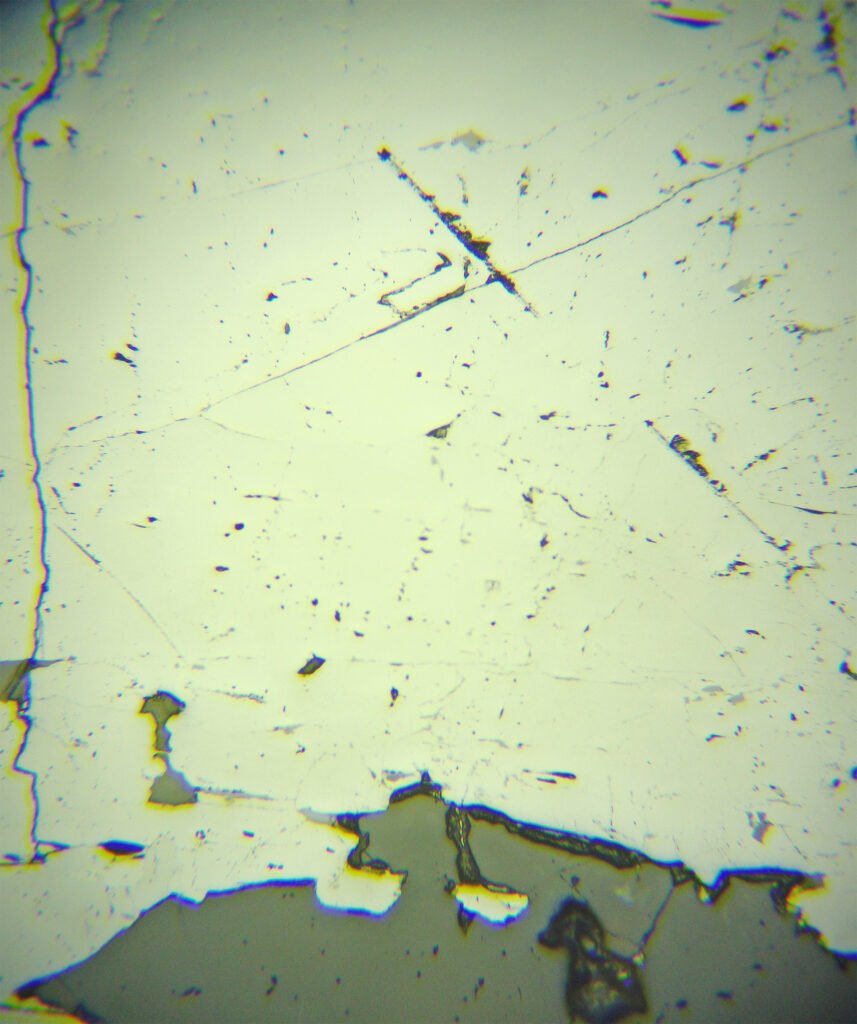
Reflection color: Medium gray, somewhere between gray to gray-white.
Depending on the adjacent minerals (quartz, sulphides, etc.) the color impression changes.
Compared to the color of sphalerite, the color of wolframite is very similar.
Compared to the color of magnetite, the color of wolframite has a similar hue, but is slightly darker.
Compared with the color of cassiterite, the color of wolframite is lighter.
Compared with the color of chalcopyrite, the color of wolframite is brownish gray.
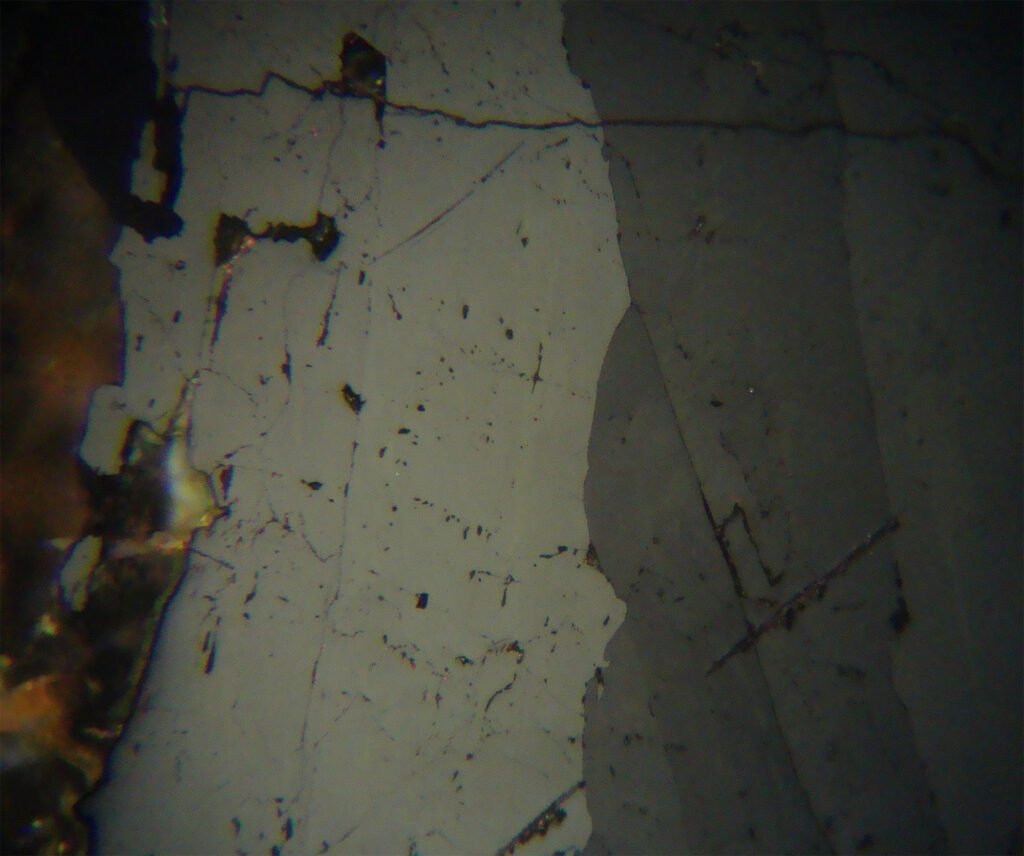
Pleochroism: Weak pleochroism in grayscale, better observable in intergranular boundaries and especially in twins.
In sections perpendicular to the z axis it is weaker and in sections parallel to the z axis it is sharper.
Reflectivity: 14.7 – 16.4%
Bireflectance: Weak.
CROSSED POLARIZED LIGHT – XPL
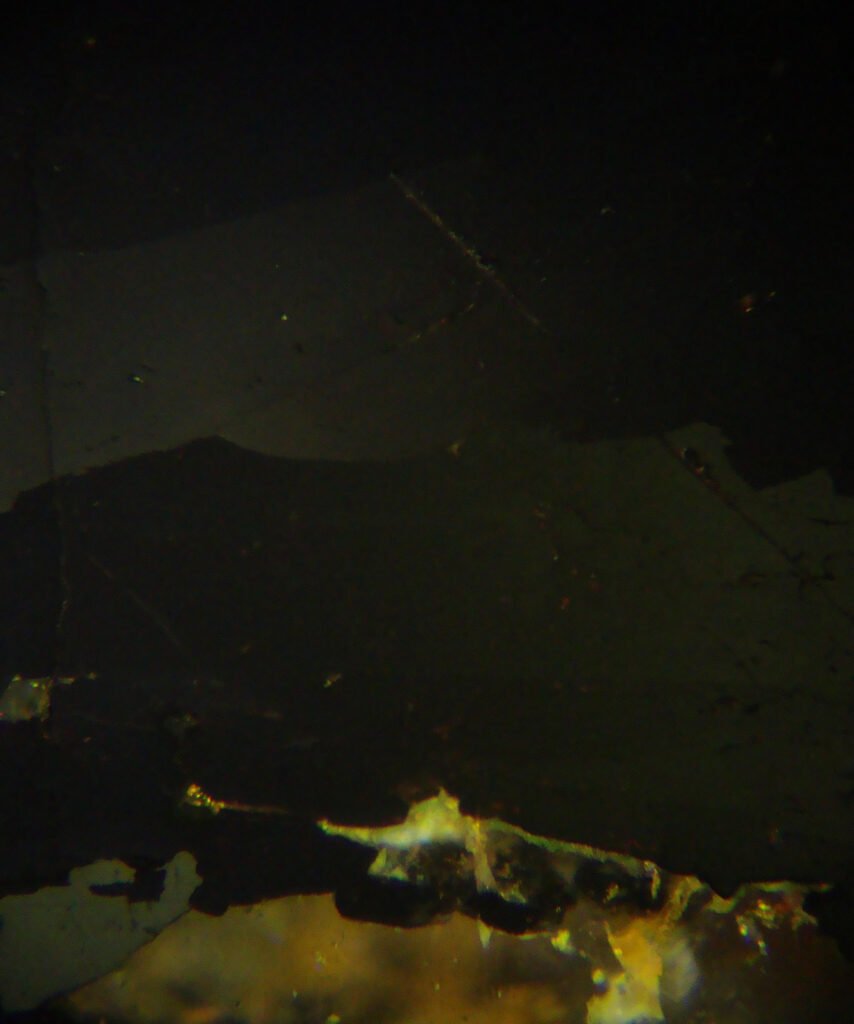
Isotropy / Anisotropy: Clear but not high anisotropy of greenish gray, yellow, gray and brown may change with variations in chemical composition. Extinction is sharply oblique, which is most visible in sections second (010) in twins.
Internal reflections: Relatively rare internal reflections, deep red-brown to deep blood-red.
Its amount increases with increasing Mn content.
May be confused with: few other minerals, once considering paragenesis.
Magnetite is similar, but has no internal reflections and is isotropic.
Hematite is much lighter and has other habits.
Ilmenite is much browner, with clear pleochroism and much stronger anisotropy.
Cassiterite is darker and has much more frequent, stronger, and clearer internal reflections.
General Characteristics:
Grain shape: Wolframite usually forms idiomorphic (euhedral) crystals. They are thick tabular (100), also lamellar along the Z axis. The crystals are usually very large, much larger than the standard size of polished sections. May be anhedral. Rare are fine-grained aggregates. Very rarely, forms resembling gel structures have been found. Wolframite can occur in two generations, with the second growing on the first in a disoriented or net-like manner.
Grain size varies from less than 1 mm to 10 centimeters, often the crystals are isolated in quartz. Wolframite-Mn generally occurs in much smaller grains than Wolframite-Fe.
Cleavage, both at (010) and (100), therefore in two directions, is often visible.
Twins on (100) are very common, they are simple twins, they are almost never lamellar.
Zonation can often be observed, even in hand specimen. Zonation may show that the mineral’s habit has changed during its growth. Zones are generated more by porosity than by changes in chemical composition. Incipient oxidation is often observed along the zones, manifested by the formation of limonite (goethite and others). Crystals can easily break along these zones, simulating cleavage. Zonation with scheelite also occurs, with alternating zones of the two minerals.
Cataclasis, even intense, can be observed in several cases.
Ondulose extinction, generated by intense stresses, can occur.
Inclusions are frequent. They can be of arsenopyrite (in idiomorphic crystals!), molybdenite, native bismuth, bismuthhinite, chalcopyrite, gold, columbite or microlite.
Wolframite nuclei can occur in cassiterite crystals.
Substitutions are rare. They occur in some complex deposits, where pneumatolitic wolframite formation occurred together with intense sulfide mineralization. In these cases, wolframite is replaced by galena, sphalerite, arsenopyrite, pyrrhotite, pyrite, chalcopyrite and siderite. More frequent are substitutions of wolframite for scheelite or vice versa, which creates a series of problems in the processing of the ore. Substitutions of wolframite for scheelite are much more frequent than substitutions of scheelite for wolframite.
Intergrowths can occur with cassiterite, hematite or scheelite.
Alterations generate powdery products of various types, including a structure with the formation of alteration “eyes” (elliptical structures). Usually the alteration occurs at the edges of the crystals.