5. Reflected Light Microscopy
Sample preparation: Ullmannite polishes easily. Its hardness is similar to that of gersdorffite, greater than that of linnaeite, and much less than that of pyrite.
PLANE POLARIZED LIGHT – PPL
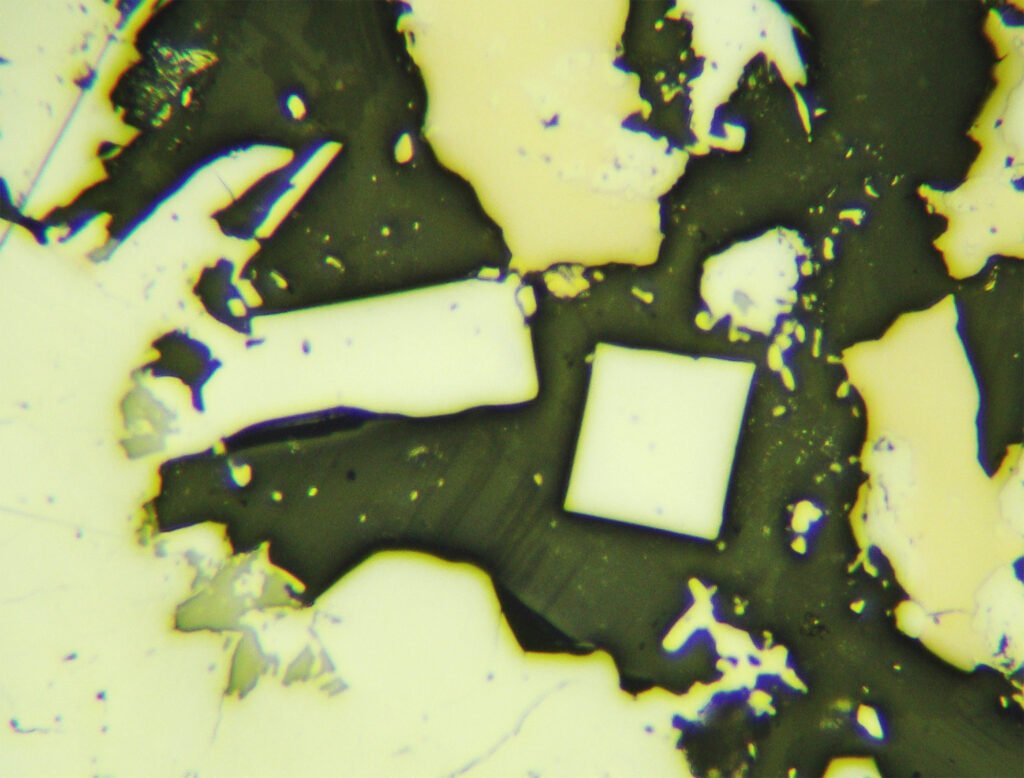
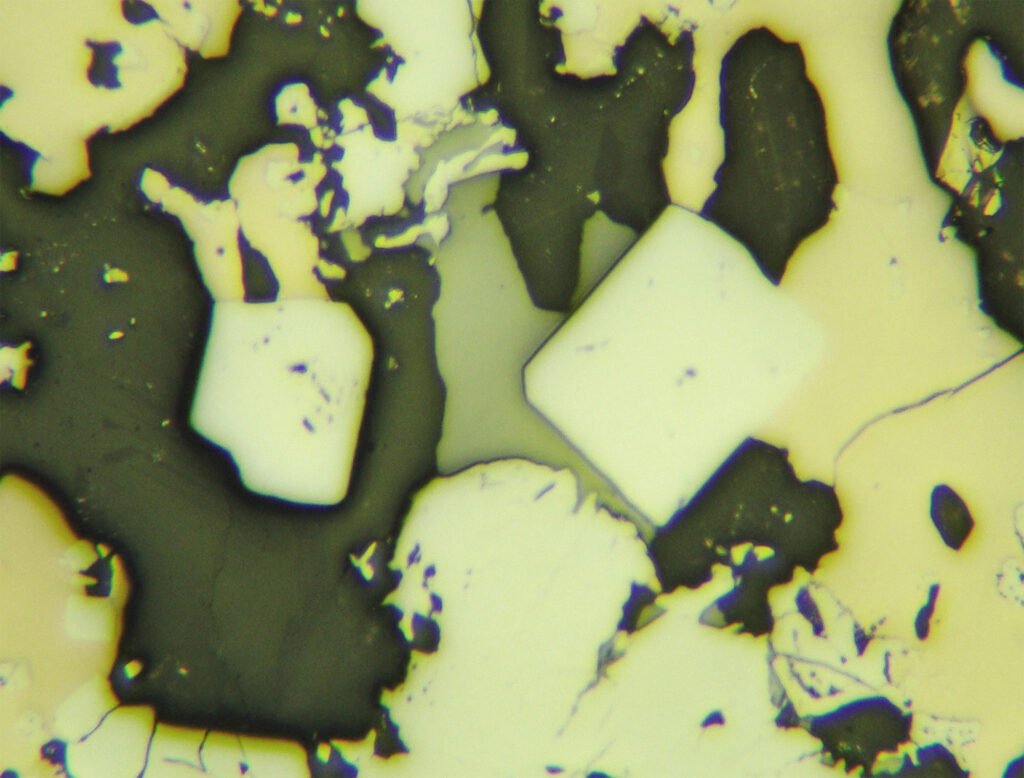
Reflection color: Light gray, almost white.
Compared to the color of galena, the color of ullmannite is lighter.
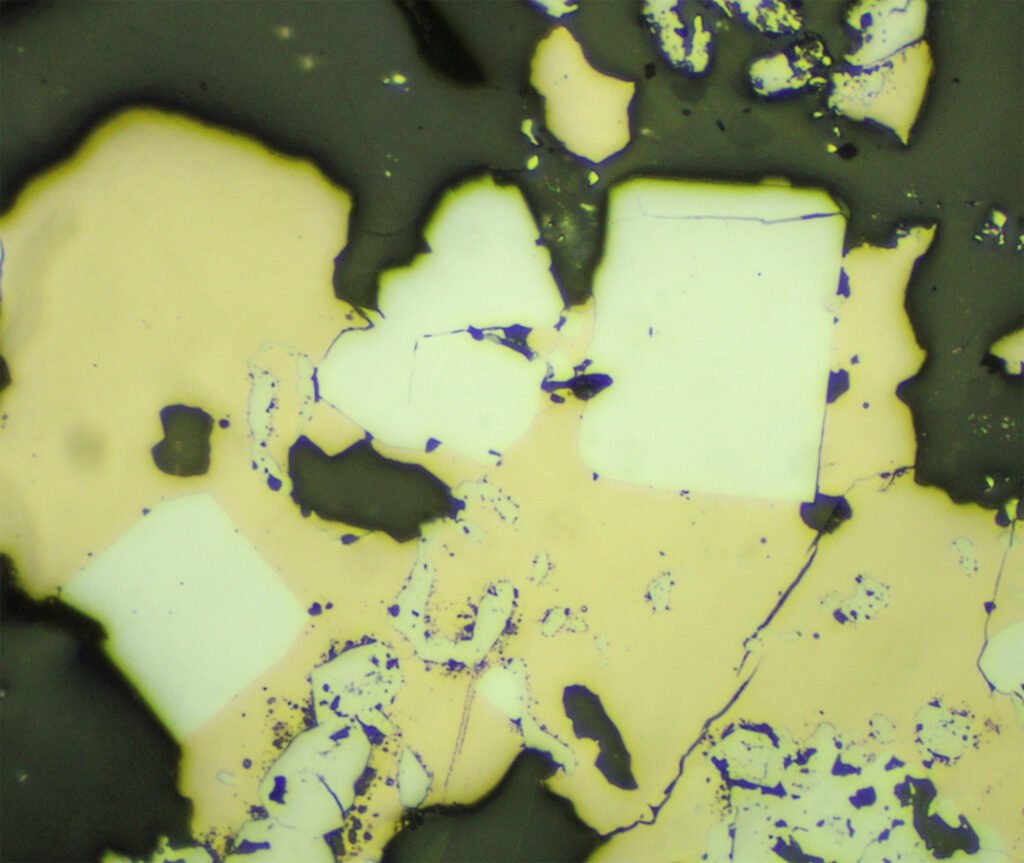
Compared to the color of gersdorffite, the color of ullmannite is very similar, slightly less yellow. The reflectivity is higher than that of gersdorffite.
Compared to the color of eskutterudite, the color of ullmannite is more yellowish and lighter.
Compared to the color of linnaeite, the color of ullmannite is whiter, as linnaeite is pinkish.
Pleochroism: No.
Reflectivity: 45.5% (46.3% if with As)
Bireflectance: No.
CROSSED POLARIZED LIGHT – XPL
Isotropy / Anisotropy: Isotropic, but sometimes weakly anisotropic.
Internal reflections: No.
May be confused with: Ullmannite can easily be confused with one of the cubic minerals of the Pyrite Group, as well as with minerals of the Linnaeite Series.
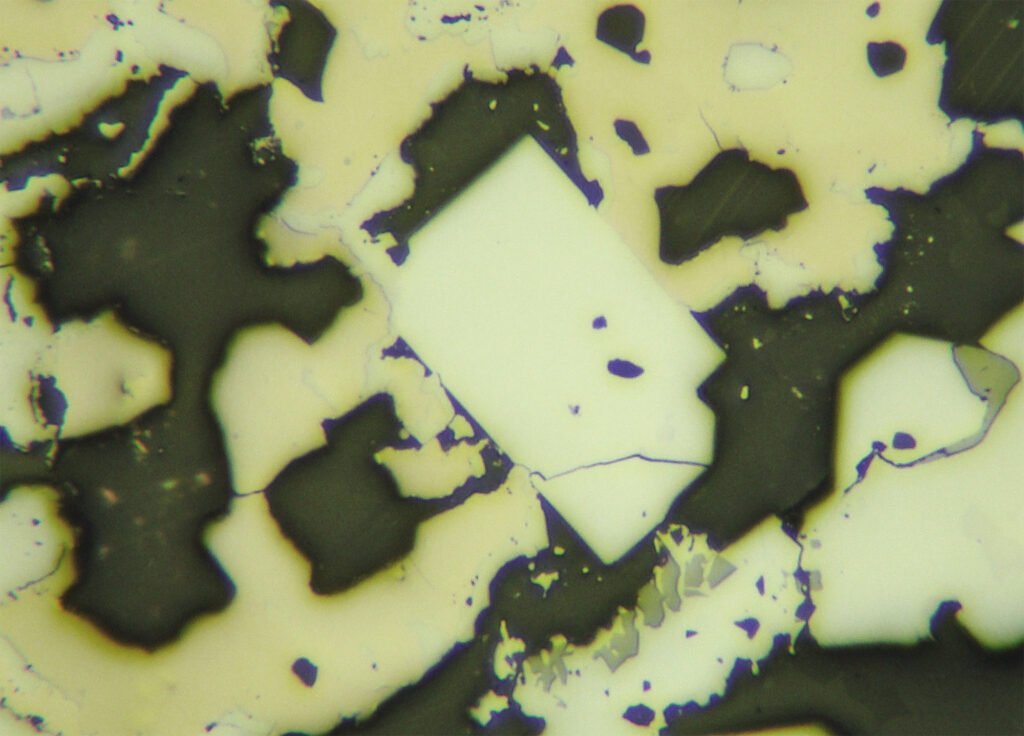
Very typical and quite diagnostic are the cubic forms it develops. Evaluation of paragenesis is important for the identification of ullmannite.
Eskutterudite is less yellow and less clear.
Gersdorffite generally shows more pronounced cleavage, exhibits triangular polishing pits much more frequently, and has lower reflectivity.
Galena forms idiomorphic crystals much more rarely and shows lower reflectivity.
General Characteristics:
Grain shape is generally idiomorphic, occurring in more or less well-developed crystals predominantly showing a cube shape. This highly idiomorphic habit is very diagnostic and conspicuous. Anhedral aggregates were not observed. It can form crusts when associated with gersdorffite.
Cleavage parallel to (100) is frequently visible in polished sections. Cleavage parallel to (110) can only be visualized occasionally.
Hardness of the outer zones of the grains is often higher.
Triangular polishing pits may be present, but are rare, much rarer than in gersdorffite and galena.
Zoning is occasionally visible even without chemical attack and generally occurs only in the outer portions of the grains. With chemical attack, zoning is evidently easier to visualize.
Intergrowths with galena and chalcopyrite occur.
Inclusions of gold may be present.
Substitutions 1: Ullmannite can be replaced by breithauptite, millerite, chalcopyrite, and sphalerite.
Substitutions 2: Ullmannite replaces breithauptite.