1. Characteristics
Crystal system: Triclinic or monoclinic prismatic.
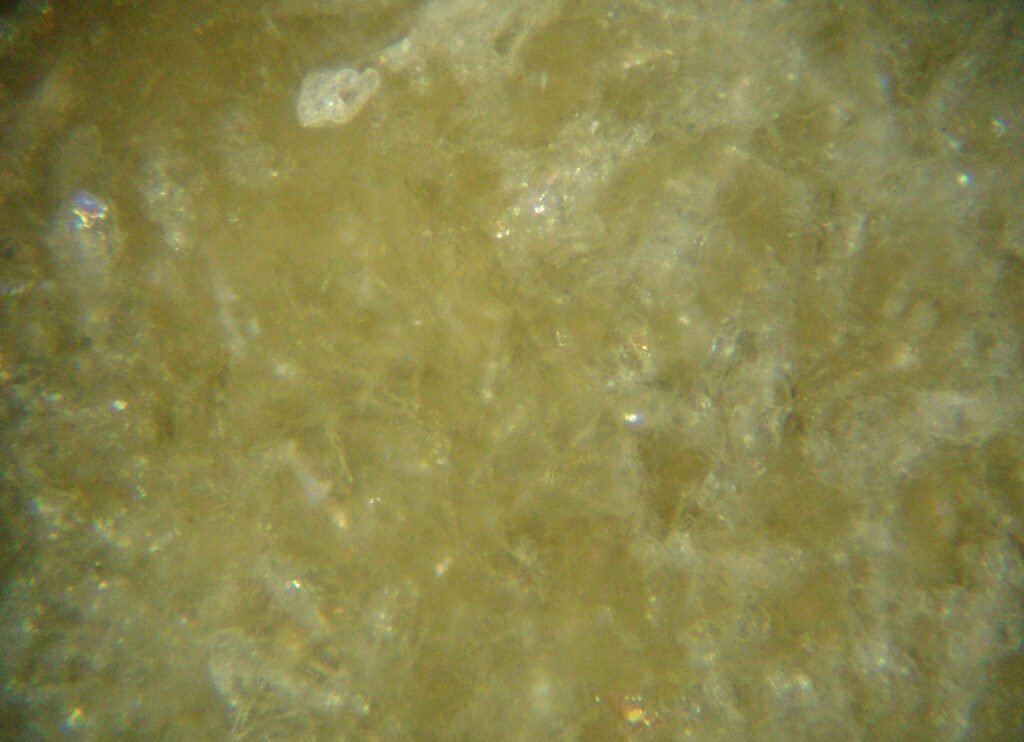
Color: Usually light to dark green, can be colorless, white, beige, pink, brown, gray to black.
Habit: Tabular, micaceous, fibrous, fine granular, massive, radial, pyramidal crystals extremely rare.
Cleavage: {001} perfect.
Tenacity: Sectile, flexible.
Twinning: No.
Fracture: No information available.
Mohs Hardness: 1
Parting: No.
Streak: White.
Lustre: Pearly, waxy.
Diaphaneity: Transparent.
Density (g/cm³): 2.58 – 2.83
2. Geology and Deposits
Talc is an uncommon mineral that occurs in mafic and ultramafic rocks rich in Mg and hydrothermally altered in conditions of metamorphism of greenschist facies, such as serpentinites and steatites, where brucite is associated. In these occurrences it occurs with chlorite or magnesite in the reaction zones around the serpentinite bodies.
It also occurs with calcite and tremolite in metamorphosed siliceous marbles and in talc-tremolite-schists. Occurs in magnesian skarns.
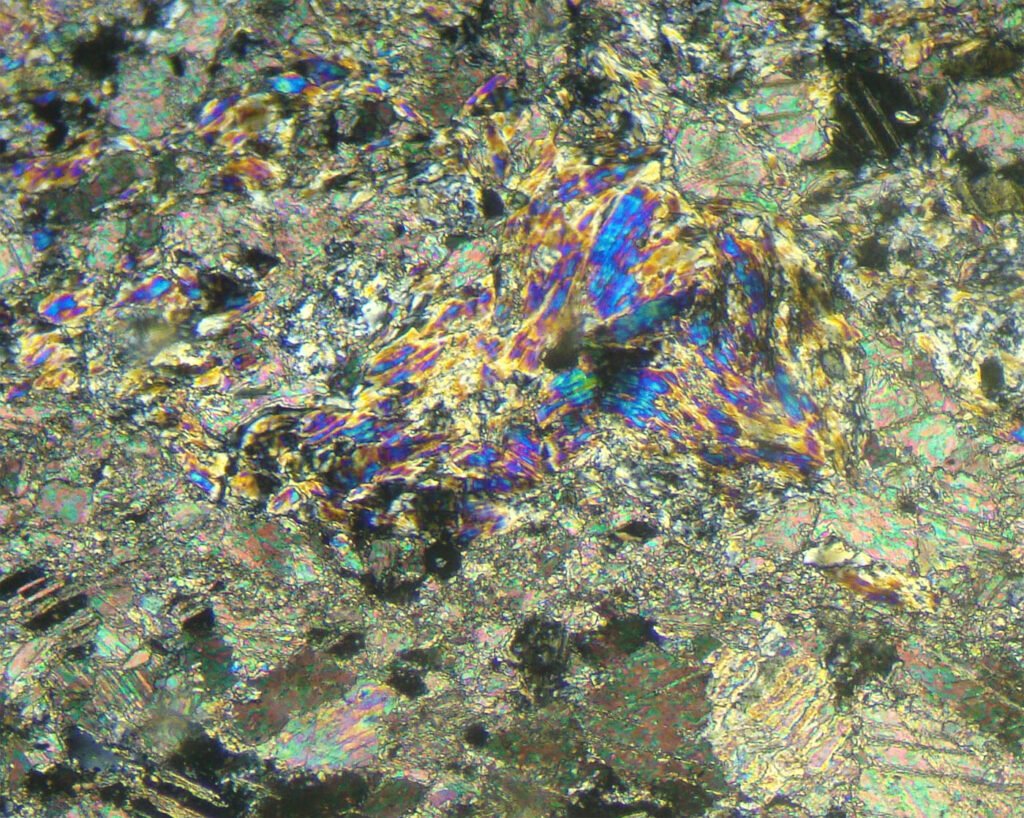
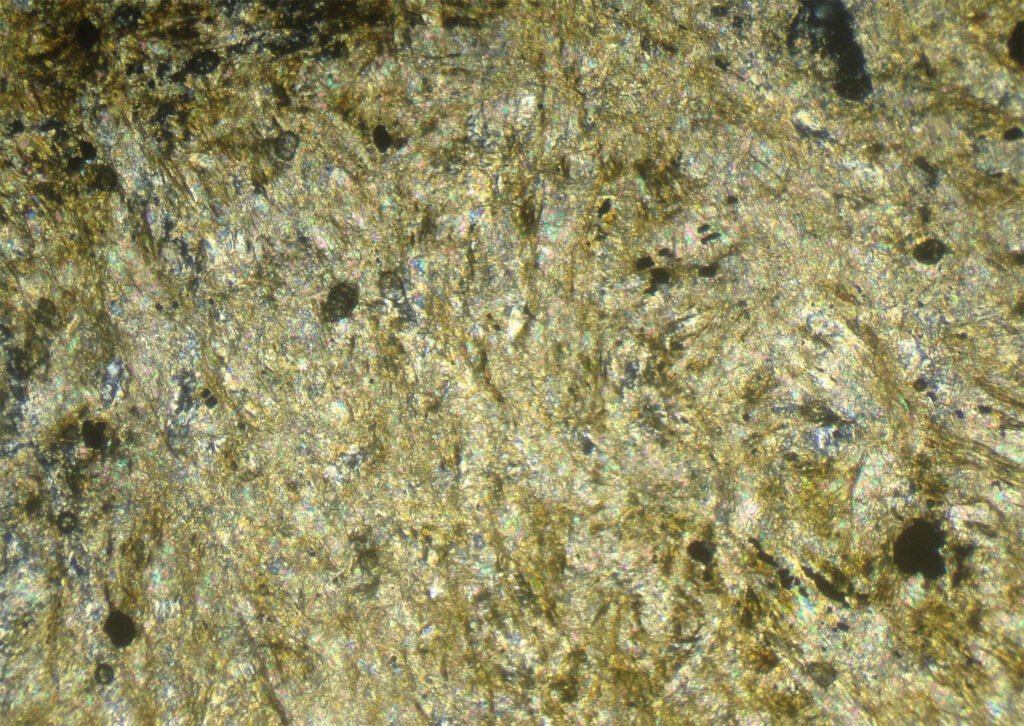
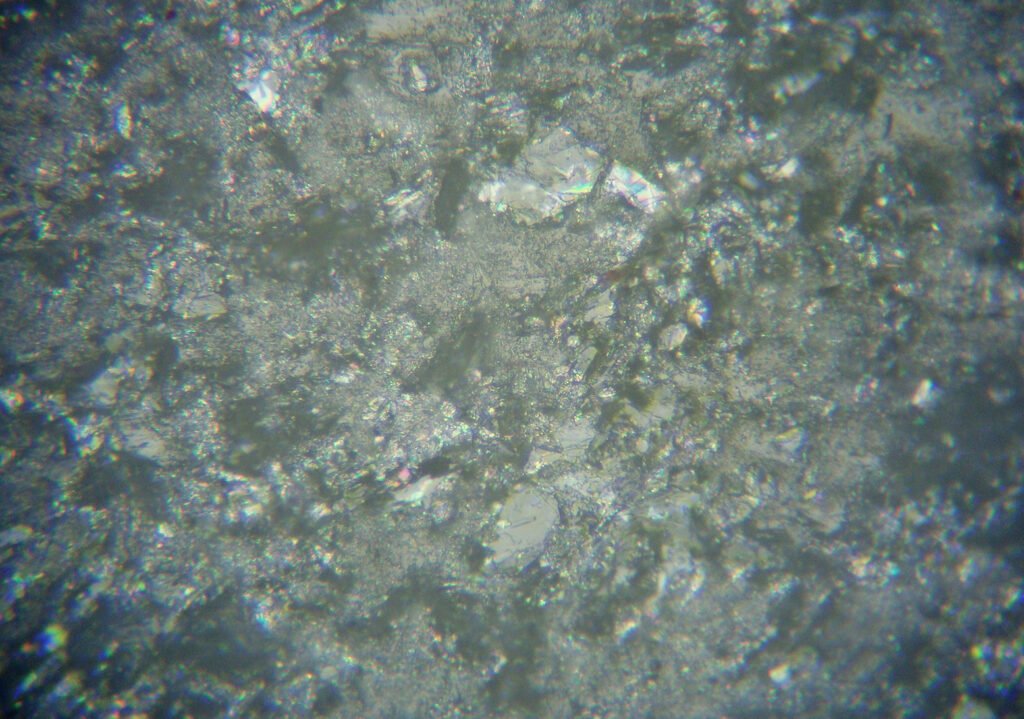
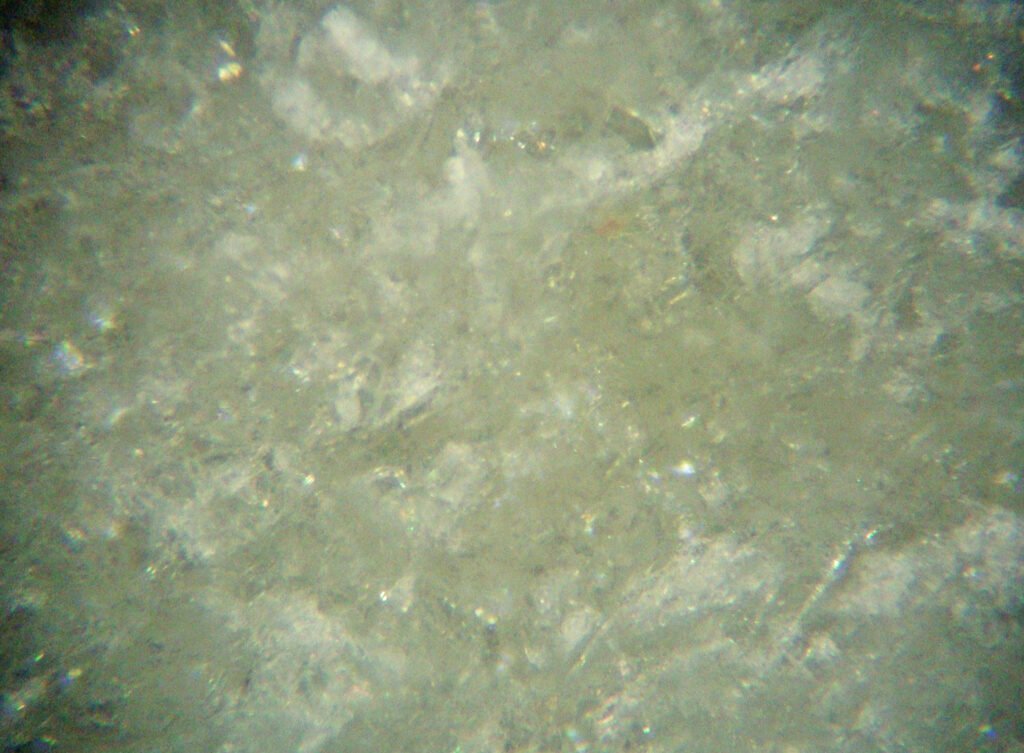
“Steatite” designates a compact metamorphic rock, popularly known as “soapstone”, which is mainly composed of talc, with very subordinate amounts of other minerals (chlorite, tremolite, quartz, magnesite, etc.). The granulation is very fine and even under the microscope it is very difficult to distinguish, for example, between tremolite and talc. The rock has a greasy feel due to the large amount of talc and has some very interesting properties: it is impermeable, it is not attacked by alkaline or acidic substances, it resists temperatures from negative to 1,000oC and it resists weathering. This rock has many different uses and has the potential to create a regional hub for the production of decorative artifacts and utilities, for example.
3. Mineral Associations
It is associated with quartz, pyrite, kyanite and
– carbonates (calcite, dolomite, magnesite), generally abundant,
– other phyllosilicates (chlorite, vermiculite, clay minerals),
– typical low-grade metamorphic minerals such as serpentine, actinolite, tremolite, anthophyllite, brucite, “asbestos” and
– minerals from source rocks such as olivine (forsterite), pyroxenes (diopside), hematite, magnetite, anthophyllite and chromite.
4. Transmitted Light Microscopy
Refraction indices: nα: 1.539 – 1.550 nβ: 1.589 – 1.594 nγ: 1.589 – 1.600
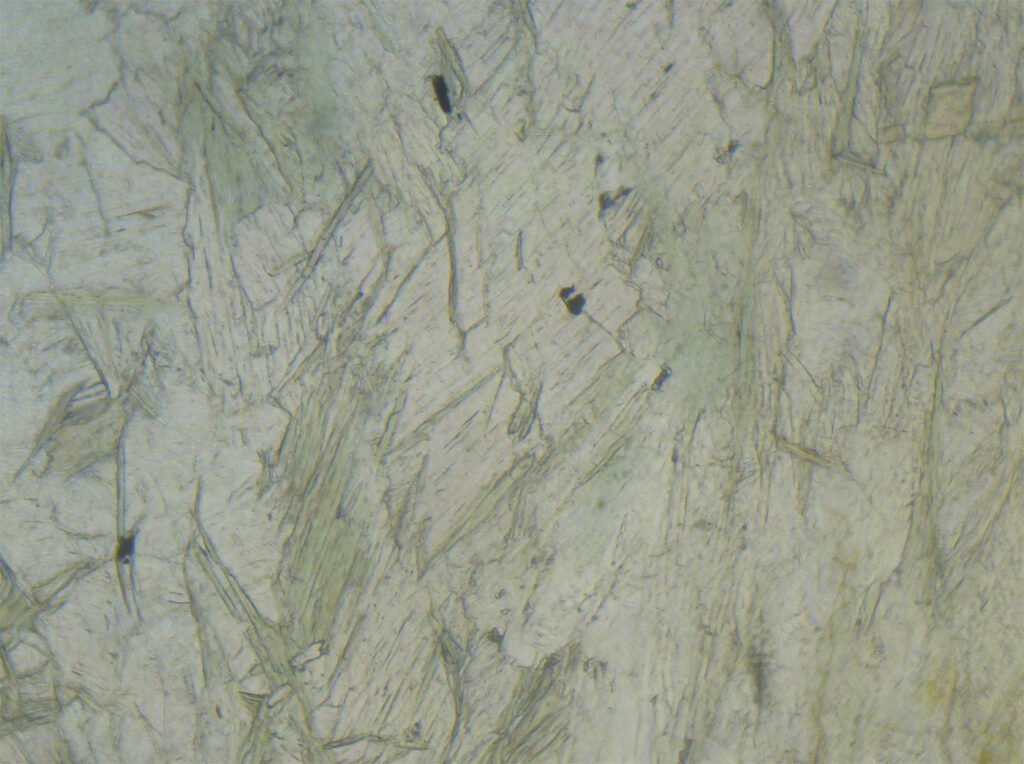
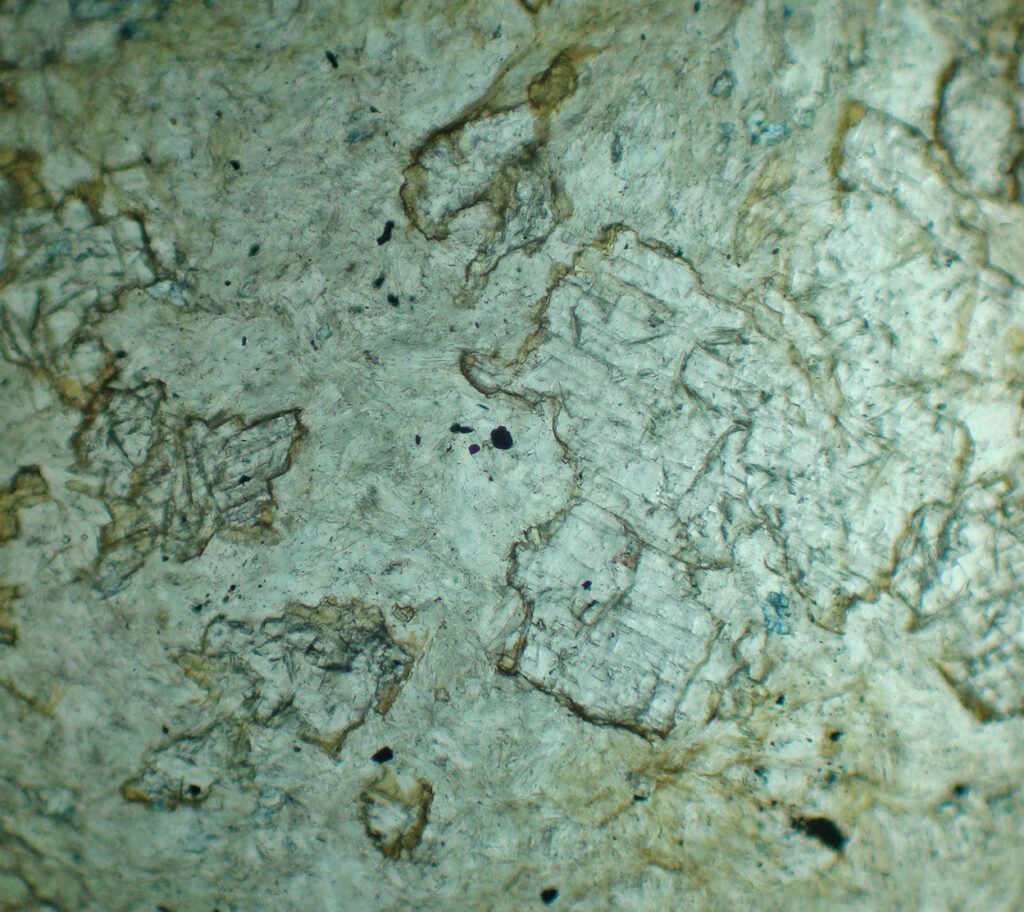
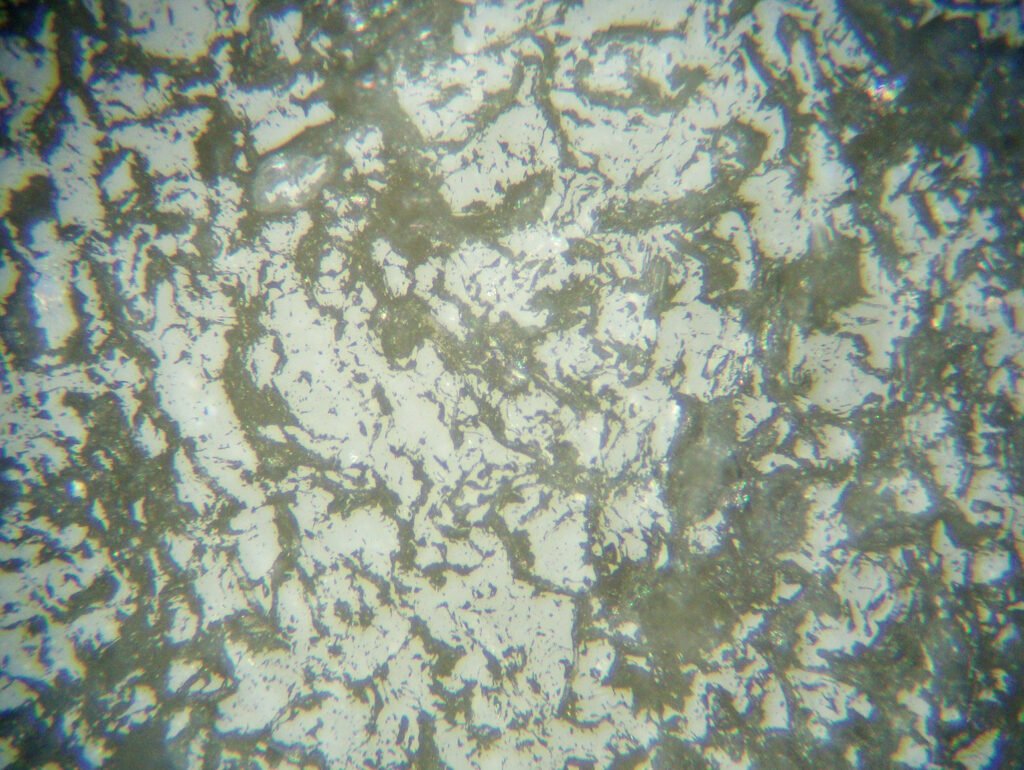
PLANE POLARIZED LIGHT – PPL
Color / Pleochroism: Colorless. Only in the dark varieties can it present color and a discreet pleochroism.
Relief: Low to moderate.
Cleavage: {001} perfect (like the micas!)
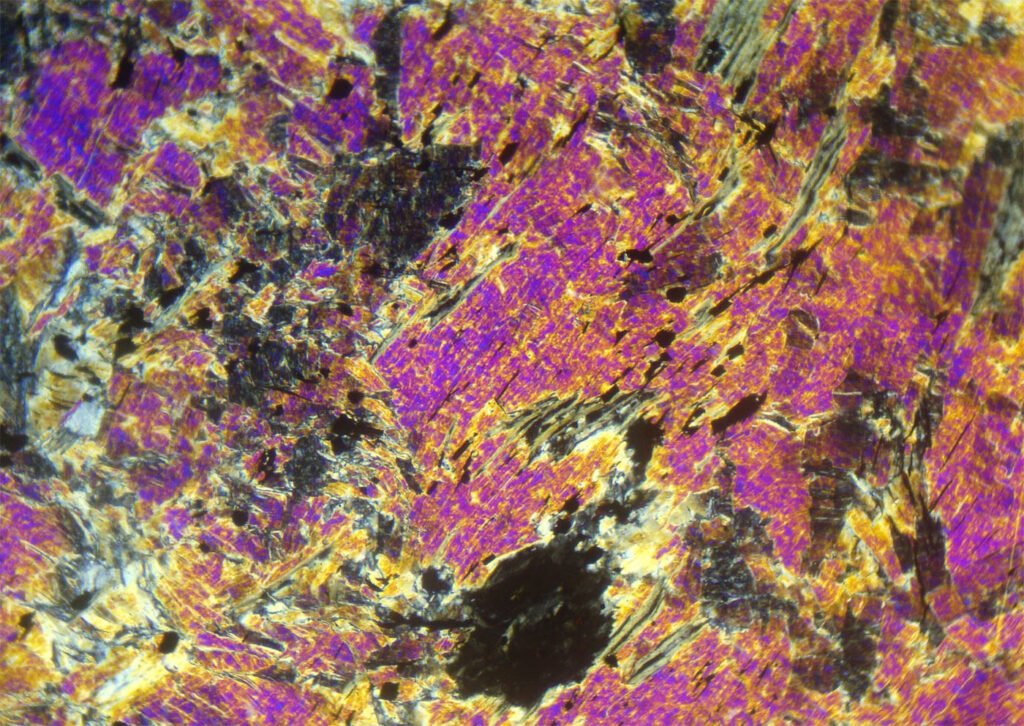
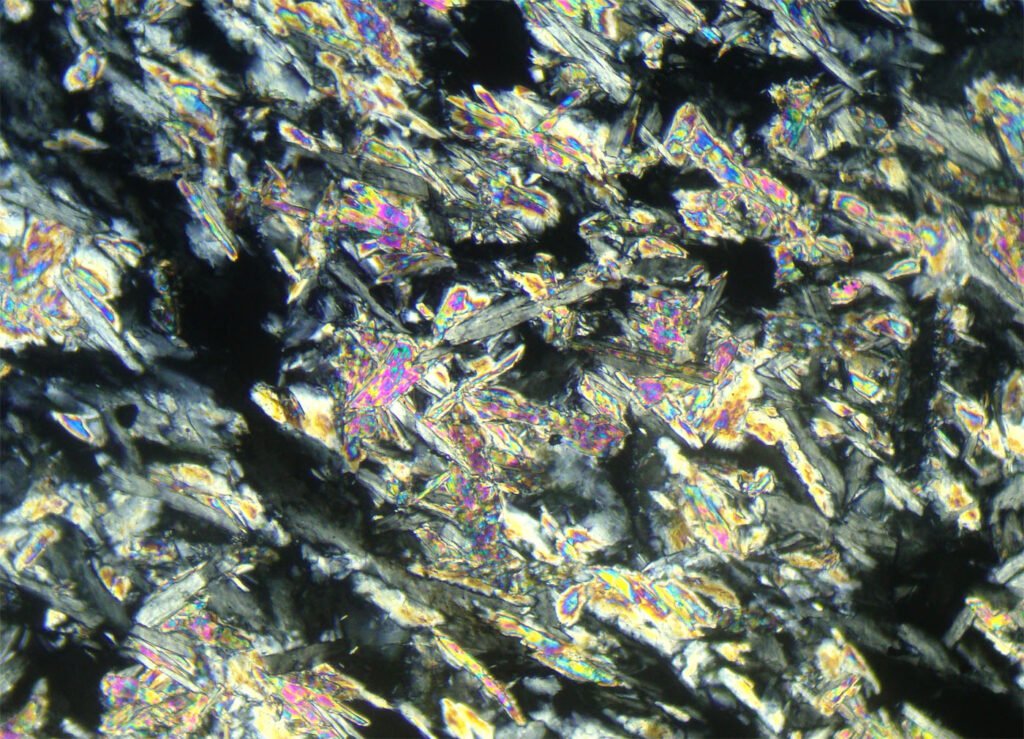
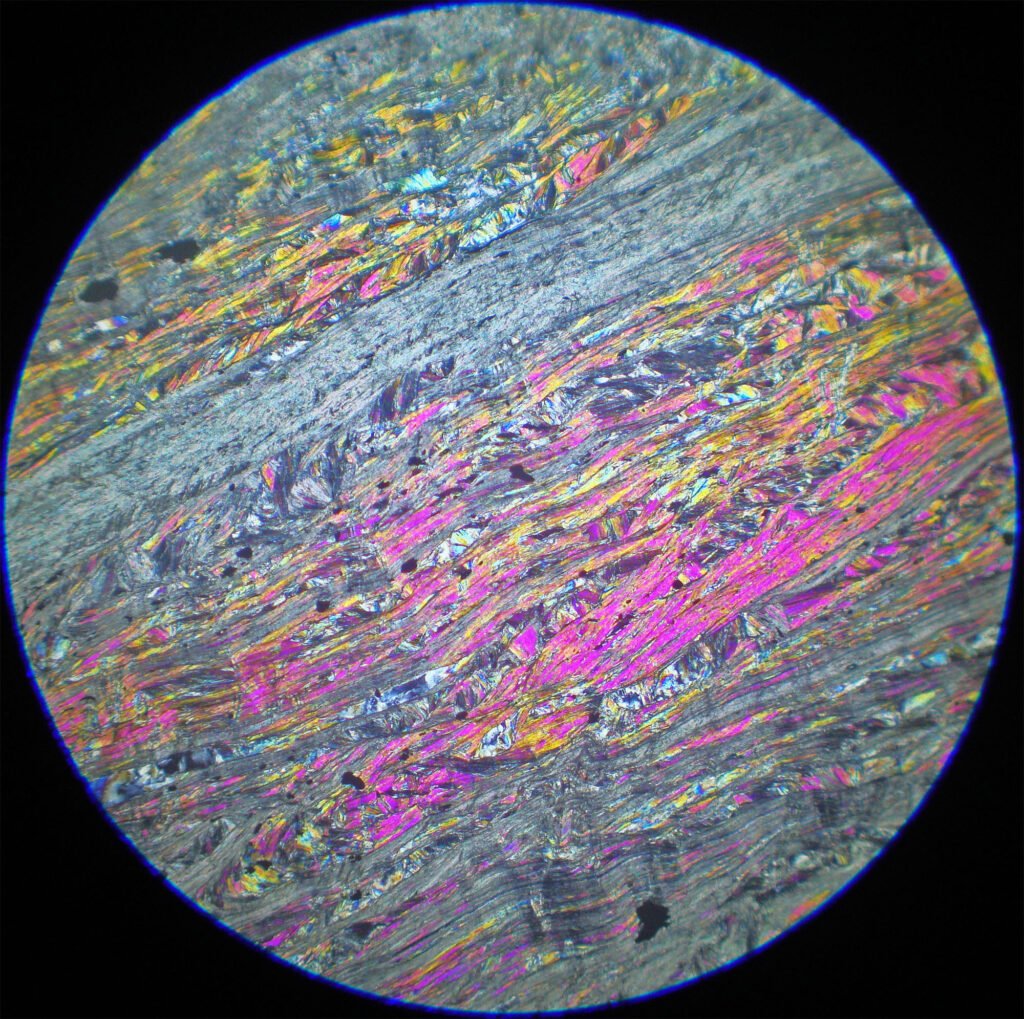
Habits: Very fine granular, lamellar, fibrous, foliate, radiated, massive. Flakes and aggregates, often with cleavage in one direction. “Steatite” is a massive variety of very fine-grained talc with a greasy feel that makes up “soapstone”.
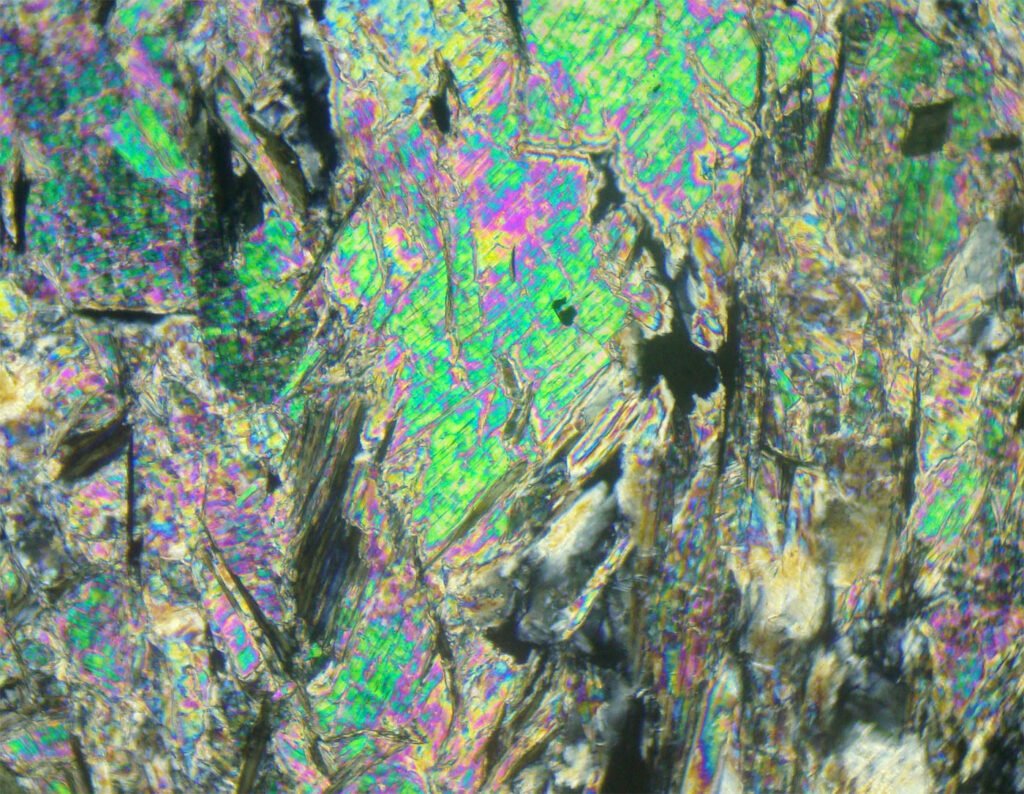
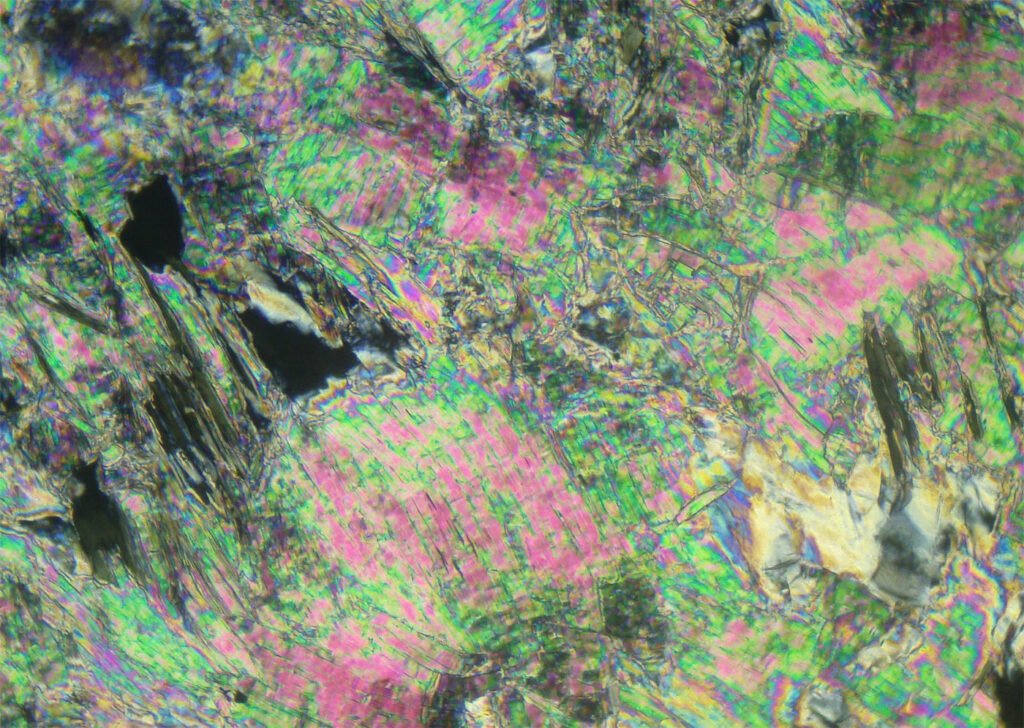
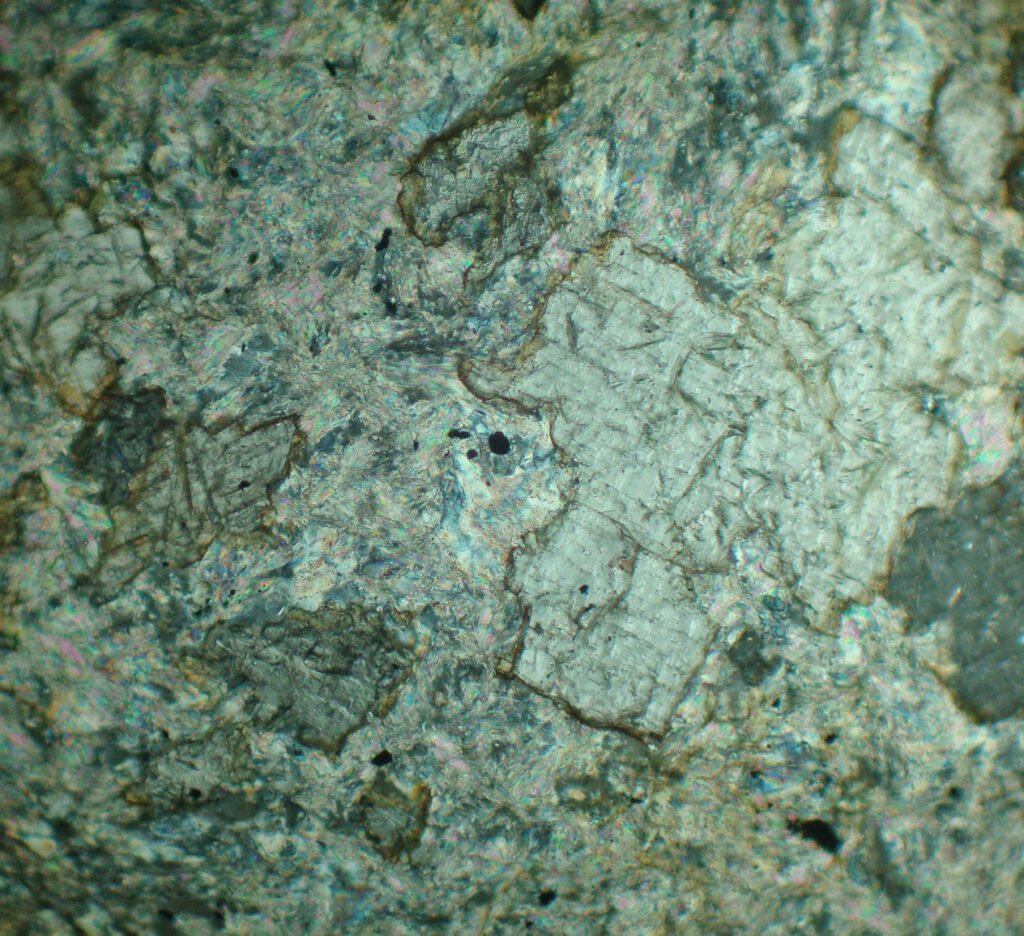
CROSSED POLARIZED LIGHT – XPL
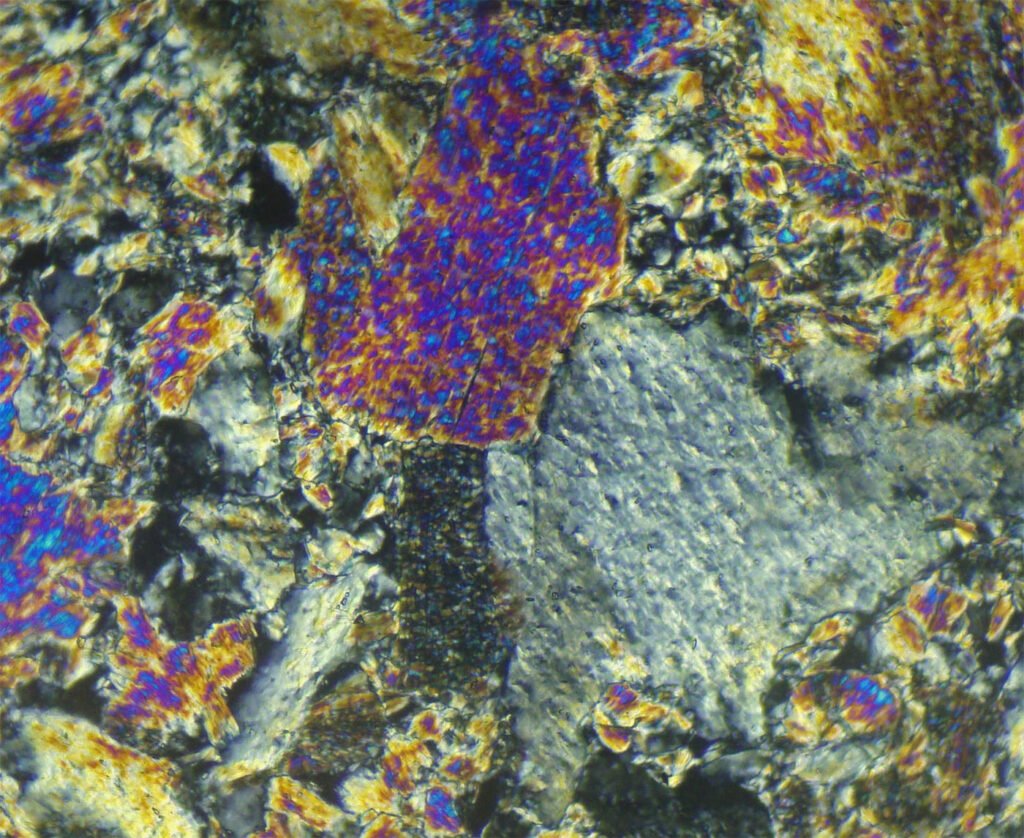
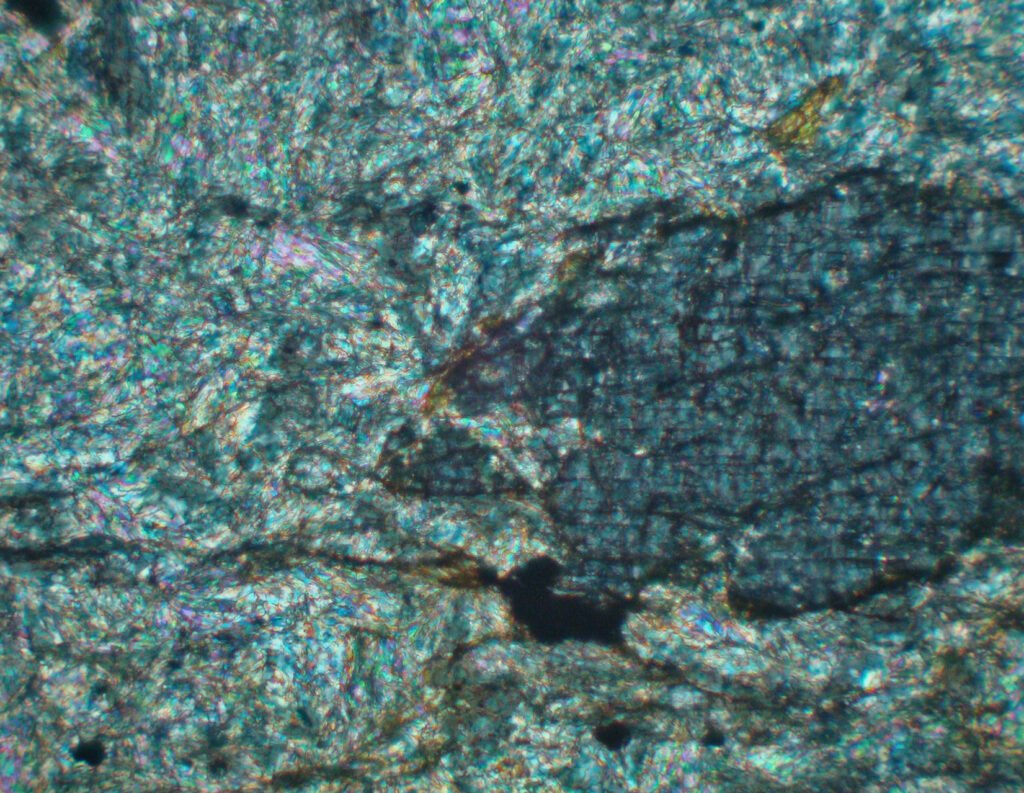
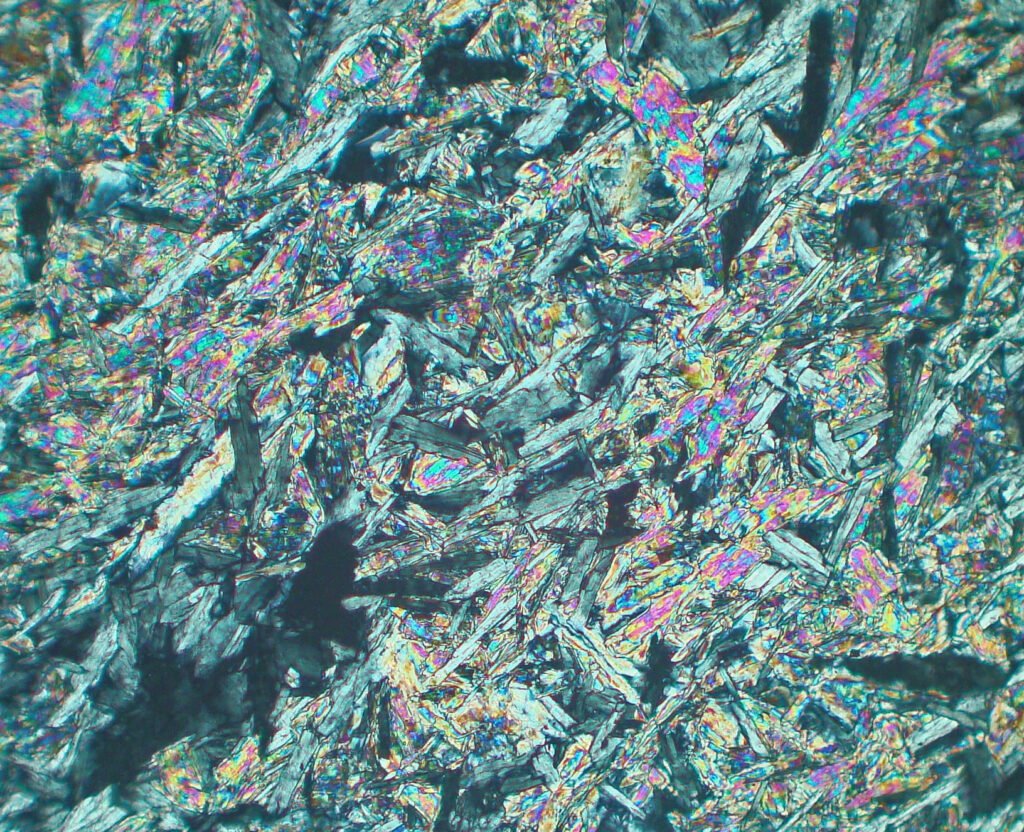
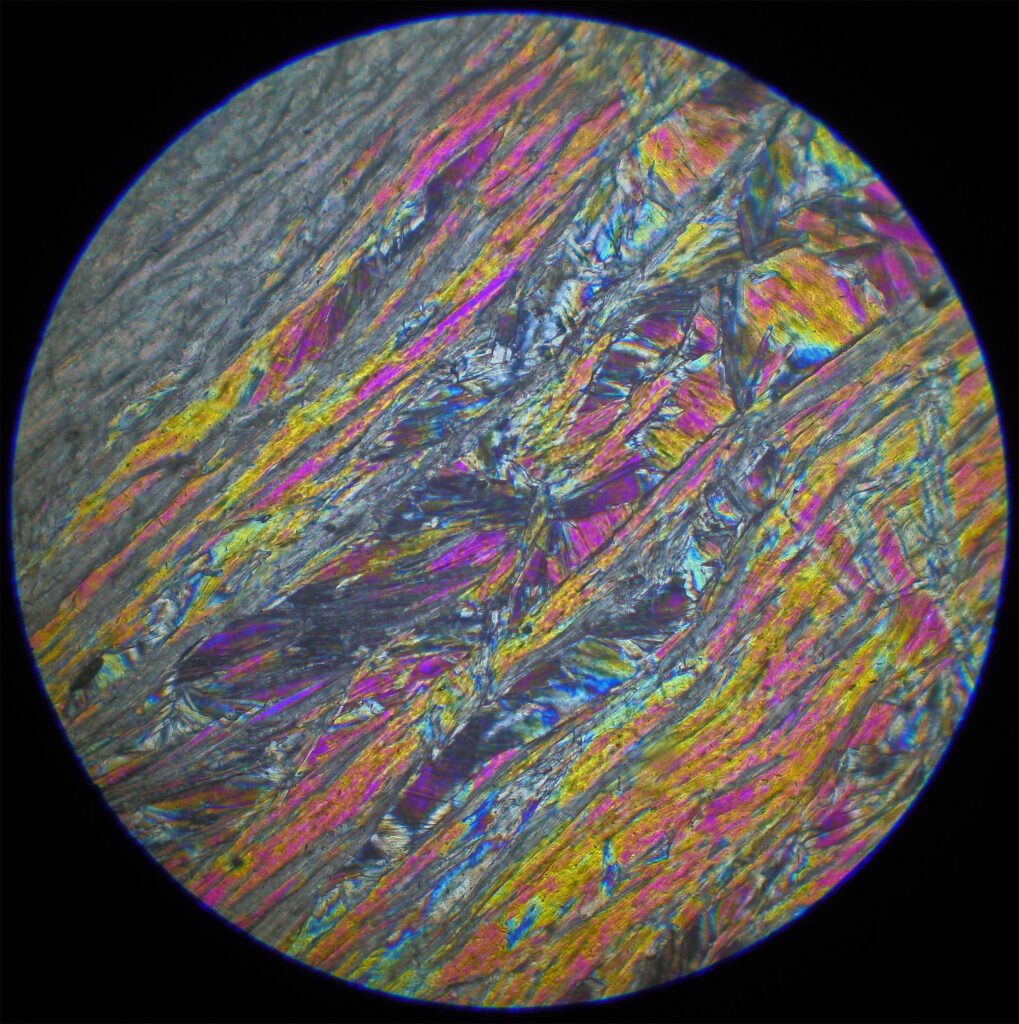
Birefringence and Interference Colors: Birefringence of up to 0.051: colors of up to 3rd order, giving it a white (“pearlaceous”) appearance with various colors mixed together. In the basal sections it presents gray colors of 1st order.
Extinction: Parallel to the direction of cleavage and mottled (like micas!)
Elongation sign: ES(+) (like the micas!)
Twins: No.
Zoning: No.
CONVERGENT LIGHT
Character: B(-), can simulate being uniaxial (2V = 0). The high interference colors and the generally tiny size of the crystals make obtaining the interference figure usually very difficult, almost impossible.
2V angle: 0 – 30º
Alterations: talc is very resistant, but can alter to chlorite in some cases.
May be confused with: other flake-like minerais with strong interference colors. When in small grains, it cannot be distinguished from muscovite, pyrophyllite and sericite by optical means. In this case, the association of minerals is used for identification.
Muscovite is very similar and easy to confuse with talc, especially if the grains are very small. Compared with muscovite, talc has a higher birefringence and “zoned” or banded appearance of colors. In addition, talc has a 2V smaller angle than muscovite (2V = 35-50º).
Paragonite has 2V = 40-50º, an information of less importance due to the difficulty to obtain good interference figures in minerals which such high interference colors.
Pyrophyllite is virtually identical with talc, but has 2V = 53 – 62º (usually difficult to measure).
Brucite is similar, but has lower interference colors and is U(+) (difficult to see, grains are very small).
Gibbsite is B(+), but the same problem as with brucite: flakes too small for a decent interference figure.