5. Reflected Light Microscopy
Sample preparation: Domeykite polishes very well. Its hardness upon polishing is medium, greater than that of chalcocite and similar to that of algodonite. Some polishing grooves may be persistent. It tarnishes quickly, especially if other ore minerals are present.
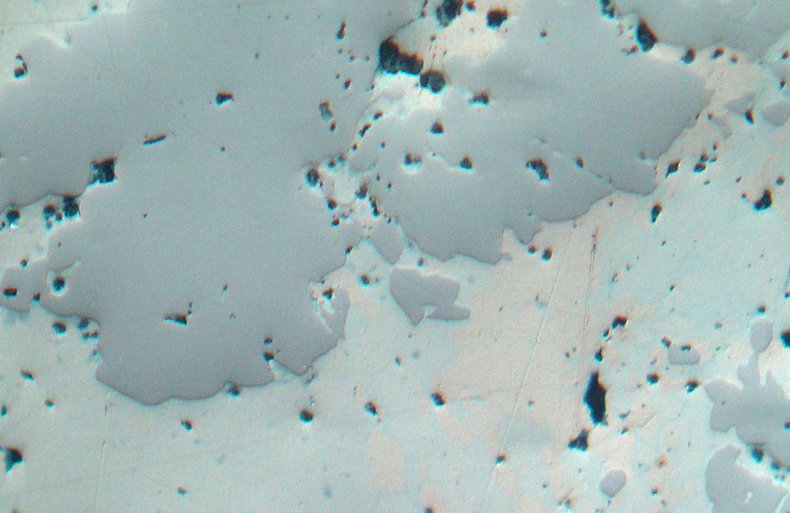
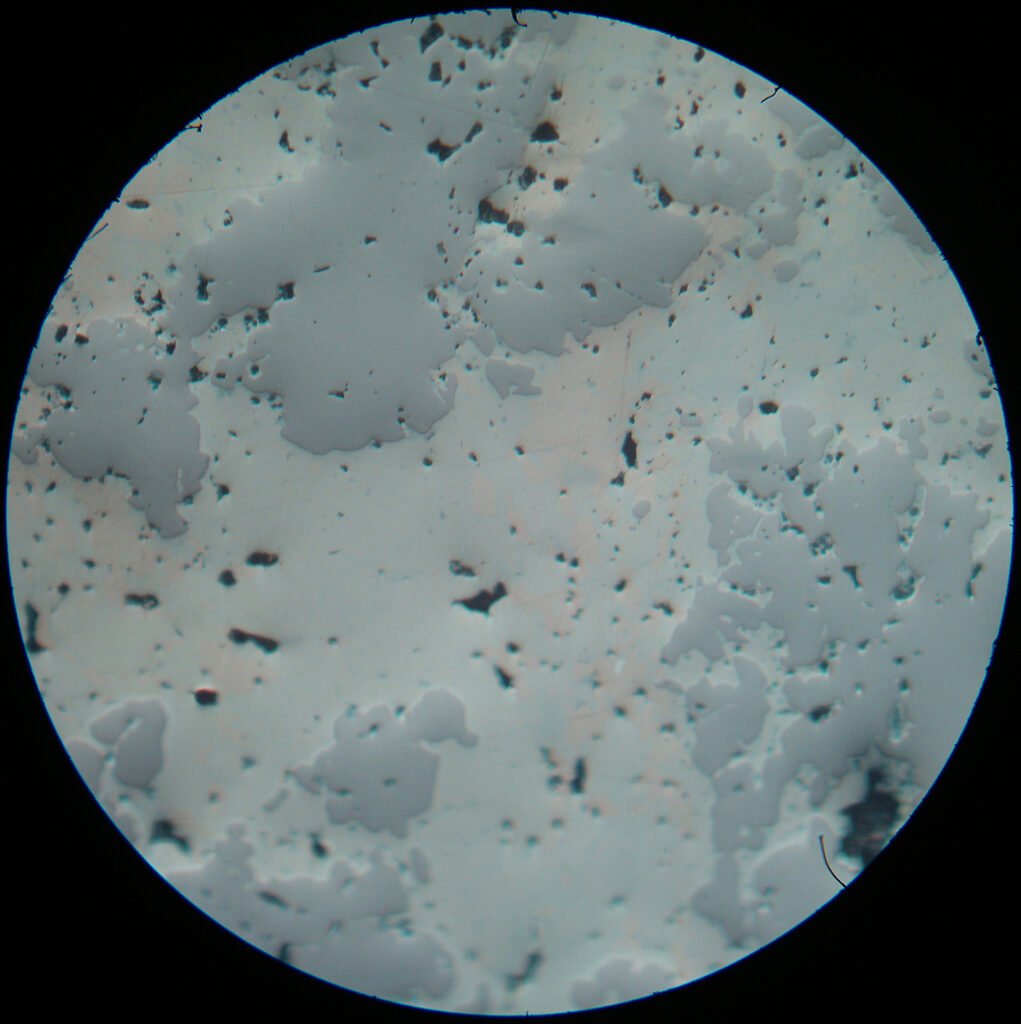
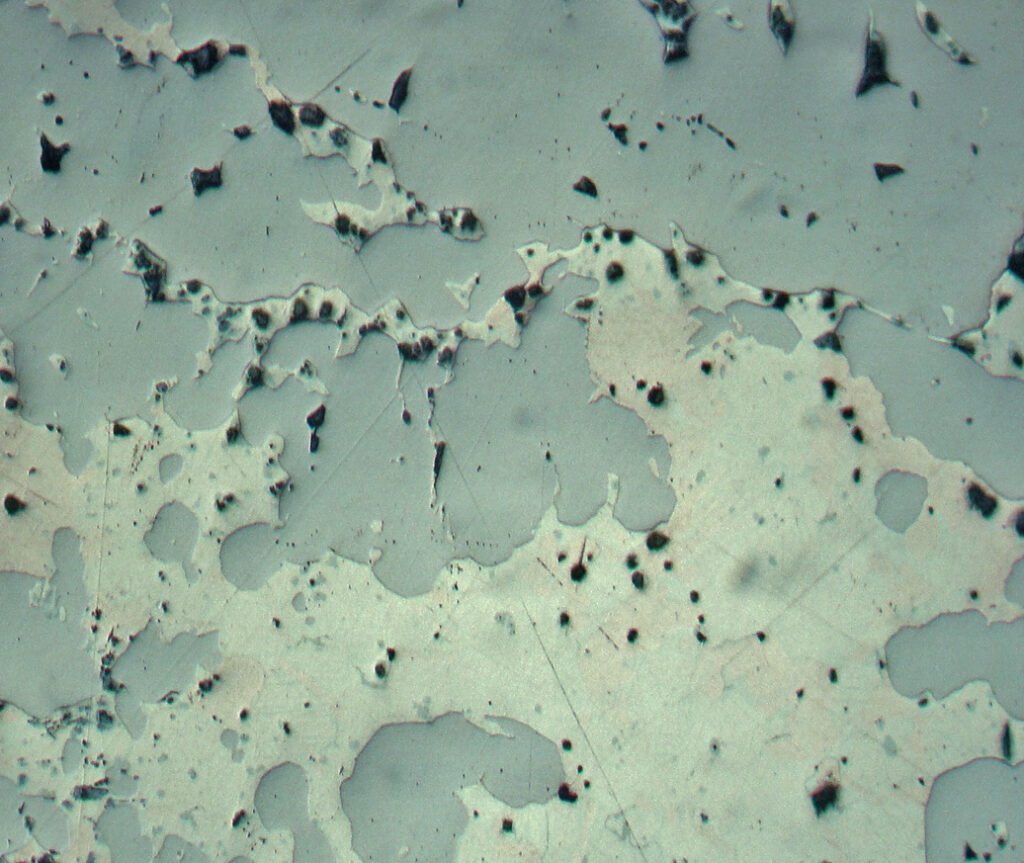
PLANE POLARIZED LIGHT – PPL
Reflection color: White yellowish to very light gray.
Domeykite-β is somewhat bluish-gray in contrast, less yellowish than domeykite-α, but very similar. This difference is only visible in freshly polished sections!
Compared to the color of algodonite, the color of domeykite is darker and more yellowish-gray.
Compared to the color of “whitneyite”, the color of domeykite is darker and more yellowish-gray.
Pleochroism: No.
Domeykita-β has weak to distinct pleochroism.
Reflectivity: Very high, at 65.06%,
Bireflectance: No.
CROSSED POLARIZED LIGHT – XPL
Isotropy / Anisotropy: Isotropic.
Domeykite-β exhibits quite distinct anisotropy in orange hues. Colors may vary between samples from different locations.
Internal reflections: No.
May be confused with: The recognition of domeykite and its associated minerals is difficult. Knowing the paragenesis reduces the possibility of mistakes, but there are many cases of complicated and unexpected mixtures, so observations must be careful.
Native copper with As (“whitneyite”) has very similar reflection colors, but it is isotropic. It probably has many polishing grooves, like native copper poor in As.
The minerals can occur in isolation, but generally domeykite contains algodonite, algodonite contains whitneyite, and whitneyite contains algodonite. The whitneyite + domeykite association is very rare.
Here are the most common minerals in this paragenesis. None of them show birreflectance nor internal reflections. All four have very high reflectivity, between 45 and 65%.
Algodonite: In PPL, light creamy white, tarnishes like domeykita and very weak pleochroism. In XPL, weak anisotropy.
Cu+As – “Whitneyite”: In PPL, creamy white, tarnishes very quickly (more than native Cu), no pleochroism. In XPL, isotropic.
Domeykite-α: In PPL, steel gray. tarnishes to yellowish, iridescent, and brownish crust, no pleochroism. In XPL, isotropic.
Domeykite-β: In PPL, slightly more blue-gray in contrast, with distinct pleochroism. In XPL, distinct anisotropy in orange hues.
Koutekite: In PPL, bluish gray like cuprite, with weak pleochroism in bluish hues with gray. In XPL, strong anisotropy.