1. Characteristics
Crystal system: Monoclinic prismatic.
Color: Dark green to brown, gray to greenish gray.
Habit: Long, acicular prismatic.
Cleavage: {110} perfect, like all amphiboles.
Tenacity: Brittle.
Twinning: Simples ou múltiplas comuns, // a {100}.
Fracture: No information available.
Mohs Hardness: 5 – 6
Parting: No.
Streak: White to gray.
Lustre: Vitreous, silky if fibrous
Diaphaneity: Transparent.
Density (g/cm³): 3.4 – 3.6
2. Geology and Deposits
Grunerite is a rarer amphibole that is common in banded iron formations (BIFs) that have undergone medium- to high-grade metamorphism. Two generations of grunerite can coexist in these rocks, with different habits (tabular/acicular). In rocks with little quartz, grunerite exhibits a prismatic habit; in rocks with a lot of quartz, its habit is fibrous.
It is also found in rocks formed by contact metamorphism, in schists (grunerite-quartz-schists) and in some blueschist facies quartzites, the “grunerite-quartzites”.
In some cases, cummingtonite-grunerite series amphiboles occur in silicic volcanic rocks. Also in some diorites, along with hornblende.
3. Mineral Associations
In banded iron formations, it is associated with quartz, hematite (specularite), magnetite, riebeckite, stilpnomelane, and siderite, among others.
It also occurs with hedenbergite, prehnite, proto-ferro-suenoite, galena, garnet (almandine), annite, arfvedsonite, augite, micas, tridymite, and olivine (fayalite).
4. Transmitted Light Microscopy
Refraction indices: nα: 1,663 – 1,686 nβ: 1,680 – 1,709 nγ: 1,696 – 1,729
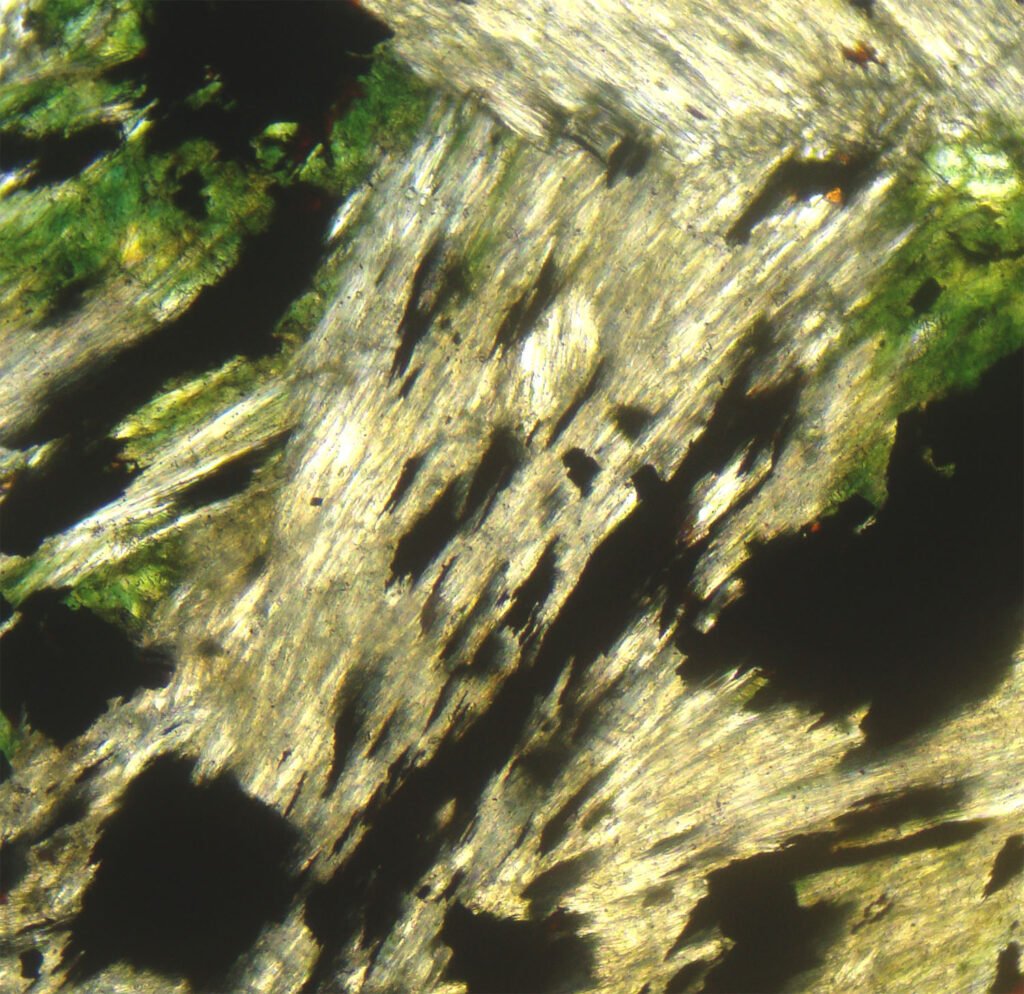
PLANE POLARIZED LIGHT – PPL
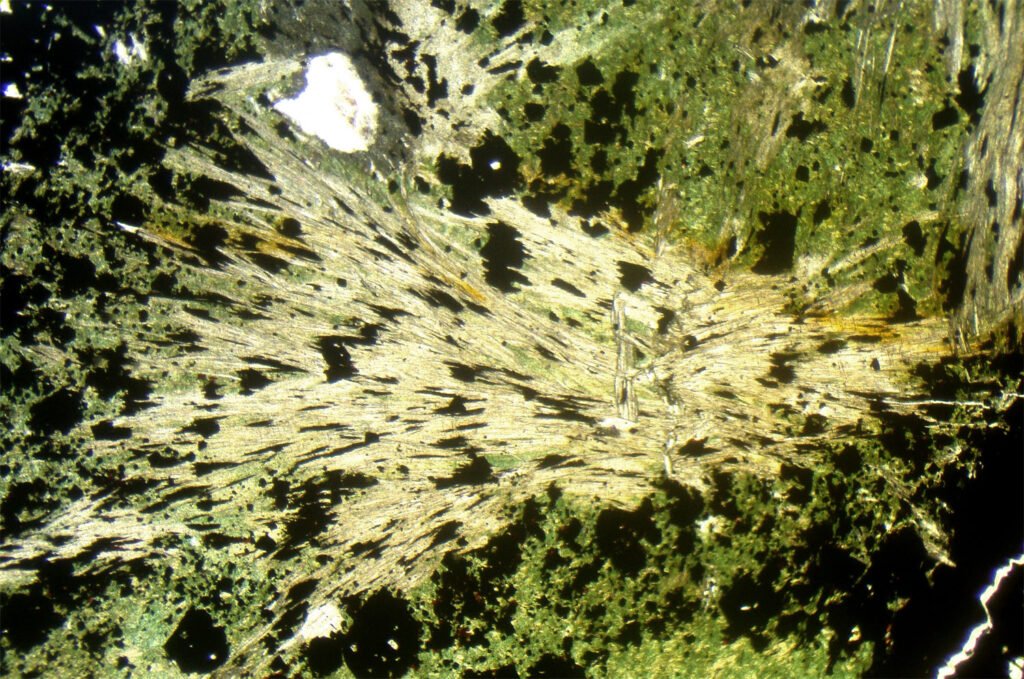
Color / Pleochroism: Colorless, it can be pale green or pale brown. With increasing Fe content it can be weakly pleochroic:
X = pale yellow,
Y = pale yellow-brown,
Z = pale brown
Relief: Moderate to high.
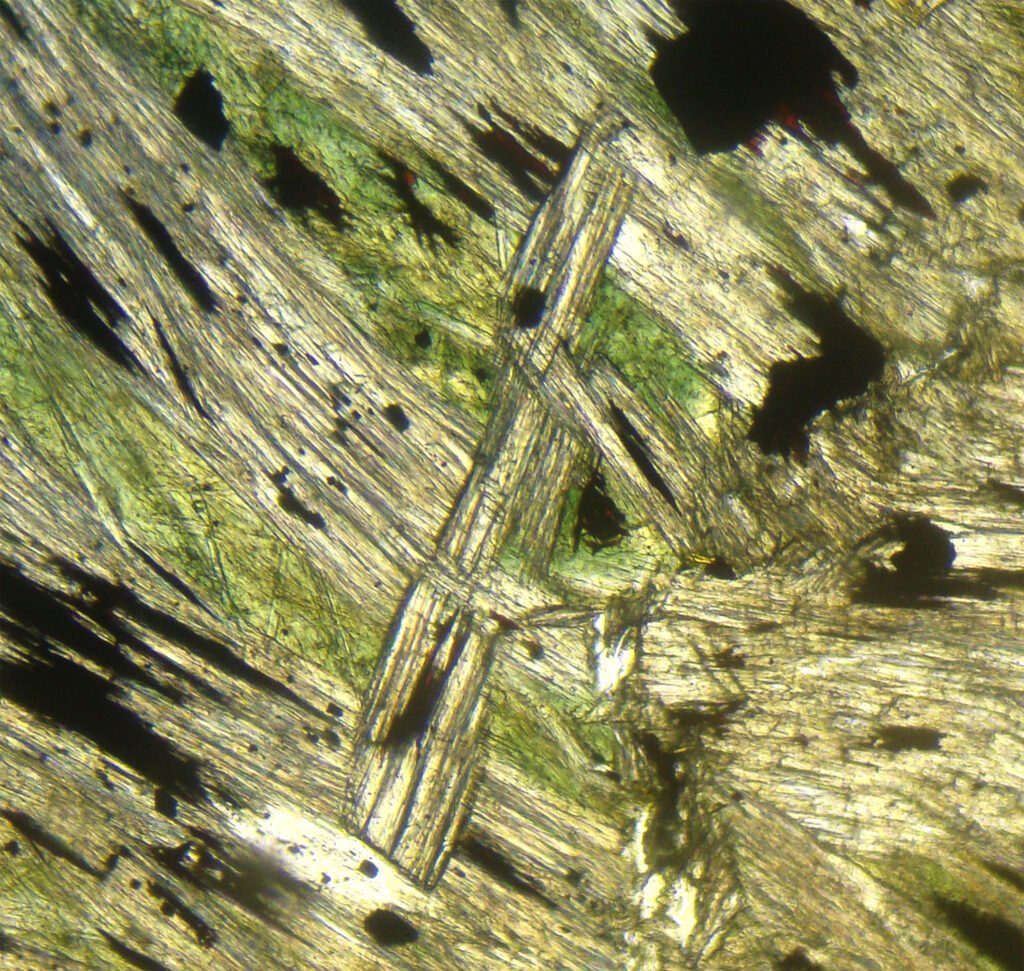
Cleavage: {110} perfect.
Longitudinal sections show only one cleavage, parallel to the crystallographic z-axis (vertical).
Basal sections show two cleavages that intersect at angles of 124º and 56º, forming rhombuses (as in all amphiboles).
Due to the typical acicular/fibrous habit of grunerite, these cleavages are difficult to visualize.
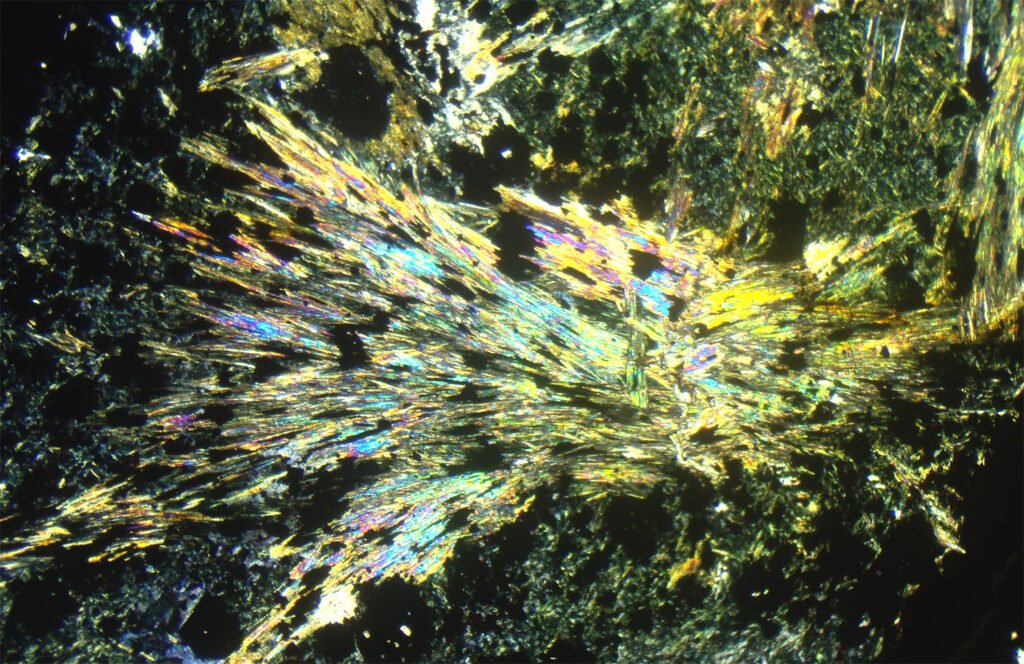
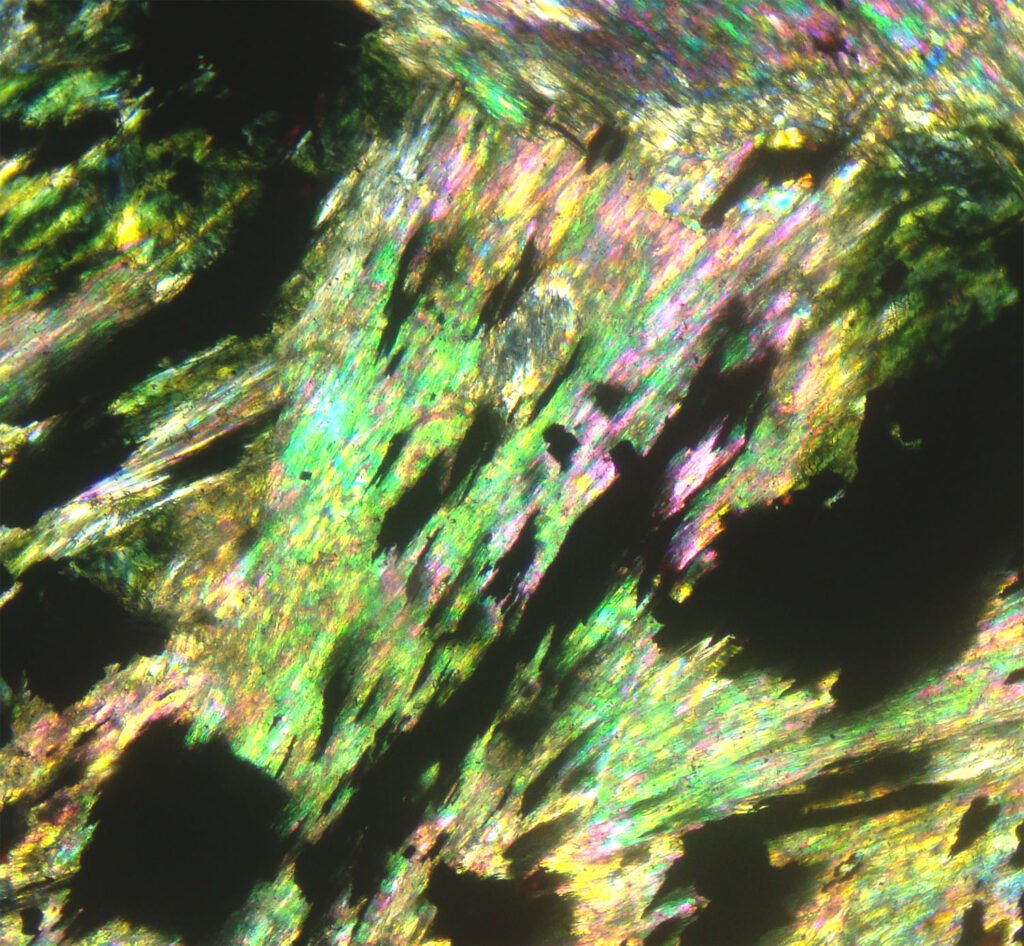
Habits: Its characteristic habit is in aggregates of acicular to fibrous crystals, which can be asbestiform, forming masses composed of fibers in various orientations. Radial aggregates are common.
It can be elongated, tabular, or prismatic.
CROSSED POLARIZED LIGHT – XPL
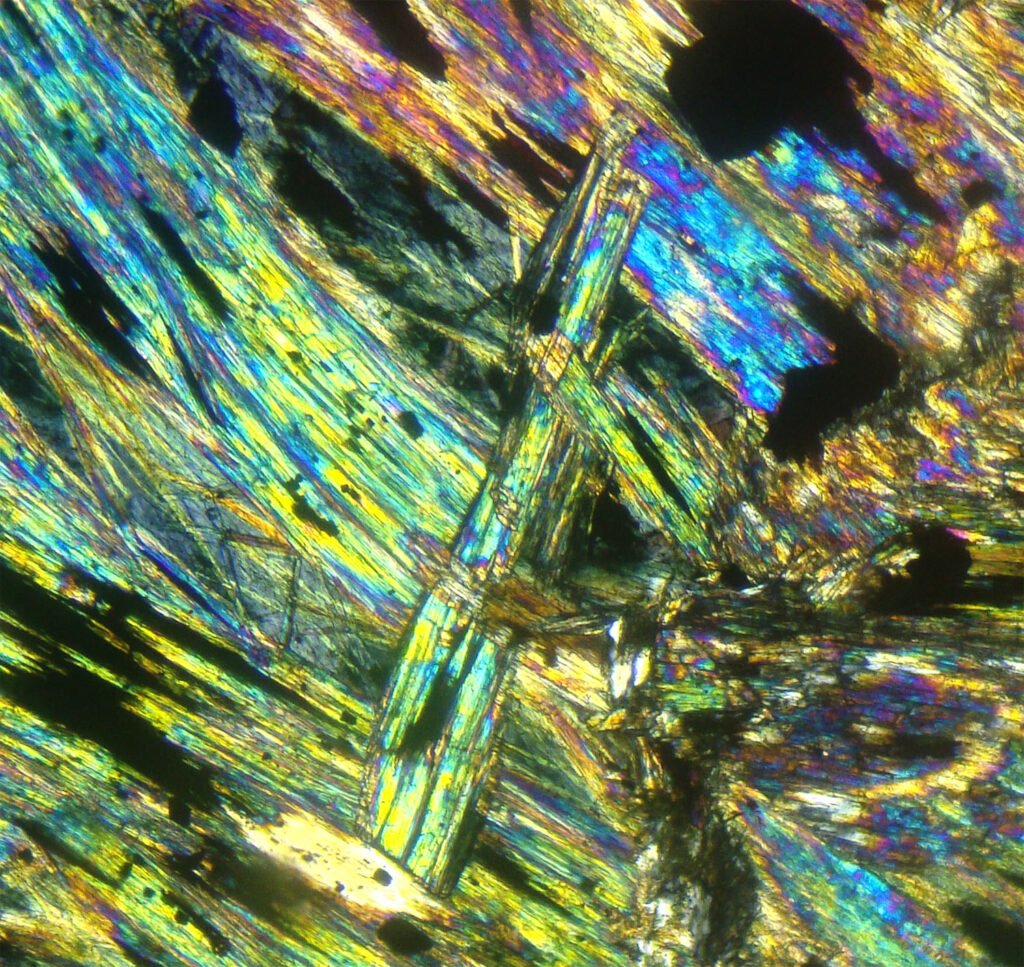
Birefringence and Interference Colors: Maximum birefringence of 0.033 to 0.043, corresponding to intense, colorful hues, up to the 3rd order. When the crystals are very thin (acicular/fibrous), observing the colors becomes very difficult.
Extinction: In longitudinal sections it is oblique up to 16º (10 – 15º), it can appear to be parallel. In basal sections it is symmetrical.
Elongation sign: ES(+)
Twins: Common, simple or multiple (polysynthetic), parallel to {100}. They form narrow twin lamellae, parallel to the length of the longitudinal sections.
Zoning: No.
CONVERGENT LIGHT
Character: B(-)
2V angle: 70 – 90º
Alterations: Overgrowths of green hornblende and exsolution lamellae of hornblende can occur, mainly in cummingtonite, but also in grunerite. Alteration to chlorite and talc is possible.
May be confused with: Other amphiboles have a fibrous habit, but thin lamellar twinning is a very important diagnostic feature for both grunerite and cummingtonite. Paragenesis, with association with magnetite and hematite, is also diagnostic.
Cummingtonite may be similar, but its extinction angle is larger, generally 15-21º.
Anthophyllite and gedrite have parallel extinction and lower birefringence, and do not show twinning.
Tremolite exhibits twinning much more rarely.