5. Reflected Light Microscopy
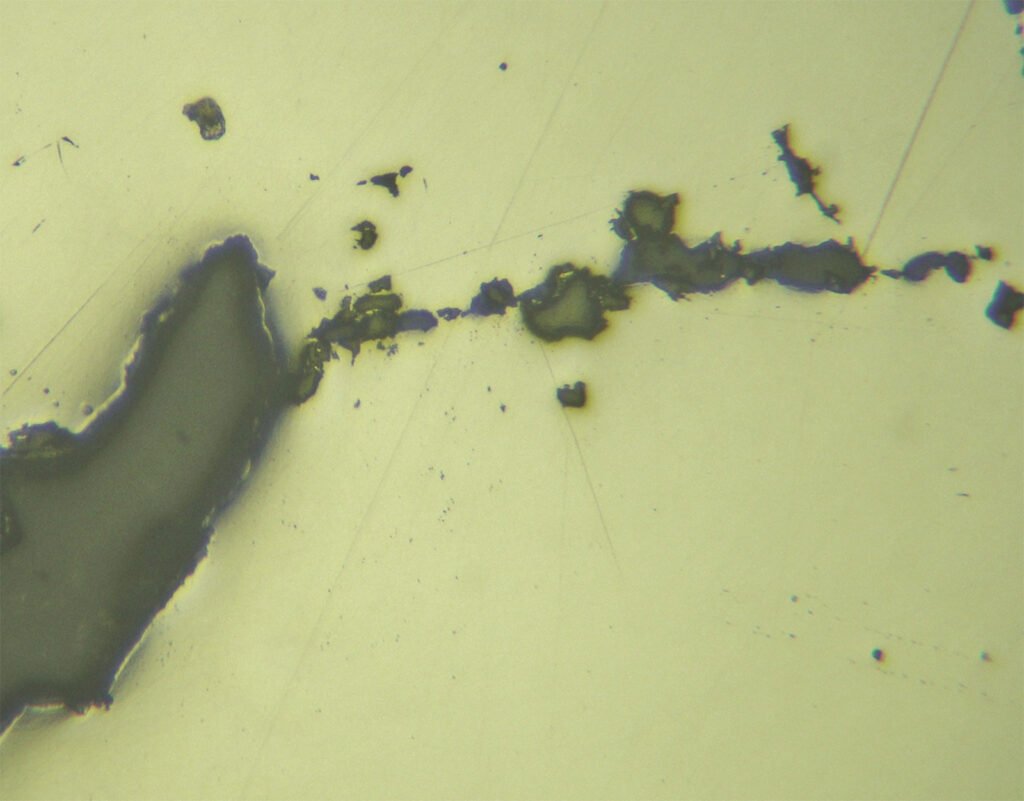
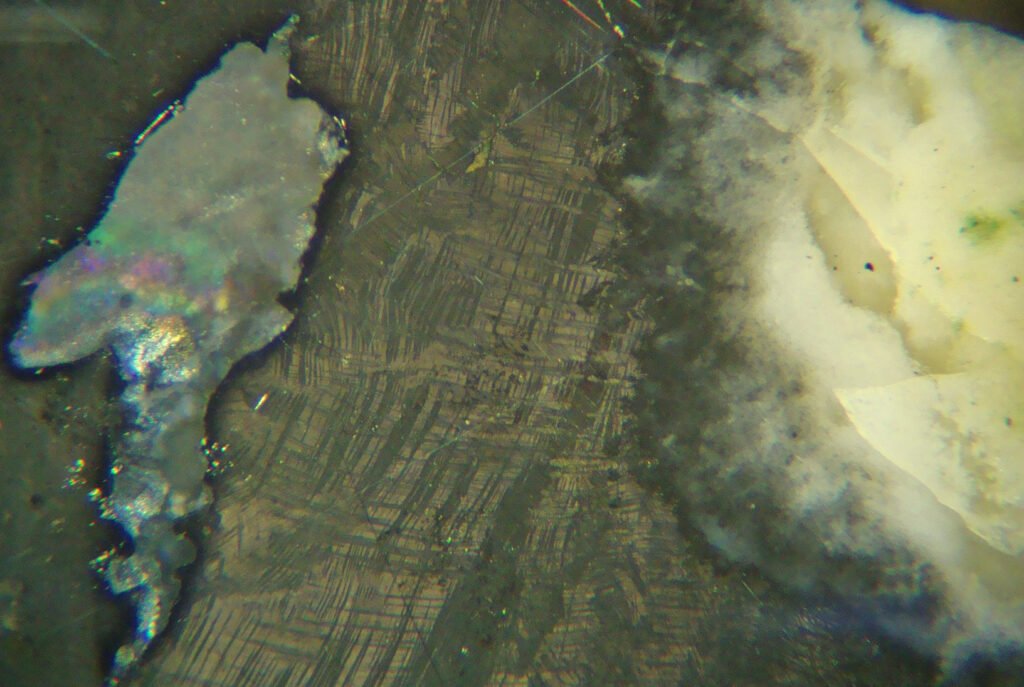
Sample preparation: despite its low hardness, bismuth acquires a good polish when ocurring alone. When it occurs with other minerals, it is generally scratched and with negative relief. It has a lower hardness than all the minerals of its paragenesis and lower than all the minerals that could be confused with it.
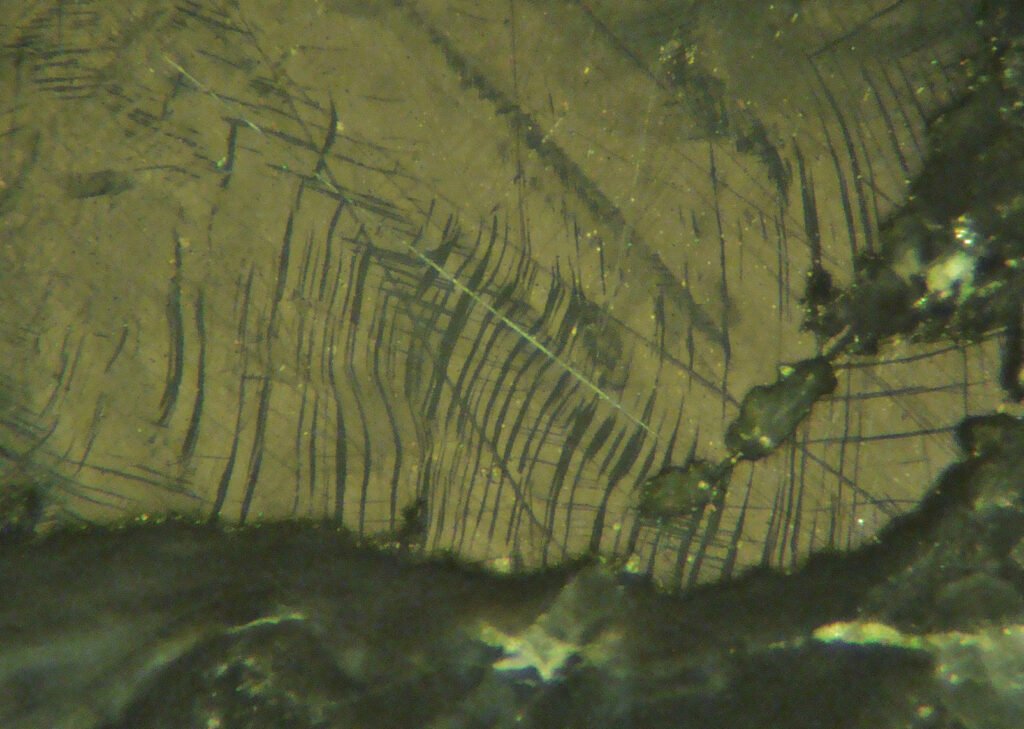
The polishing hardness is greater than that of molybdenite, but less than the hardness of bismuthinite, galena and, of course, arsenopyrite and cassiterite. Some special care is necessary during the grinding and polishing of the section: the material cannot be heated due to the recrystallization that occurs at 75ºC and excessive force must not be used to avoid the formation of twin lamellae.
PLANE POLARIZED LIGHT – PPL
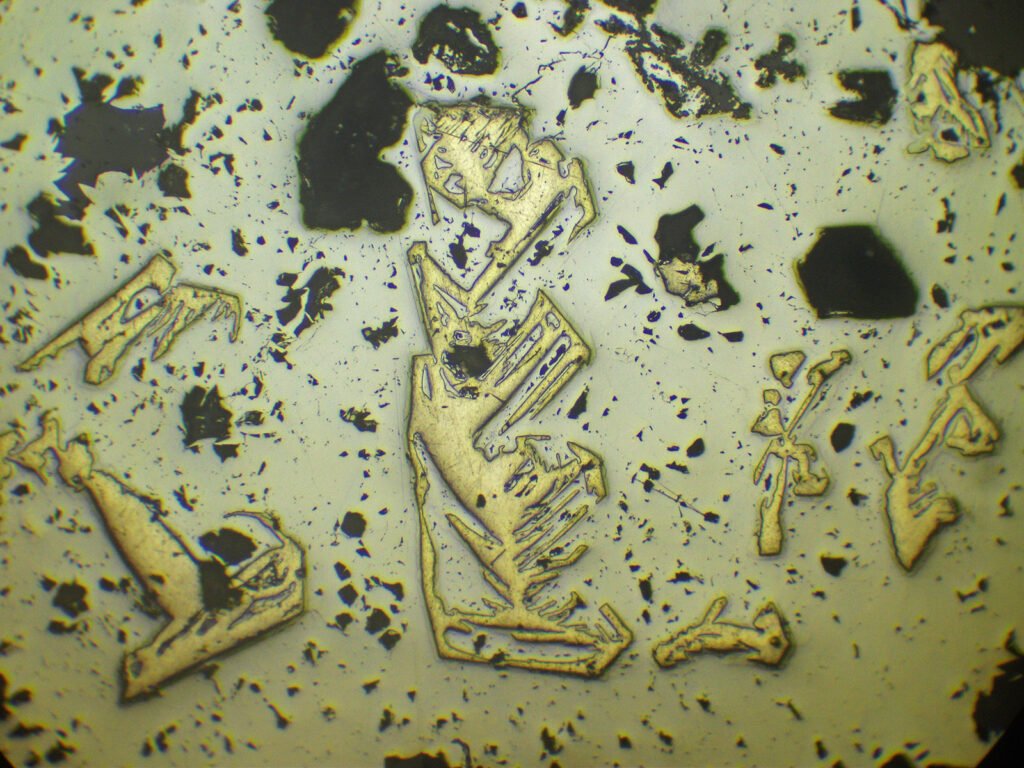
Reflection color: Bright white with a reddish-cream, rosy hue. It tarnishes very quickly to pinkish cream, later, much more slowly, to brownish.
Compared with the color of antimony, the color of bismuth is lighter.
Compared to the color of native silver, the color of bismuth is less luminous and a little more cream or yellow.
Compared to the color of native arsenic, the color of bismuth is pinkish cream.
Compared to the color of nickeline, the color of bismuth is whiter, less pink, and much more luminous.
In contact with bismuth:
– chalcopyrite is greyish olive green,
– pyrrhotite is greyish cream brown,
– skutterudite, safflorite and rammelsbergite are white.
Pleochroism: Very discreet, almost imperceptible, between white-cream and white-cream with a grayish tone.
Reflectivity: 65.35 – 66.65%
Bireflectance: No.
CROSSED POLARIZED LIGHT – XPL
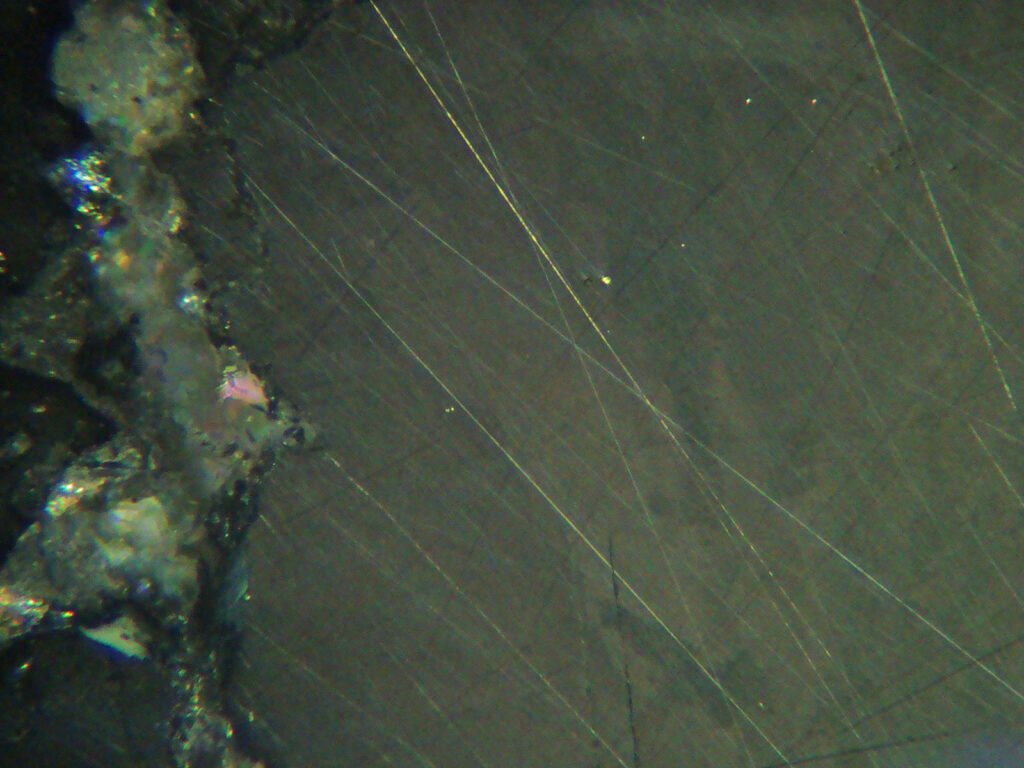
Isotropy / Anisotropy: May have a satin luster.
Distinct to strong yellowish to gray-blue anisotropy, typically in greenish hues, which is masked by the many polishing scratches in lower quality sections.
Internal reflections: No.
May be confused with: some other high reflectivity minerals. Very diagnostic is the high reflectivity associated with low hardness. The lamellar twinning structure is very common and the diagnostic anisotropy in most cases can also be observed.
Native silver is similar but is isotropic. When in small grains, however, it is difficult to tell the difference in color between both ND and bismuth can be mistaken for silver.
Native antimony, dyscrasite and some rare ore minerals are also similar.
General Characteristics:
Grain shape is rounded, usually with very thooted edges. The sizes are sometimes quite expressive. It also forms well-developed dendrites, which can reach several centimeters in length. When occurring in subordinate amounts, bismuth usually forms small, rounded grains or interstitial fills. The individual bismuth grains are often separated from each other by thin crusts of safflorite, löllingite or skutterudite.
Polishing scratches are usually present in large numbers.
Negative relief may occur, as bismuth is softer than all other minerals in the paragenesis. Depending on the quality of the polishing cloth (“soft”/“hard”) the negative relief may be not very pronounced or expressive.
Air corrosion (tarnishing) is very fast, clouding to pinkish-yellow with a tinge of red and later brown in the polished section. It is a very characteristic and diagnostic blurring.
Cleavage {0001} – basal – is sometimes visible, especially in pieces with incipient alteration to bismuthite, but is usually not present.
Radial fractures around bismuth grains form because the bismuth expands as it cools. Thus, the bismuth grains included in other minerals “explode” the host mineral, generating radial fractures. This feature can be seen in scheelites and sometimes in arsenopyrites and skutterudites.
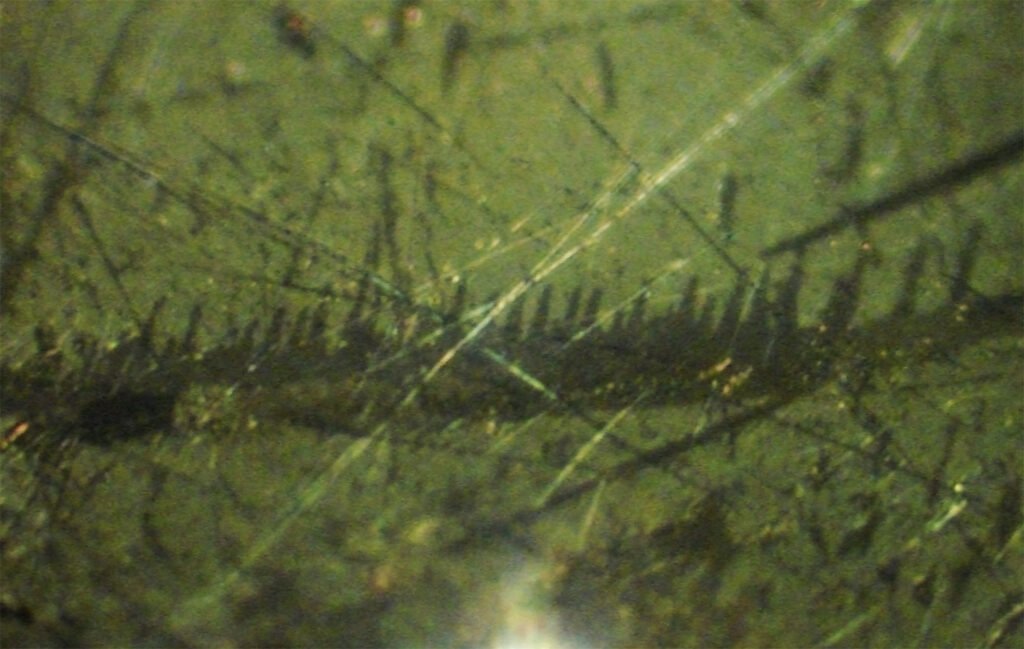
Polysynthetic twins in lamellae arranged parallel to (01-12) are almost always present, similar to “fern leaves” (herring-bone). It can be in the form of a chess (“parquet”). Few occurrences do not show macla. If the section is polished with excessive force, polysynthetic twins are also generated.
Interpenetration twins also occur, but are rare.
Zonations do not occur.
Unmixings do not occur, but some grains may be sectored.
Deformations are frequent.
Substitutions 1: bismuth replaces cobaltite, glaucodote, skutterudite, galena, tetrahedrite, pitchblende, other sulfides and tellurides of Bi.
Substitutions 2: bismuth is replaced by silver, schirmerite, nickeline, bismuthinite, rammelsbergite and skutterudite. In isolated cases it is replaced by arsenic and sulfides.
Myrmekites can occur with bismuthinite, pyrrhotite, galena and chalcopyrite. Bismuth myrmekites with gold are due to the decomposition of maldonite.
Inclusions 1: bismuth inclusions occur in molybdenite, bismuthinite, galena, chalcopyrite, arsenopyrite, schapbachite, Sb minerals and along wolframite cleavages. It forms skeletal or dendritic crystals in safflorite, skutterudite, pitchblende and rammelsbergite. It can form inclusions with pseudo-cubic shapes in galena and chalcopyrite.
Inclusions 2: inclusions in bismuth can be of cosalite, bismuthinite and joséite.
Incipient alteration or decomposition of Pb-Bi sulfosalts forms borders with large amounts of tiny droplets of bismuth in grains of cosalite, galenobismutite, emplectite and wittichenite.
Alteration of bismuth leads to the formation of several transparent oxidized Bi minerals, the so-called “bismuth ochers”, which include Bi carbonate (bismuthite).The alteration takes place in the grains along irregular fronts, rarely along the cleavage.