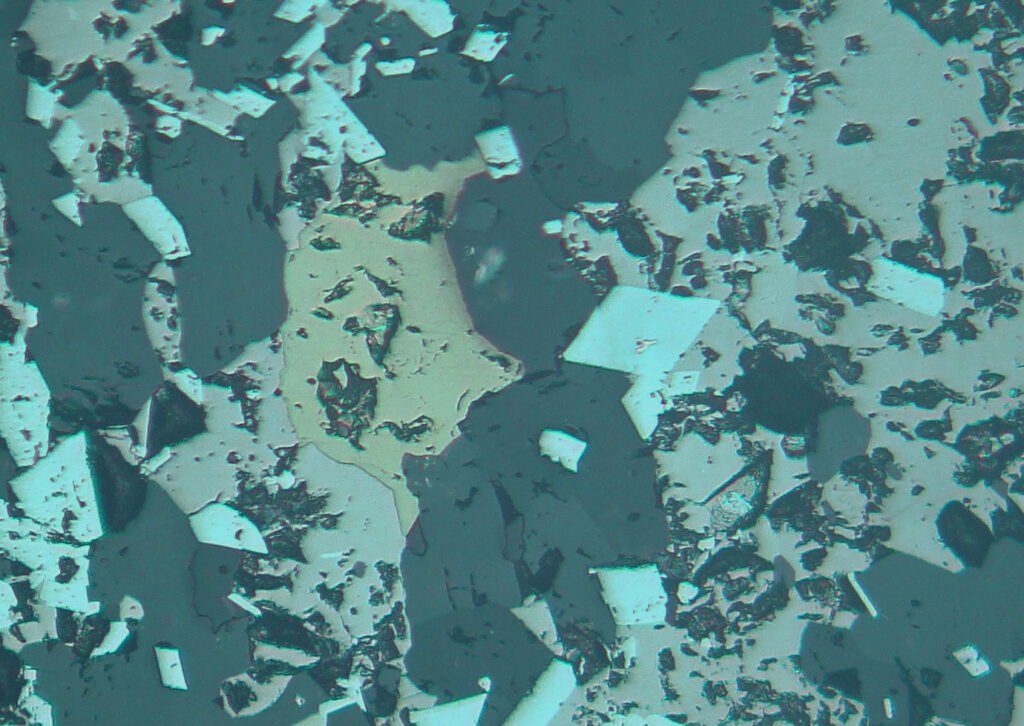
5. Reflected Light Microscopy
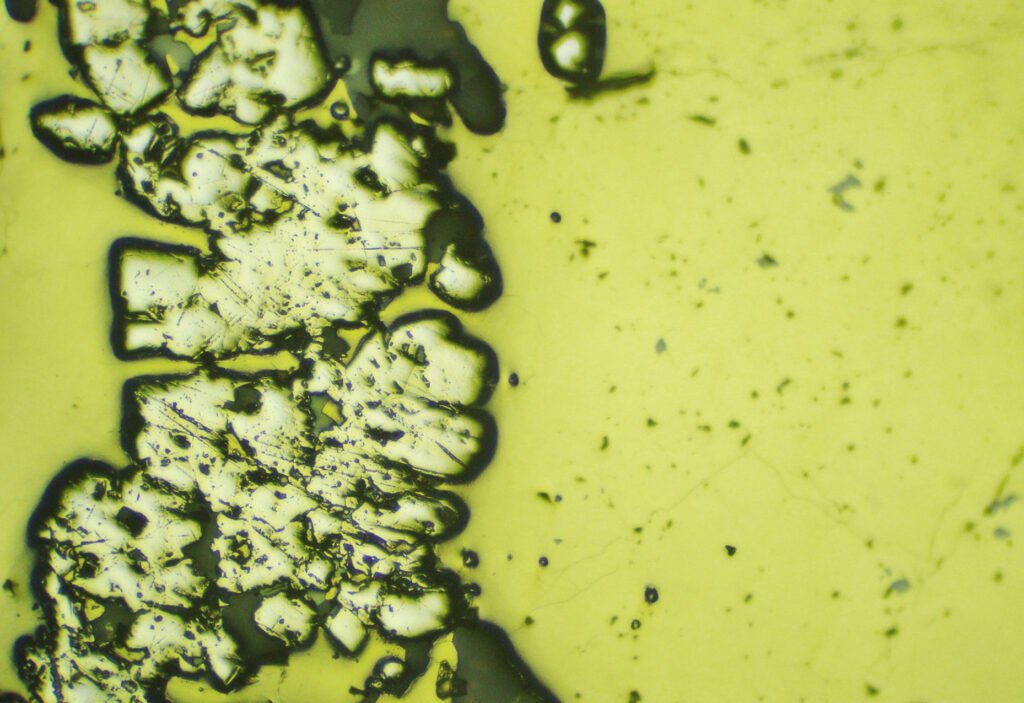
Sample preparation: Chalcopyrite acquires an excellent polish with great ease, as its hardness is only slightly greater than that of galena. It is less than the hardness of sphalerite and, of course, less than magnetite, pentlandite and pyrite. Sections need to be cleaned and dried properly after polishing, otherwise the color will darken. In some sections this darkening is uniform, in others the darkening takes place in patches.
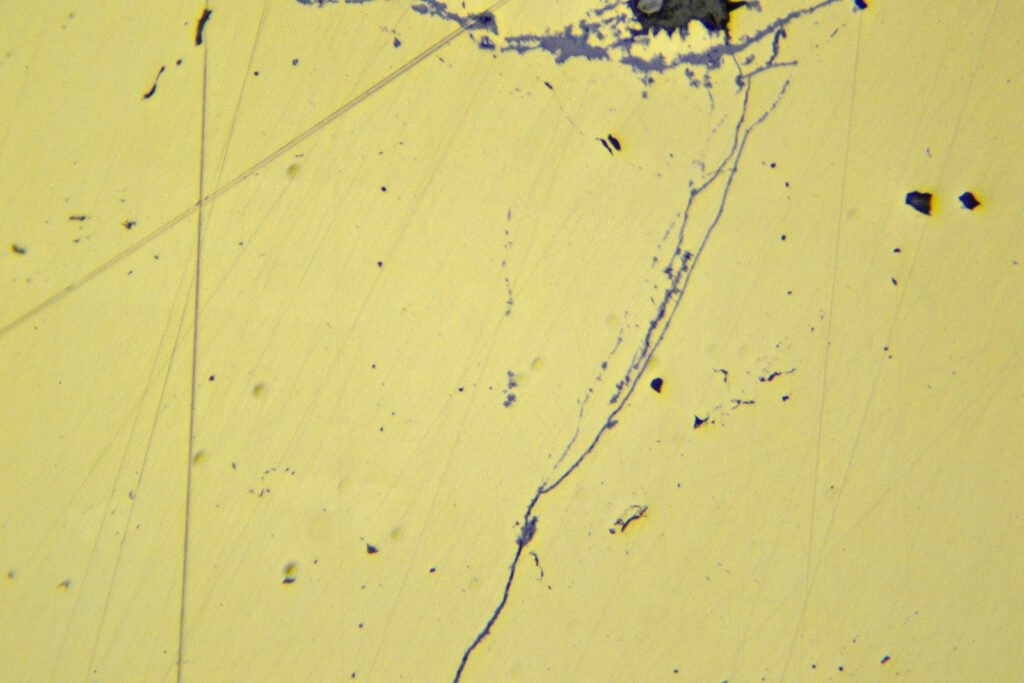
PLANE POLARIZED LIGHT – PPL
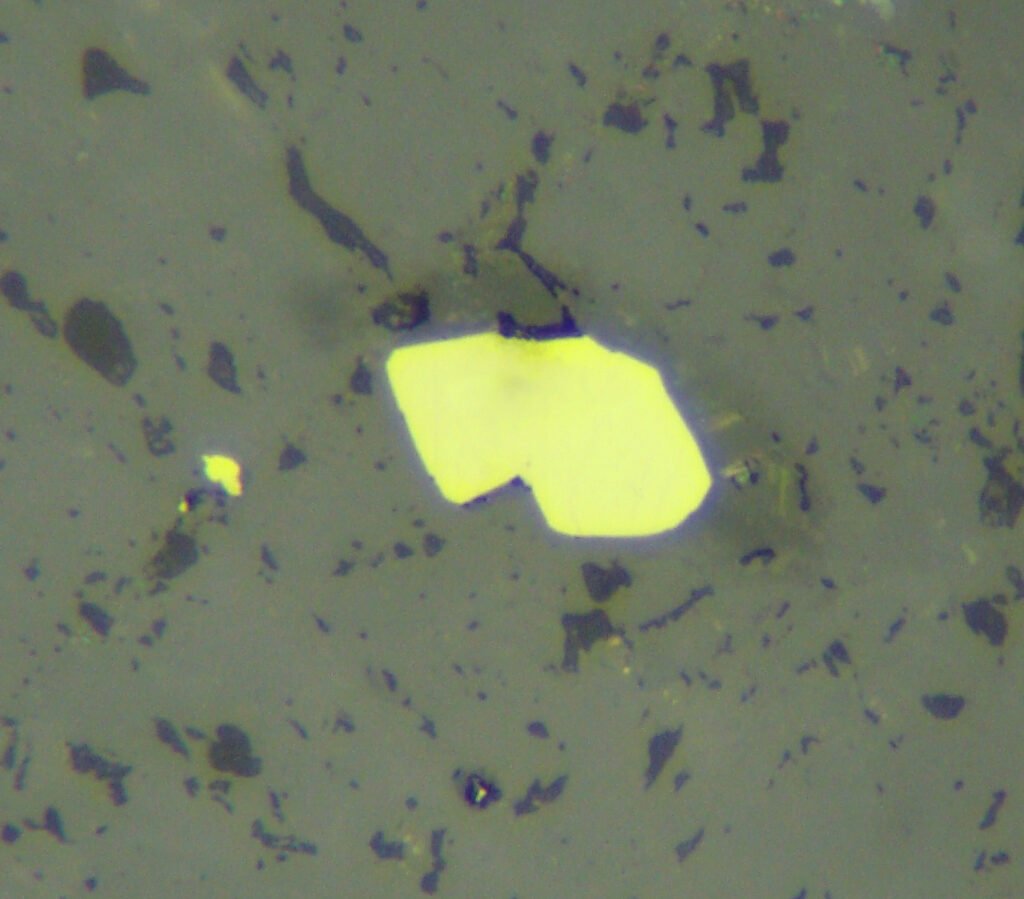
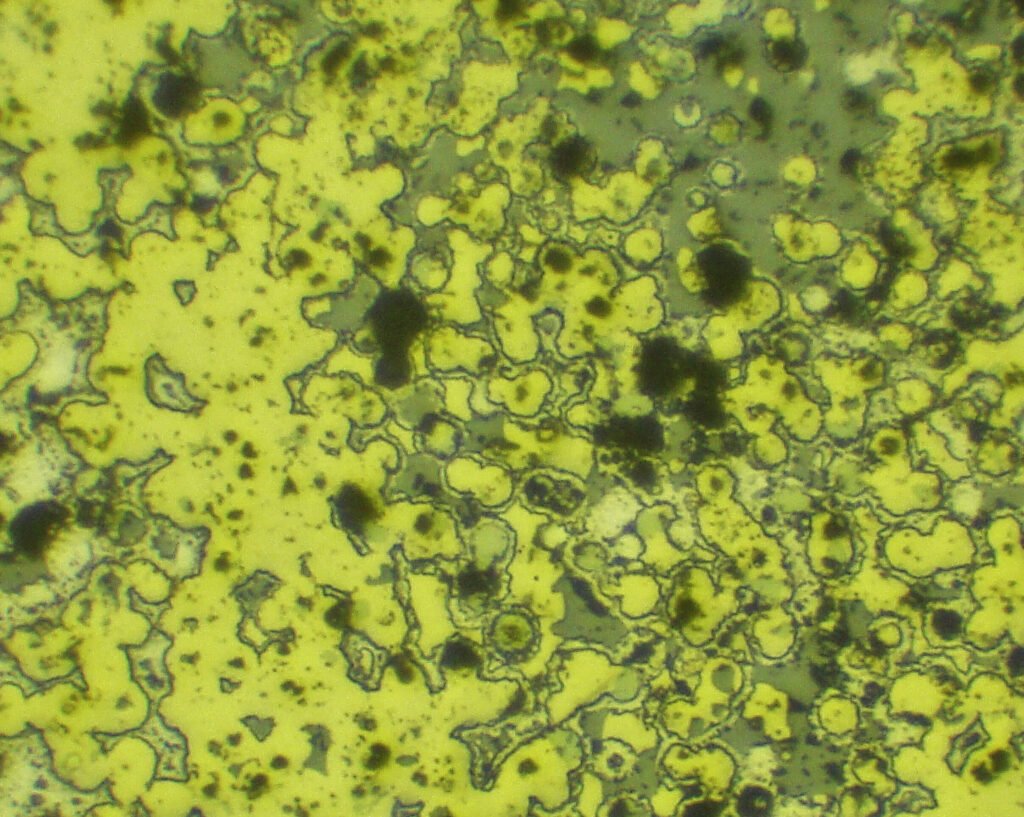
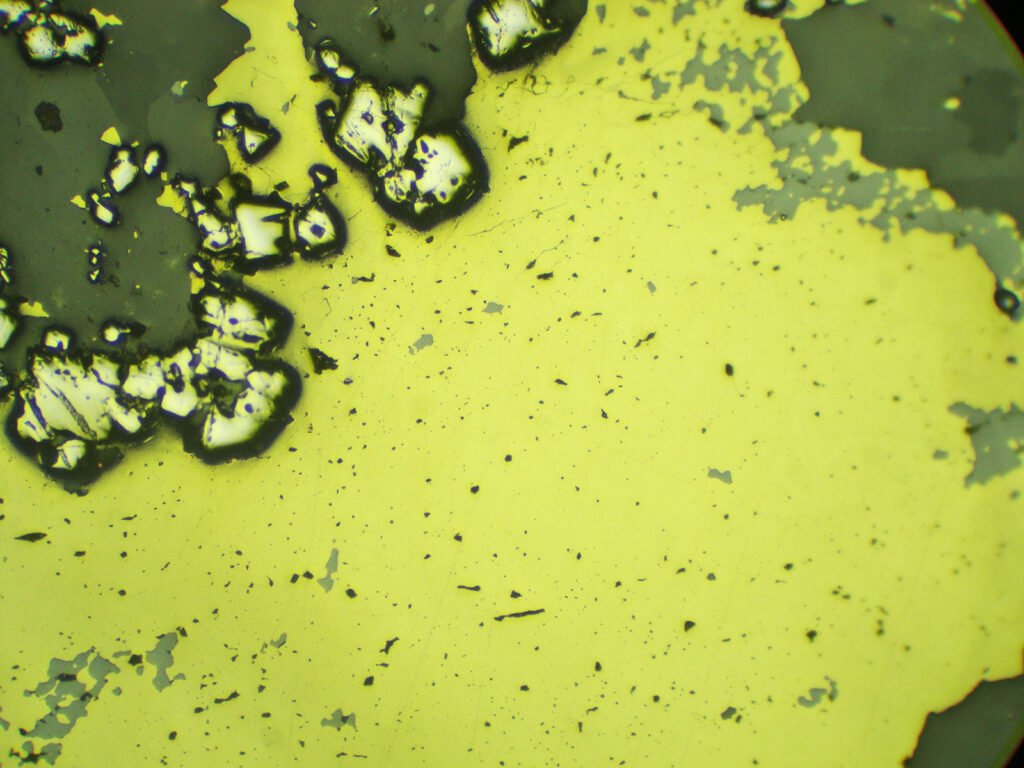
Reflection color: Strong yellow with intense shine; sometimes with greenish or brownish hues (if with Se).
Compared to the colors of pyrite, pentlandite and jamesonite, the color of chalcopyrite is much more yellow, a strong gold.
Compared to the color of native gold, the color of chalcopyrite is olive green to yellow-brass, depending on the relationship between the amounts of gold and chalcopyrite.
Compared to the color of pyrrhotite, the color of chalcopyrite is a little darker, with no cream or brownish hues.
Compared with the color of cubanite, the color of chalcopyrite is light yellow.
Pleochroism: Weak, normally impossible to observe. If the chalcopyrite is strongly pleochroic, it was formed at high temperatures and probably has abnormal compositions, with more Fe.
Reflectivity: 38.69 to 39.80%, but changes noticeably between different occurrences
Bireflectance: No.
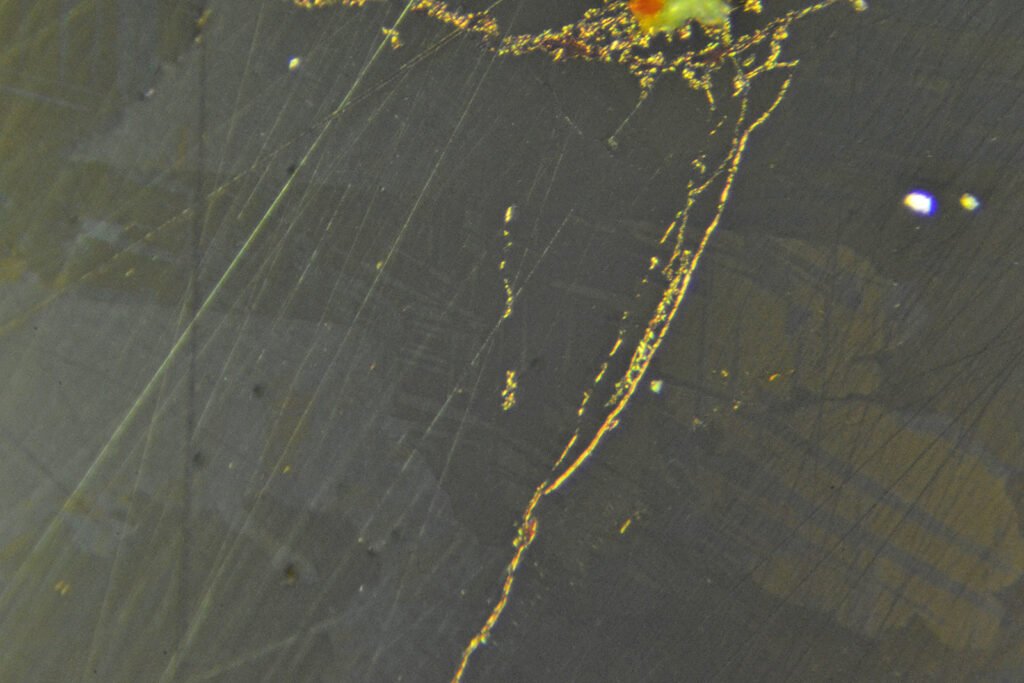
CROSSED POLARIZED LIGHT – XPL
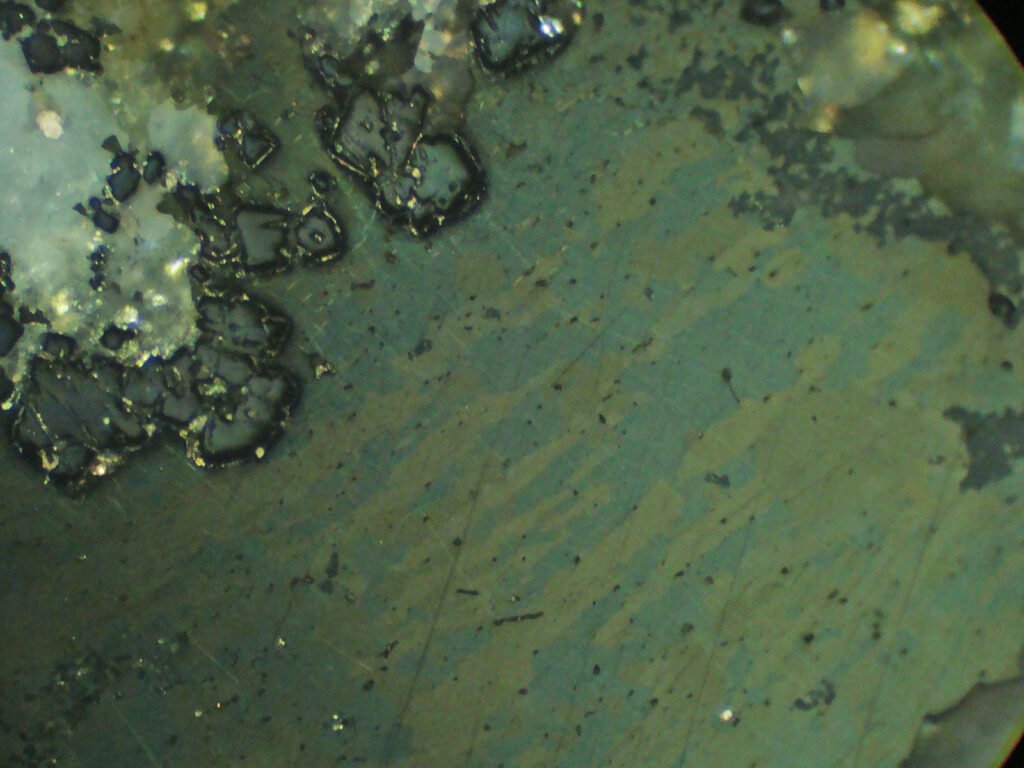
Isotropy / Anisotropy: It is always weakly anisotropic, which is best observable in bright lighting. Anisotropy colors range from olive brown to blue or bluish to yellowish.
Chalcopyrites with strong pleochroism are more anisotropic.
Due to the low hardness, thick Beilby layers develop during polishing, which hide the effects of anisotropy.
Internal reflections: No.
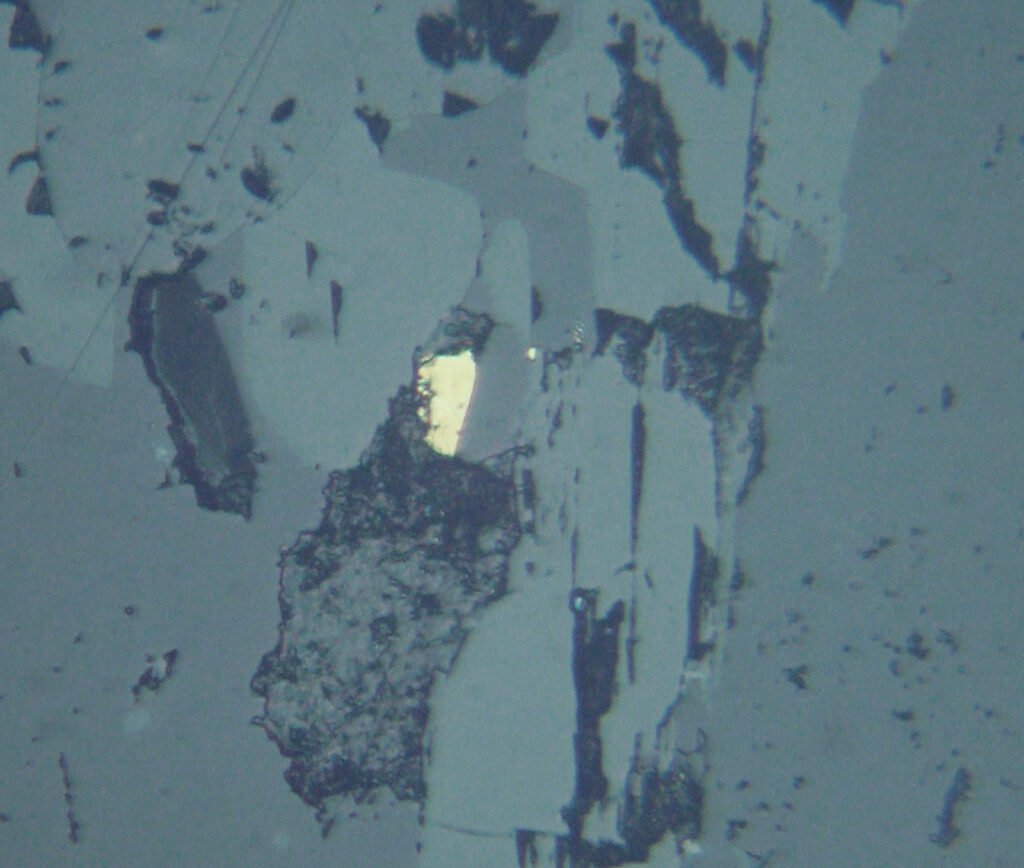
May be confused with: when freshly polished, the color is so characteristic that there is practically no difficulty in identifying it. Very small grains can be mistaken for native gold.
Millerite is slightly lighter and creamier in color, tends to form acicular crystals;
Cubanite is slightly browner and very anisotropic;
Pyrite is much harder (much worse polish, high relief), more reflective and much weaker in color.
General Characteristics:
Grain shape is usually anhedral, occurring as masses with no definite shape. When there are crystals, which is very rare, it is somewhat isometric, which corresponds to the cubic symmetry of the high-temperature shape, as long as the aggregates have not undergone cataclase or deformation. When it occurs with other ores, the shape of the grains is anhedral, space-filling. Several generations of chalcopyrite may be present, each with its own characteristics.
Grain size is often very diverse even in the same sample, ranging from very small to 5 – 10 cm. There is a diffuse relationship between the grain sizes of chalcopyrite and the grain sizes of neighboring minerals.
Polishing scratches are normal due to the low hardness, making it difficult to produce a section without some persistent scratches, especially if the aggregates are larger.
Intergranular boundaries are always very interfingered (“verzahnt” in German). Sometimes this intimate relationship between the grains is highly developed due to mechanical stresses. The plasticity of chalcopyrite allows the formation of structures similar to the “lead tail” of galena. In well-polished sections these structures cannot be observed, only in hand samples or in sections that have undergone chemical attack. In most cases, these structures have already undergone recrystallization. Many ores that show bands of chalcopyrite alternating with other minerals, were formed by this process.
Cleavage is rarely noticeable. Only when the chalcopyrite is undergoing oxidation or cementation does the cleavage become visible. Chalcopyrites that originated by the alteration of cubanite show abundant cleavages according to {111}.
Twins are almost always present; its observation in CPL must be performed with CPL+2º and with intense lighting. In grains or small aggregates, visualization is usually difficult to impossible. Even in larger aggregates, the twins can be very subtle, difficult to observe even with intense lighting and somewhat uncrossed nicols. Generally, the twins appear in the form of lamellae, but they can form spots or irregular areas. The twins are of various laws that change from grain to grain. The shape and width of the lamellae changes and may be characteristic for a given occurrence. In the same grain, there are often great variations in the widths and lengths of the lamellae, in the predominance of one set or the other and in the relationships of the sets to each other. The lamellae can originate (i) during grain growth, (ii) often due to pressure (depending on fractures and cataclastic zones) or (iii) by the transformation of high-temperature (cubic) chalcopyrite to the low-temperature phase. . An indication as to the orientation of the lamellae can be obtained from the cubanite lamellae, arranged parallel to (111).
Unmixings in chalcopyrite are very common. At high temperatures, chalcopyrite contains several other substances, which unmix with lowering the temperature.
Unmixings of sphalerite occur in many chalcopyrites in the form of small inclusions mainly in the form of stars and small skeletons, but also as small rods, shapes resembling myrmekites, dust and rods. These star-shaped exsolutions are restricted to high-temperature deposits. In the literature, these inclusions are described as “chalcopyrite disease”, because it resembles measles, for example.
Unmixings of cubanite occur if the temperature is not lowered too quickly. Perfect lamellae form parallel to (111). Cubanite can be recognized by its typical lamellar habit, by the cream reflection color, slight bireflectance in cream tones, absence of pleochroism, reflectivity of 38.62 to 42.18% and, in CPL, by the distinct anisotropy between light blue and blue dark.
Unmixings of stannite occur in the same way as sphalerite unmixings. They can be recognized by their medium gray reflection color with an olive hue, absence of pleochroism and bireflectance, reflectivity of ~29%, and distinct anisotropy between violet and slate green.
Unmixings of valleriite only occur in high temperature chalcopyrites. The shapes and their distribution can be very irregular, but they can also occur rigorously parallel to (100) and (001), therefore parallel to the pseudo-cube. Even in small grains, valleriite is easy to recognize due to the medium brown to bluish gray reflection color, strong pleochroism between brown and bluish gray, strong bireflectance, low reflectivity (10.20 – 18.51%) and strong anisotropy between yellowish and brown.
Unmixings of magnetite are described in the literature, forming fine alignments in high-temperature chalcopyrites. In fact, it is the alteration of cubanite lamellae.
Unmixings of tennantite-tetrahedrite are rare. Usually the little grains are just small crystals of star-shaped or curved lamellae, formed on former crystalline faces and incorporated later as the grain continued its growth.
Unmixings of mackinawite are restricted to high temperature chalcopyrites. The shapes and their distribution can be very irregular, but they can also occur rigorously parallel to (100) and (001), therefore parallel to the pseudo-cube. Mackinawite has a reflectivity of 22.38 – 47.13%, a reflection color in lighter and darker cream tones, with distinct bireflectance and strong pleochroism in cream tones. It has extreme brownish to almost sky blue anisotropy.
Unmixings of pyrrhotite can occur in high temperature chalcopyrites, developing capillary habits. They can originate by exsolution or by decomposition of cubanite lamellae.
Unmixings of chalcopyrite into bornite, sphalerite, stannite and some other minerals can occur.
Pseudo-unmixings (or pseudo-exsolutions) can occur when chalcopyrite has replaced only one of two de-mixed minerals. An example is chalcopyrite with ilmenite oriented lamellae, which is actually the relict of an unmixed titanomagnetite in which chalcopyrite has replaced only magnetite.
Inclusions of stephanite and ullmannite may occur.
Zonation of some typical pattern rarely develops and is limited to crystals that have grown on top of each other. It becomes noticeable in some cases through soft nuances of color and is easier to see through chemical etching.
Substitutions of chalcopyrite for bornite or of bornite for chalcopyrite are common, as the disintegration of bornite generates chalcopyrite, chalcocite or idaite.
Oriented intergrowths are very frequent and may occur with sphalerite, pyrite, tennantite-tetrahedrite, stannite, bornite, pentlandite, digenite, cubanite, covellite, valleriite, pyrite, bournonite, linnaeite, mackinavite, magnetite, marcasite, pyrrhotite, cobaltite and polybasite. Among these minerals, intergrowths with those whose crystal lattice is similar to that of chalcopyrite are more frequent, and those with structures of other types (such as intergrowths of chalcopyrite with magnetite and pyrrhotite) are rare.
Deformations are quite common. Sometimes they occur plastically, without fractures, being recognizable by the deformations of the twin lamellae. In many cases, cataclasis occurs, but it is rarer and less developed than, for example, in sphalerite.
Gel structures with rhythmic banded depositions are rare. They are easily noticeable even without chemical attack if the parallel band structure of chalcopyrite is enhanced by other minerals existing between the bands.
Myrmekites are very rare. If present, they are poorly developed, and may occur with bornite, pyrargyrite, stannite, cassiterite, chalcocite, sphalerite, galena and others.
Substitutions are extremely common, as chalcopyrite is a very common mineral in many types of ores. Chalcopyrite replaces sphalerite, pyrite, magnetite, pyrrhotite, stannite, tetrahedrite, galenas, polybasite, cubanite, maucherite, nickelline, pentlandite, pitchblende, Sb minerals and others, but, also, gangue minerals. It is often difficult to define whether it is a replacement, a filling of open fractures with solutions, or a pressure filling. In turn, chalcopyrite can be replaced by covellite, digenite, chalcocite, electrum, silver minerals, magnetite, hematite and goethite.
Alteration of chalcopyrite in the oxidation zone produces various minerals such as limonite, chalcocite or covellite. Thus, the sequences chalcopyrite-limonite, chalcopyrite-chalcocite zone-limonite, chalcopyrite-covellite zone-limonite are possible. The three can occur side by side. If the occurrence contains carbonates, copper is retained in the form of malachite, azurite and others. A rare alteration is tabular marcasite parallel to (111) of chalcopyrite, with covellite in the intermediate portions. In the cementation zone, the tendency is for the formation of minerals that are increasingly rich in copper: chalcopyrite→bornite→covellite→chalcocite. The two intermediate terms may be absent. In rare cases the process occurs in reverse order, in which case the chalcopyrite can form films on bornite and others.