GRAPHITE

Graphite – C – a native element, is easy to recognize macroscopically due to its bright gray color, lamellar shape, unctuous feel and being very soft, it get your fingers dirty. It is very similar to molybdenite (MoS2), which it was confused with for a long time. It is not a common mineral; in ores it is rare.

Graphite is one of the polymorphs of carbon (others: diamond, chaoite and lonsdaleite). It can form well-crystallized isolated plates with hexagonal sides up to 20 cm in diameter. It also forms fine “amorphous” particles in coals that have gone through the last stages of coal formation (meta-anthracites). Large graphites occur in veins that fill fractures or fissures, forming massive crystalline aggregates of fibers or needles.

It is always very pure; a variety contain uranium. “Cliftonite” occurs in meteorites and is a pseudomorphosis in graphite octahedra on kamacite (Fe,Ni).

1. Characteristics

Crystal system: Hexagonal dihexagonal bipiramidal.          

Color: Steel gray to iron black.     

Habit: Tabular, columnar, earthy, massive, veneered, compact, globular with radial structure.       

Cleavage: {0001} perfect. Twinning produces triangular striations at the base. 

Tenacity: Flexible, sectile.        

Twinning: Maybe on {11-21}.       

Fracture: Conchoidal, micaceus.       

Mohs Hardness: 1 – 2

Parting: No.         

Streak:  Black to steel gray, glossy.        

Lustre: Metallic to dull.          

Diaphaneity: Opaque.           

Density (g/cm³): 1.9 – 2.3


2. Geology and Deposits

Graphite is frequent, common, in sediments with carbonaceous matter that have undergone contact metamorphism and regional metamorphism, to any degree: schists, quartzites, marbles, paragneisses, amphibolites, metamorphic coals and other carbon-bearing rocks. Therefore, it is common in metamorphic ores, where it exhibits an earthy texture or appears as very fine flakes. The size of graphite flakes depends on the formation temperature and metamorphic grade. Graphite deposits are usually in metamorphic terrains; the larger the graphite lamellae, the greater the value of the ore.

Graphite of magmatic origin can occur in gabbros, dunites, granites and in pegmatitic-pneumatolitic paragenesis. In the latter, the textures are of large, foliated grains. In hydrothermal veins it is very rare; it is also rare in pegmatites.

It also occurs in meteorites, associated with troilite and various silicates.


3. Mineral Associations

It associates with a large number of metamorphic minerals that form in the metamorphic conditions of graphite such as psilomelane, pyrolusite, calcite, diopside, tsavorite, fluorapatite, garnet, chondrodyte, spinel, quartz, norbergite, pyrite and tanzanite (zoisite).

In veins it is associated with realgar, native arsenic, tourmaline, apatite, titanite and arsenopyrite. Magmatic graphite can occur in association with nickel-bearing pyrrhotite, magnetite and hematite.


4. Transmitted Light Microscopy

Does not apply, as graphite is completely opaque.

The literature reports that, in extremely fine flakes, graphite is transparent, deep blue, pleochroic. In this case, it shows extreme birefringence and is U(-). This observation is very difficult to obtain on thin sections.

5. Reflected Light Microscopy

Sample preparation: polishing graphite is difficult due to the low hardness of the mineral. If the crystals are large, the surface is smudged and of poor quality. If the crystals are smaller and the neighboring minerals are not too hard, the graphite lamellae achieve a good polish, but it is necessary to use only very fine abrasives with plenty of water, without applying too much force. Basal sections always end up peeling due to cleavage.       

PLANE POLARIZED LIGHT – PPL

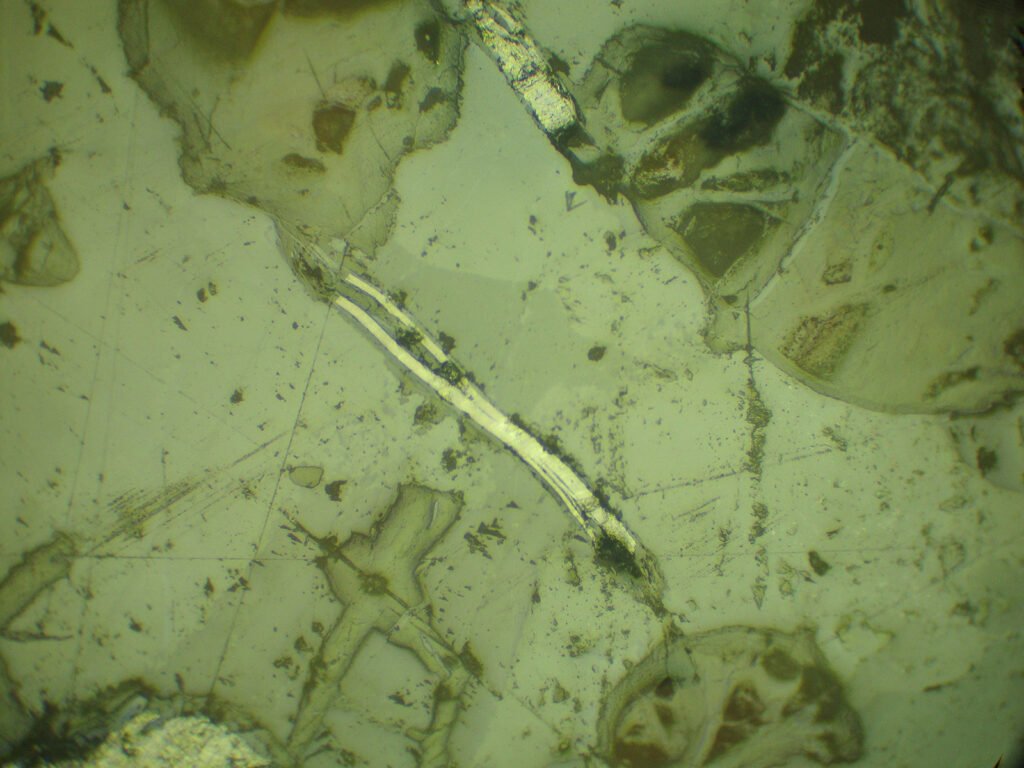
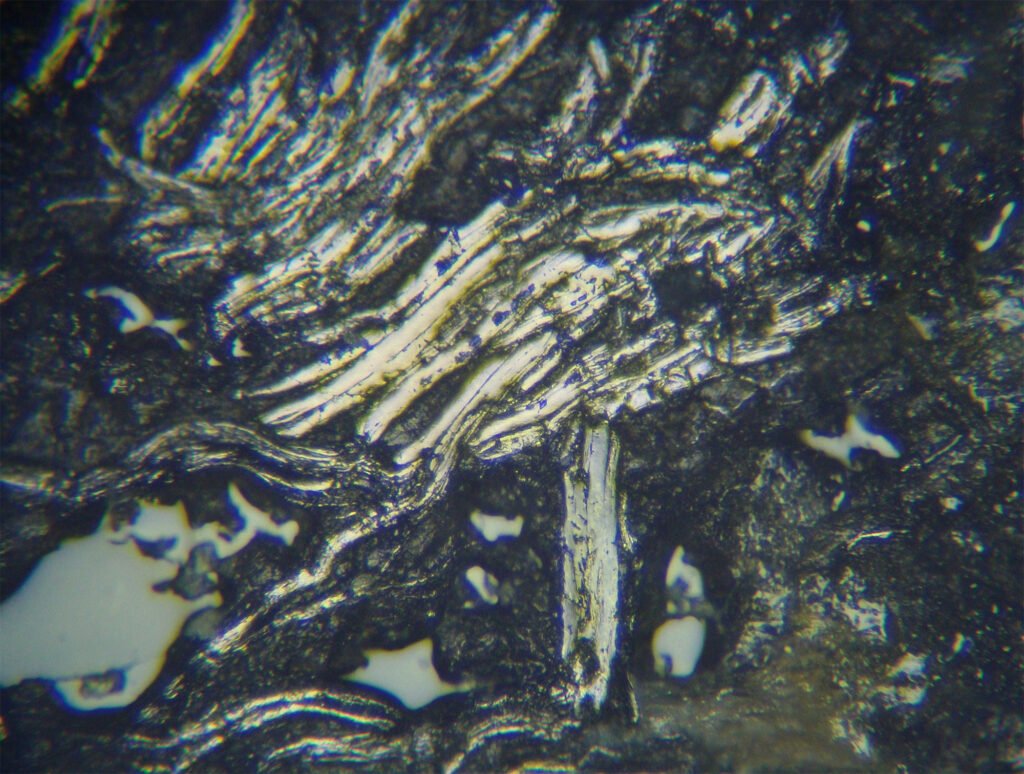
Reflection color: White gray with a brown or orange tint.       

Pleochroism: Very strong in shades of gray, one of the strongest of ores.

Reflectivity: 7.4 a 21.48%        

Bireflectance:  Very high, easy to perceive      

CROSSED POLARIZED LIGHT – XPL

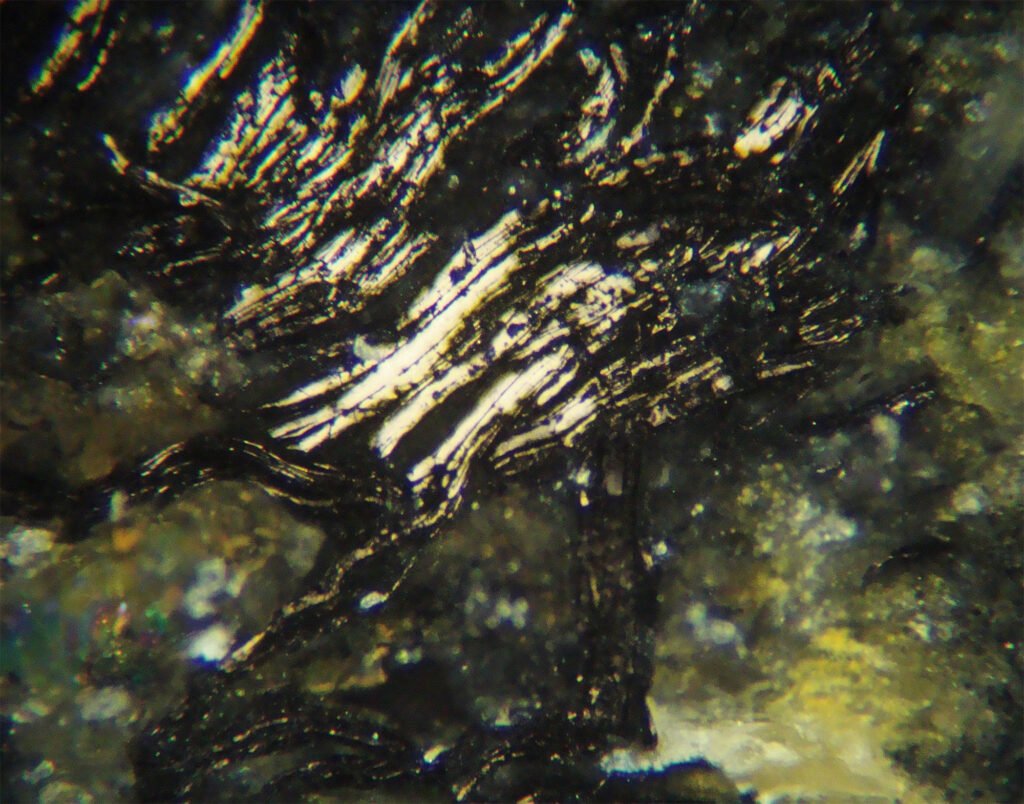
Isotropy / Anisotropy: Extreme anisotropy from light brownish gray to dark gray. Uncrossing the nicols in 2nd, one of the colors is straw yellow and violet tones are common.        

Internal reflections: No.      

May be confused with: the characteristics of graphite, when in well-formed lamellae, are extremely diagnostic.

Molybdenite is extremely similar and can easily be confused with graphite. Theoretically, molybdenite does not dirty the fingers and, under the microscope, it has greater reflectivity, a violet-pink color and anisotropy in bluish and non-yellowish tones like graphite. Graphite in “earthy” aggregates, of very small crystals, is difficult to identify. Paragenesis can help a lot.

Mackinawite is more metallic.

Chalcophanite is from another paragenesis.

Valleriite has higher reflectivity.

General Characteristics:

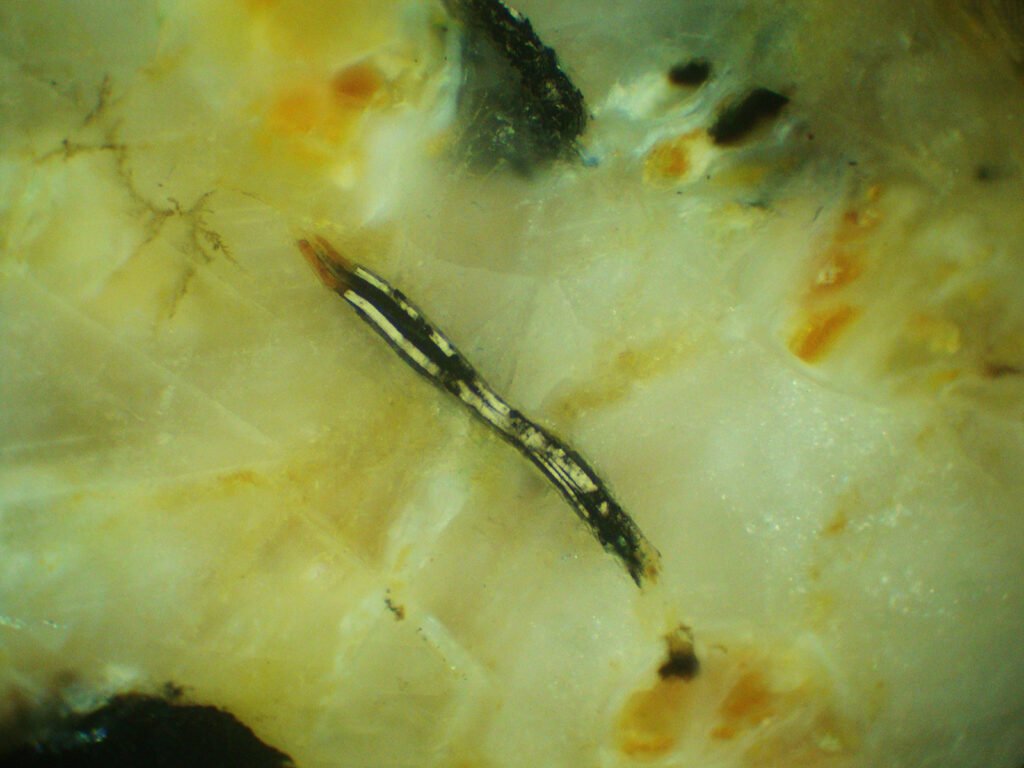
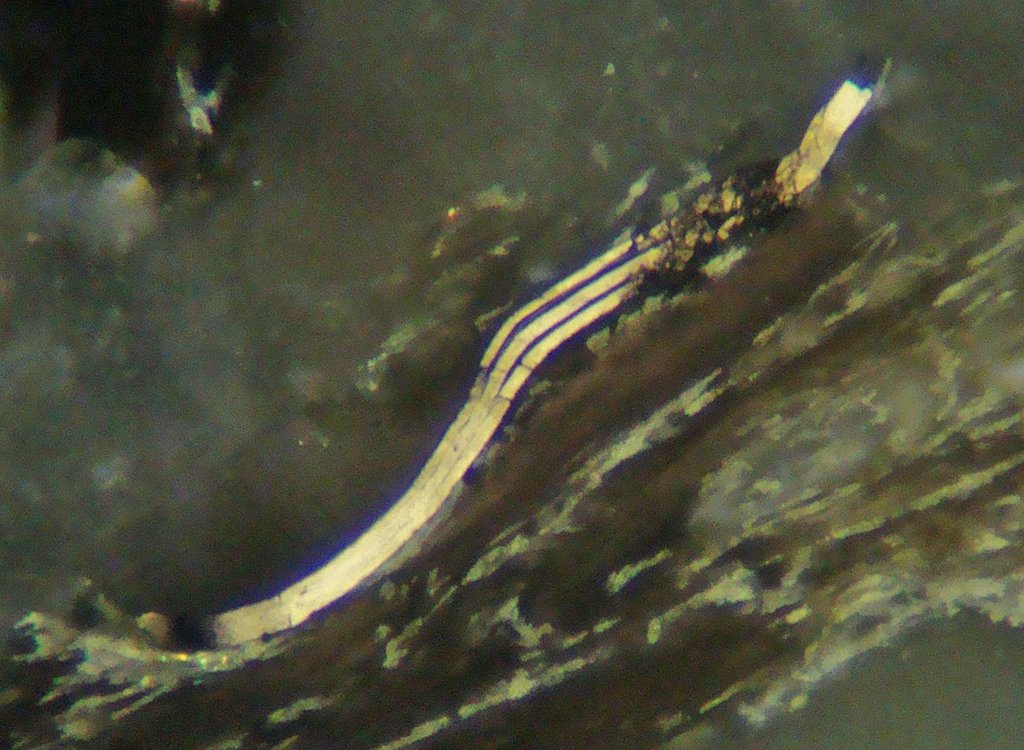
Grain shape: usually ocurrs in lamellae or straws, which can be straight and with variable widths or can be “crumpled”, bent, due to tectonic stress. These slides can be stacked. Folded lamellae will show an effect reminiscent of ondulose extinction during the rotation of the stage. Graphite can also form spherical aggregates that will show a rotating black bar with the movement of the microscope stage as a function of pleochroism/anisotropy. The individual grains are tabular and their size varies greatly according to geological origin. In homogeneous aggregates the grains are euhedral and little intergrown. Graphite grains, in general, always tend to be euhedral. In very rare cases there are botryoidal and other forms. In some instances graphite forms spheres with acicular crystals arranged radially.

Cleavage is usually quite visible even in well-polished sections, somewhat reminiscent of mica cleavage.

Ondulose extinction in deformed graphite lamellae is very common, as in micas.

Zonation was not observed.

Twins do not occur.

Replacements are extremely rare.

Inclusions 1: Graphite inclusions occur in sphalerite and pyrite.

Inclusions 2: Inclusions in graphite can be from galena, pyrite, native silver and brannerite.

Deformations due to translation according to (0001) and bending in all directions in this plane are common. The folds are almost always accompanied by the opening of the graphite sheets.

Magmatic graphites can form spherical aggregates with a radial structure.

Alterations does not occur, as graphite is very resistant