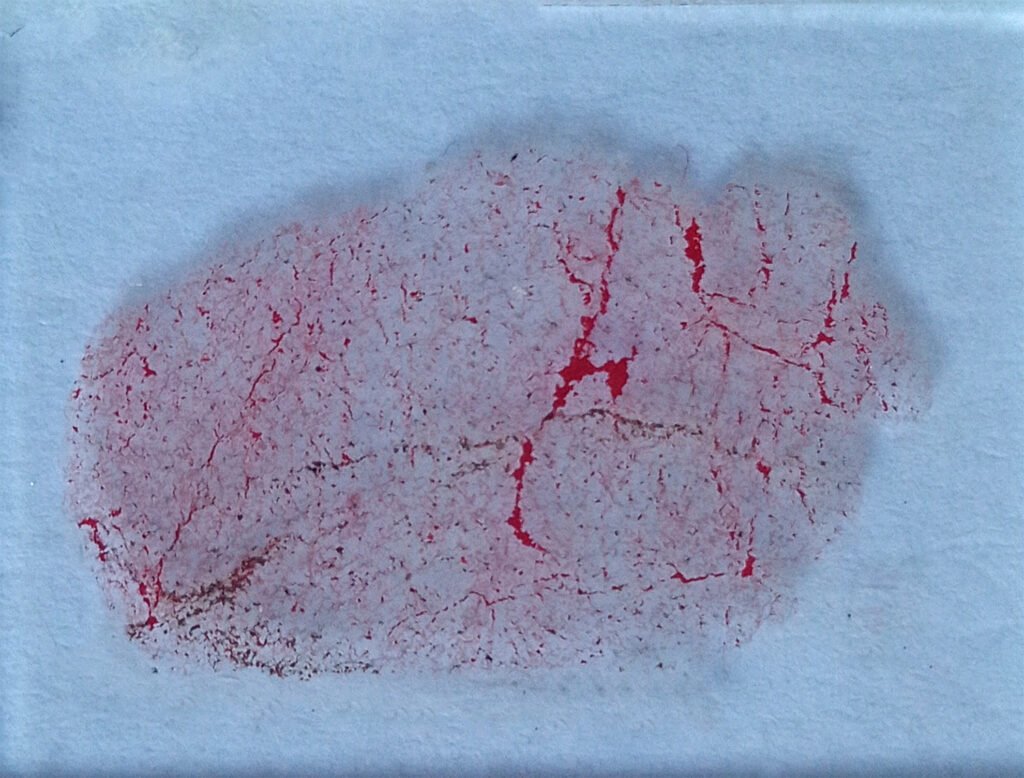
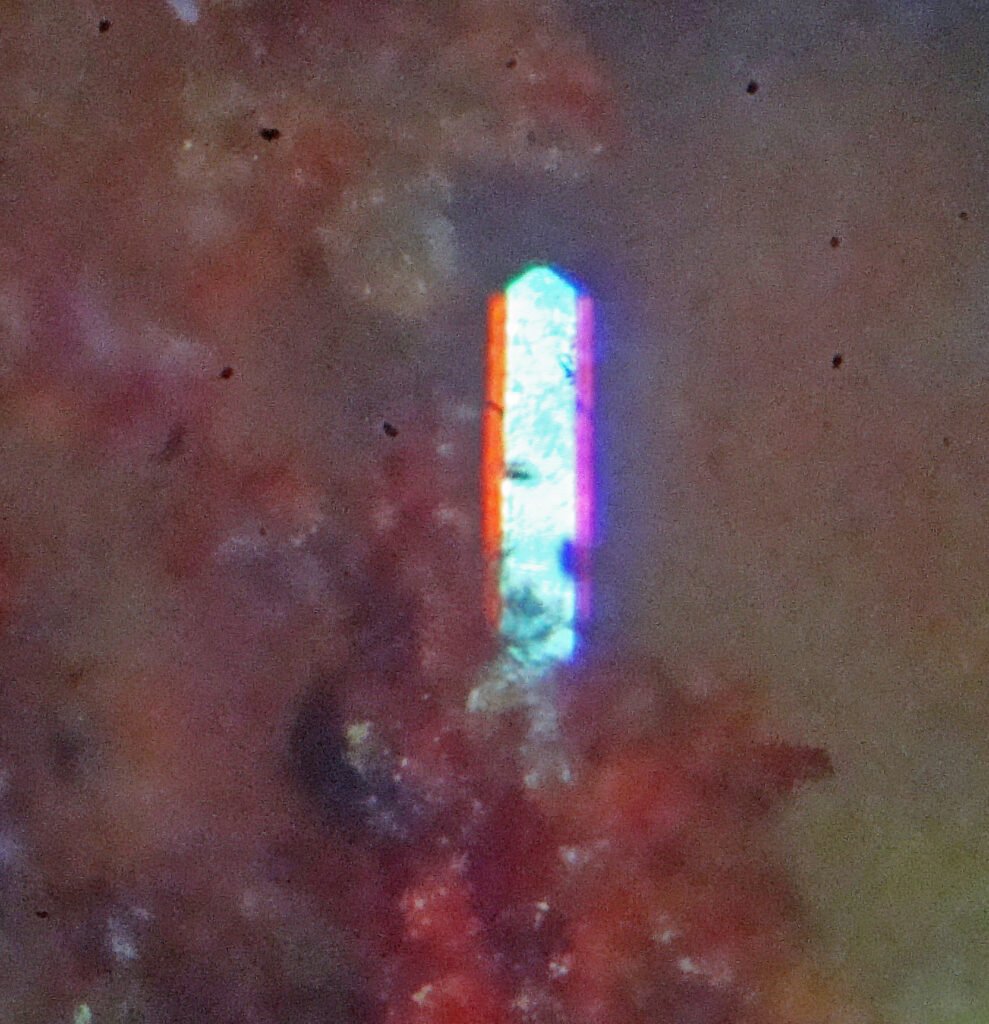
Cinnabar – HgS – is a relatively common sulfide and is the most common ore of mercury.
It is trimorph with metacinnabar and hypercinnabar. One variety is “hepatic cinnabar”, a mixture of cinnabar with bituminous and earthy matter that occurs in the mines of Idrija, Slovenia. When hepatic cinnabar appears in curved lamellar crystals, it is called “corallinerz”.
Chemically, cinnabar is normally very pure, but impurities incorporated during the sample preparation process can simulate anomalous levels of other elements. Cinnabar crystals containing traces of chlorine darken when exposed to sunlight.
Mercury is toxic, so cinnabar mining must be conducted with doubled safety measures. Although cinnabar is relatively insoluble and the toxicity of the pure material is low, always wash your hands after handling it. Do not inhale the dust when breaking the mineral. Never lick or ingest. Do not heat in poorly ventilated environments as cinnabar releases toxic mercury vapors. Cinnabar samples may contain microdroplets of native mercury, which is easily absorbed by the skin, so wear disposable gloves when handling them.
Crystal system: Trigonal trapezohedral.
Color: Intense shades of several different reds, red-brown, lead gray.
Habit: Granular, massive, lamellar, short to long prismatic, incrustations, tabular or rhombohedral crystals up to 10 cm.
Cleavage: {10-10} perfect.
Tenacity: Brittle, a bit sectile.
Twinning: Common, contact twins, on (0001).
Fracture: Subconchoidal , irregular.
Mohs Hardness: 2 – 2.5
Parting: No.
Streak: Intense red to reddish-brown.
Lustre: Intense adamantine, metallic or dull.
Diaphaneity: Transparent.
Density (g/cm³): 8.0 – 8.2
Cinnabar is a low temperature hydrothermal mineral (~100ºC), deposited by ascending epithermal aqueous solutions or even alkaline hot springs. Generally, the occurrences of cinnabar are located in orogenic areas that are active or have been active in recent geological time.
Depositions can occur in sedimentary, igneous or metamorphic rocks. At the temperature limits of cinnabar formation, the depositions of igneous and volcanic solutions overlap and there is no way to draw a precise boundary between them. As these cinnabar depositions occur far from metal-bearing magmas, it is often impossible to determine the source of the mercury.
Cinnabar occur associated with silica (quartz, opal, chalcedony), carbonates (calcite, dolomite, siderite), barite, native mercury, native gold, native silver, cassiterite and orpiment.
Also with many sulfides such as pyrite, marcasite, arsenopyrite, chalcopyrite, bornite, chalcocite, covellite, enargite, galena, realgar, famatinite, sphalerite, stibnite, metacinnabar, berthierite and chalcostibite.
Refraction indices: nω: 2,905 nε: 3, 256
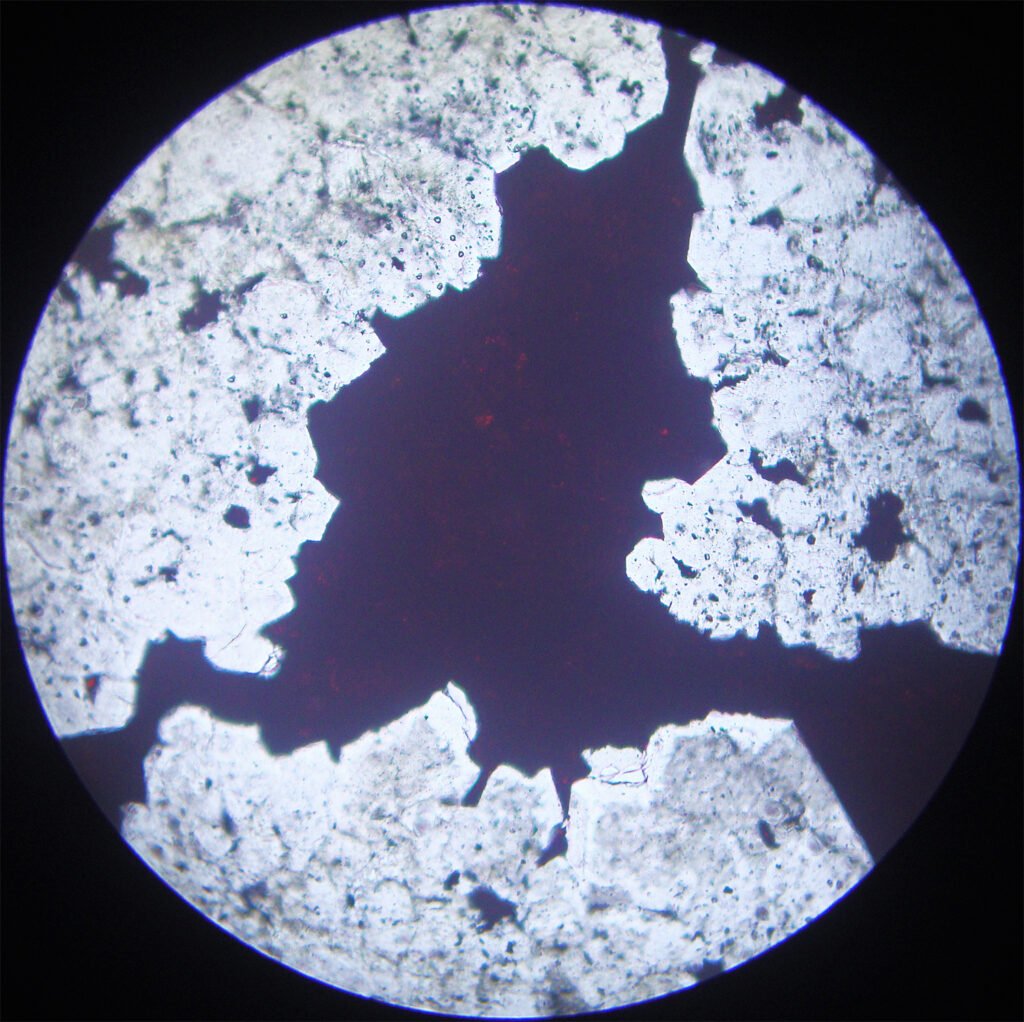
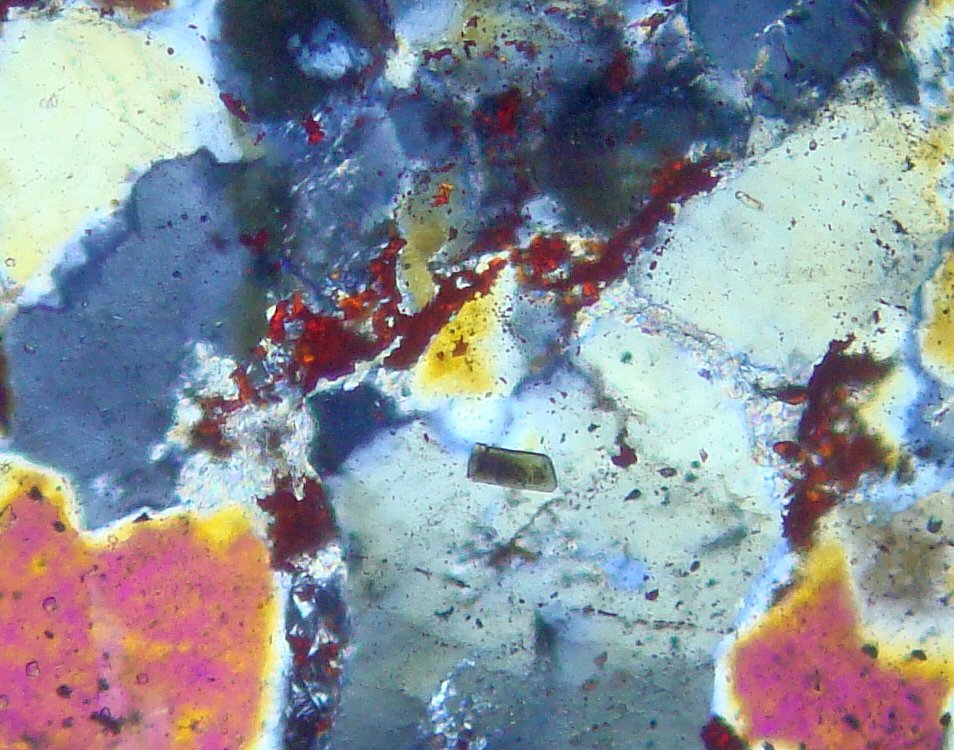
PLANE POLARIZED LIGHT – PPL
Color / Pleochroism:Red, very strong color.
Relief: Very high.
Cleavage: {10-10} perfect.
Habits: Granular, massive, lamellar, short to long prismatic, incrustations, tabular or rhombohedral crystals.
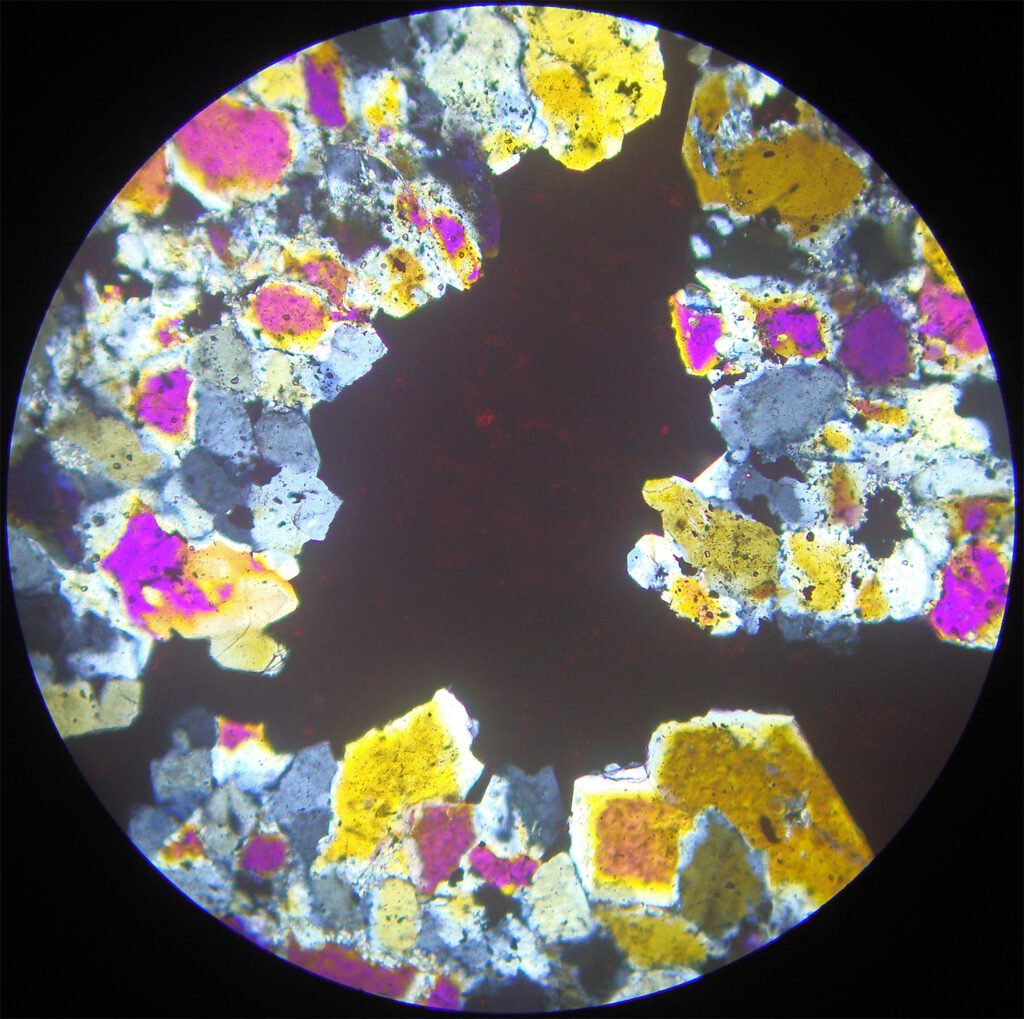
CROSSED POLARIZED LIGHT – XPL
Birefringence and Interference Colors: birefringence of 0.351: high-order colors, reminiscent of those of carbonates, but the own intense red color of cinnabar masks these colors.
Extinction: No information available.
Elongation sign: No information available.
Twins: Contact twins, common.
Zoning: No information available.
CONVERGENT LIGHT
Character: U(+)
2V angle: No.
Alterations: cinnabar alters to metacinnabar and livingstonite.
May be confused with: other red and more or less transparent minerals.
Cuprite has a deeper red color and is usually associated with native copper and other Cu minerals.
Realgar is much more yellowish than cinnabar.
Piemontite has different paragenesis and habits.
Goethite shows different habits, similar to chalcedony.
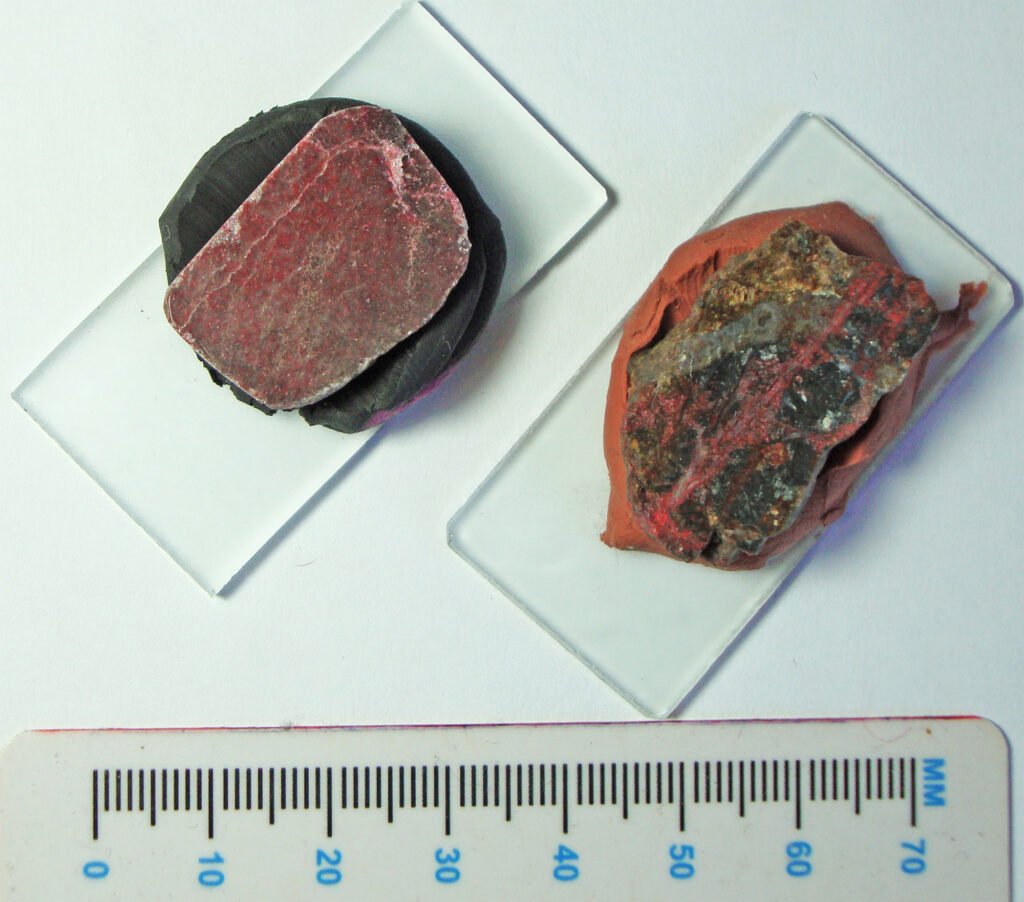
Sample preparation: Due to its low hardness, it is difficult to get a good polish on cinnabar and the section will always have many polishing scratches. Polishing hardness is higher than that of native antimony, native arsenic and realgar. It has approximately the same hardness as stibnite, but less than the hardness of galena and much less than the hardness of cuprite.
The quality of the polished section is highly dependent on neighboring minerals. When cinnabar contains a “dust” of pyrite grains, making a good polished section is very difficult. When accompanied by calcite or stibnite, it is possible to obtain excellent sections. The polish on sections (10-10) is better than that on (0001): the sections (0001) still look porous when the sections (10-10) are already excellently polished.
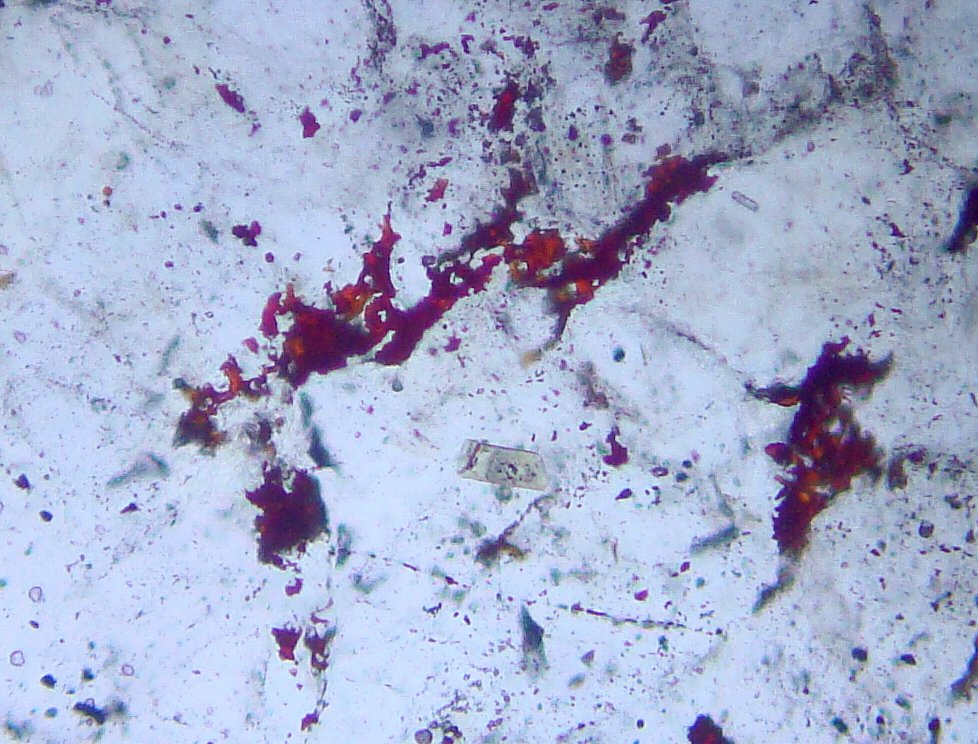
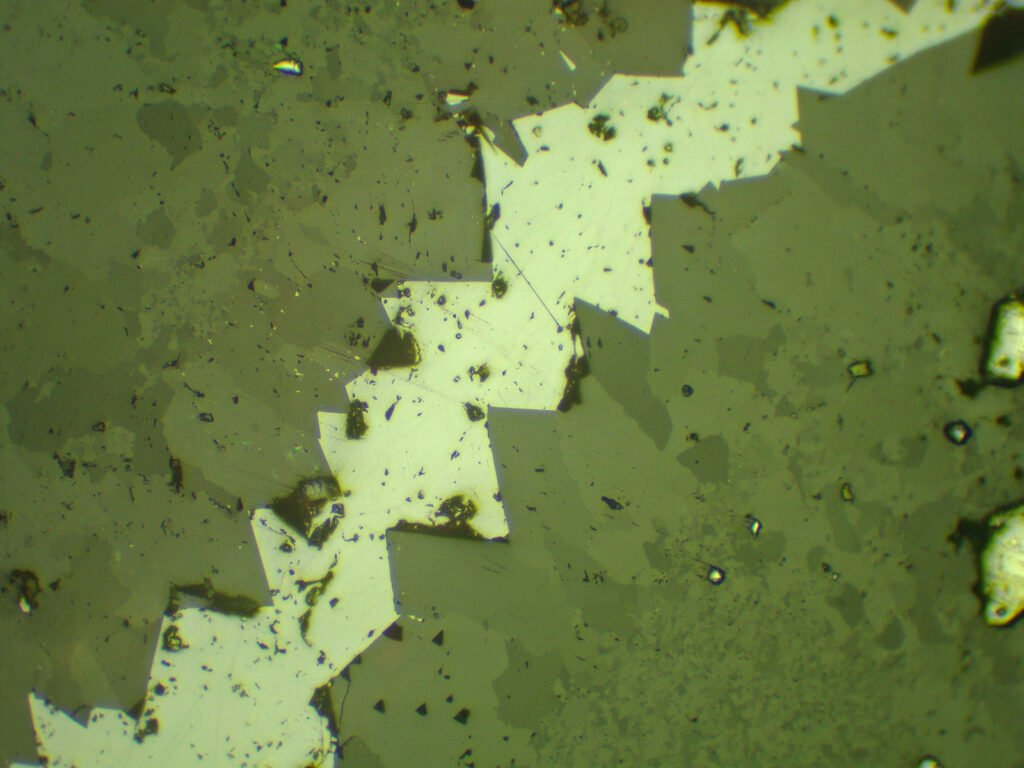
PLANE POLARIZED LIGHT – PPL
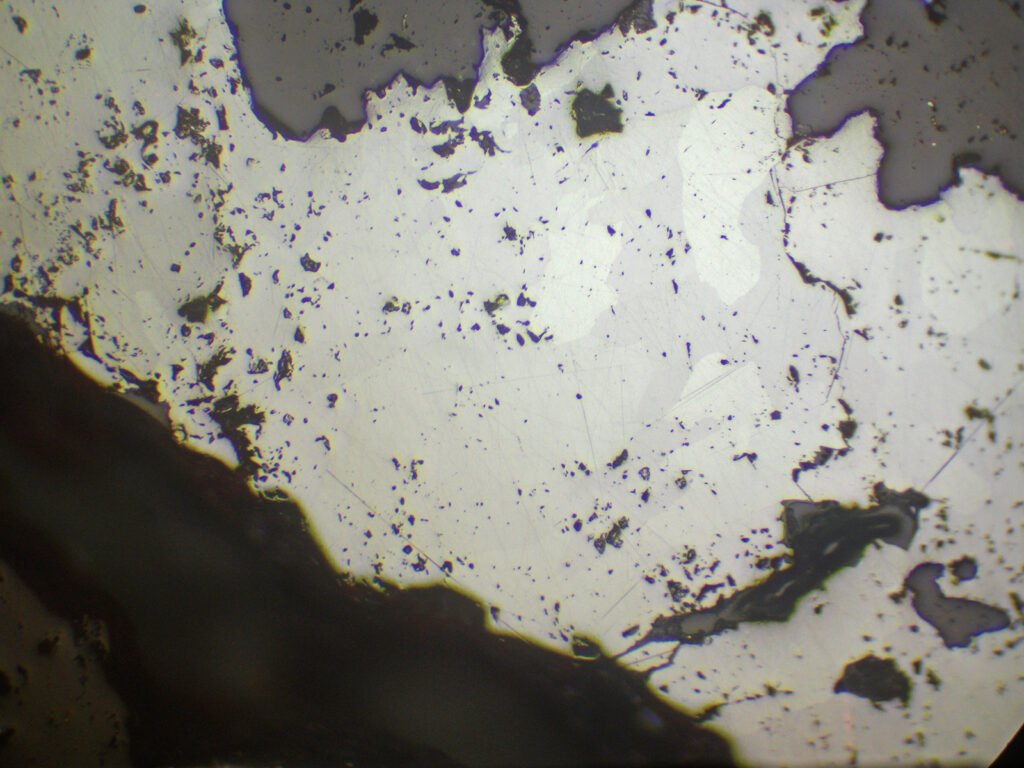
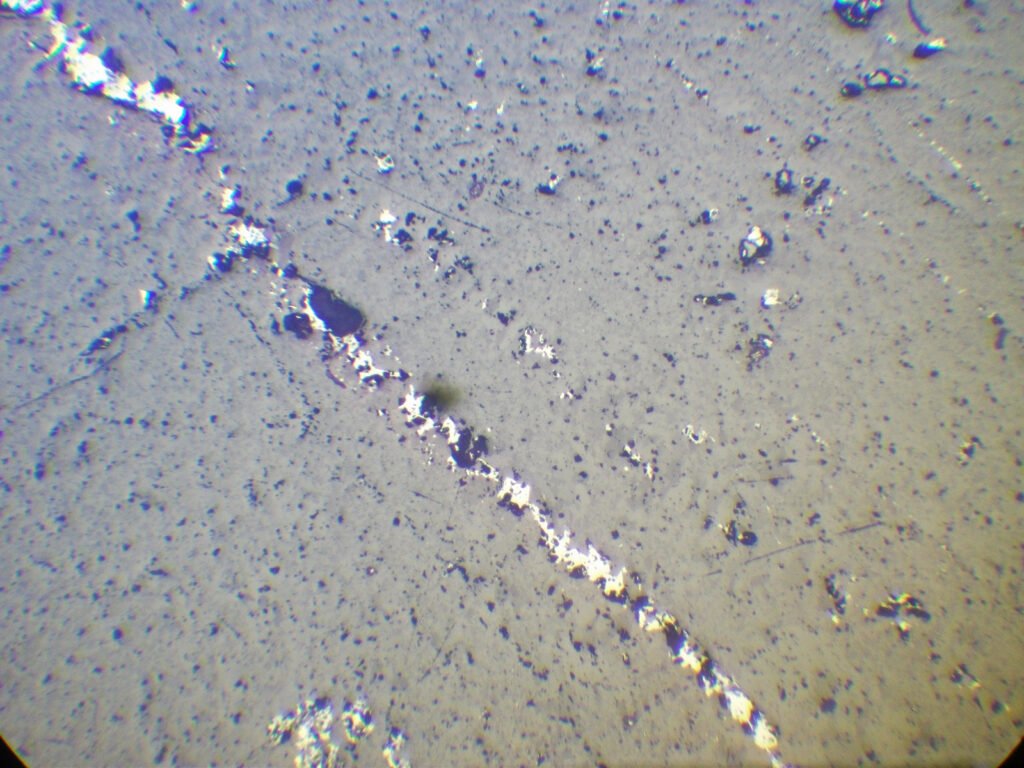
Reflection color: White to bluish-white (may be slightly greenish), but blue hues are only noticeable in the presence of neighboring white minerals.
Compared to the color of galena, the color of cinnabar is bluish and darker.
Pleochroism: Distinct to faint, visible in contact between adjacent grains of different orientation.
In one orientation, there is a slight shade of pink, in the opposite orientation there is a slight shade of yellow.
Reflectivity: 27,61 – 28,41%
Bireflectance: No.
CROSSED POLARIZED LIGHT – XPL
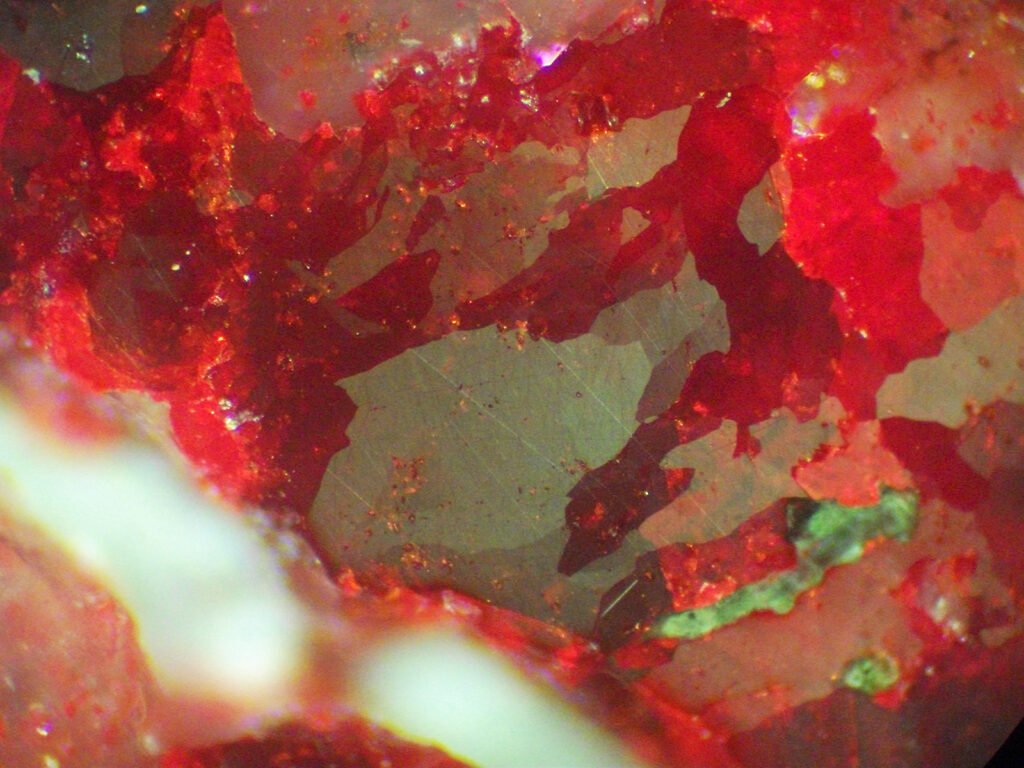
Isotropy / Anisotropy: Very strong anisotropy, ranging from light gray-green to gray-blue and green tones.
Anisotropy is masked by extremely intense internal reflections.
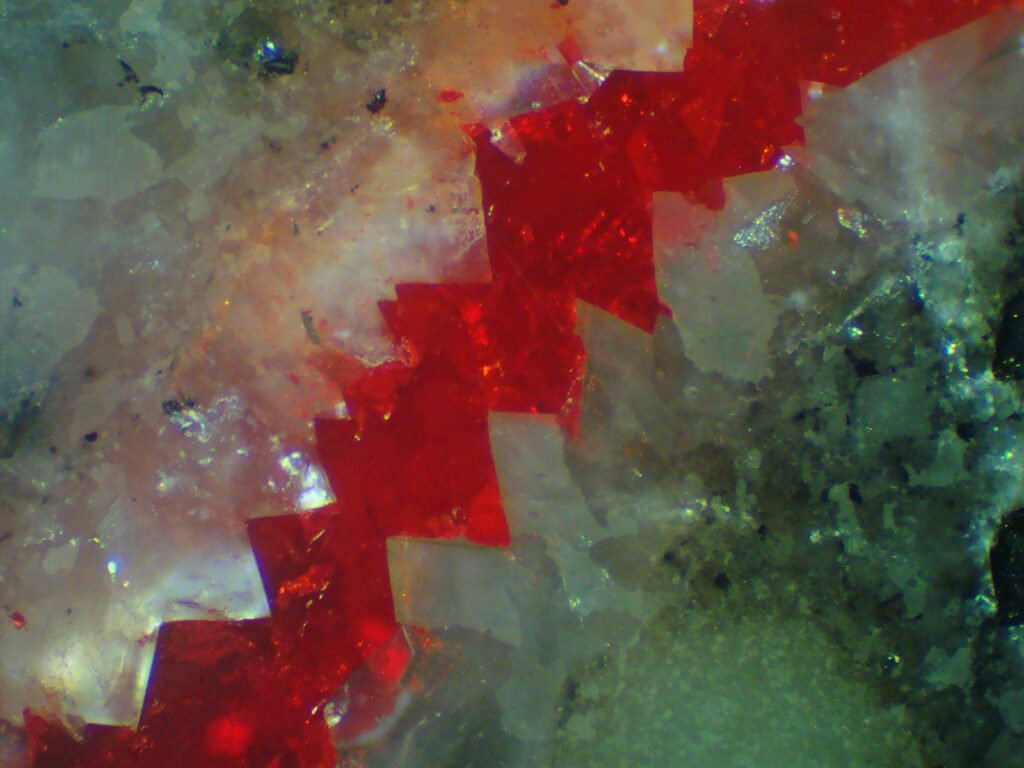
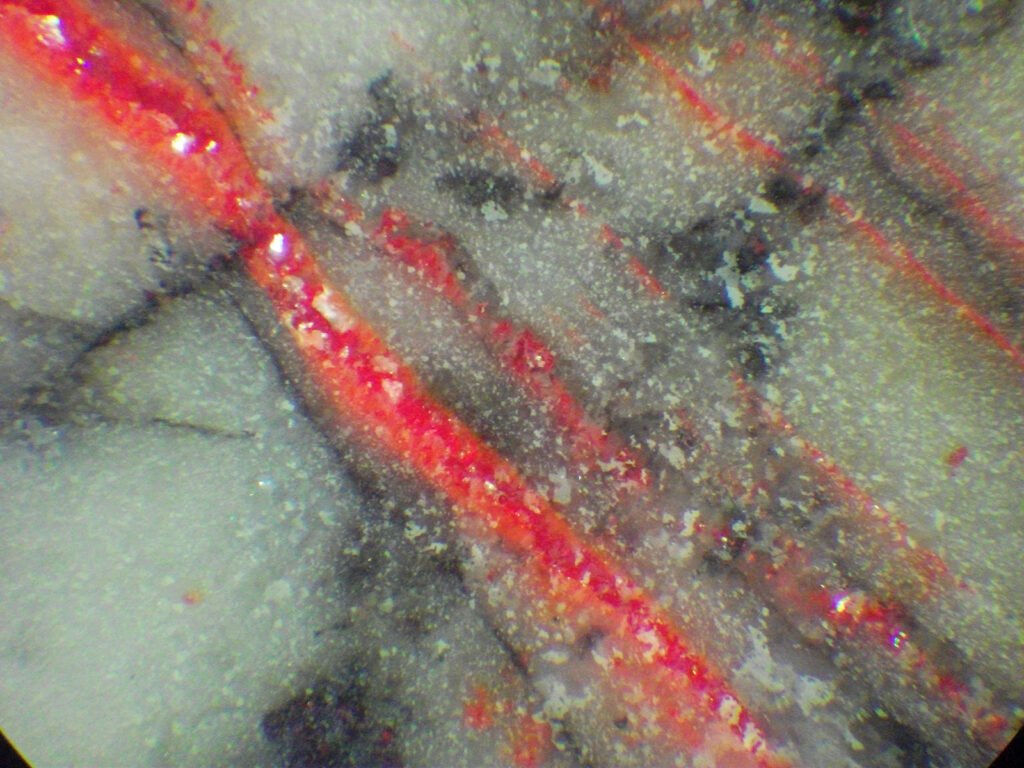
Internal reflections: Extremely intense in various shades of red. Internal reflections are especially well developed in the basal sections. Due to the high double refraction the internal reflections are always doubled, but this fact is easy to miss by an untrained observer.
May be confused with: few other minerals, because the low hardness and intense red reflections are very typical.
Proustite is greenish in PPL.
Pyrargirite is bluer and has polysynthetic twins.
Cuprite is much harder, more bluish and always contains native copper inclusions.
Hematite may look very similar macroscopically, but it has another reflection color, another habit, and is much harder.
Some very rare sulfoarsenides can also be confused with cinnabar.
General Characteristics:
Grain shape: Cinnabar tends to form idiomorphic crystals, usually very small (<0.5mm). The crystals can be rounded, of very different sizes, with little intergrowth between them. Or else they form complicated intergrowths. In limestones, as impregnation, often euhedral in rhombohedrons. They may form granular aggregates, may be coarsely radial or in rhythmic crusts. It can form surface films and occurr as a fracture filler of fractured blocks of the gangue minerals.
Polishing scratches are frequent due to the low hardness and polishing difficulties.
Cleavage paralell to (10-10) is visible only sometimes.
Twins are common macroscopically, but microscopically they are not recognizable. Some literatures reports that simple and polysynthetic twins may be present.
Zonation has not yet been found due to the lack of a substance for chemical attack.
Inclusions: extremely fine inclusions (“dust”) of pyrite may occurr scattered throughout the mineral.
Pseudomorphoses of cinnabar on (unstable) metacinnabar can occur, following the polysynthetic twins of metacinnabar. Pseudomorphoses also occur on stibnite.
Substitutions 1: Cinnabar can replace stibnite, pyrite, chalcopyrite, tennantite-tetrahedrite, quartz and metacinnabar.
Substitutions 2: cinnabar can be replaced by chalcopyrite and marcasite.