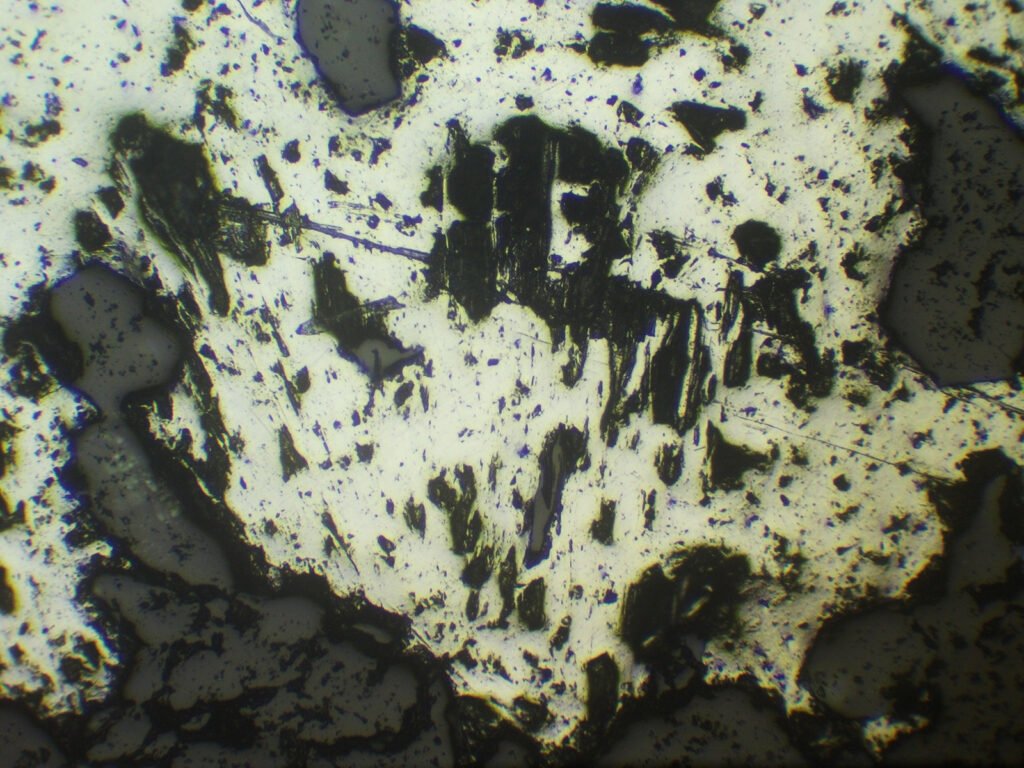
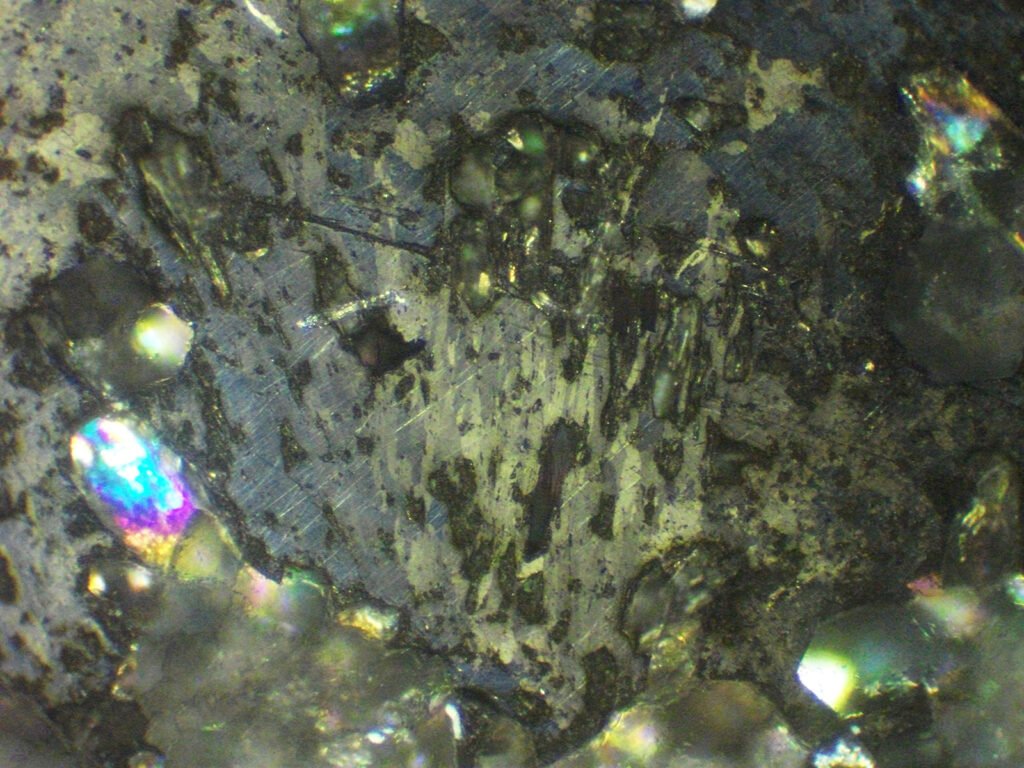
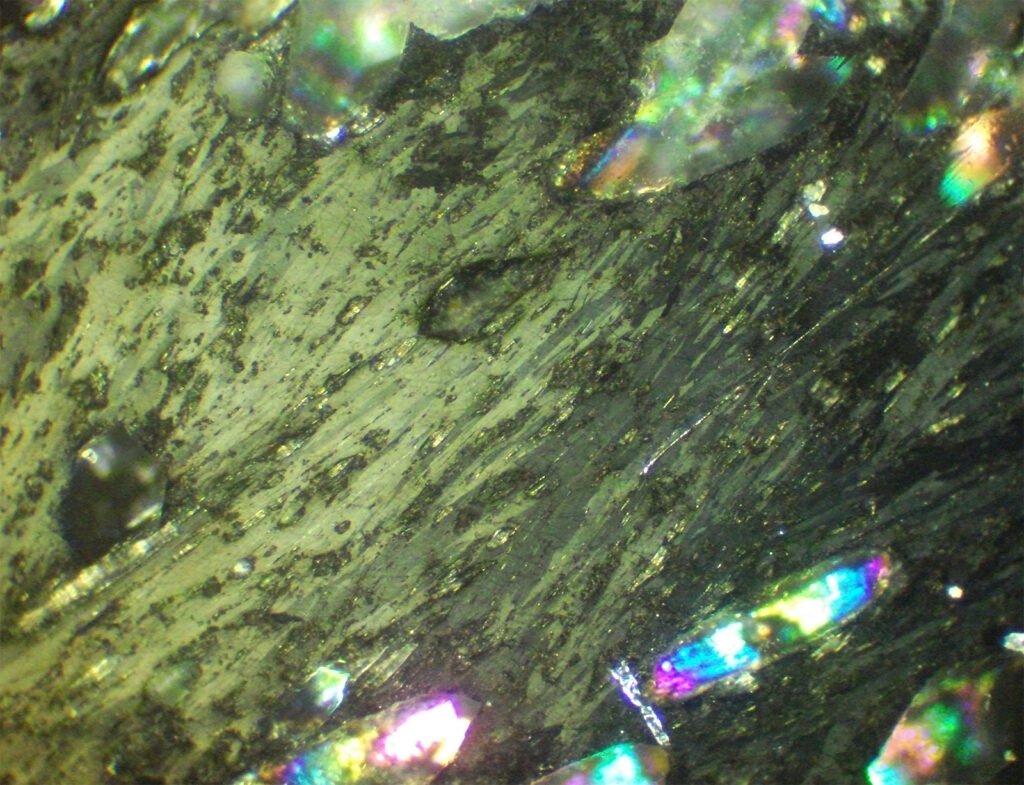
5. Reflected Light Microscopy
Sample preparation: Boulangerite acquires an even better polish than galena. Its polishing hardness is equal to or slightly less than those of galena and bournonite.
PLANE POLARIZED LIGHT – PPL
Reflection color: Medium gray, sometimes with a bluish and greenish tint.
Compared with the color of falkmanite, the color of boulangerite is a little darker.
Pleochroism: Weak but noticeable, between gray-green and gray-white.
Reflectivity: 37.26 – 39.76%
Bireflectance: Weak.
CROSSED POLARIZED LIGHT – XPL
Isotropy / Anisotropy: Distinct anisotropy between slate blue (bluish gray) and white-brown, can be light bronze, greenish hues.
In the basal sections, pale pinkish-brown.
Internal reflections: It does not show internal reflections, but may occasionally show associated red reflections, for example at the edges of clusters.
May be confused with: boulangerite is easily confused with jamesonite and falkmanite.
Jamesonite shows much stronger pleochroism and generally shows a basal cleavage parallel to the elongation.
Falkmanite has weaker anisotropy and is usually bluish or yellow-brown near the darkest position. In addition, it rarely presents twins and is difficult to observe.
Bournonite forms rounded grains, has weaker pleochroism, generally shows twin lamellae and lower reflectivity and anisotropy.
Stibnite is very similar but more strongly anisotropic and shows typical polishing imperfections and twins in a characteristic zigzag pattern.
Galena is isotropic and rarely has an acicular/fibrous habit.
Geocronite shows different color and weaker anisotropy.
General Characteristics:
Grain shape is acicular to fibrous with orthorhombic basal sections. They are chaotic aggregates of very fine, long, straight needles. Sometimes the needles may be arranged in radial clusters, more like a fan. Needles oriented in subparallel groups may also occur. Terminations are very rare.
Cleavage is only sometimes visible, in this case arranged parallel to the elongation of the needles.
Extinction is parallel, as expected for an orthorhombic mineral.
Twins do not occur. The “twinned boulangerites” cited in ancient literature were jamesonite.
Zonation does not occur.
Substitutions 1: boulangerite can be replaced by bournonite, chalcopyrite, galena, tetrahedrite, pyrargyrite and many other Sb minerals. If boulangerite is replaced by chalcopyrite, a bournonite reaction edge forms. Replacement with galena can generate intergrowths that resemble graphic textures.
Substitutions 2: boulangerite replaces stannite, pyrite, sphalerite, cassiterite and stibnite.
Oriented intergrowths can occur with falkmanite, stibnite, meneghinite and jamesonite.
Weathering forms finely pulverized galena within the boulangerite aggregates.