
ARAGONITE
Aragonite – CaCO3 – is a fairly common carbonate, but much rarer than calcite, the most common polymorph of Ca carbonate; the third is vaterite (very rare). It does not constitute ore, but aesthetic pieces fetch a competitive price in the collector minerals market.
It is the main member of the Aragonite Group. May contain Pb, Zn and Sr. There are at least nine varieties, defined by levels of certain elements (e.g. Sr) or by specific habits (e.g. “flos ferri”, occuring in caves).
Aragonite can exhibit fluorescence, phosphorescence, and cathodoluminescence. Under longwave ultraviolet light it fluoresces in pale pink, yellow, white or bluish, with greenish or white phosphorescence. Under shortwave UV light it shows yellowish, red or white fluorescence, also with white phosphorescence. These properties can be very useful for determining, in a hand specimen, whether a given rock contains aragonite in its composition.
1. Characteristics
Crystal system: Orthorhombic bipiramidal.
Color: Colorless to white. Impurities make it blue, green, red or violet.
Habit: Long to short prismatic, acicular, tabular, stalagtitic, columnar, radial, fibrous crusts.
Cleavage: {010} distinct, {110} very poor, {011} very poor.
Tenacity: Brittle.
Twinning: Twins are generalized, with cyclic twins at {110}, generating pseudo-hexagonal aggregates of contact and penetration twins. Polysynthetic twins generate thin lamellae or striations parallel to [100].
Fracture: Sub-conchoidal.
Mohs Hardness: 3.5 – 4
Parting: No.
Streak: Colorless/white.
Lustre: Vitreous, resinous.
Diaphaneity: Transparent.
Density (g/cm³): 2.947
2. Geology and Deposits
Aragonite almost always forms at low temperatures and close to the surface, crystallizing under a very narrow range of physicochemical conditions. It is a common product of biological processes: shells, corals and pearls are made of aragonite. It is metastable to calcite and converts to calcite on a time scale of up to 100 million years. There is no aragonite from past geological times.
In caves it can be found as speleothems. In geysers it forms sinters, pisoliths and massive lamellar deposits. Occurs as oolites on the seafloor. In Fe deposits, it occurs associated with siderite. In serpentinites, dunites and altered peridotites it occurs with calcite, dolomite and other magnesium minerals. In various types of ore deposits and in several different rocks, it occurs as a replacement mineral. In basalts and andesites, in fractures and vesicles, it can occur. It occurs in some metamorphic rocks of the blueschist facies.
In sediments, it forms, among others, aragonitic gravels, sands and muds. Among carbonate sedimentary rocks, aragonite is an essential component of at least 20 different types of rocks.
3. Mineral Associations
It occurs evidently associated with other carbonates such as calcite, dolomite, siderite, magnesite, ankerite, cerussite, hydromagnesite, malachite, azurite, smithsonite and kutnohorite,
Associates to other alteration minerals or minerals formed near the surface such as brucite, goethite, clay minerals, native sulfur and sulfates (celestine, gypsum).
Also with native copper, zeolites, pyrite, barite and fluorite. In blue schists, with pumpellyite, lawsonite, glaucophane and quartz. In altered ultramafic rocks, with magnesite, hydromagnesite and brucite.
4. Transmitted Light Microscopy
Refraction indices: nα: 1.529 – 1.530 nβ: 1.680 – 1.682 nγ: 1.685 – 1.686
PLANE POLARIZED LIGHT – PPL
Color / Pleochroism: Colorless. Never shows pleochroism.
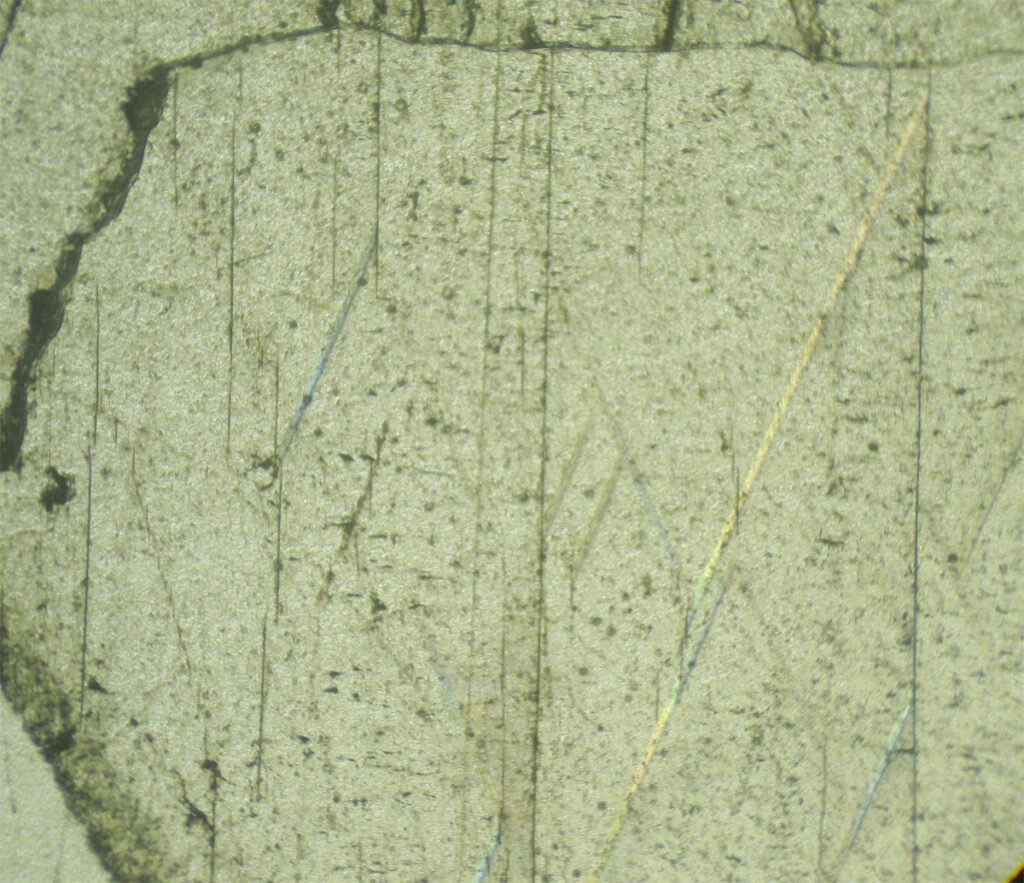
Relief: The relief varies between low and moderate to high every 90º of the rotation of the stage in crystals with well defined cleavage. This phenomenon has been dubbed “relief pleochroism” (or “chagrin change”) and is typical of carbonates (calcite, dolomite, aragonite, siderite, rhodochrosite and magnesite).
When microcrystalline, these carbonates do not show “relief pleochroism”.
Cleavage: {010} distinct, {110} bad and {011} bad. Usually only one cleavage is visible in thin section.
Habits: Short or long prismatic, acicular, tabular, stalagtitic, columnar, radiated aggregates, fibrous crusts of fine acicular crystals, coralloid, reniform, pisolitic, globular. Twins are common (see below).
CROSSED POLARIZED LIGHT – XPL
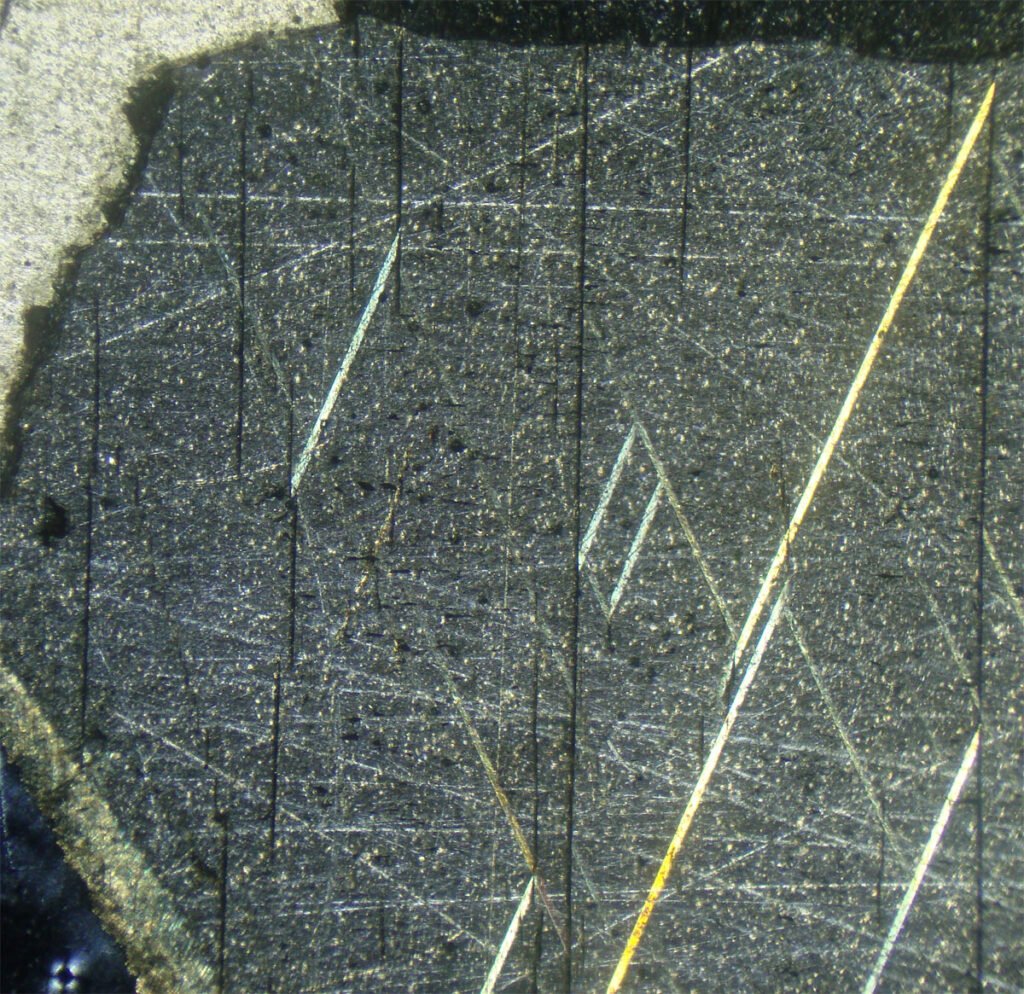
Birefringence and Interference Colors: Maximum birefringence of 0.156, very high, like all carbonates, resulting in pearly colors of up to 8th order.
Extinction: Parallel in longitudinal sections and symmetrical in basal sections.
Elongation sign: Difficult to determine due to extreme birefringence.
Twins: Cyclic twins on {110}, resulting in typical pseudo-hexagonal aggregates.
Polysynthetic twins generate thin lamellae or striations parallel to {100}.
Zoning: No information available.
CONVERGENT LIGHT
Character: B(-)
2V angle: 18 – 19º
Alterations: recrystallizes to calcite; pseudomorphs are possible.
May be confused with: calcite, but calcite has two cleavages that intersect at 120 and 60° and is U(-).
5. Reflected Light Microscopy
Reflected light microscopy is not the recommended analytical method for the identification of aragonite. However, it is important to make a polished thin section or a polished section to identify the opaque minerals that occur associated with aragonite.
Sample preparation:
PLANE POLARIZED LIGHT – PPL
Reflection color:
Pleochroism:
Reflectivity:
Bireflectance:
CROSSED POLARIZED LIGHT – XPL
Isotropy / Anisotropy:
Internal reflections:
May be confused with:
General Characteristics: