1. Characteristics
Crystal system: Monoclinic prismatic.
Color: Dark green, black, green, pale greenish yellow, greenish gray, reddish brown.
Habit: Short to long prismatic, acicular, fibrous, rarely granular. Crystals up to 20 cm.
Cleavage: {110} good, typical of pyroxenes.
Tenacity: Brittle
Twinning: Common, on {100}
Fracture: Splintery.
Mohs Hardness: 6
Parting: On {100}.
Streak: Gray.
Lustre: Vitreous.
Diaphaneity: Transparent.
Density (g/cm³): 3.4 – 3.6
2. Geology and Deposits
Aegirine-augite is characteristic of rocks of igneous complexes of peralkaline character (Na2O + K2O > Al2O3). In plutonic rocks, it occurs in peralkaline granites with K-feldspar, quartz-syenites, pegmatitic syenites, nepheline-syenites, nephelinoliths (ijolites, lujavrites) and pyroxenites, as well as in the associated pegmatites, dykes, sills and hydrothermal veins. In addition, occurs in the contact aureloes of these rocks.
In ultra-alkaline volcanic or hypabissal rocks, it occurs in alkaline basalts, basanites, essexites, theralites, tephrites, malignites, ijolites, melteigites, tinguaites, trachytes, phonolites, pantellerites and analcimites.
Also in buchites and in Fe-rich, metamorphic and metasomatic rocks.
It can occur in carbonatites, granulites, glaucophane-schists and riebeckite-schists.
By phenitization, fibrous aegirine-augite is formed from biotite or green hornblende.
3. Mineral Associations
It occurs associated with some well-known minerals such as quartz, calcite, micas (phlogopite), feldspars (albite, sanidine, orthoclase, microcline), feldspathoids (nepheline, leucite, nosean, sodalite), titanite, brookite, zircon, sodic amphiboles ( richterite) and magnetite.
Occurs with minerals typical of alkaline rocks such as eudialyte, fluorapatite, analcime, garnets (andradite, melanite), amphiboles (arfvedsonite, riebeckite), astrophyllite, aenigmatite, catapleiite, pyrochlore, lavenite and lorenzite.
Also with troilite, rhodonite, opal (hyalite), volcanic glass (obsidian) and ilvaite.
4. Transmitted Light Microscopy
Refraction indices: nα: 1.700 – 1.760 nβ: 1.710 – 1.800 nγ: 1.730 – 1.813
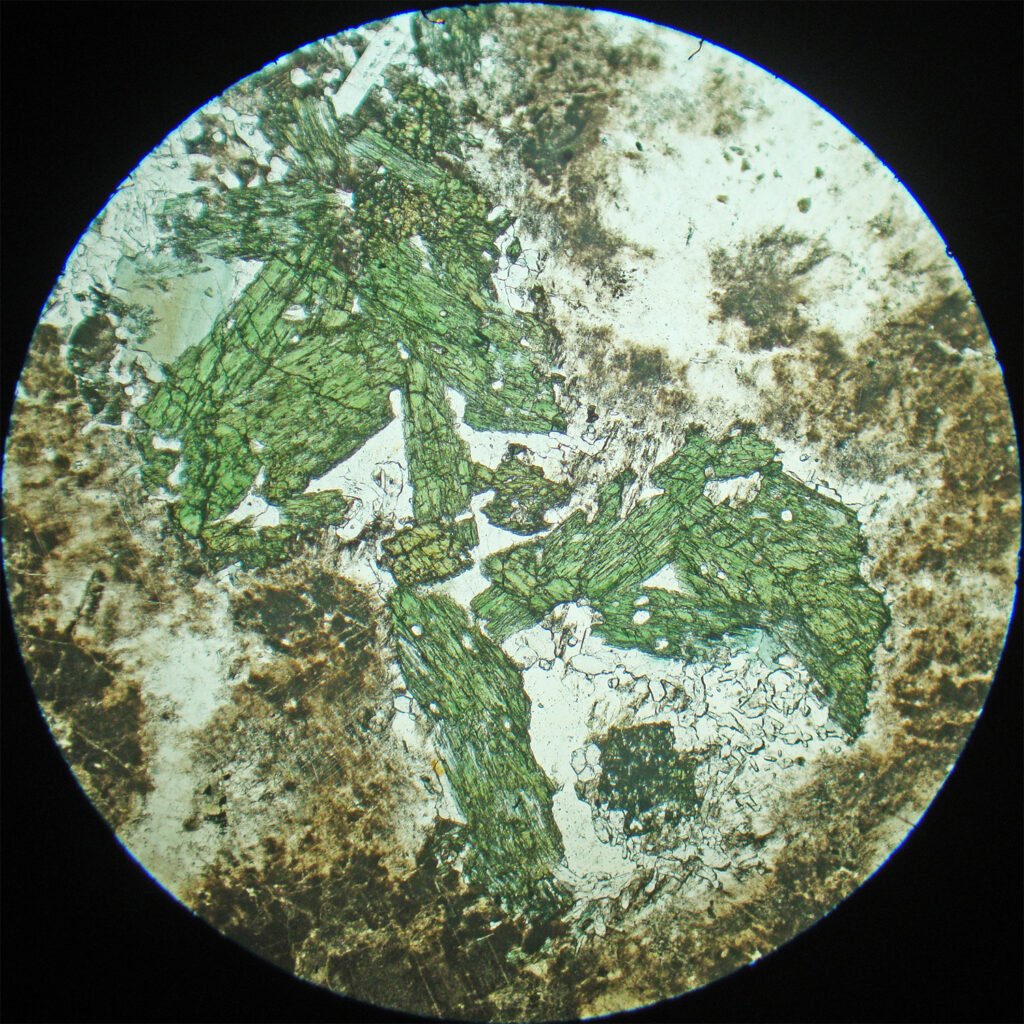
PLANE POLARIZED LIGHT – PPL
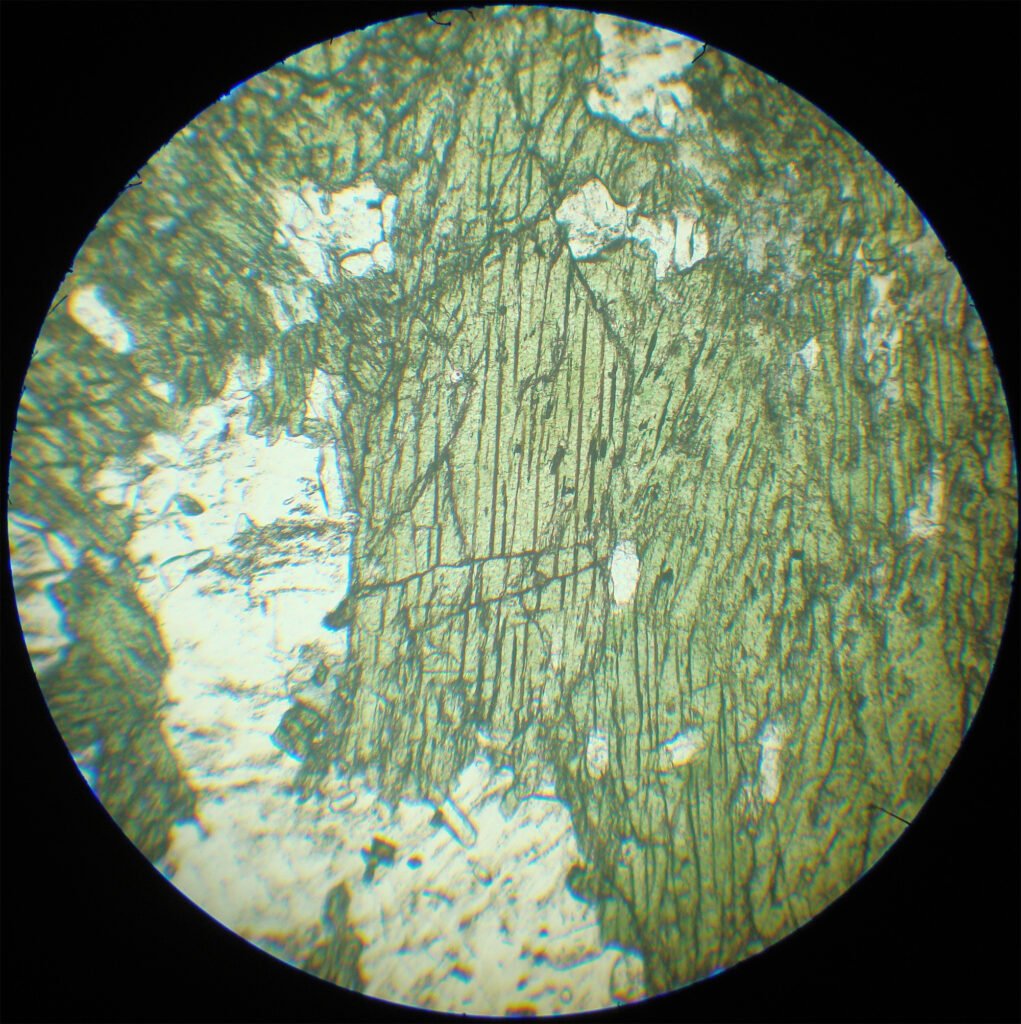
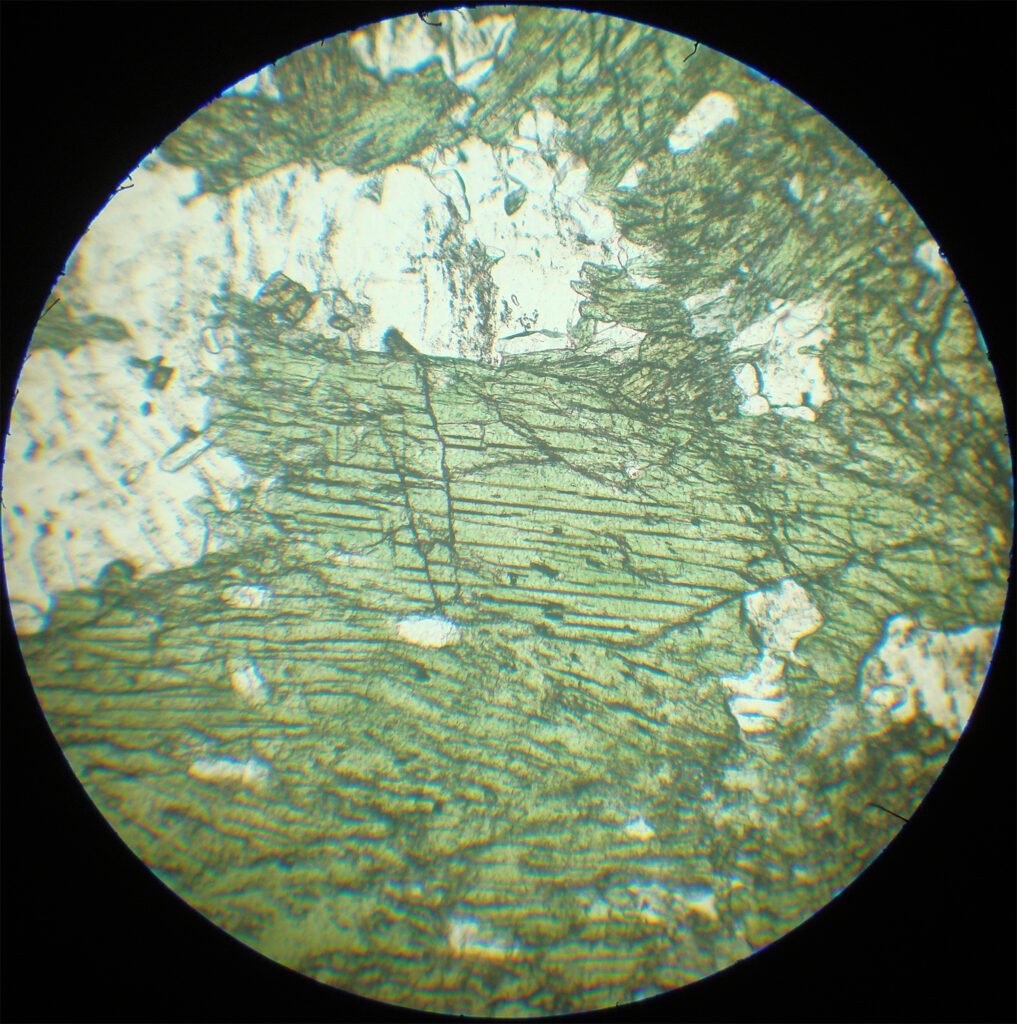
Color / Pleochroism: Greenish, brown, yellowish brown, pale green, yellowish green or dark green, with clear pleochroism:
X = green to olive green, can be emerald green.
Y = light green, grass green, yellow.
Z = green, yellowish green, brownish green, yellow.
When brown, weak pleochroism in brown and yellow tones.
Color zonation is common, with edges darker than the core!
Relief: High.
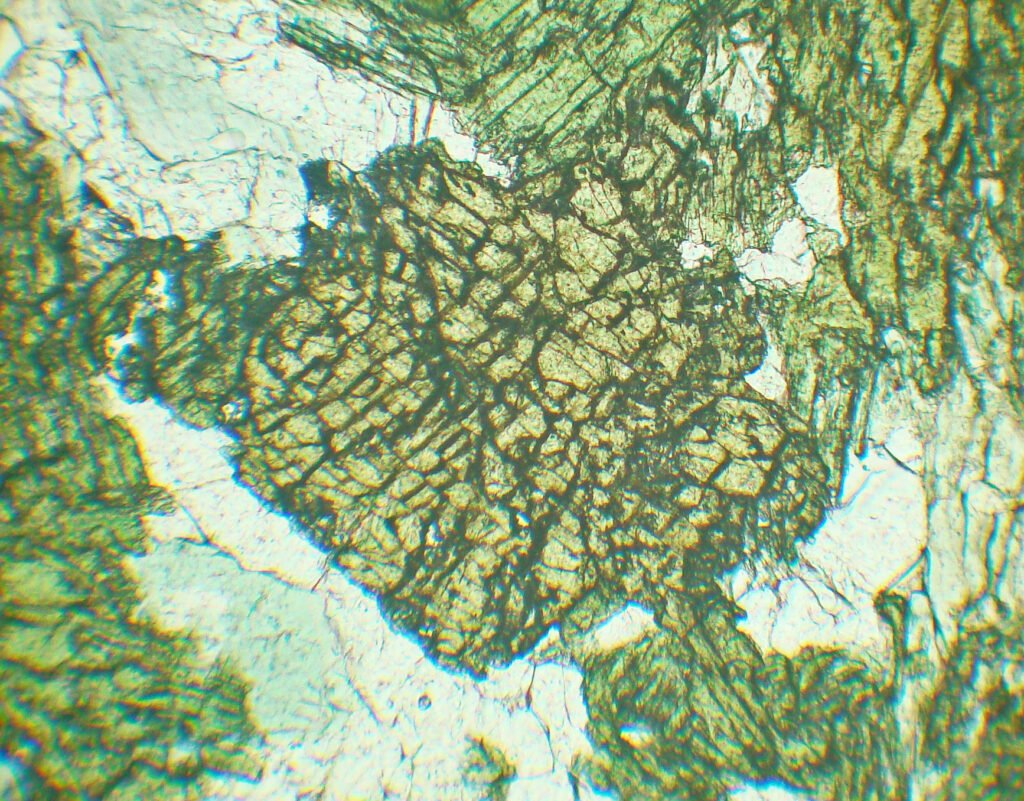
Cleavage: {110} very good, like all pyroxenes.
Habits: Long prismatic, fibrous, acicular, rarely granular. More rarely short prismatic. In volcanic rocks often idiomorphic.
In phonolites it occurs as dendritic to radial aggregates in the matrix.
Basal sections show typically with 8 sides, with the cleavages forming an angle of 87 and 93º to each other, characteristic of pyroxenes.
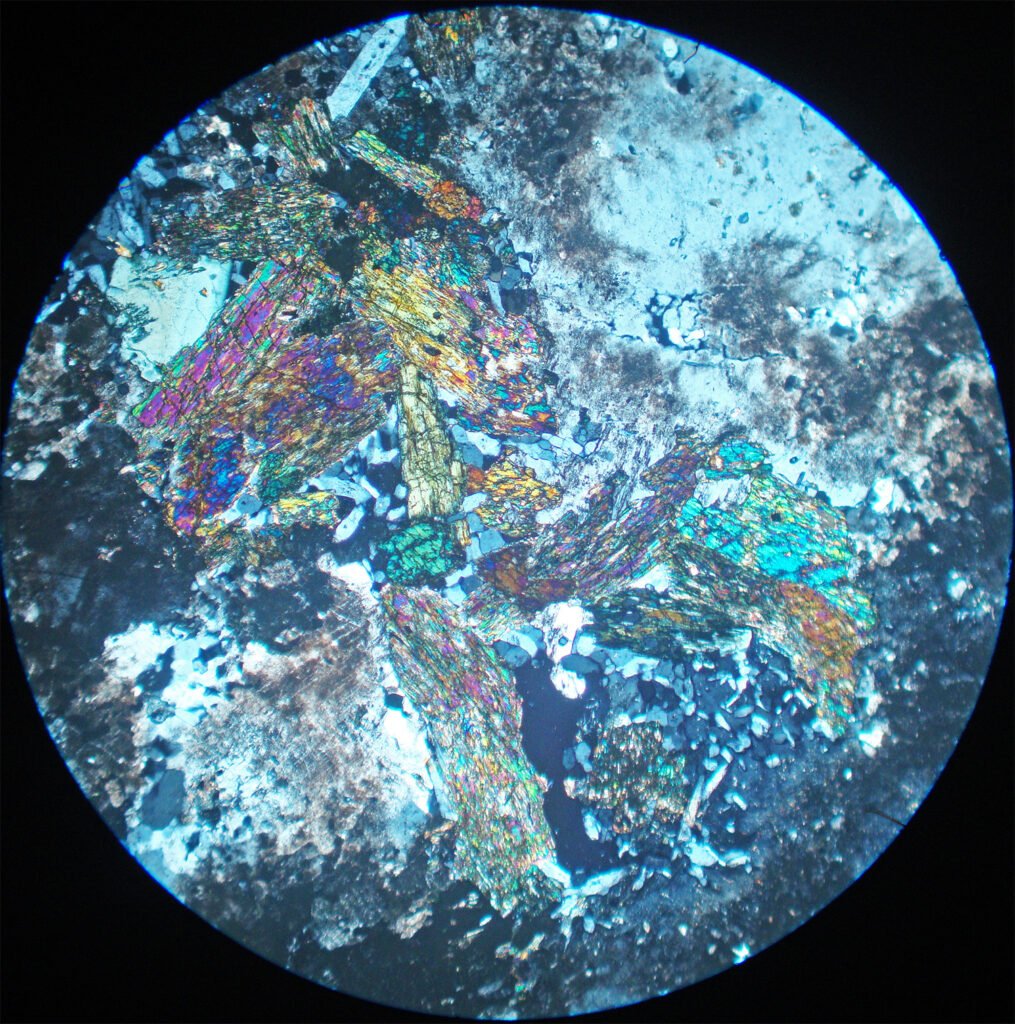
CROSSED POLARIZED LIGHT – XPL
Birefringence and Interference Colors:
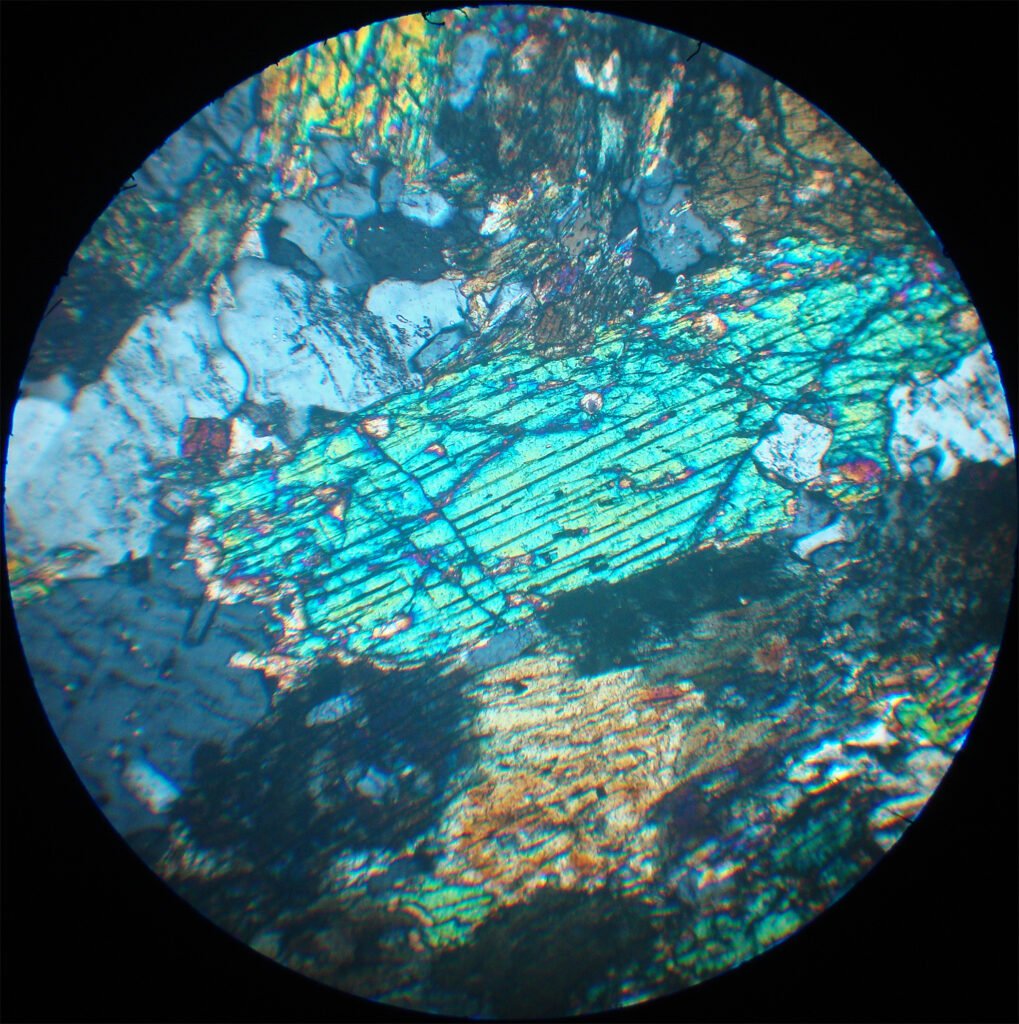
Maximum birefringence of 0.028 to 0.053, corresponding to strong, intense, colorful colors, until the end of the 2nd order to the beginning of the 3rd order. Colors increase with increasing Fe3+ content, but may be masked by the intense color of the mineral.
Anomalous interference colors at the extinction position are possible due to the zonal distribution of the aegirine component during growth, resulting in hourglass zonation.
Extinction: Oblique between 55 and 85º, usually around 80º.
Elongation sign: ES(-)
Twins: Common, simple and lamellar, by {100}.
Zoning: Very common, with a core richer in augite and a rim richer in aegirine. Diopside nucleus followed by augite and aegirine may occur.
Hourglass zoning is possible.
CONVERGENT LIGHT
Character: B(-) or B(+)
2V angle: 70 – 110o
Alterations: very resistant, but under hydrothermal conditions it can change to arfvedsonite and to ilvaite. By uralitization (very common!) it can alter to chlorite or very fine-grained amphiboles.
May be confused with: aegirine, which has a more yellowish pleochroism and much smaller extinction.
Augite exhibits weaker colors, lower birefringence, smaller extinction angles and 2V angles.
Diopside has lower interference colors and occurs in other paragenesis.
Omphacite has lower refractive indices, higher extinction angles and weaker pleochroism.
Green hornblende has different cleavage, lower birefringence, lower angle extinction and SE(+).
Arfvedsonite and riebeckite show positive elongation signal and amphibole cleavage.
Epidote has only one cleavage and much weaker pleochroism.
Pumpellyite occurs in other paragenesis.