5. Reflected Light Microscopy
Sample preparation: Alabandite acquires a good polish easily after careful grinding. Its hardness upon polishing is slightly less than that of sphalerite. In many cases, the polished surface becomes covered, after days or weeks, with a brownish-black film resembling mold, as occurs with recent fractures in macro samples. During polishing, the polishing cloth becomes covered with green dust.
PLANE POLARIZED LIGHT – PPL
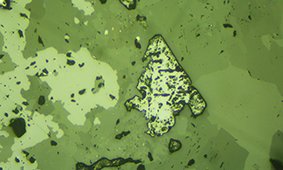
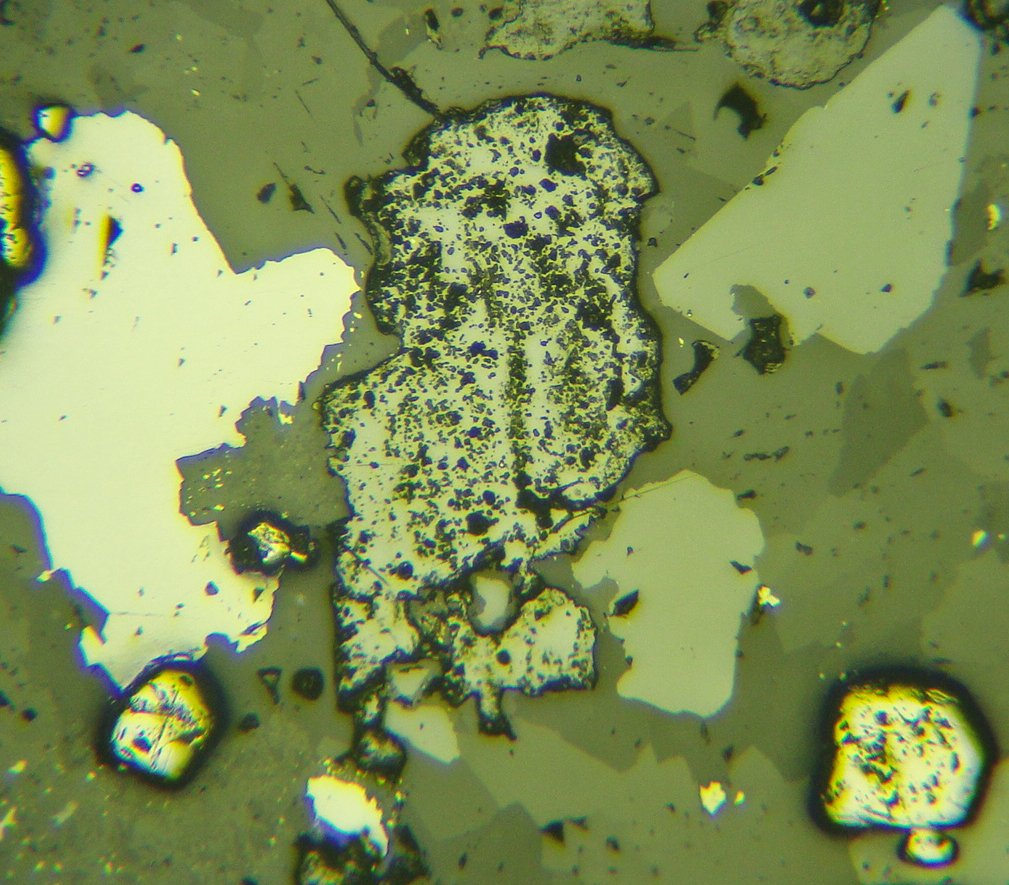
Reflection color: Grayish-white, may have a greenish tint.
Compared to the color of sphalerite, the color of alabandite is distinctly lighter.
Pleochroism: No.
Reflectivity: 21.91%.
Bireflectance: No.
CROSSED POLARIZED LIGHT – XPL
Isotropy / Anisotropy: Isotropic, completely dark.
Sometimes a very weak anomalous anisotropy can occur, in colors ranging from light gray to gray-black.
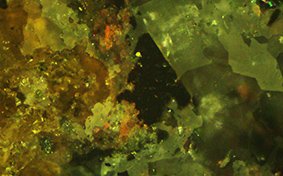
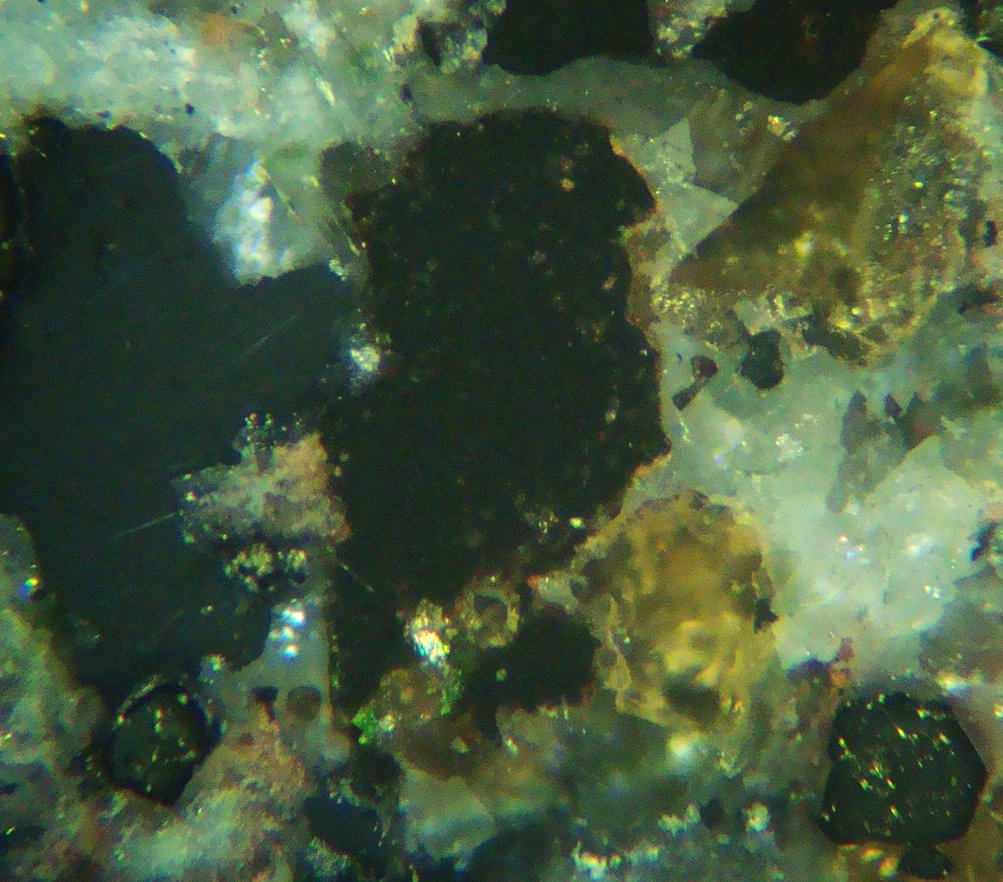
Internal reflections: With some attention, and after immersion in oil, internal reflections in deep green can be observed. If oxidized, internal reflections in brown to brownish hues will appear.
May be confused with: Very similar to sphalerite, which has lower reflectivity and internal reflections of different colors.
Some other similar ores are anisotropic and much harder. The deep green internal reflections are very diagnostic.
General Characteristics:
Grain shape: Alabandite generally has coarse, anhedral grains. In crusts, the grains are euhedral, subsequently covered by other minerals. The grains are slightly dentate.
Cleavage is only visible in low-quality polished sections.
Twins, vine lamellar, very similar to those of sphalerite, are often visible due to the relief generated by polishing.
Zoning occurs in some cases, when small grains exhibit idiomorphic pyrrhotite inclusions, arranged parallel to (111). Larger grains show these inclusions in a marginal zone. After chemical etching, zoning is usually observed.
Inclusions, very small (“dust”), of chalcopyrite and pyrite may occur. Pyrrhotite inclusions occur in the form of idiomorphic grains, arranged parallel to (111).
Substitutions are common. Pyrite and marcasite frequently penetrate fractures and cleavages, and may replace appreciable portions of the alabandite. Pyrolusite can, rarely, form in fractures.