ANGLESITE

Anglesite – PbSO4 -is an uncommon sulfate, but it is the most common secondary lead mineral along with cerussite. It contains 74% lead, but only constitutes ore when it occurs in larger volumes. It has sporadic uses as a gemstone.

It is classified in the Barite Group and forms a series with barite. It forms epitaxies with galena and barite, and there are three varieties (with Ba, with Cu, with Ag).

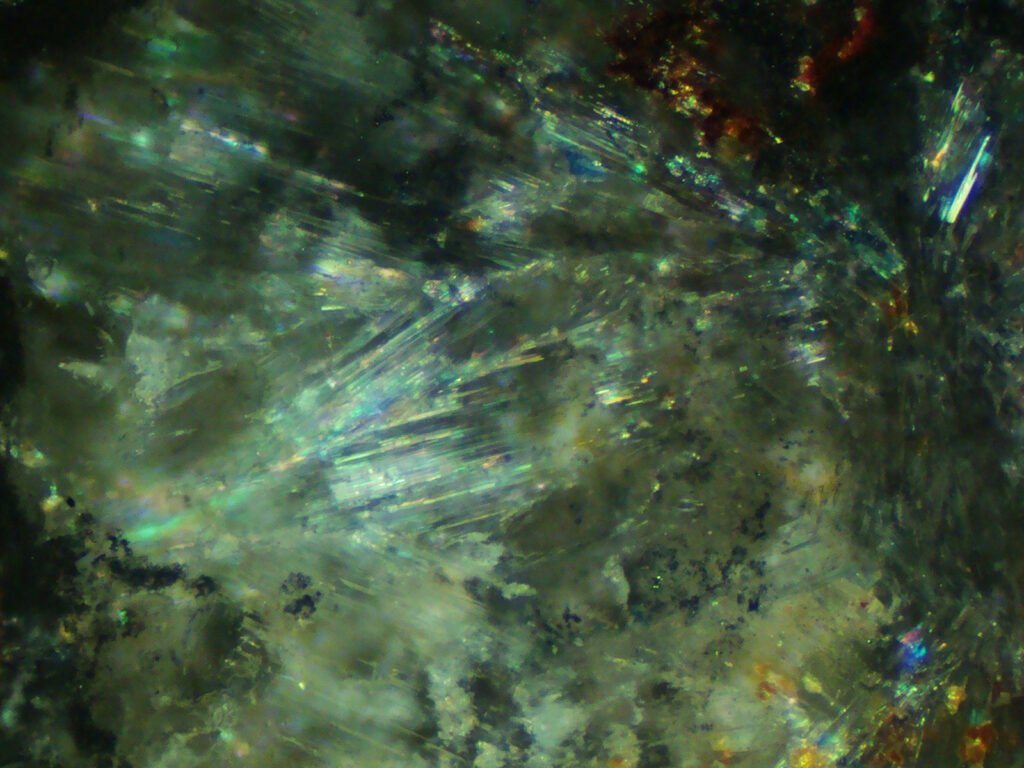
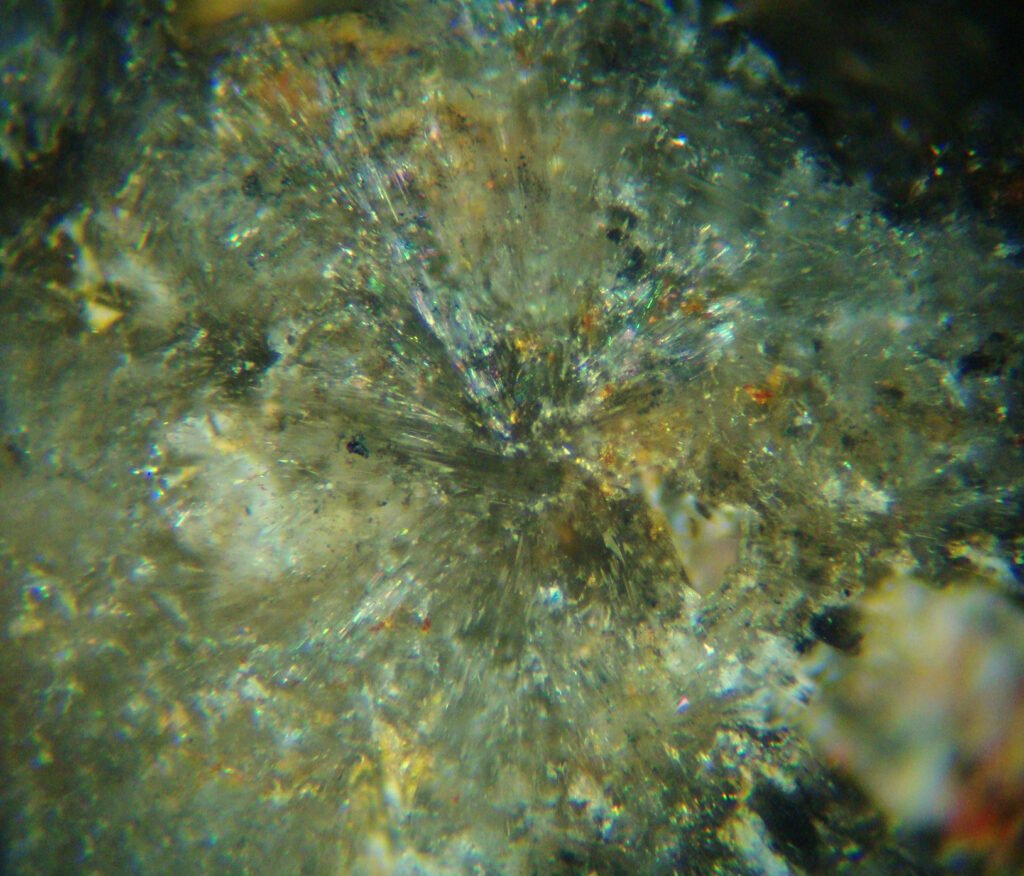
Anglesite usually occurs as subhedral to anhedral crystals in a matrix. When idiomorphic, the crystals are elongated with a rhombic cross-section. The maximum size of the crystals reached 50 cm. It can be recognized by its high density, adamantine luster, high refractive index due to lead (“shines brighter”), and by the fusion test, because its fusibility is only 1.5 on the von Kobell scale, which causes anglesite to crackle in a candle flame. Under ultraviolet light, it exhibits fluorescence in shades of yellow and golden-yellow.

Because it contains lead, caution is necessary: ​​do not inhale dust when breaking or grinding, do not lick, do not swallow, always wash hands after handling.

1. Characteristics

Crystal system: Orthorhombic bipyramidal. 

Color: Colorless or white, shades of gray may occur. It can be orange, yellow, green, or blue. More rarely, violet. 

Habit: Tabular or prismatic crystals (almost 200 combined forms), fibrous aggregates, nodular, stalagmite, granular, massive. 

Cleavage: {001} good, {210} distinct, {010} in strokes. Vertical striations.

Tenacity: Brittle.        

Twinning: No.       

Fracture: Irregular to conchoidal.

Mohs Hardness: 2.5 – 3

Parting:  No.        

Streak: Colorless.         

Lustre: Adamantine, vitreous, dull when massive.          

Diaphaneity: Transparent.          

Density (g/cm³): 6,37 – 6,39


2. Geology and Deposits

Anglesite forms as a secondary mineral in oxidation zones of lead sulfide ores, typically from galena (PbS). Anglesite forms under acidic conditions; cerussite forms under alkaline conditions.


3. Mineral Associations

As it generally forms from galena, it can form pseudomorphic crystals from galena or contain remnants of unaltered galena within it. Other minerals that form pseudomorphs on galenas are cerussite, pyromorphite, chalcocite, and covellite.

In addition, it is associated with other secondary Pb minerals – with or without other associated metals – such as cerussite, lanarkite, leadhillite, linarite, massicot, mimetite, pyromorphite, kaledonite, boleite, and wulfenite.

In these oxidized zones also occur secondary Cu minerals (malachite, azurite, brochantite), secondary Zn minerals (smithsonite, hemimorphite), sulfides (pyrite, sphalerite), native sulfur, barite, limonite (goethite), quartz, and gypsum.


4. Transmitted Light Microscopy

Refraction indices:  nα: 1,878     nβ: 1,883       nγ: 1,895

PLANE POLARIZED LIGHT – PPL

Color / Pleochroism: Colorless, without pleochroism. 

Relief: Very high.           

Cleavage: {001} good, it may be visible.           

Habits: Typically, the crystals are long prismatic structures with rhomboid (lozenge-shaped) basal sections.            

CROSSED POLARIZED LIGHT – XPL

Birefringence and Interference Colors: Maximum birefringence of 0.017: first-order colors up to pink and red, but not blue.

Extinction: It must be parallel, since anglesite is orthorhombic. 

Elongation sign: No information available. 

Twins:  No. 

Zoning: No. 

CONVERGENT LIGHT

Character: B(+)          

2V angle: 75º         

Alterations: Anglesite can alter to seconday galena.          

May be confused with: Other transparent minerals typical of oxidation zones in polymetallic ores.

Barite and celestine show lower birefringence.
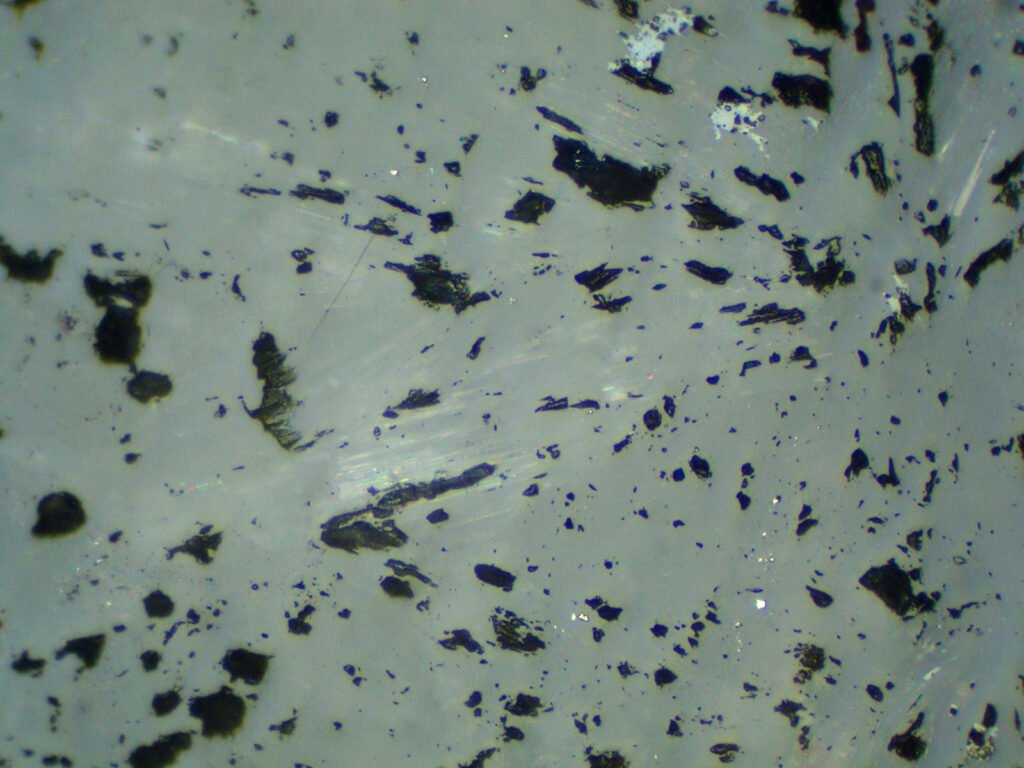
5. Reflected Light Microscopy

Sample preparation: Anglesite exhibits a medium hardness upon polishing, similar to that of cerussite. It achieves an excellent polish.

PLANE POLARIZED LIGHT – PPL

Reflection color: Dark gray.       

Pleochroism: No.      

Reflectivity: 12–16%, slightly above the reflectivity of gangue minerals.  

Bireflectance: No.       

CROSSED POLARIZED LIGHT – XPL

Isotropy / Anisotropy: It does not exhibit anisotropy, but it is not isotropic. 

Internal reflections: White, milky, multicolored to brownish. Low double refraction, which means that internal reflections are practically invisible in pairs.

May be confused with: Other transparent minerals with light colors from oxidation zones, but the association with galena, either as crystals or as galena remnants, is very characteristic.

Cerussite is very similar, but it is lighter, does not exhibit pleochroism, and is strongly anisotropic.

Pyromorphite does not exhibit colored internal reflections and has a reflectivity of only 4%.

Phosgenite is very difficult to distinguish from anglesite, but phosgenite is rare, forms different (tetragonoid) crystals, is sectile and flexible, while anglesite is brittle.  

General Characteristics: 

Grain shape: Rhythmic crusts of very fine granulation are very common over galena, often with intermediate layers of secondary galena.

Cleavage is hardly visible.