1. Characteristics
Crystal system: Orthorhombic, rhombic bipiramidal
Color: Colorless, white, bluish-gray, more rarely blue, orange, pink, reddish, yellow or violet.
Habit: Crystals (prismatic or tabular) are rare, usually form compact, granular or fibrous (parallel or radial) masses.
Cleavage: {010} and {100} perfect, {001} good, yielding pseudocubic fragments (hence the name “cube spar”).
Tenacity: Brittle.
Twinning: See above.
Fracture: Irregular.
Mohs Hardness: 3 – 3.5
Parting: No.
Streak: White to light gray.
Lustre: Pearly on {010}, vitreous on {001} and {100}.
Diaphaneity: Transparent.
Density (g/cm³): 2.9 – 3.0
2. Geology and Deposits
Anhydrite is a typical main component of evaporitic sequences and related deposits such as salt domes (where it is located at their tops). Initially, gypsum (CaSO4.2H2O) crystallizes, when the concentration of salts in seawater crosses the range between 68% and 88%. By dehydration of gypsum, anhydrite is then formed. The loss of water implies a reduction in volume (60%) and can form caves (“anhydrite karst”). The reaction is reversible, creating partially anhydrite, partially gypsum crystals.
In deposits of sulphide ores, it occurs in the oxidation zone. It can occur primary in hydrothermal veins. In rare cases it occurs in vesicles (cavities) of basic volcanic rocks (basalts). Anhydrite crystals can dissolve, leaving a cavity that can then be filled with quartz, amethyst, calcite, dolomite or prehnite, creating pseudomorphoses.
3. Mineral Associations
The association with gypsum is very common, as gypsum dehydrates to anhydrite and anhydrite hydrates to gypsum. In evaporitic sequences, in addition to gypsum, anhydrite occur with halite, sylvite, carbonates (calcite, dolomite, magnesite), illite, polyhalite, brucite, boracite, celestite and native sulfur.
In hydrothermal veins it occurs with fluorite, quartz, rhodochrosite and sulphides (galena, chalcopyrite, molybdenite, pyrite).
In cavities of volcanic rocks occurs with chalcedony, quartz (amethyst), calcite and zeolites.
4. Transmitted Light Microscopy
Refraction indices: nα: 1.567 – 1.574 nβ: 1.574 – 1.579 nγ: 1.609 – 1.618
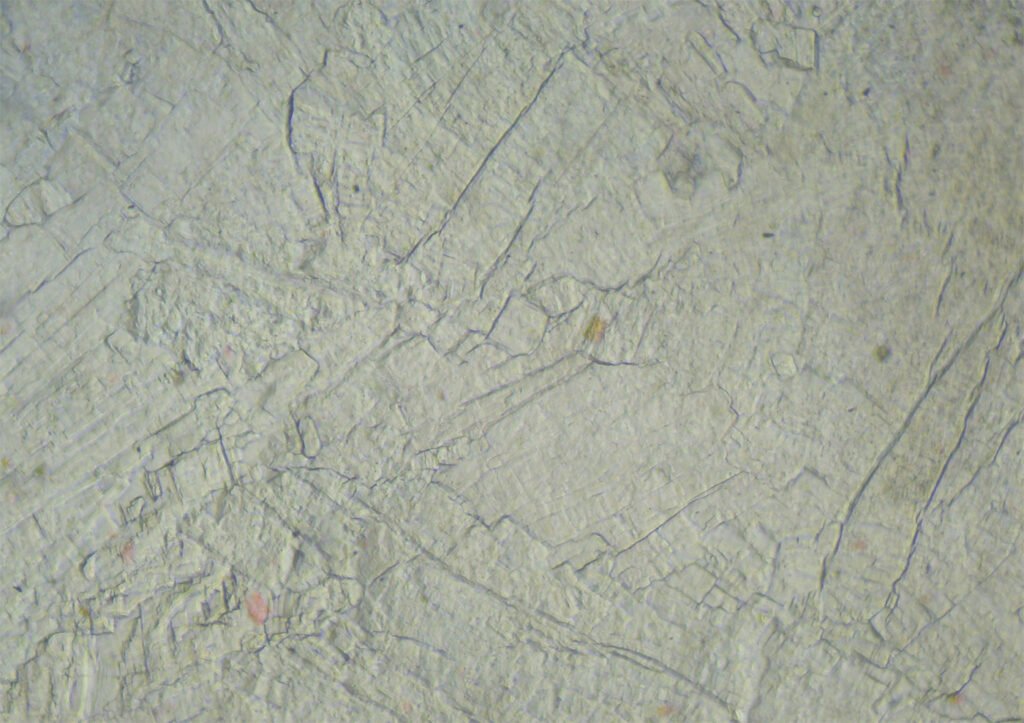
PLANE POLARIZED LIGHT – PPL
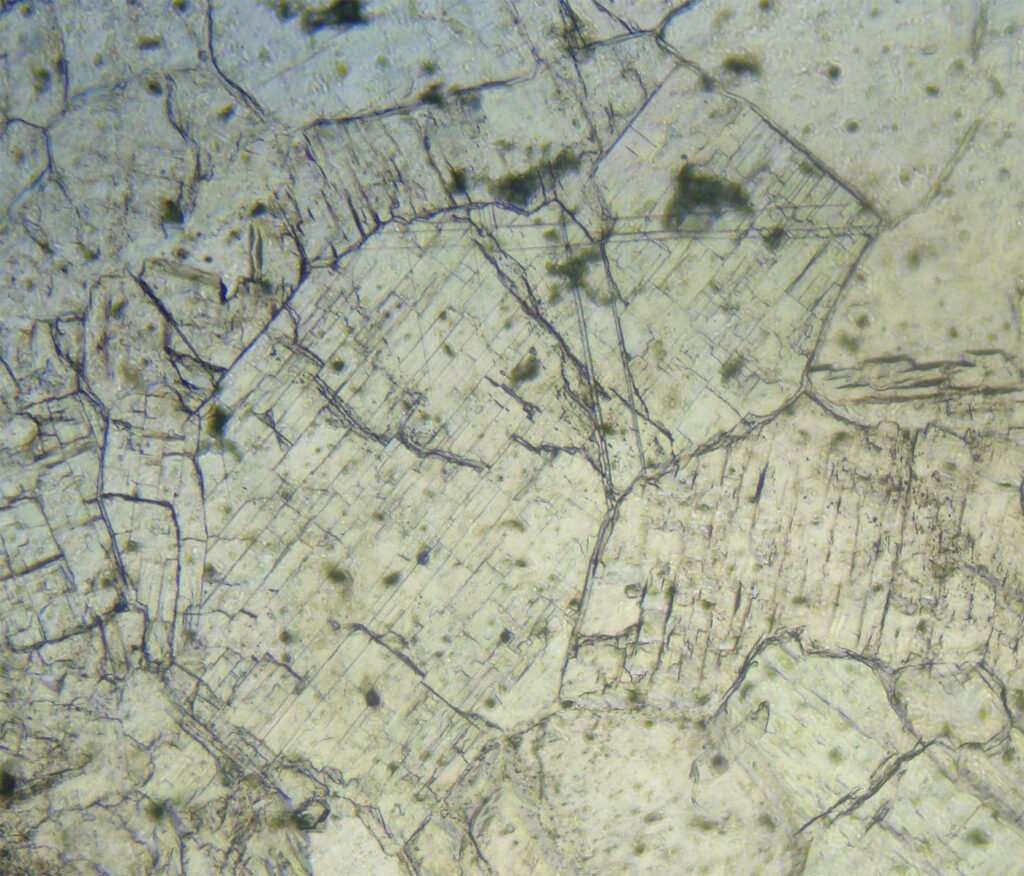
Color / Pleochroism: Colorless.
Violet colored anhydrites show pleochroism:
X = colorless to very light yellow or pink,
Y = light violet or pink,
Z = violet.
Relief: Low to moderate.
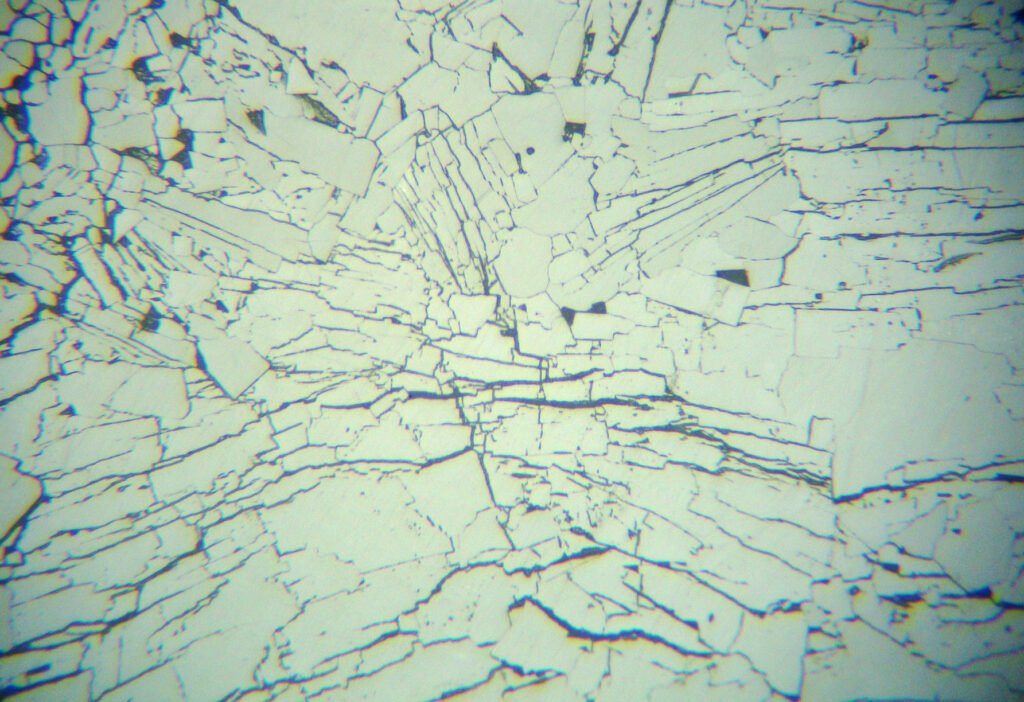
Cleavage: {010} perfect, {100} very good and {001} good to imperfect.
The set of the 3 cleavages creates cubic fragments. When the crystals are tabular but very fine, cleavage is usually not observed. In larger crystals, the cleavage parallel to the elongation becomes visible.
Cleavage may be deformed due to stresses.
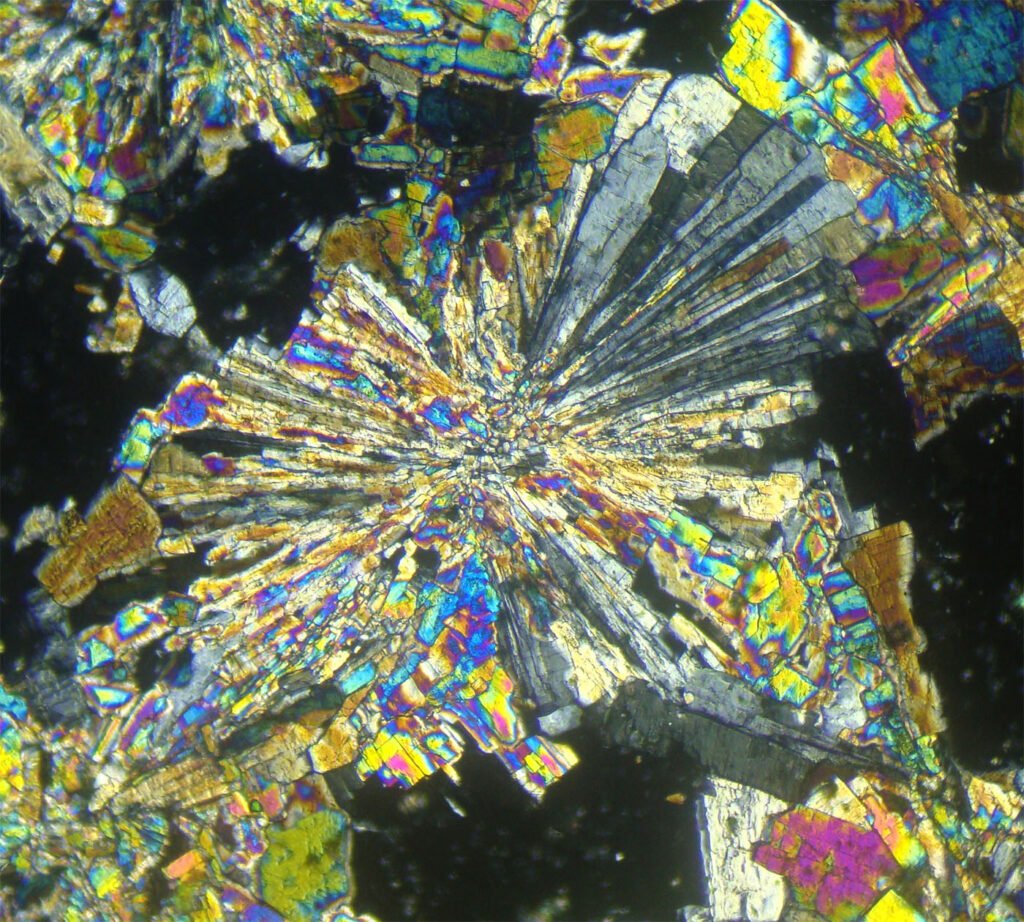
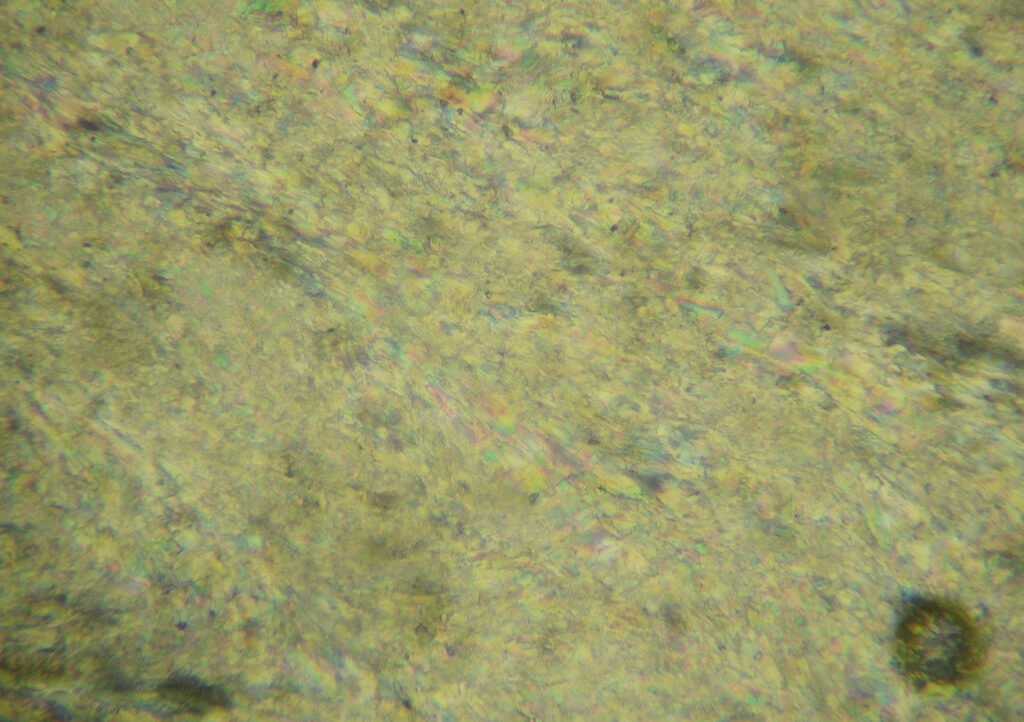
Habits: Crystals are tabular, anhedral to subhedral, granular, massive, fibrous (radial or plumose), curved, contorted concretionary shapes. Radial aggregates of tabular crystals of gypsum and anhydrite are possible as the two minerals often occur together.
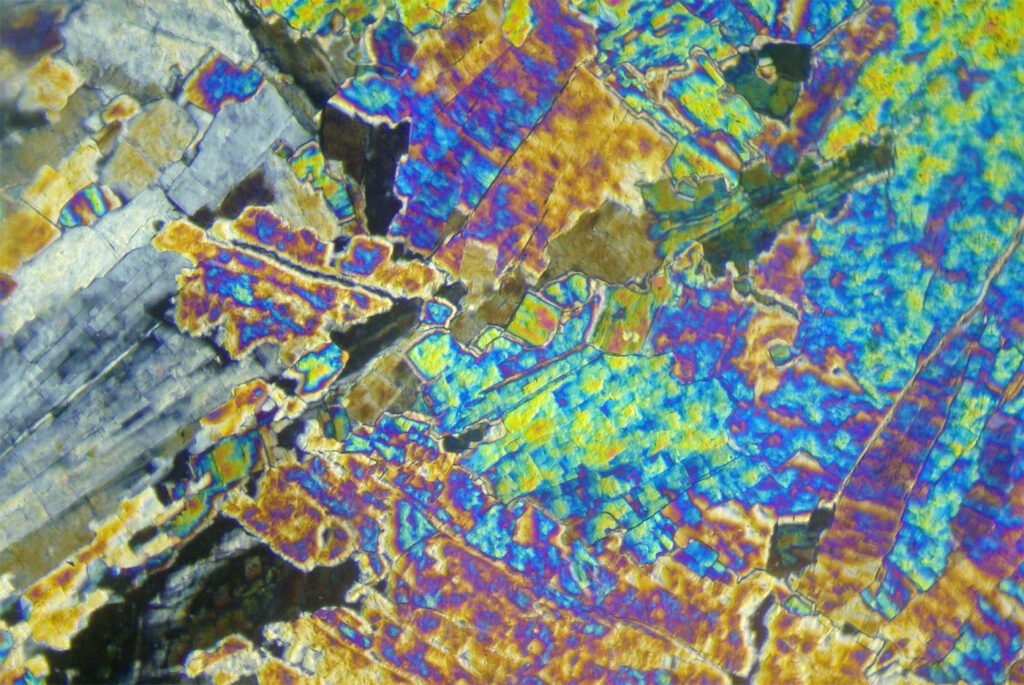
CROSSED POLARIZED LIGHT – XPL
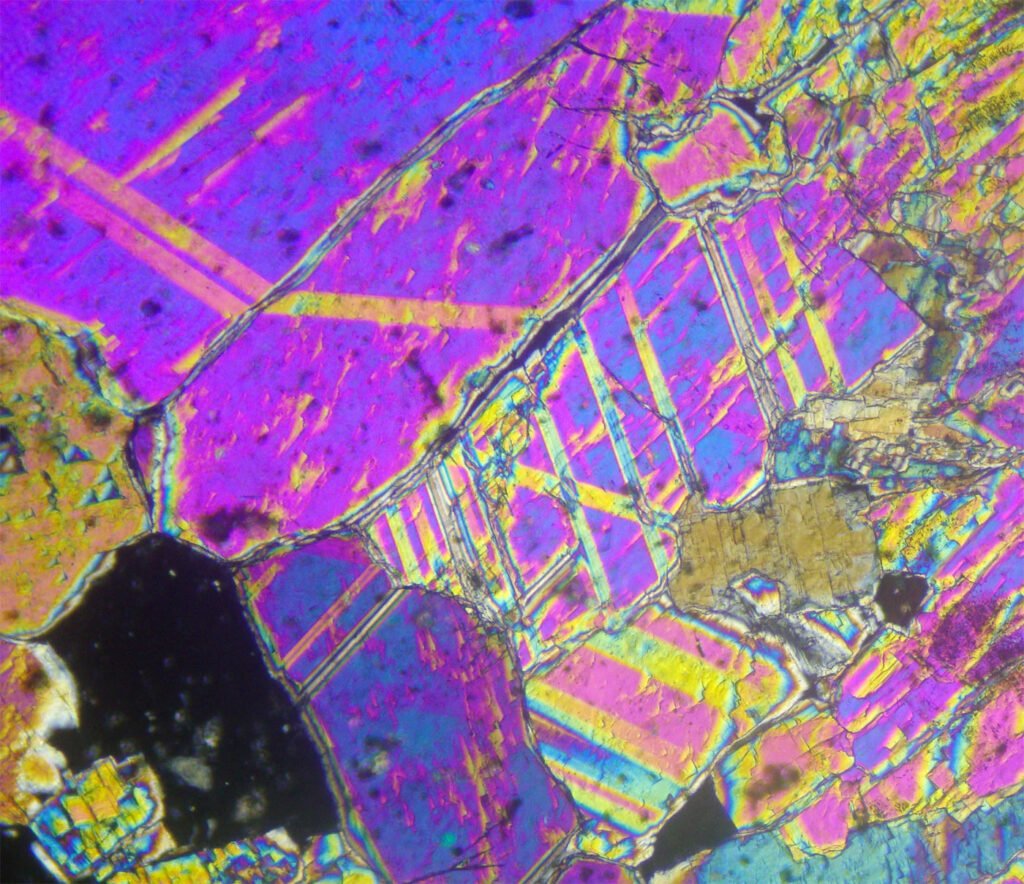
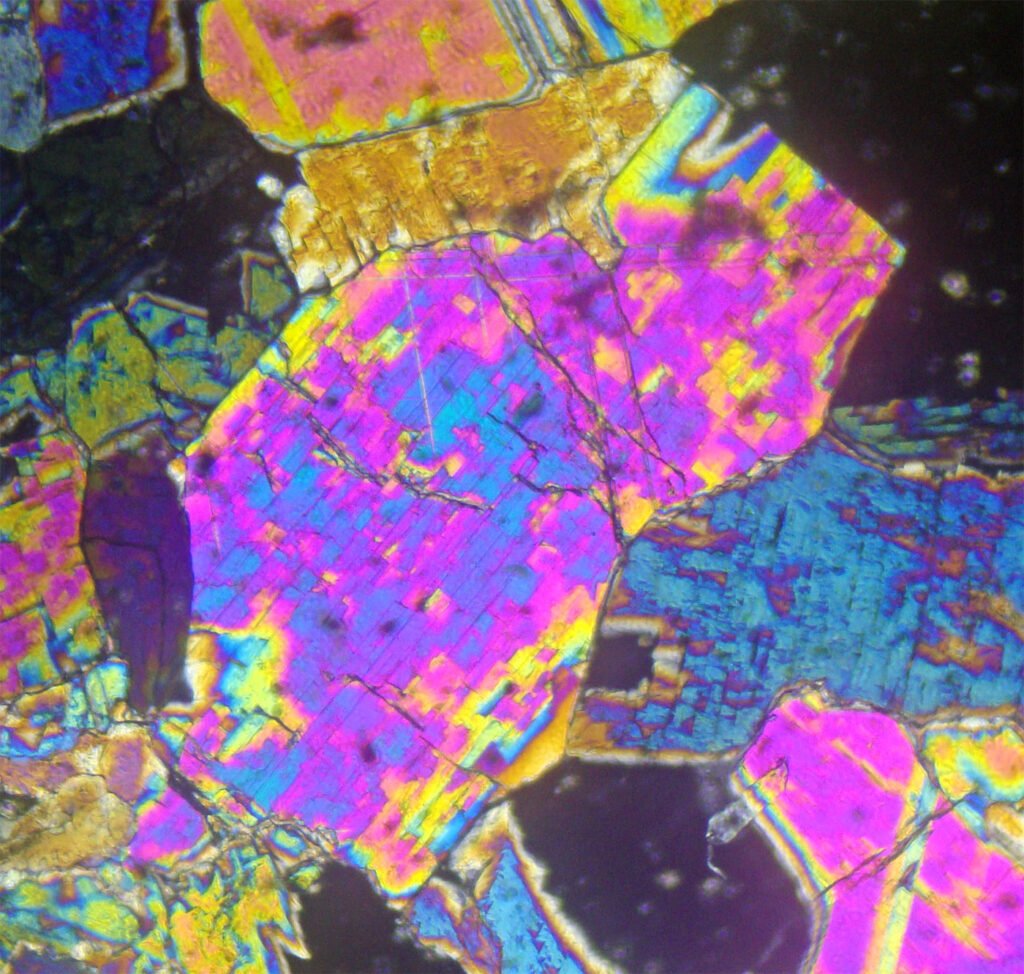
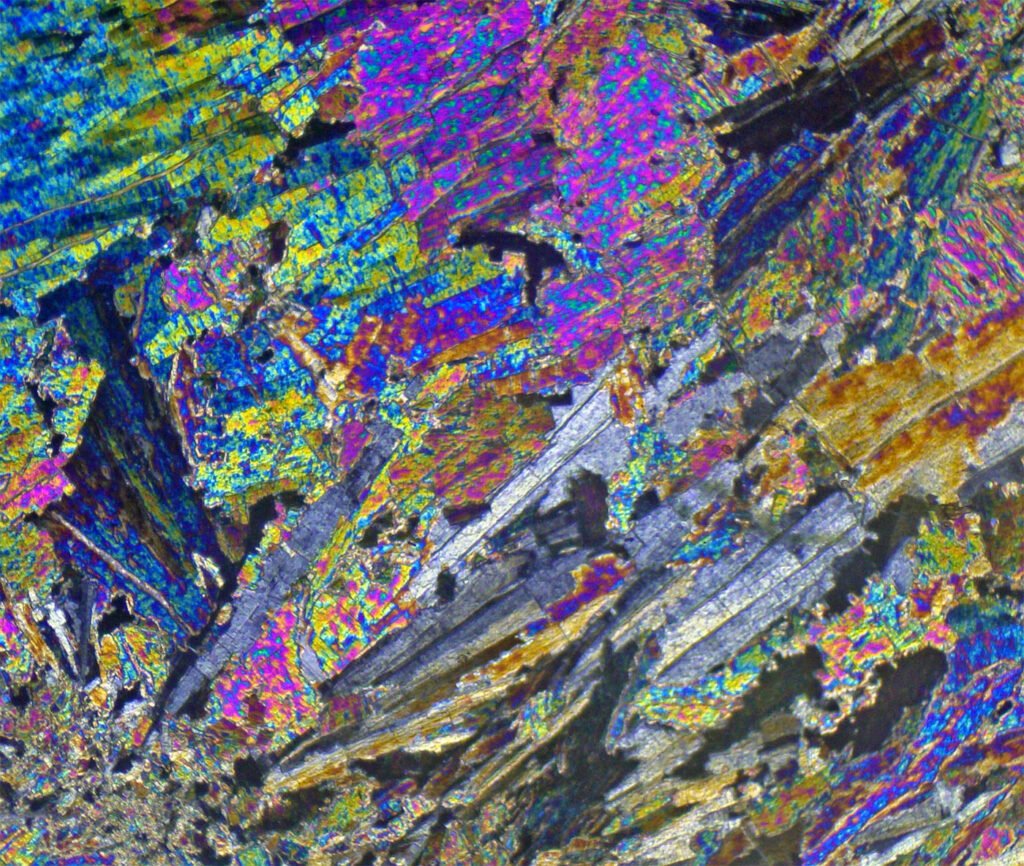
Birefringence and Interference Colors: High birefringence, from 0.042 to 0.044: intense colors, very colorful, up to 3rd order green.
Extinction: Parallel to the cleavage directions.
Elongation sign: ES(+) or ES(-), is not diagnostic.
Twins: Single or repeated twins (polysynthetic lamellae by pressure deformation) according to {011} are common. Contact twins are rare.
Zoning: No.
CONVERGENT LIGHT
Character: B(+)
2V angle: 36-45º
Alterations: to gypsum, by hydration. This hydration increases the volume by up to 60% and starts at the cleavage planes.
May be confused with: some of the minerals that occur associated.
Gypsum has the same habit, but has gray interference colors, oblique extinction, and much worse cleavage quality.
Barite shows medium relief, lower quality cleavage and rarer twins.
Celestite may be similar, but has medium relief.
Quartz and feldspars in general do not show cleavage.