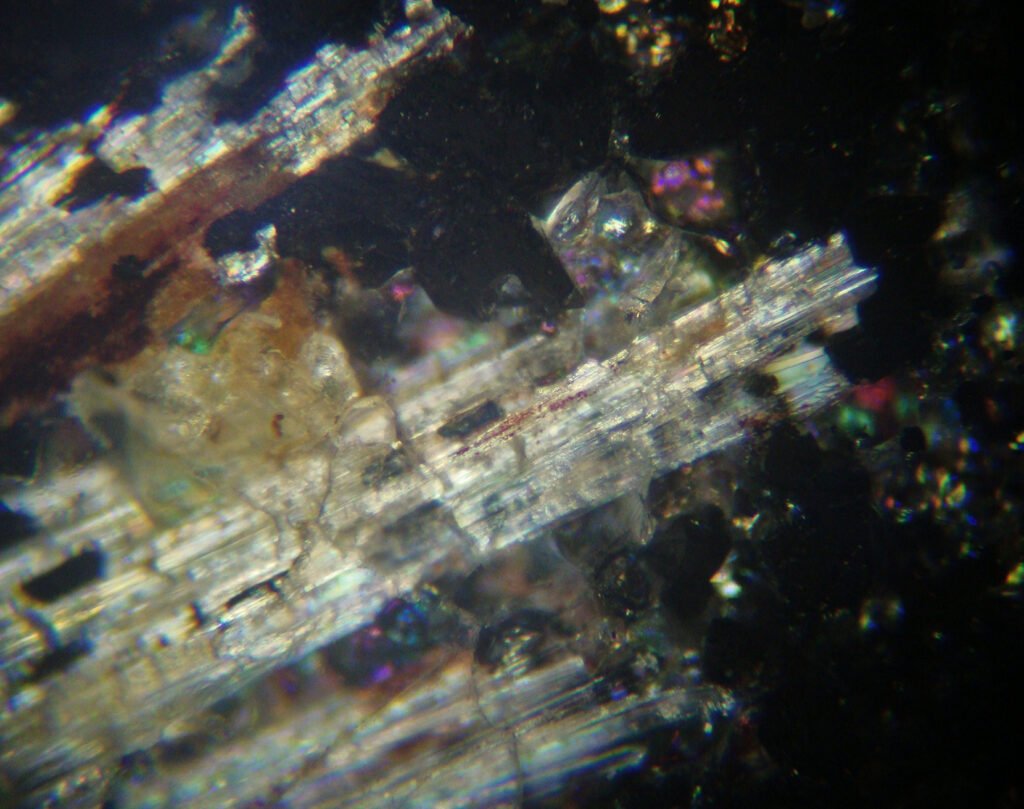
1. Characteristics
Crystal system: Ortorhombic, bipiramidal.
Color: Gray to green, can be brown to beige.
Habit: It usually occurs as lamellar or fibrous, asbestiform crystals. Long prismatic, up to 25 cm.
Cleavage: {210} perfect, {010} imperfect, {100} imperfect.
Tenacity: Brittle. Fibers are elastic.
Twinning: No.
Fracture: Conchoidal.
Mohs Hardness: 5.5 – 6
Parting: No.
Streak: White to gray.
Lustre: Vitreous, pearly on cleavages.
Diaphaneity: Transparent.
Density (g/cm³): 2.95 – 3.2
2. Geology and Deposits
Anthophyllite is found only in medium to high grade Mg-rich metamorphic rocks. The reaction is:
olivine + tremolite + talc = olivine + tremolite + anthophyllite.
It is also typical of ultrabasic igneous rocks, by the reaction
olivine + tremolite + talc = olivine + tremolite + anthophyllite.
In impure dolomitic shales, the reaction is
talc + tremolite + magnesite = tremolite + anthophyllite + magnesite.
It occurs in amphibolites, anthophyllite-cordierite-gneisses, metaquartzites, iron formations (Banded Iron Formations – BIF), granulites, anthophyllite-talc-schists derived from clayey sediments, hornfels (cornubianite) and mafic to ultramafic igneous rocks.
It also forms as a product of retrometamorphic reaction in ultramafic rocks, associated with serpentinites. In this case it forms small, poorly developed crystals. It is a frequent process in shear zones, where the fractures open space for the passage of fluids.
3. Mineral Associations
Anthophyllite occurs with quartz, feldspar (plagioclase), garnet (almandine), other amphiboles (actinolite, gedrite, tremolite), rutile, micas (phlogopite, vermiculite, Chlorite Group), cordierite, sillimanite, olivine and staurolite.
4. Transmitted Light Microscopy
Refraction indices: nα: 1.598 – 1.674 nβ: 1.605 – 1.685 nγ: 1.615 – 1.697
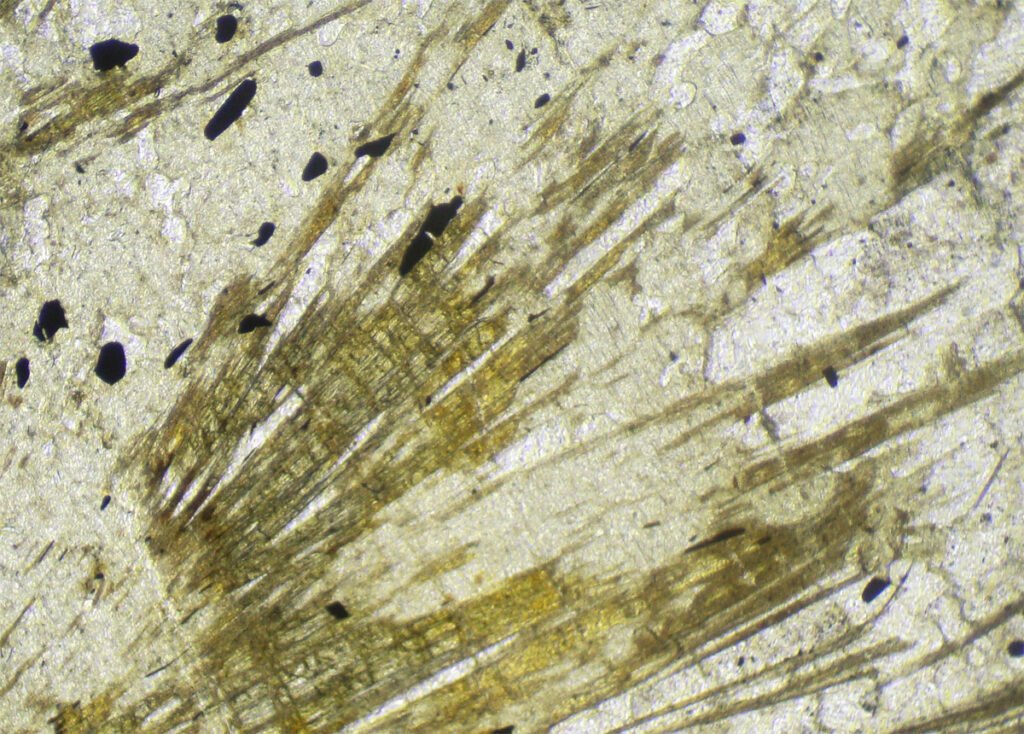
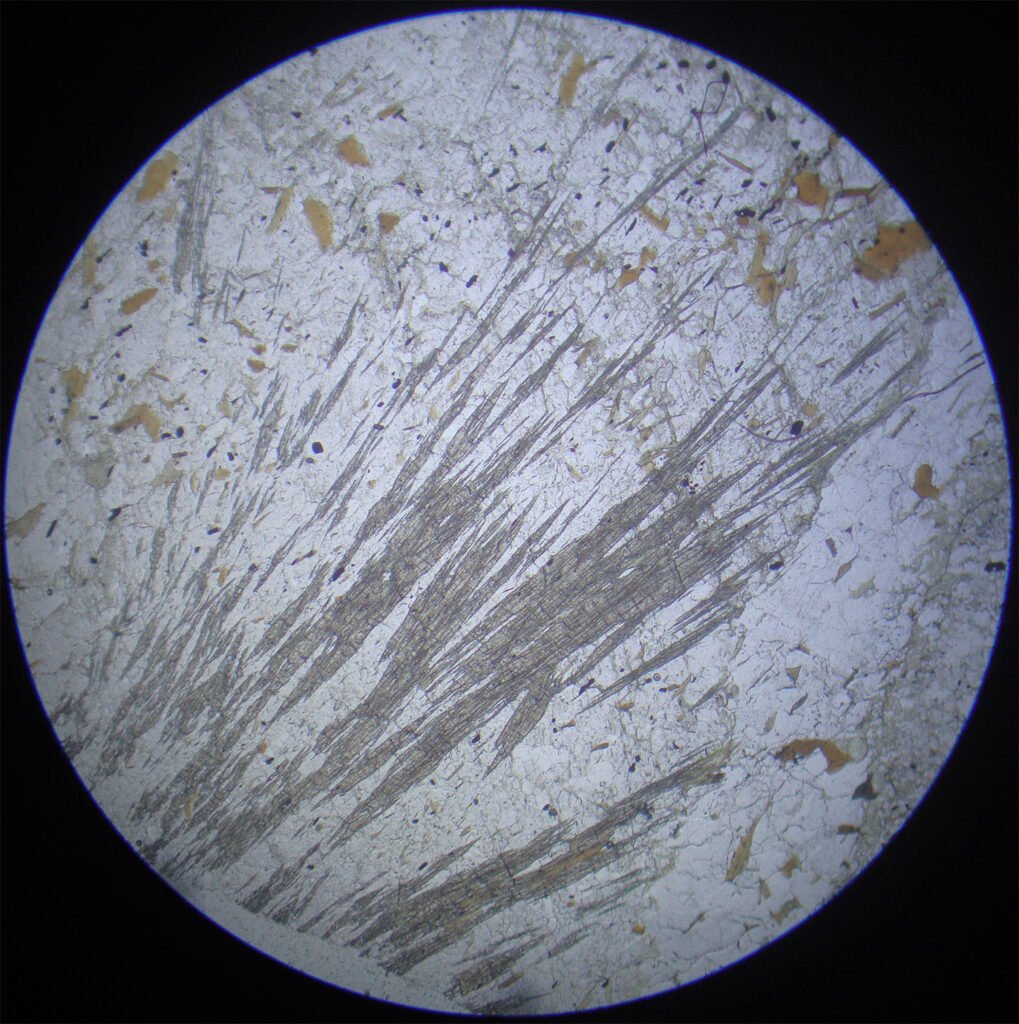
PLANE POLARIZED LIGHT – PPL
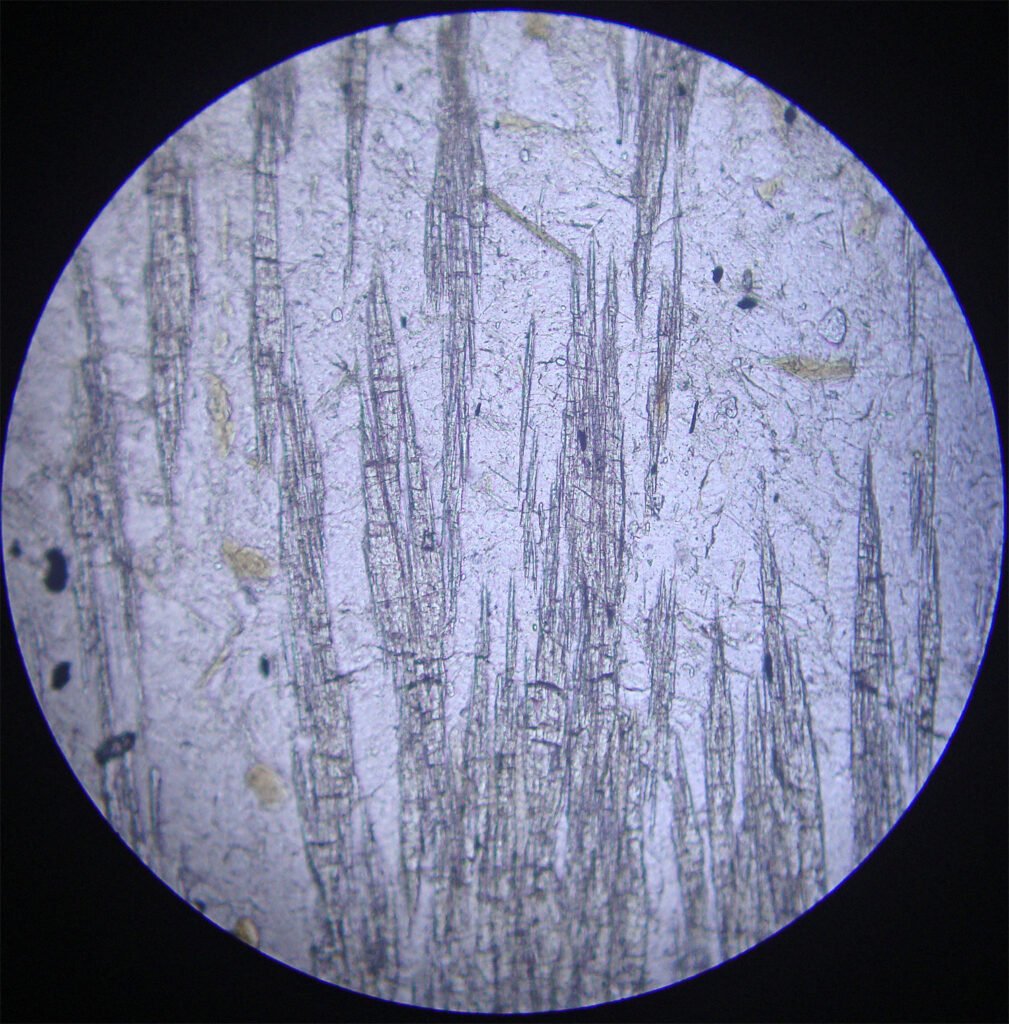
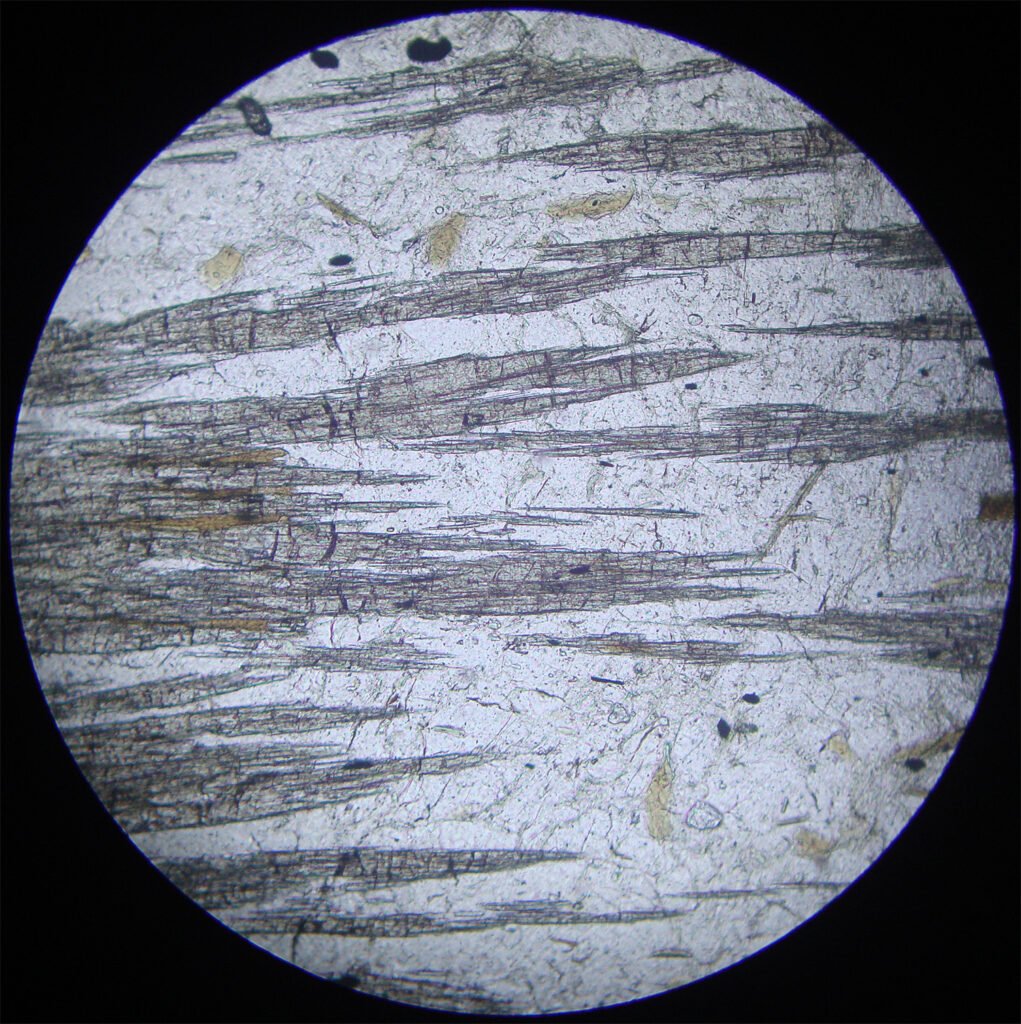
Color / Pleochroism: Usually colorless, more rarely pale green or pale yellow. If Fe-rich, moderate pleochroism in brown, yellowish-brown, gray-brown, gray-blue to green and lilac colors.
Relief: Moderate.
Cleavage: Perfect {210}, generating two cleavages in the basal sections with angles of 54.5º and 125.5º to each other. In the prismatic sections only one cleavage. Other cleavages at {010} and {100}, both distinct.
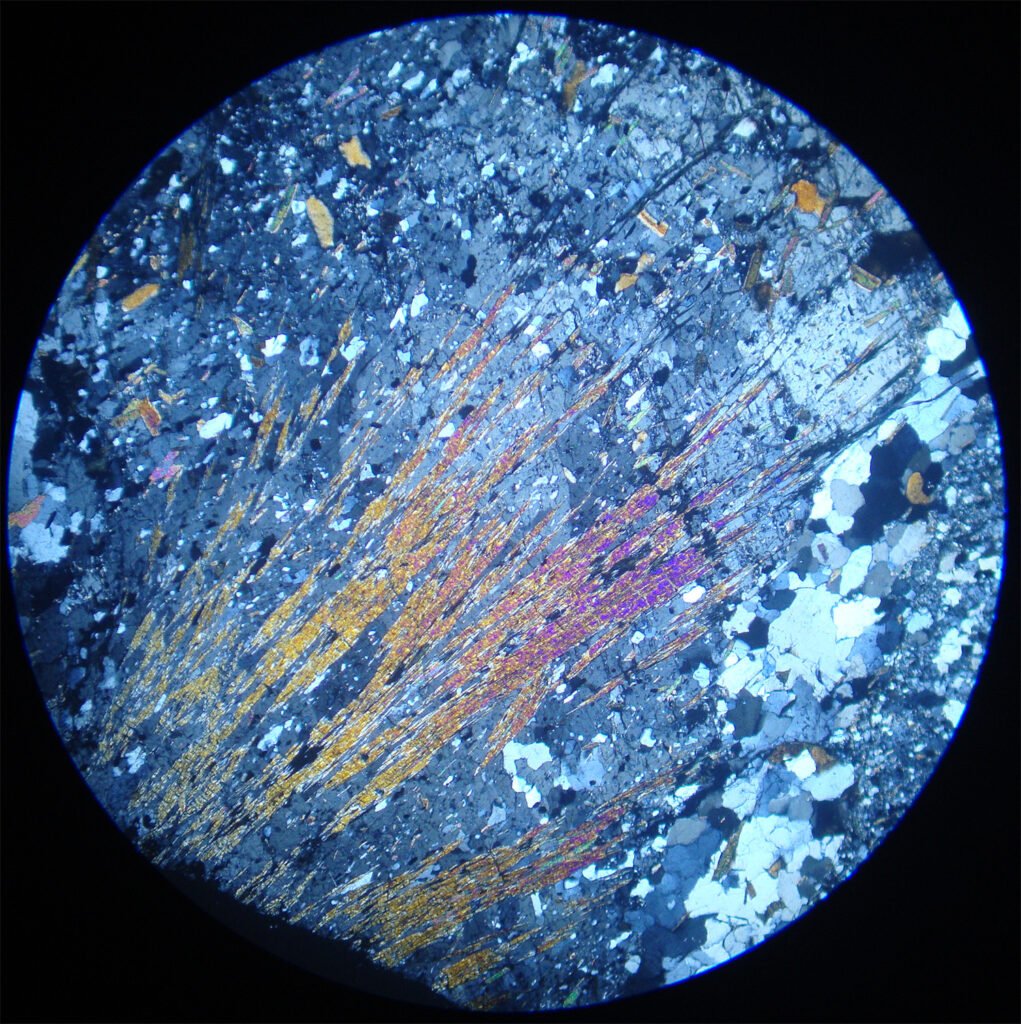
Habits: Usually lamellar or fibrous, asbestiform (hence the name “gray asbestos”). Also as aggregates of prismatic crystals without well-developed endings.
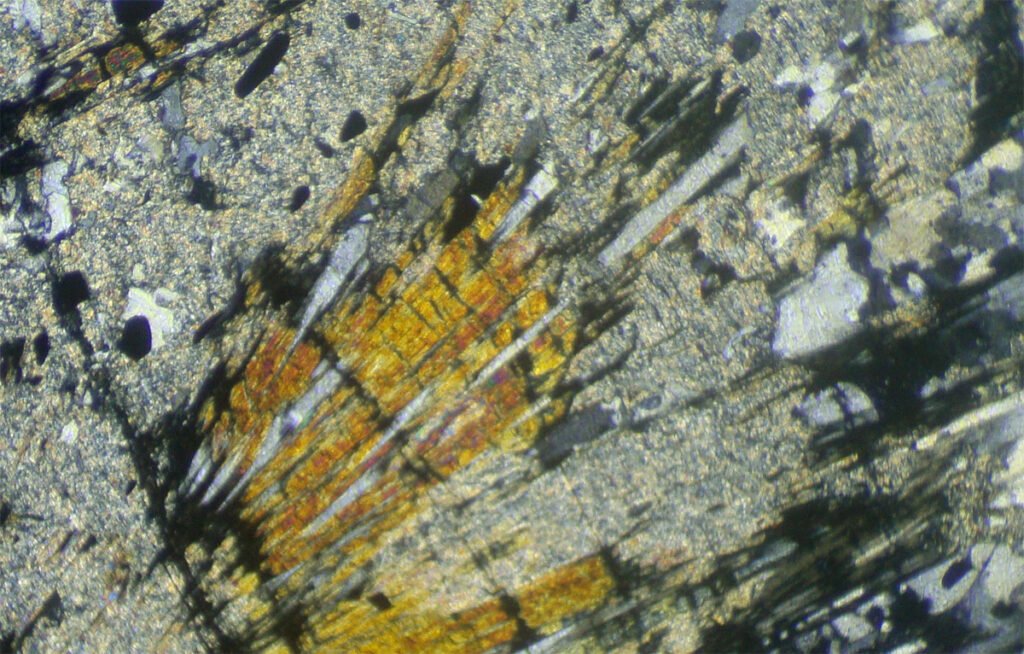
CROSSED POLARIZED LIGHT – XPL
Birefringence and Interference Colors: Medium birefringence, ranging from 0.017 to 0.023, resulting in colors up to the end of 1st order and beginning of second order: yellow, orange, intense red, purple to blue.
Extinction: Parallel in longitudinal sections (diagnostic!), symmetrical in basal sections.
Elongation sign: ES(+)
Twins: No.
Zoning: No.
CONVERGENT LIGHT
Character: B(+) or B(-)
2V angle: 57 – 80o
Alterations: no information available.
May be confused with: actinolite and tremolite may have identical habits, but have oblique extinction.