1. Characteristics
Crystal system: Orthorhombic dipyramidal.
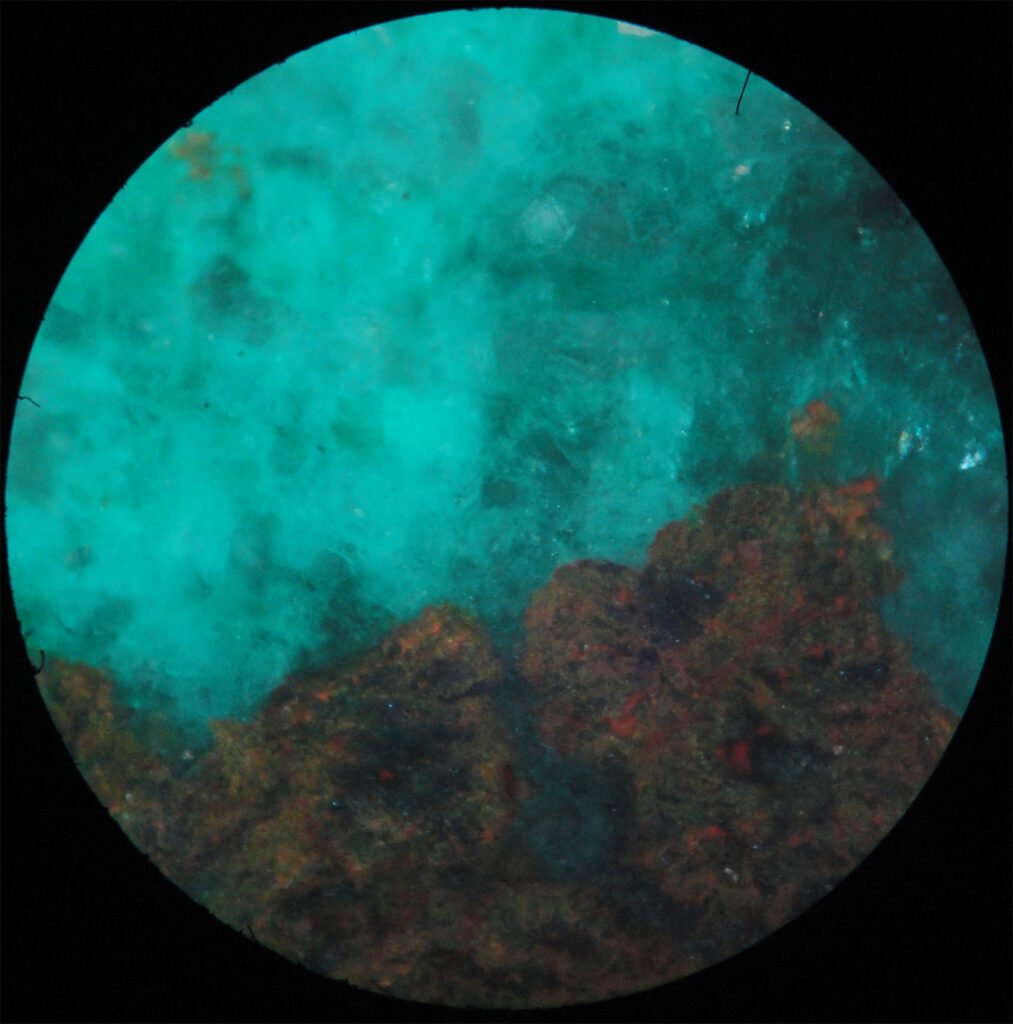
Color: Intense light green (emerald green), and greens ranging from dark shades to black.
Habit: Tabular, acicular, and fibrous, forming mat-like aggregates. Reniform, massive, or granular within veins.
Cleavage: {010} perfect, {100} poor.
Tenacity: Brittle.
Twinning: No.
Fracture: Irregular.
Mohs Hardness: 3.5
Parting: No.
Streak: Pale green.
Lustre: Vitreous.
Diaphaneity: Transparent.
Density (g/cm³): 3.88
2. Geology and Deposits
Antlerite was once considered a rare mineral, until it was discovered to be the primary ore in the oxidized zones of several massive copper mines, such as Chuquicamata (Chile), where it fills veins that transect altered granodiorite in all directions.
However, it occurs only in copper mines characterized by highly acidic conditions (low carbonate content), especially those located in arid regions. In such mines, primary sulfide ore is found at depth; above it lies a zone of oxidized minerals (where antlerite occurs); and above this oxidized zone, at the surface, is the “gossan” – the leached zone.
Antlerite also forms as a corrosion product on bronze sculptures in urban environments, in the presence of atmospheric SO2. It develops in sheltered areas with low rates of alteration, where copper ions accumulate within highly acidic aqueous films. On the exposed surfaces of these sculptures, the primary corrosion product is brochantite.
3. Mineral Associations
It occurs associated with goethite and gypsum.
It naturally occurs alongside a number of other copper minerals, such as brochantite, cuprite, azurite, malachite, chalcanthite, atacamite, kröhnkite, linarite, marshite, connellite, carbonatocyanotrichite, serpierite, and natrochalcite.
4. Transmitted Light Microscopy
Refraction indices: nα: 1.726 nβ: 1.738 nγ: 1.789
PLANE POLARIZED LIGHT – PPL
Color / Pleochroism: pleochroic between: x = yellowish green, y = bluish green and z = green.
Relief: High.
Cleavage: Perfect on {010}, poor on {100}.
Habits: Tabular, acicular and fibrous, reniform, massive or granular in veins.
CROSSED POLARIZED LIGHT – XPL
Birefringence and Interference Colors: Maximum birefringence of 0.063, presenting interference colors of up to 3rd order (pink-green).
Extinction: Probably paralell.
Elongation sign: No information available.
Twins: No.
Zoning: No.
CONVERGENT LIGHT
Character: B(+)
2V angle: 53º
Alterations: No information available.
May be confused with: Other green secondary Cu minerals.