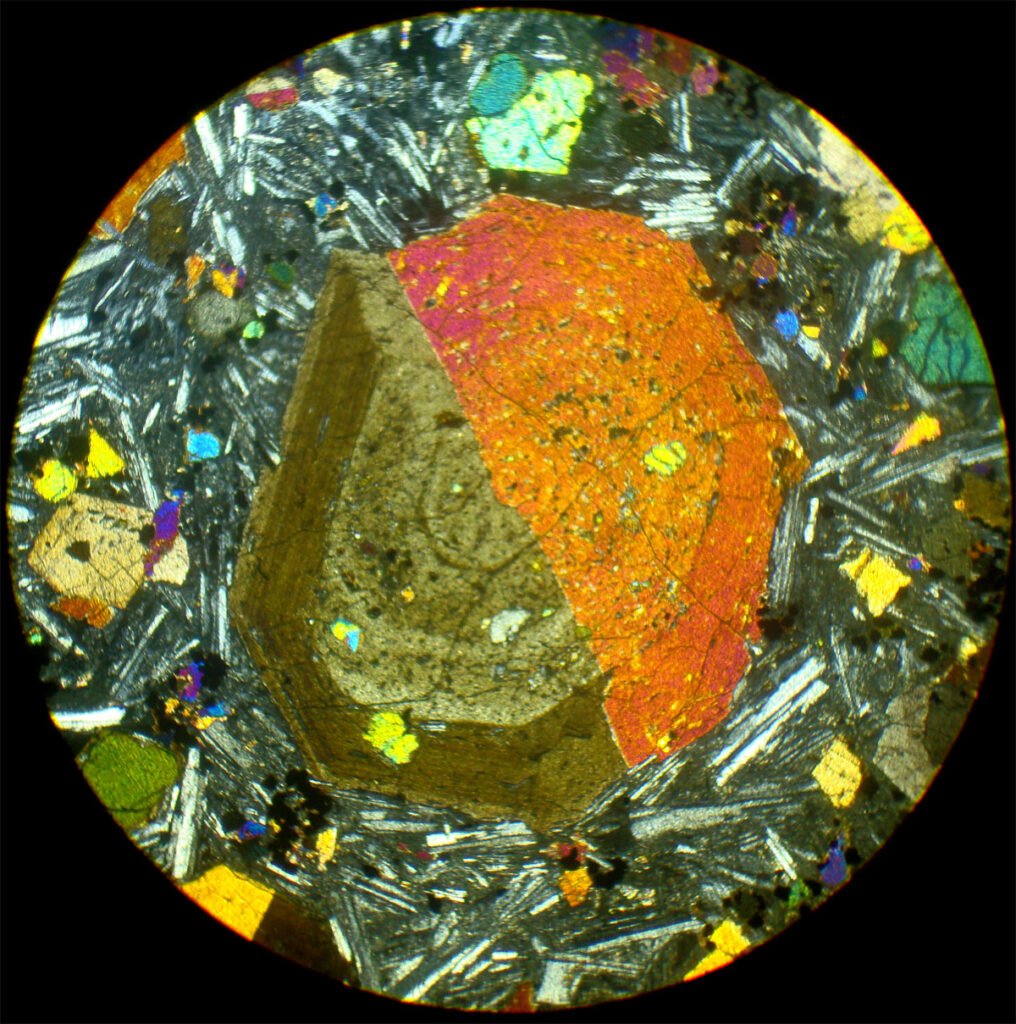
1. Characteristics
Macroscopically, augite-(Ti) is black, with a black streak.
2. Geology and Deposits
Augite-(Ti) occurs in Ti-rich alkaline basaltic and ultramafic igneous rocks – both intrusive and extrusive – such as syenites (peralkaline syenites, augite syenites), gabbros (analcime gabbros, nepheline gabbros), monzosyenites (nepheline monzosyenites, leucite monzosyenites), and nephelinolites.
It is also significant in pyroxenites (jacupirangites), alkaline basalts, analcimites, tephrites, basanites, hyalobasanites (limburgites), alkaline rocks occurring as dikes (essexites, camptonites, monchiquites), theralites, teschenites, and lamprophyres.
3. Mineral Associations
Augite-(Ti) occurs with:
– silica varieties such as tridymite,
– feldspars such as plagioclase and sanidine,
– feldspathoids such as leucite and nepheline,
– micas such as Ti-biotite and phlogopite,
– pyroxenes such as aegirine-augite and diopsidic pyroxenes,
– amphiboles such as brown hornblende (kaersutite) and pargasite-(Ti),
– opaque minerals typical of these rocks, such as magnetite and ilmenite.
Additionally, it occurs with olivine, melilite, garnets (andradite-(Ti)), apatite, analcime, spinel, rhönite, scapolite, titanite, and perovskite.
4. Transmitted Light Microscopy
Refraction indices: nα: 1.695 – 1.741 nβ: 1.700 – 1.746 nγ: 1.728 – 1.762
PLANE POLARIZED LIGHT – PPL
Color / Pleochroism: Brownish-purple to reddish-purple; the color varies with the Ti content and is strongly pleochroic in this case. This pleochroism distinguishes it from common augite.
When Fe³⁺ is present, the color tends toward brownish-yellow, grayish, or greenish, with weak pleochroism:
α = pale brownish-yellow, green, greenish-yellow.
β = brownish-purple to reddish-purple, violet, pale brown.
γ = brownish-yellow, brownish-violet to grayish-green.
Relief: Moderate.
Cleavage: {110} perfect, as in all pyroxenes. In longitudinal sections, there is only one cleavage; in basal sections, there are two cleavages that intersect at nearly right angles – 87° and 93°.
Habits: Short prismatic, short columnar; may be tabular. Phenocrysts can be long columnar.
CROSSED POLARIZED LIGHT – XPL
Birefringence and Interference Colors: Birefringence between 0.021 and 0.033, with interference colors ranging from the upper 2nd order to the lower 3rd order.
In the extinction position, anomalous interference colors – such as bluish, leather-brown, and gray – are typical.
Extinction: Generally oblique, with an angle between 32–55º.
Elongation sign: This does not apply.
Twins: Lamellar twins parallel to (100) occur, as well as equal-sided twins that are intergrown obliquely to the cleavage lamellae.
Zoning: Very common, typical, forming concentric zones. Generally, the core has a low Ti content – or none at all – while the rims are Ti-rich.
Zones parallel to [001] exhibit more intense colors compared to zones parallel to [-111], resulting in a zoning pattern known as “hourglass” zoning.
CONVERGENT LIGHT
Character: B(+)
2V angle: 42 – 65º.
Alterations: In plutonic rocks, augite-(Ti) alters to titaniferous hornblende through post-magmatic processes. In trachybasalts, augite-(Ti) is partially or completely replaced by brown hornblende (kaersutite).
May be confused with: Few other minerals, when considering the paragenesis, their characteristic clinopyroxene features, strong pleochroism, and anomalous interference colors.
Brown hornblende, among other differences, exhibits smaller extinction angles.