5. Reflected Light Microscopy
Sample preparation: the polishing hardness of acanthite is one of the lowest known; so it is very difficult to polish. The hardness is lower than the hardness of galena and native silver and approximately the same as jalpaite. When accompanied only by lower hardness minerals such as calcite, careful polishing produces polished surfaces of good quality. When accompanied by minerals of higher hardness it is almost impossible to produce a polished section of good quality. This difficulty in polishing is a very diagnostic aspect; only jalpaite is so soft. Vigorous polishing can produce surface films on acanthite that cover and mask all mineral structures.
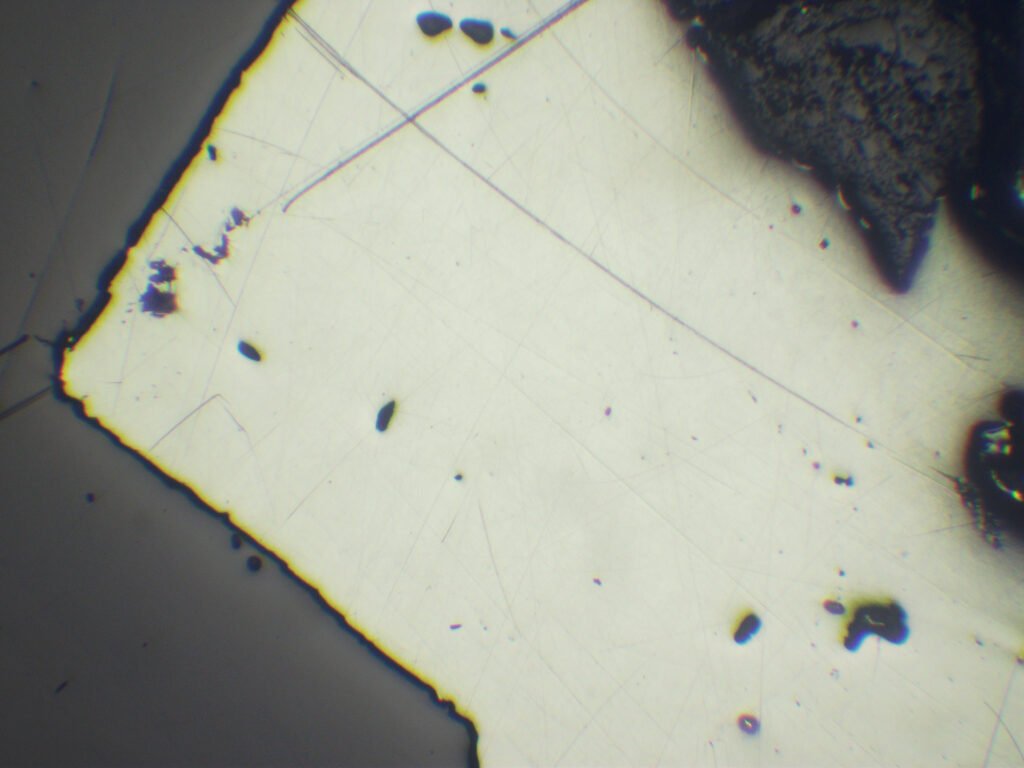
PLANE POLARIZED LIGHT – PPL
Reflection color: Light gray or grayish white.
Next to white minerals, a greenish tinge can be well defined.
Next to galena and native silver, it can show a bluish tint.
Compared to the color of galena, the color of acanthite is much darker and greenish gray in color.
Compared with the color of certain sections of polybasite, the color of acanthite is almost the same.
Compared with the color of native silver, the color of acanthite is distinctly green, there may be bluish hues.
Pleochroism: Its pleochroism is only visible with oil immersion, in favorable sections, only in the contrast in intergranular limits and twin lamellae, but it becomes clearer in sections that rested for a few days, due to incipient air corrosion.
Reflectivity: 29.59%
Bireflectance: No
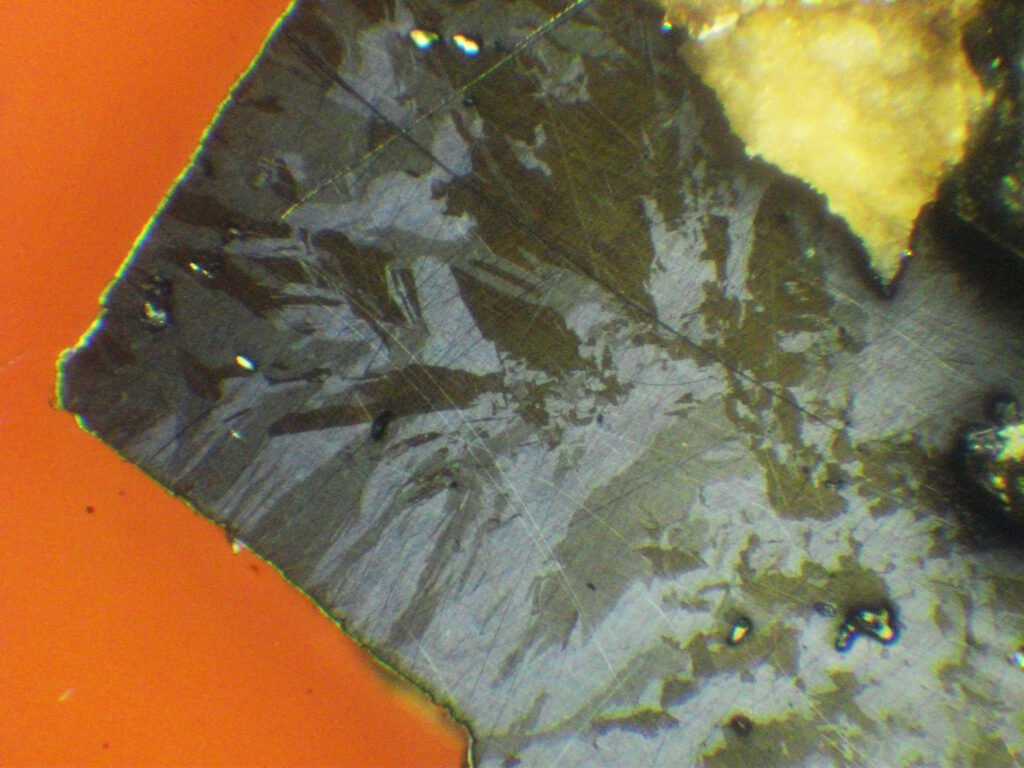
CROSSED POLARIZED LIGHT – XPL
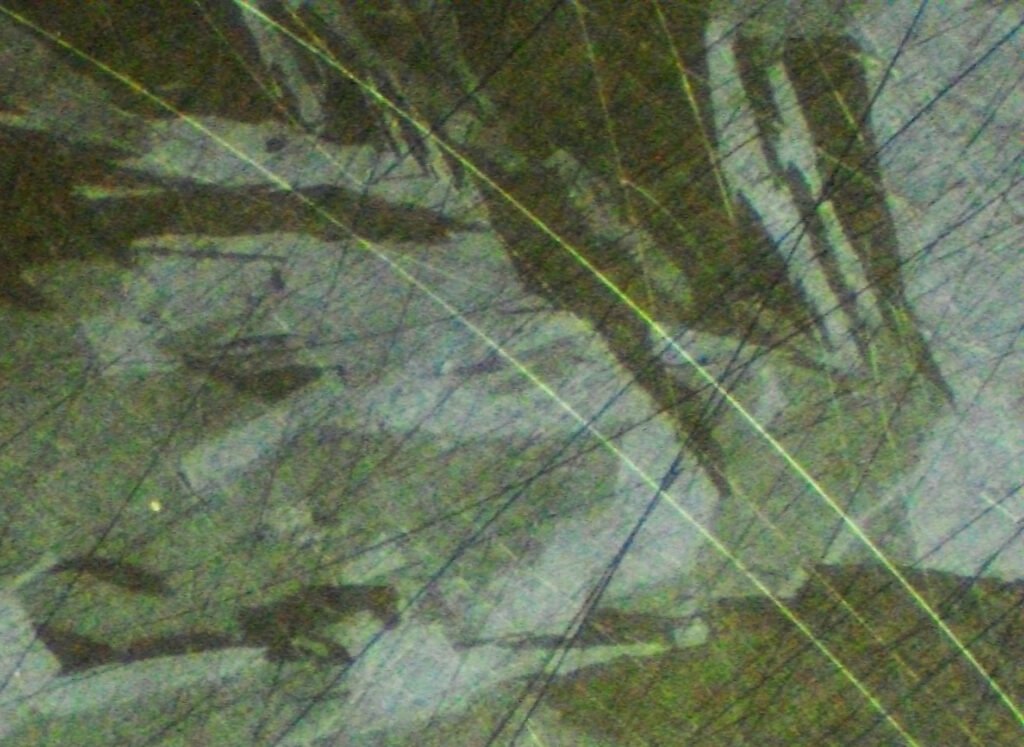
Isotropy / Anisotropy: Weak anisotropy, only visible in well-polished sections, without polishing scratches or surface films, which is almost impossible to achieve. It can simulate isotropy. Sections with many scratches are useless due to depolarizations along the scratches. It can show the lamellar structure of acanthite-beta, as well as a large number of polishing scratches that are not visible in PPL.
Internal reflections: No.
May be confused with: other minerals of its paragenesis.
Jalpaite is very similar in small grains, but is harder and has pinkish hues.
Stromeyerite is not attacked by light.
Polybasite has internal reflections.
General Characteristics:
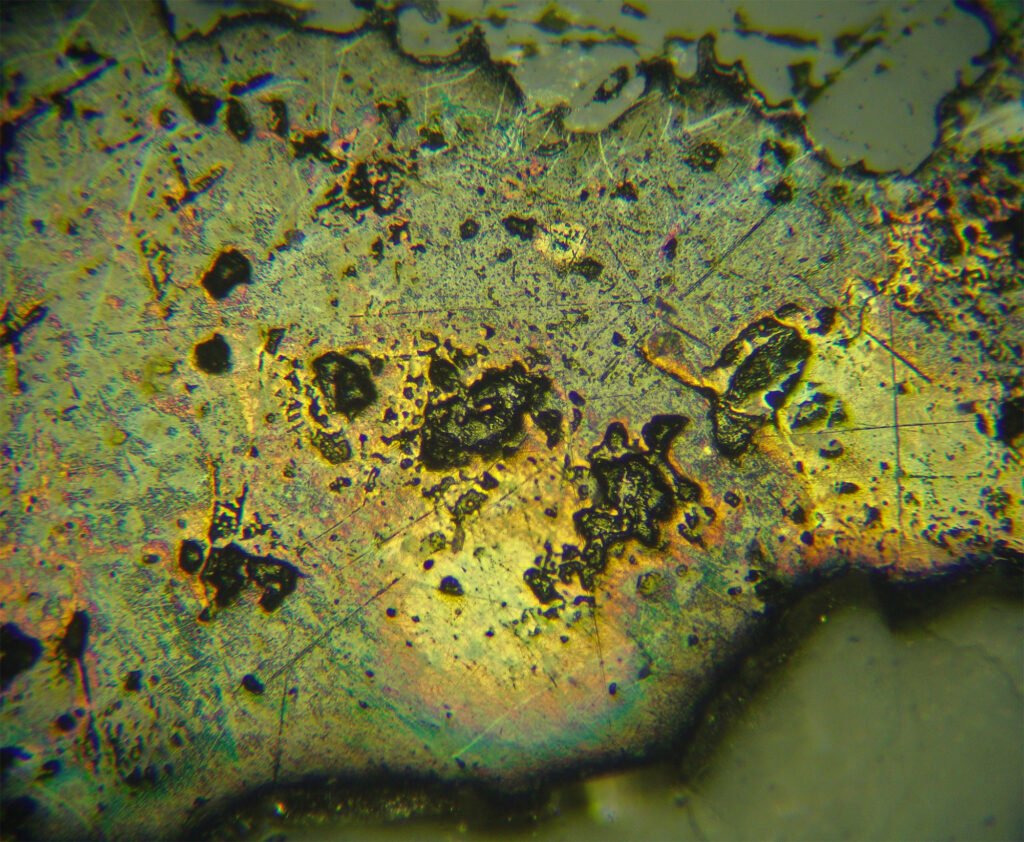
Grain shape: acanthtite occurs as idiomorphic crystals or as aggregates of polygonal or intergrown (“toothed”) grains. Isolated crystals show the faces of the cube or octahedron. The grain size varies from centimeter crystals to submicroscopic (cryptocrystalline) grains of some masses called “Silberschwärze” (German = silver black.). It can form coverings of very small grains or spongy friable masses.
Polishing scratches, due to the low hardness, are almost unavoidable, very difficult to eliminate.
Negative relief is very common, it just does not occur if acanthite occurs with other very soft minerals.
Air corrosion due to heating the microscope halogene lamp is so fast that it disturbs the analysis, but can highlight structures that are otherwise not visible. In addition, air corrosion serves as a very diagnostic feature, as it occurs in that intensity on only a few minerals.
Cleavage can sometimes be seen in especially large crystals, but is usually barely noticeable due to the malleability of the mineral.
Polysynthetic twins are common, forming coarse-textured lamellae (“lamellar acanthite”). These lamellae are transformation lamellae from argentite to acanthite, showing that their formation occurred above 177ºC. Grains without twins occur, showing that their formation below this temperature is possible. Due to the difficulty of producing a chemical attack on acanthite and due to the poor anisotropy, the twins can be difficult to visualize.
Zonation can occur, being visible in varying degrees of sharpness due to light attack (“air corrosion”).
Translational deformations are frequent due to the malleability of acanthite.
Unmixings are very rare in acanthite, but acanthite occurs as unmixings in galena.
Inclusions of acanthite may occur in pyrite, sphalerite, galena and tetrahedrite.
Pseudomorphs of acanthite on argentite are common; they will just not be present in acanthite formed at low (< 177ºC) temperatures.
Substitutions 1: acanthite can replace galena, sphalerite, pyrite, chalcopyrite, covellite, pitchblende and many Ag minerals; Remains of these minerals can be found within acanthite. Frequent and economically important were the replacements of the oxidation zones and the cementation zones, where acanthite is formed from ores with lower levels of silver, depositing on the remains of these. Rhythmic depositions were observed in ores from the oxidation zone and from the cementation zone, such as concentric masses of cerussite and other lead minerals from oxidation zones.
Substitutions 2: acanthite can be replaced, starting with veins, by chalcopyrite, covellite, digenite, electrum and gold.
Intergrowths, myrmekitic or not, are frequent and can occur with covellite, bismuthinite, galena and chalcopyrite, as well as with Ag-Sb or Ag-As minerals such as proustite, pyrargirite, freibergite and polybasite. In some cases, the intergrowths of acanthite and pyrargirite resemble the oleander leaf lamellae of dyscrasite.
Disintegration of acanthite occurs with higher temperatures and low sulfur pressure, producing curls or hooks of native silver, which often protrude from a still undisintegrated acanthite remnant.