BISMUTHINITE
Bismuthinite – Bi2S3 – is a relatively common sulfide found in various distinct parageneses. It occurs within polymetallic ores and serves as an important source of Bi, though it is never the primary ore mineral in a deposit.
It is classified within the Stibnite Group, with which it is isostructural and forms a solid-solution series. Impurities such as Pb, Cu, As, Te, Se, Fe, and Sb may be present.
1. Characteristics
Crystal system: Orthorhombic dipyramidal.
Color: From lead-gray to tin-white, with a yellowish to iridescent tarnish.
Habit: Typically short to long prismatic; may be acicular and radial. It can be massive – ranging from foliated to fibrous – or, rarely, granular.
Cleavage: {010} perfect and easy, {100} and {110} imperfect. Striations paralell to (001).
Tenacity: Flexible, somewhat sectile.
Twinning: No.
Fracture: No information available.
Mohs Hardness: 2 – 2.5
Parting: No.
Streak: Lead gray.
Lustre: Metallic.
Diaphaneity: Opaque.
Density (g/cm³): 6.78
2. Geology and Deposits
Bismuthinite is typical of high- and low-temperature hydrothermal vein deposits. It occurs in veins associated with Pb-Cu-Bi-Ag, in veins containing Sn-W and base metals, and in Co-Ni veins.
It is also found in tourmaline-bearing copper deposits associated with granites, in certain high-temperature gold veins, and in recent volcanic-exhalative deposits. It occurs in some granitic pegmatites and in metasomatic rocks, such as skarns (Au, Cu, Pb-Zn, and W-bearing) and gumberites.
Occasionally, bismuthinite and native bismuth are found in placers.
3. Mineral Associations
It occurs associated with common gangue minerals such as quartz, fluorite, barite, chlorite, calcite, and siderite.
In granitic pegmatites, the typical gangue – in addition to those mentioned above -includes potassium feldspar (“adularia”), tourmaline, garnet (andradite), and beryl.
It occurs alongside common sulfides such as galena, iron sulfides (pyrite, pyrrhotite, marcasite), sphalerite, chalcopyrite, arsenopyrite, and molybdenite.
It is also found with famatinite, cylindrite, nickeline, jamesonite, digenite, tennantite, langisite, and siegenite.
In the Bi-Pb-Cu-Ag-Au paragenesis, it occurs with native bismuth, bismutite, bismite, joseite, cosalite, parkerite, ikunolite, tetradymite, aikinite, gustavite, gladite, acanthite, stannite, gold, maldonite, and wurtzite.
It is also associated with oxides (“wolframite,” scheelite, magnetite, cassiterite) and radioactive minerals (pitchblende, uraninite).
Bismuthinite occurs with minerals typical of oxidation zones, such as jarosite, malachite, and scorodite.
It is also found with alteration products of bismuthinite, such as wittichenite and klaprothite.
4. Transmitted Light Microscopy
Not applicable, as bismuthinite is completely opaque.
5. Reflected Light Microscopy
Sample preparation: Bismuthinite is easy to polish to perfection, provided that no excessively hard minerals are present in the section. Its polishing hardness is significantly lower than that of cassiterite or wolframite, lower than that of chalcopyrite or native gold, approximately equal to that of galena or chalcocite, and higher than that of emplectite or native bismuth.
PLANE POLARIZED LIGHT – PPL
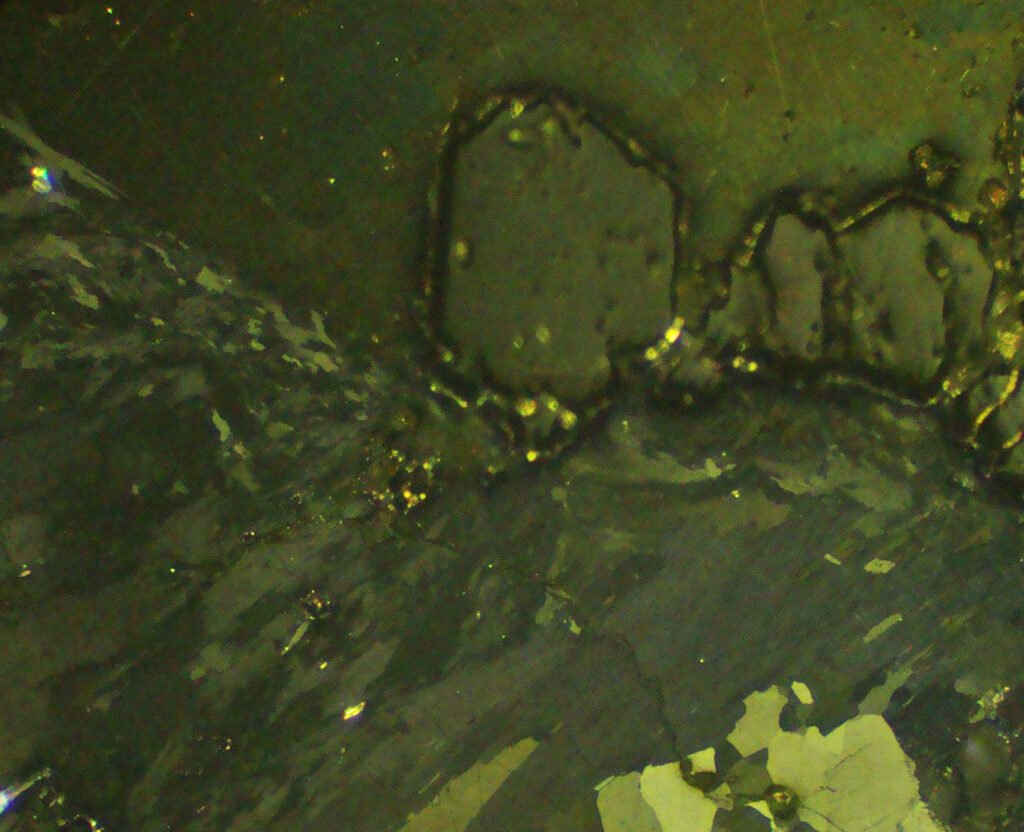
Reflection color: Medium gray, reminiscent of galena, though slightly yellowish and somewhat lighter.
Compared to the color of native bismuth, the color of bismuthinite is darker, with a bluish-gray hue.
Compared to the color of chalcopyrite, the color of bismuthinite is bluish-gray.
Compared to the color of galena, the color of bismuthinite is lighter—a creamy white.
Compared to the color of stibnite, the color of bismuthinite is much lighter.
Compared to the color of emplectite, the color of bismuthinite is lighter and whiter.
Compared to the colors of emplectite, wittichenite, and annivite, the color of bismuthinite is whiter, whereas the colors of these other minerals are more or less brownish-gray.
Pleochroism: Very weak – much weaker than that of stibnite – but clearly visible at intergranular boundaries. Colors range from pale yellowish-white / white to light gray / bluish-grayish-white.
Reflectivity: 36.91 to 48.77, varies by section.
Bireflectance: Very weak to strong.
CROSSED POLARIZED LIGHT – XPL
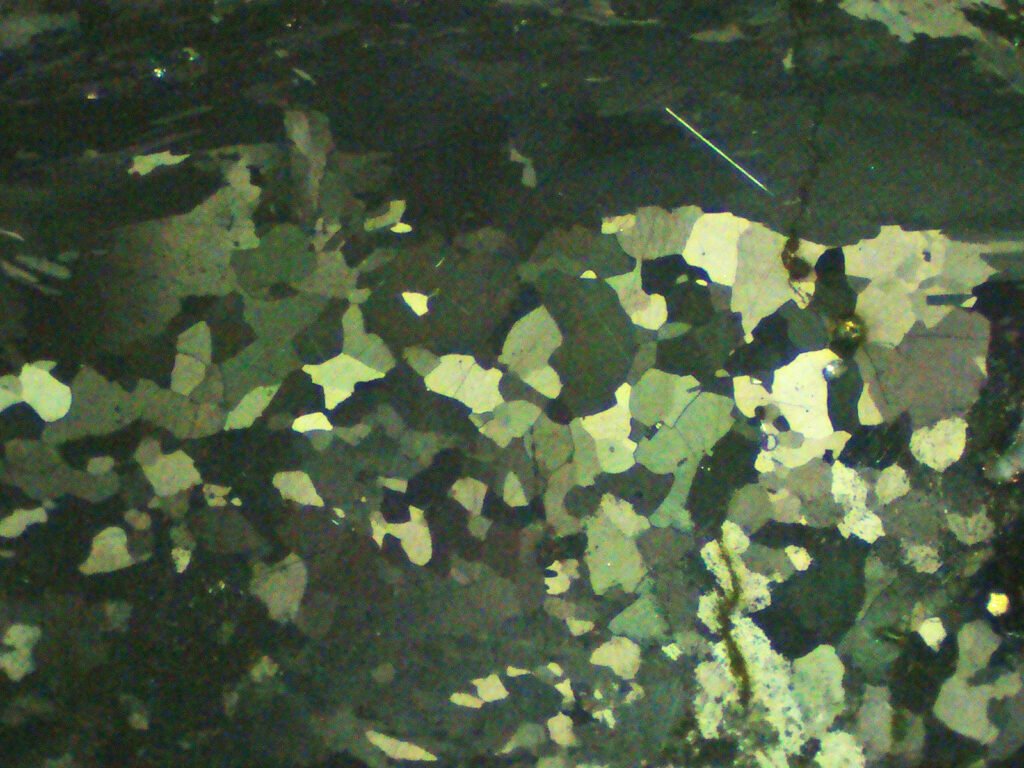
Isotropy / Anisotropy: Very strong anisotropy, ranging from slate-gray to yellowish-brown or violet-gray.
The anisotropy is less pronounced than that of stibnite. Extinction is straight, but in large crystals, it is generally undulatory.
Internal reflections: No.
May be confused with: Many other minerals. However, its paragenesis – especially its association with native bismuth, which is easily recognized – reduces the likelihood of misidentification.
Identifying Cu-Bi and Pb-Bi sulfosalts, which are frequently associated with native bismuth, is particularly challenging; however, these minerals are much rarer, making bismuthinite the most probable mineral.
Stibnite exhibits lower reflectivity, stronger reflection pleochroism, generally absent cleavage, more pronounced anisotropy, and very frequent twinning.
Boulangerite is similar, but it has lower reflectivity, and its blue-gray reflection color is diagnostic.
General Characteristics:
Grain shape: typically occurs as radiating fibrous aggregates. It is rarely granular. Idiomorphic acicular crystals are uncommon.
Cleavage parallel to (010) is frequently observed in coarse fibrous material, resulting in long, straight fractures along this cleavage direction.
Twinning is not inherently present; however, deformation can cause structural corrugation, leading to the formation of polysynthetic twins. These appear as parallel lamellae of varying widths (both individually and relative to one another) and exhibit undulose extinction. They may also display spindle-like (fusiform) shapes.
Zoning is absent.
Alteration of bismuthinite leads to the formation of wittichenite, klaprothite, and other minerals.
Inclusions 1: Bismuthinite may contain inclusions of native bismuth (very typical!), native gold, cosalite, and chalcopyrite.
Inclusions 2: Bismuthinite occurs as inclusions within native bismuth, chalcopyrite, stannite, ikunolite, molybdenite, pyrrhotite, cassiterite, and tetrahedrite.
Substitutions 1: Bismuthinite replaces native bismuth, emplectite, famatinite, pyrite, arsenopyrite, sphalerite, pyrrhotite, magnetite, chalcopyrite, parkerite, and uraninite.
Substitutions 2: Bismuthinite may be replaced by Bi-tellurides, Au-Ag tellurides, tetrahedrite, stannite, digenite, chalcocite, and sulfosalts; rarely by cassiterite.
Substitutions 3: The replacement of native bismuth by bismuthinite occurs frequently. In many cases, bismuthinite forms thin crusts along the edges of native bismuth. It may also extend into the native bismuth along fractures and twin lamellae. In the gossan zone, bismuthinite is replaced by heterogeneous decomposition products, sometimes resulting in striking replacement textures.
Intergrowths of bismuthinite occur with galena, acanthite, chalcopyrite, emplectite, chalcocite, stannite, native gold, tetradymite, tetrahedrite, and parkerite.
Gneissic textures may be exhibited by bismuthinite from disturbed zones, with signs of recrystallization, similar to textures observed in galena.